Fresh Cheese Market Size
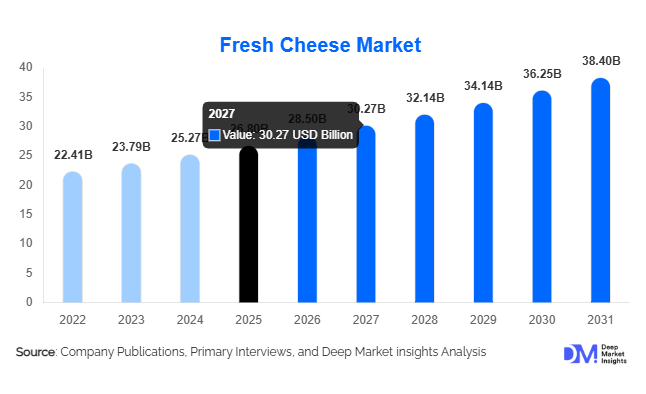
According to Deep Market Insights, the global fresh cheese market size was valued at USD 26.8 billion in 2025 and is projected to grow from USD 28.5 billion in 2026 to reach USD 38.4 billion by 2031, expanding at a CAGR of 6.2% during the forecast period (2026–2031). The market growth is primarily driven by rising global demand for protein-rich dairy products, increasing consumption of Western-style fast food such as pizza and bakery items, and expanding retail availability of refrigerated dairy products across emerging economies. Growing consumer preference for clean-label, minimally processed, and high-protein foods is further accelerating adoption of fresh cheese varieties such as mozzarella, cream cheese, cottage cheese, and paneer.
Key Market Insights
- Mozzarella dominates global consumption due to its widespread use in pizza chains, frozen foods, and quick-service restaurants worldwide.
- Asia-Pacific is the fastest-growing region, driven by rising dairy adoption in India, China, and Southeast Asia.
- Foodservice expansion is a key demand driver, particularly with the global growth of QSR chains and bakery outlets.
- Health-conscious consumption is reshaping demand patterns, boosting high-protein and low-fat cheese variants such as cottage cheese and paneer.
- Cold chain infrastructure expansion is enabling broader distribution of perishable dairy products in developing markets.
- E-commerce grocery platforms are accelerating retail penetration, especially in urban and semi-urban regions.
What are the latest trends in the fresh cheese market?
Rising Demand for High-Protein and Functional Dairy Products
Consumers are increasingly prioritizing protein-rich diets, leading to strong demand for cottage cheese, paneer, and low-fat cream cheese. Manufacturers are launching fortified and functional variants enriched with probiotics, vitamins, and reduced fat content. This trend is particularly strong among fitness-focused consumers and vegetarian populations in India and Western markets.
Expansion of Clean Label and Natural Dairy Products
The shift toward clean-label consumption is driving demand for minimally processed fresh cheese products with no preservatives or artificial additives. Organic and grass-fed dairy sourcing is gaining traction, especially in Europe and North America. Brands are investing in transparent labeling, traceability systems, and sustainable sourcing to build consumer trust.
What are the key drivers in the fresh cheese market?
Growth of Global Foodservice and QSR Industry
The rapid expansion of pizza chains, cafés, bakeries, and fast-food restaurants is significantly boosting demand for mozzarella and cream cheese. These segments rely heavily on standardized bulk cheese supply, making foodservice one of the strongest demand drivers globally. Increasing urbanization and rising disposable incomes are further strengthening this trend.
Rising Health and Wellness Awareness
Consumers are increasingly shifting toward high-protein, nutrient-dense diets, supporting demand for fresh cheese as a natural protein source. Cottage cheese and paneer are widely adopted in fitness and vegetarian diets, while low-fat and lactose-free variants are expanding appeal among health-conscious consumers.
Retail Expansion and Cold Chain Improvements
Improved refrigerated logistics, supermarket expansion, and organized retail penetration are making fresh cheese widely accessible. Emerging economies are investing in cold storage infrastructure, reducing spoilage rates and enabling long-distance distribution of perishable dairy products.
What are the restraints for the global market?
Short Shelf Life and Storage Challenges
Fresh cheese products require strict refrigeration and have limited shelf stability, making transportation and storage costly. In regions with weak cold chain infrastructure, this significantly restricts market penetration and increases product wastage.
Volatility in Raw Milk Prices
Fluctuations in global milk supply and feed costs directly impact production pricing and profit margins. This volatility creates pricing instability for manufacturers and can reduce affordability for end consumers in price-sensitive markets.
What are the key opportunities in the fresh cheese industry?
Growth of Plant-Based and Hybrid Dairy Innovation
Rising lactose intolerance and vegan trends are creating opportunities for hybrid dairy products that combine traditional cheese with plant-based ingredients. Innovation in fermentation technologies and dairy alternatives is opening new product categories in the fresh cheese segment.
Expansion in Emerging Markets
Asia-Pacific, Latin America, and the Middle East present strong growth opportunities due to rising urbanization, Western dietary influence, and increasing disposable income. Localization of products such as paneer in India and fresh cheese spreads in China is driving regional expansion.
Premiumization and Artisanal Cheese Demand
Consumers are increasingly willing to pay premium prices for artisanal, organic, and specialty fresh cheese varieties. This trend is encouraging manufacturers to develop high-value product lines targeting gourmet retail and specialty food stores.
Report Scope
| Report Metric | Details |
|---|---|
| Market Size in 2025 | USD 26.8 Billion |
| Market Size in 2026 | USD 28.5 Billion |
| Market Size in 2031 | USD 38.4 Billion |
| CAGR | 6.2% (2026-2031) |
| Base Year for Estimation | 2025 |
| Historical Data | 2022-2024 |
| Forecast Period | 2026-2031 |
| Report Coverage | Revenue Forecast, Competitive Landscape, Supply Chain Disruption, Growth Factors, Environment & Regulatory Landscape and Trends |
| Geographies Covered | North America, Europe, APAC, Middle East and Africa, LATAM |
| Countries Covered | U.S., Canada, U.K., Germany, France, Spain, Italy, Russia, Nordic, Benelux, Rest of Europe, China, Korea, Japan, India, Australia, Singapore, Taiwan, South East Asia, Rest of Asia-Pacific, UAE, Turky, Saudi Arabia, South Africa, Egypt, Nigeria, Rest of MEA, Brazil, Mexico, Argentina, Chile, Colombia, Rest of LATAM |
Explore more data points, trends and opportunities Download Free Sample Report
Product Type Insights
The global fresh cheese market is characterized by a diverse product portfolio, with each type catering to distinct culinary, nutritional, and regional consumption preferences. Mozzarella continues to dominate the market, accounting for approximately 32% of global share, primarily due to its unmatched versatility and widespread use in pizza, fast food, frozen meals, and processed food formulations. The strong dominance of mozzarella is largely supported by the rapid expansion of global quick-service restaurant chains, increasing consumption of Italian and American-style cuisines, and the rising demand for ready-to-cook and ready-to-eat food products. Additionally, improvements in cold chain logistics and packaging technologies have significantly extended mozzarella shelf life, further strengthening its penetration in both retail and foodservice channels across developed and emerging economies.Paneer is emerging as one of the fastest-growing product segments, particularly in South Asia, where vegetarian dietary habits significantly influence dairy consumption patterns. Its growth is strongly supported by rising disposable incomes, rapid urbanization, and increasing penetration of North Indian and Indo-Chinese cuisines in restaurants and foodservice outlets. Paneer’s cultural significance, coupled with its role as a primary protein source in vegetarian diets, ensures sustained demand across both rural and urban regions. In addition, increasing exports of Indian dairy products to the Middle East and North America are expanding its global footprint.Other varieties such as ricotta, mascarpone, quark, and specialty fresh cheeses collectively cater to niche premium and gourmet applications. These products are widely used in European culinary traditions, desserts, and high-end restaurant menus. Their growth is driven by rising demand for artisanal and authentic food experiences, especially among affluent consumers and gourmet chefs. Innovation in premium dairy formulations and increasing tourism-driven culinary exposure are also contributing to steady growth in these segments across Europe and North America.
Application Insights
The application landscape of the fresh cheese market is highly diversified, with the foodservice sector emerging as the largest and most dynamic segment. The rapid global expansion of quick-service restaurants, bakery chains, cafés, and casual dining establishments has significantly increased demand for fresh cheese ingredients. Foodservice operators prefer fresh cheese due to its versatility, consistency, and ability to enhance flavor profiles across a wide range of cuisines. The growing trend of international cuisine adoption, particularly Italian, American, and fusion foods, has further strengthened consumption in this segment. Additionally, rising urbanization and changing lifestyle patterns have led to increased dining-out frequency, directly boosting institutional demand.Industrial applications represent a rapidly expanding segment, driven by the growing demand for convenience foods such as frozen meals, ready-to-eat products, and packaged bakery items. Food manufacturers extensively use fresh cheese as a functional ingredient to enhance texture, flavor, and nutritional value in processed foods. The surge in demand for convenience and time-saving food solutions, particularly among working populations in urban areas, is a key driver of industrial consumption. Technological advancements in food processing and preservation have also enabled broader integration of fresh cheese into mass-produced food products.Additionally, the increasing incorporation of fresh cheese into salads, protein-rich snacks, and health-focused meal kits is expanding its application base. The rising popularity of fitness-oriented diets and clean-label products has encouraged manufacturers to develop innovative cheese-based offerings that cater to evolving consumer preferences. This trend is expected to further diversify demand across both retail and institutional channels over the forecast period.
Distribution Channel Insights
Distribution channels play a critical role in shaping the accessibility and growth of the fresh cheese market. Supermarkets and hypermarkets continue to dominate global distribution, accounting for the largest share due to their ability to provide a wide range of dairy products under controlled temperature conditions. These retail formats benefit from strong consumer trust, product variety, and the convenience of one-stop shopping. The presence of dedicated refrigerated sections ensures product freshness, which is a key requirement for fresh cheese consumption.Convenience stores are witnessing steady growth, particularly in urban and semi-urban regions, where consumers prioritize quick access and immediate purchase options. These stores cater to on-the-go consumption trends and smaller household requirements, making them an important channel for daily and impulse purchases. Their expansion in emerging economies is further strengthening their contribution to overall market growth.Foodservice distribution channels remain essential for bulk procurement, supplying restaurants, hotels, catering services, and QSR chains. These institutional buyers require consistent quality, large volumes, and reliable supply chains, making foodservice distribution a cornerstone of the global fresh cheese industry. The expansion of global hospitality and tourism sectors continues to reinforce the importance of this channel.
Explore more data points, trends and opportunities Download Free Sample Report
Fresh Cheese Market Segmentations
By Product Type
- Mozzarella
- Cream Cheese
- Cottage Cheese
- Ricotta Cheese
- Mascarpone Cheese
- Paneer
- Quark
- Labneh
- Others
By Form
- Spreadable Fresh Cheese
- Block Cheese
- Crumbled Cheese
- Sliced Cheese
- Shredded Cheese
By Source of Milk
- Cow Milk-Based Fresh Cheese
- Buffalo Milk-Based Fresh Cheese
- Goat Milk-Based Fresh Cheese
- Sheep Milk-Based Fresh Cheese
- Blended Milk Variants
By Distribution Channel
- Supermarkets & Hypermarkets
- Convenience Stores
- Specialty Dairy Stores
- Online Retail
- Foodservice Distribution Channels
By End-Use
- Household Consumption
- Foodservice Industry
- Industrial Processing
Regional Insights
Europe
Europe holds the largest share of the global fresh cheese market, supported by deeply rooted dairy traditions, high per capita cheese consumption, and advanced dairy processing infrastructure. Countries such as Germany, France, Italy, and the Netherlands play a pivotal role in regional dominance. The strong cultural integration of cheese in daily diets, combined with well-established cold chain systems, ensures consistent demand. The region’s growth is further driven by increasing demand for premium and artisanal cheese varieties, rising health-conscious consumption patterns, and continuous innovation in dairy processing technologies. Additionally, strong export capabilities and presence of leading dairy producers reinforce Europe’s leadership position in the global market.
North America
North America is a highly mature yet steadily growing market, led primarily by the United States. Strong demand for mozzarella and cream cheese is fueled by the extensive presence of fast-food chains, bakery industries, and packaged food manufacturers. The region benefits from high consumer purchasing power, well-developed retail infrastructure, and strong brand penetration. Growth is also supported by rising demand for high-protein diets, functional foods, and convenience-based meal solutions. Canada contributes to regional growth through stable retail consumption and increasing foodservice expansion. Continuous product innovation and the introduction of organic and reduced-fat cheese variants are further driving market expansion.
Asia-Pacific
Asia-Pacific is the fastest-growing region in the global fresh cheese market, driven by rapid urbanization, rising disposable incomes, and evolving dietary habits. Countries such as India, China, Japan, and Southeast Asian nations are witnessing strong growth in dairy consumption due to increasing exposure to Western cuisines and expanding middle-class populations. The proliferation of quick-service restaurants and café culture has significantly boosted demand for fresh cheese ingredients. India’s large vegetarian population also supports strong growth in paneer consumption, while China’s growing dairy awareness is driving new demand opportunities. Expansion of cold chain infrastructure and retail modernization are further accelerating regional growth.
Latin America
Latin America is emerging as a promising market, with Brazil and Mexico leading regional consumption. Growth is primarily driven by rising disposable incomes, urbanization, and increasing adoption of cheese in fast food and home cooking. The expansion of international restaurant chains and growing popularity of Western dietary patterns are further supporting demand. Improved retail infrastructure and increasing availability of imported dairy products are also contributing to market expansion. Additionally, the region’s growing tourism and hospitality sectors are boosting foodservice consumption of fresh cheese products.
Middle East & Africa
The Middle East & Africa region is experiencing steady growth, driven by expanding tourism, hospitality development, and rising imports of dairy products. Gulf Cooperation Council (GCC) countries such as the UAE and Saudi Arabia are key contributors, supported by high expatriate populations and strong demand from luxury hotels, restaurants, and catering services. Increasing urbanization, improving retail infrastructure, and rising consumer awareness of dairy nutrition are further supporting market expansion. In Africa, gradual economic development and improving cold chain logistics are enhancing accessibility and consumption of fresh cheese products. Overall, the region’s growth is strongly tied to import dependence and expanding foodservice industries.
Key Players in the Fresh Cheese Market
- Lactalis Group
- Saputo Inc.
- Arla Foods
- FrieslandCampina
- Fonterra Co-operative Group
- Savencia Fromage & Dairy
- Bel Group
- Emmi AG
- DMK Group
- Schreiber Foods
- Dairy Farmers of America
- Granarolo
- Ornua
- Agropur Cooperative
- Murray Goulburn