Forage Inoculants Market Size
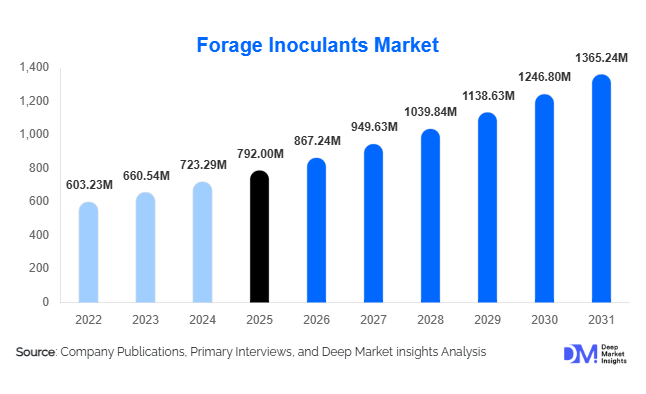
According to Deep Market Insights, the global forage inoculants market size was valued at USD 792 million in 2025 and is projected to grow from USD 867.24 million in 2026 to reach USD 1,365.24 million by 2031, expanding at a CAGR of 9.5% during the forecast period (2026–2031). The forage inoculants market growth is primarily driven by increasing demand for high-quality livestock feed, rising commercialization of dairy and beef farming, and growing adoption of biological solutions that improve silage fermentation efficiency and nutrient preservation.
Key Market Insights
- Biological feed preservation solutions are gaining rapid adoption as livestock producers seek improved feed conversion efficiency and reduced silage losses.
- Dairy cattle applications dominate global demand, accounting for the majority of inoculant consumption due to measurable improvements in milk yield and feed digestibility.
- North America leads the global market, supported by large-scale mechanized farming and widespread use of corn silage.
- Asia-Pacific is the fastest-growing regional market, driven by dairy modernization programs in China and India.
- Multi-strain and enzyme-enhanced inoculants are replacing single-strain products, offering enhanced aerobic stability and nutrient retention.
- Precision agriculture integration, including automated application systems and data-driven feed optimization, is reshaping purchasing decisions.
What are the latest trends in the forage inoculants market?
Shift Toward Multi-Strain and Functional Microbial Solutions
Manufacturers are increasingly developing advanced microbial blends combining homofermentative and heterofermentative bacteria to improve both fermentation speed and aerobic stability. These next-generation inoculants enhance nutrient preservation while reducing spoilage losses during feed-out stages. Farmers are prioritizing products that deliver measurable performance outcomes such as higher milk yield, improved weight gain, and reduced feed waste. The trend toward functional additives also includes enzyme integration, enabling improved fiber digestion and nutrient availability, particularly in high-moisture silage systems. Customized solutions tailored to crop types and climate conditions are becoming a key differentiator among suppliers.
Digitalization and Precision Livestock Farming Integration
Technology adoption is transforming how forage inoculants are selected and applied. Automated applicators integrated into forage harvesters ensure accurate dosing and uniform distribution, improving product efficacy. Digital livestock management platforms now incorporate silage analytics, enabling farmers to monitor fermentation outcomes and optimize feeding strategies. Data-driven advisory models supported by manufacturers and cooperatives are helping producers quantify return on investment, accelerating adoption across commercial farms. Mobile-based farm management tools are also enhancing awareness among emerging-market producers, bridging knowledge gaps and supporting broader market penetration.
What are the key drivers in the forage inoculants market?
Rising Global Demand for Dairy and Meat Production
Growing consumption of dairy and meat products worldwide is pushing livestock producers to improve feed efficiency and productivity. Since feed costs account for a majority of livestock production expenses, improving silage quality directly impacts profitability. Forage inoculants enhance fermentation, reduce nutrient loss, and improve digestibility, allowing farmers to achieve higher animal performance from the same feed volume. Expansion of commercial dairy operations across Asia and Latin America is further strengthening long-term demand.
Increased Focus on Feed Loss Reduction and Sustainability
Silage losses caused by poor fermentation and aerobic spoilage can reach significant levels without treatment. Forage inoculants minimize dry matter loss and improve storage stability, helping farms maintain consistent feed supply throughout the year. Sustainability initiatives promoting efficient resource utilization and reduced methane emissions are also encouraging adoption of biological feed additives. Improved feed digestibility contributes to lower emissions intensity per unit of milk or meat produced, aligning with environmental regulations and corporate sustainability goals.
What are the restraints for the global market?
Limited Awareness Among Smallholder Farmers
Despite strong benefits, adoption remains uneven in developing regions where small-scale farmers rely on traditional silage practices. Limited technical knowledge and perceived cost sensitivity hinder market penetration. Suppliers must invest in farmer education programs, demonstration trials, and cooperative partnerships to expand adoption among emerging agricultural economies.
Performance Variability Due to Application Conditions
The effectiveness of forage inoculants depends heavily on moisture levels, forage composition, and application accuracy. Improper handling or inconsistent dosing can reduce product performance, creating skepticism among first-time users. Manufacturers are addressing this challenge through improved formulation stability and integrated technical advisory services.
What are the key opportunities in the forage inoculants industry?
Expansion of Commercial Dairy Farming in Emerging Markets
Rapid industrialization of dairy farming across Asia-Pacific and Latin America presents significant growth opportunities. Governments supporting milk productivity and food security initiatives are encouraging adoption of scientific feeding practices. Large commercial farms require consistent silage quality, creating sustained demand for advanced inoculant solutions.
Climate-Resilient Feed Preservation Solutions
Climate variability is increasing the need for reliable forage preservation technologies. High temperatures and unpredictable rainfall elevate spoilage risks, making microbial inoculants essential for maintaining feed stability. Companies developing climate-adapted strains suitable for tropical and arid regions are expected to capture substantial growth opportunities.
Report Scope
| Report Metric | Details |
|---|---|
| Market Size in 2025 | USD 792 Million |
| Market Size in 2026 | USD 867.24 Million |
| Market Size in 2031 | USD 1365.24 Million |
| CAGR | 9.5% (2026-2031) |
| Base Year for Estimation | 2025 |
| Historical Data | 2022-2024 |
| Forecast Period | 2026-2031 |
| Report Coverage | Revenue Forecast, Competitive Landscape, Supply Chain Disruption, Growth Factors, Environment & Regulatory Landscape and Trends |
| Geographies Covered | North America, Europe, APAC, Middle East and Africa, LATAM |
| Countries Covered | U.S., Canada, U.K., Germany, France, Spain, Italy, Russia, Nordic, Benelux, Rest of Europe, China, Korea, Japan, India, Australia, Singapore, Taiwan, South East Asia, Rest of Asia-Pacific, UAE, Turky, Saudi Arabia, South Africa, Egypt, Nigeria, Rest of MEA, Brazil, Mexico, Argentina, Chile, Colombia, Rest of LATAM |
Explore more data points, trends and opportunities Download Free Sample Report
Product Type Insights
Homofermentative lactic acid bacteria inoculants continue to dominate the global forage inoculants market, capturing the largest share due to their rapid pH reduction capabilities and ability to stabilize fermentation effectively. These products are particularly valued in high-volume silage operations where consistent feed quality is critical. Dual-strain and multi-strain inoculants are experiencing increased adoption as farmers seek enhanced aerobic stability and prolonged storage performance, minimizing spoilage and nutrient loss. Enzyme-enhanced inoculants are emerging as premium offerings, especially in high-value dairy farming systems, where they improve digestibility and feed conversion, leading to measurable productivity gains and higher milk yields. The growing emphasis on maximizing forage efficiency and reducing feed costs is expected to further propel the adoption of advanced product types across regions.
Application Insights
Corn silage applications represent the largest segment globally, underpinned by widespread cultivation in North America and Europe and its central role in high-yield dairy operations. Alfalfa and grass silage applications are expanding steadily, driven by rising dairy production and a growing focus on nutrient preservation in Europe, North America, and parts of Asia-Pacific. Small grain and sorghum silage are witnessing increasing demand in emerging markets such as Latin America and parts of Asia, where climate variability and diverse crop rotation strategies favor these crops. Across all silage types, the primary objectives remain consistent: improving fermentation, preserving nutrients, and enhancing feed efficiency, which directly impacts livestock performance and profitability. The rise in sustainable livestock practices and the need for consistent feed quality are further strengthening the market for specialized applications.
Distribution Channel Insights
Agricultural cooperatives and feed distributors remain the primary channels for forage inoculant sales, offering both product supply and technical advisory support to optimize silage outcomes. Direct sales to large commercial farms are growing as manufacturers establish closer relationships with high-volume buyers, ensuring tailored solutions and ongoing support. Additionally, online agricultural platforms are gaining traction, particularly for standardized and premium inoculant products aimed at technologically advanced farms, providing convenient access and detailed product information. The integration of digital advisory services with e-commerce channels is expected to further expand reach, particularly in regions with dispersed farm networks.
Livestock Type Insights
Dairy cattle account for the majority of global forage inoculant consumption, representing nearly 60% of demand due to the direct correlation between silage quality and milk production efficiency. Beef cattle applications are experiencing steady growth, particularly in Latin America and North America, where improving feed conversion and meat quality are critical to export competitiveness. Sheep, goat, and specialty livestock segments contribute a smaller but growing share as precision feeding and optimized silage practices spread globally. The increasing focus on maximizing productivity across all livestock types, alongside the rising cost of feed, is encouraging broader adoption of forage inoculants across diverse animal categories.
Explore more data points, trends and opportunities Download Free Sample Report
Forage Inoculants Market Segmentations
By Microbial Type
- Homofermentative Lactic Acid Bacteria
- Heterofermentative Lactic Acid Bacteria
- Dual-Strain / Multi-Strain Inoculants
- Enzyme-Enhanced Microbial Inoculants
- Other Functional Microbial Cultures
By Forage Crop Type
- Corn Silage
- Alfalfa Silage
- Grass Silage
- Small Grain Silage
- Sorghum & Other Forage Crops
By Application Method
- Liquid Inoculants
- Dry / Freeze-Dried Powder Inoculants
- Water-Soluble Formulations
By Functionality
- Fermentation Enhancement
- Aerobic Stability Improvement
- Nutrient Preservation & Digestibility Enhancement
- Mycotoxin & Spoilage Control
By Livestock Type
- Dairy Cattle
- Beef Cattle
- Sheep & Goats
- Poultry Feed Silage Applications
- Others
By Distribution Channel
- Direct Sales to Commercial Farms
- Agricultural Cooperatives
- Feed & Silage Additive Distributors
- Online & Precision Agriculture Platforms
Regional Insights
North America
North America dominates the global forage inoculants market, accounting for approximately 34% of demand in 2025. The United States leads due to its large dairy herds, extensive corn silage production, and high awareness of feed optimization technologies. Strong mechanization, adoption of precision farming, and integrated livestock nutrition programs further support market growth. Canada is also a significant contributor, with adoption driven by modernized farm systems, government-backed productivity initiatives, and a growing focus on sustainable forage management. Key growth drivers include the rising cost of feed, regulatory emphasis on reducing waste, and the adoption of high-performance inoculants that enhance silage stability and milk yield.
Europe
Europe holds around 27% of the global market share, led by Germany, France, the Netherlands, and the United Kingdom. The region’s market expansion is strongly influenced by strict environmental regulations, sustainability targets, and the need to reduce greenhouse gas emissions from livestock operations. Farmers are increasingly adopting multi-strain and enzyme-enhanced inoculants to improve feed efficiency, meet emission reduction goals, and enhance nutrient preservation. High awareness of animal welfare, government incentives for sustainable farming practices, and premium dairy production standards are significant drivers supporting continuous growth in European markets.
Asia-Pacific
Asia-Pacific is the fastest-growing regional market, driven by expanding dairy industries in China and India, supported by government-backed livestock productivity programs and rising milk consumption. The adoption of silage inoculants is increasing as farmers aim to improve feed stability and livestock performance in regions with high animal stocking densities. Mature markets such as Australia and Japan emphasize high-quality feed management practices, including advanced inoculants for optimal nutrient utilization. Additional growth drivers include increasing investments in modernized farming infrastructure, rising awareness of feed efficiency, and the need to support a growing population with sustainable dairy production.
Latin America
Latin America represents nearly 10% of global demand, with Brazil and Argentina as the key markets. Growth is supported by the expansion of beef and dairy exports, coupled with improved feed management practices that stabilize production costs and enhance animal performance. Favorable climatic conditions for diverse forage cultivation, combined with increased mechanization and the adoption of high-efficiency inoculants, are driving market penetration. Government initiatives promoting livestock productivity, along with a rising focus on quality and export-oriented meat production, further contribute to regional growth.
Middle East & Africa
The Middle East & Africa region is steadily emerging, with adoption increasing in countries such as Saudi Arabia, South Africa, and Egypt. Water scarcity and harsh climatic conditions are creating a strong demand for efficient forage preservation technologies that maximize nutrient retention and reduce wastage. Growth is also supported by the expansion of commercial dairy farms, government incentives for agricultural modernization, and the introduction of climate-resilient feed solutions. As livestock farming becomes more industrialized, the use of high-performance inoculants is ex
Key Players in the Forage Inoculants Market
- Chr. Hansen Holding A/S
- Lallemand Inc.
- Corteva Agriscience
- BASF SE
- DSM-Firmenich
- Kemin Industries
- Volac International Ltd.
- Schaumann BioEnergy
- ADM Animal Nutrition
- Novonesis Group
- Nutreco N.V.
- Canadian Bio-Systems Inc.
- Micron Bio-Systems
- Biomin Holding GmbH
- Pioneer (Corteva brand)