Football Jerseys Market Size
According to Deep Market Insights, the global football jerseys market size was valued at USD 12.9 billion in 2025 and is projected to grow from USD 13.73 billion in 2026 to reach USD 18.72 billion by 2031, expanding at a CAGR of 6.4% during the forecast period (2026–2031). The football jerseys market growth is primarily driven by rising global football fandom, expanding commercialization of professional football leagues, increasing popularity of women’s football, and growing consumer demand for licensed sports merchandise. Football jerseys have evolved beyond traditional sports apparel into lifestyle and fashion-oriented products that symbolize club loyalty, cultural identity, and streetwear influence.
International tournaments such as the FIFA World Cup, UEFA European Championship, Copa América, and UEFA Champions League continue to generate substantial spikes in global jersey sales. Increasing digital engagement through social media platforms and e-commerce channels is enabling clubs and apparel brands to reach consumers across emerging regions, including Asia-Pacific, the Middle East, and Latin America. The market is also benefiting from the rapid adoption of sustainable manufacturing practices, including the use of recycled polyester fabrics and environmentally responsible textile processing technologies.
Replica jerseys continue to dominate unit sales due to affordability and accessibility, while authentic match jerseys are witnessing strong demand among collectors and premium consumers. Football clubs are increasingly leveraging direct-to-consumer retail models, personalized jersey customization, and limited-edition product launches to strengthen fan engagement and improve profit margins. In addition, rising participation in grassroots football, youth academies, and women’s leagues is expanding long-term market demand globally.
Key Market Insights
- Replica football jerseys dominate global sales volumes, driven by affordability, official branding, and widespread retail availability across both developed and emerging markets.
- Sustainable football apparel manufacturing is gaining strong momentum, with brands increasingly adopting recycled polyester, ocean-plastic fabrics, and low-emission textile production processes.
- Europe dominates the global football jerseys market, supported by elite football leagues, established club merchandising ecosystems, and strong consumer spending on sports apparel.
- Asia-Pacific is the fastest-growing regional market, fueled by rising football viewership, expanding youth participation, and increasing disposable incomes in countries such as China and India.
- Online retail channels account for the majority of jersey sales growth, driven by direct-to-consumer strategies, mobile commerce adoption, and personalized customization services.
- Women’s football is emerging as a major growth catalyst, increasing demand for dedicated women-focused football apparel collections and licensed merchandise.
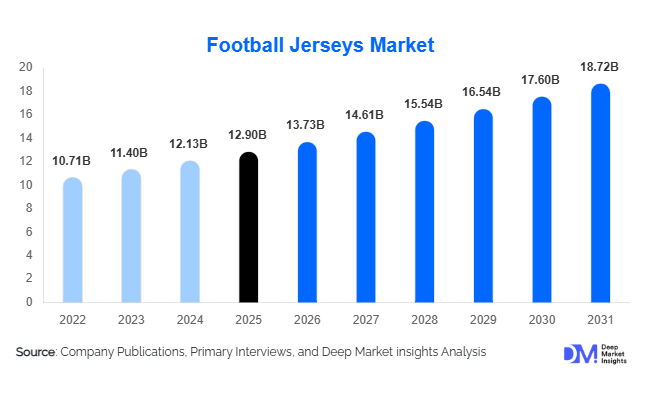
Football Jerseys Market Trends
Rise of Sustainable and Recycled Football Apparel
Sustainability has become one of the most influential trends shaping the football jerseys market. Major sportswear companies are increasingly manufacturing jerseys using recycled polyester, ocean plastics, and environmentally responsible textile processes. Consumers, particularly in Europe and North America, are prioritizing eco-friendly sports apparel as awareness surrounding climate change and textile waste continues to increase. Football clubs and apparel brands are also promoting sustainability through carbon-neutral manufacturing initiatives, water-efficient dyeing technologies, and circular apparel programs that encourage jersey recycling and reuse.
Leading brands are positioning sustainable jerseys as premium products while simultaneously integrating environmental messaging into club campaigns and marketing strategies. The adoption of sustainability certifications and supply chain transparency measures is further influencing purchasing decisions among environmentally conscious consumers. In addition, governing bodies and sports organizations are increasingly encouraging clubs to reduce their environmental footprint, accelerating the adoption of sustainable materials across professional football apparel manufacturing.
Growing Influence of Football Fashion and Streetwear Culture
Football jerseys are increasingly becoming mainstream lifestyle and streetwear products rather than purely performance-focused sports apparel. Collaborations between football clubs, designers, musicians, and fashion brands are expanding the cultural influence of football merchandise among younger demographics. Retro jersey collections, heritage-inspired kits, and limited-edition collaborations are generating strong demand within fashion-oriented consumer segments.
Social media platforms such as Instagram, TikTok, and YouTube are accelerating this trend by amplifying football culture and driving merchandise visibility globally. Consumers are increasingly wearing football jerseys as everyday casual wear, especially in urban fashion markets across Europe, North America, and Asia-Pacific. The crossover between football culture and streetwear has also created opportunities for premium pricing and collector-driven demand, particularly for rare or limited-edition jerseys linked to iconic players, clubs, or tournaments.
Football Jerseys Market Drivers
Commercialization of Global Football Leagues
The increasing commercialization of football leagues and tournaments is one of the primary drivers supporting football jerseys market growth. Major European clubs such as Real Madrid, Manchester United, FC Barcelona, Bayern Munich, and Paris Saint-Germain have evolved into global entertainment brands with extensive international fan bases. These clubs generate substantial revenues through merchandise sales, licensing agreements, and sponsorship partnerships.
International football tournaments consistently generate sharp increases in jersey sales worldwide, particularly during FIFA World Cup and UEFA Championship cycles. The globalization of football broadcasting has also expanded audience reach into emerging markets such as India, Southeast Asia, and the Middle East, increasing consumer demand for club and national team jerseys.
Expansion of Digital Retail and E-Commerce
The rapid growth of online retail and direct-to-consumer business models is significantly boosting football jersey sales globally. E-commerce platforms enable clubs and sportswear brands to directly engage consumers through customized jersey offerings, limited-edition launches, and personalized shopping experiences. Mobile commerce adoption and digital payment infrastructure improvements are further accelerating online football merchandise sales.
Social media marketing, influencer collaborations, and athlete endorsements are increasingly driving digital purchasing behavior. Clubs are leveraging official mobile applications, online stores, and digital fan communities to increase merchandise engagement and customer loyalty. Faster logistics and global shipping capabilities have additionally improved accessibility to licensed football jerseys across international markets.
Football Jerseys Market Restraints
Counterfeit and Unlicensed Merchandise
Counterfeit football jerseys remain one of the largest restraints impacting market growth globally. Unlicensed products are widely distributed across informal retail channels and online marketplaces, particularly within price-sensitive developing economies. These counterfeit products reduce revenues for official clubs, sportswear manufacturers, and licensing partners while also damaging brand reputation and exclusivity.
The availability of low-cost imitation jerseys creates pricing pressure on official merchandise providers, especially in emerging markets where consumers prioritize affordability over authenticity. Despite increasing enforcement efforts, intellectual property violations and counterfeit distribution networks continue to pose major challenges for the industry.
Volatility in Raw Material and Manufacturing Costs
Fluctuating prices of polyester, synthetic fibers, labor, and international freight transportation significantly affect football jersey manufacturing costs. Global supply chain disruptions and geopolitical uncertainties can delay production schedules and increase operational risks for sportswear companies dependent on outsourced manufacturing hubs across Asia.
Rising energy costs and inflationary pressures are also contributing to higher retail pricing for authentic and premium football jerseys. As a result, affordability concerns remain a challenge in several emerging economies where purchasing power remains limited.
Football Jerseys Market Opportunities
Growth of Women’s Football Merchandise
The rapid expansion of women’s football presents a major opportunity for football jersey manufacturers and clubs globally. Women’s leagues are witnessing increasing sponsorship revenues, higher broadcasting visibility, and record-breaking attendance levels across Europe, North America, and Asia-Pacific. This growth is creating rising demand for dedicated women-focused football jerseys with specialized sizing, styling, and branding.
Sportswear companies are increasingly launching women-specific collections and athlete collaborations to target female consumers more effectively. The increasing participation of women in football at both professional and grassroots levels is expected to create sustained long-term demand for women’s football apparel and licensed merchandise.
Personalization and Direct-to-Consumer Customization
Personalized football jerseys represent one of the fastest-growing opportunities within the market. Consumers increasingly prefer customized jerseys featuring player names, personal text, unique numbers, and exclusive designs. Advances in digital printing technologies and automated manufacturing systems are enabling faster and more cost-efficient customization processes.
Football clubs are increasingly adopting direct-to-consumer retail strategies that emphasize personalized engagement and exclusive merchandise launches. Online platforms are enabling brands to deliver customized products globally while improving profit margins and customer retention. Limited-edition collector jerseys and digitally integrated merchandise experiences are also expanding premium revenue opportunities.
Report Scope
| Report Metric | Details |
|---|---|
| Market Size in 2025 | USD 12.9 Billion |
| Market Size in 2026 | USD 13.73 Billion |
| Market Size in 2031 | USD 18.72 Billion |
| CAGR | 6.4% (2026-2031) |
| Base Year for Estimation | 2025 |
| Historical Data | 2022-2024 |
| Forecast Period | 2026-2031 |
| Report Coverage | Revenue Forecast, Competitive Landscape, Supply Chain Disruption, Growth Factors, Environment & Regulatory Landscape and Trends |
| Geographies Covered | North America, Europe, APAC, Middle East and Africa, LATAM |
| Countries Covered | U.S., Canada, U.K., Germany, France, Spain, Italy, Russia, Nordic, Benelux, Rest of Europe, China, Korea, Japan, India, Australia, Singapore, Taiwan, South East Asia, Rest of Asia-Pacific, UAE, Turky, Saudi Arabia, South Africa, Egypt, Nigeria, Rest of MEA, Brazil, Mexico, Argentina, Chile, Colombia, Rest of LATAM |
Explore more data points, trends and opportunities Download Free Sample Report
Product Type Insights
Replica jerseys account for the largest share of the football jerseys market, representing nearly 46% of global revenue in 2025. Their dominance is driven by affordability, official club branding, and strong fan demand during football league seasons and international tournaments. Replica jerseys provide consumers with authentic aesthetics at significantly lower prices compared to player-issue match jerseys, making them highly accessible across both mature and emerging markets. Authentic match jerseys continue to witness strong growth among collectors, premium consumers, and dedicated football supporters. These jerseys are manufactured using advanced performance fabrics, lightweight construction, and player-grade technology, allowing brands to position them as premium products with higher profit margins. Limited-edition and retro-inspired jerseys are also generating growing demand within lifestyle and fashion-oriented segments.
Training jerseys and warm-up apparel are increasingly gaining traction due to rising participation in amateur football leagues, academies, and fitness-oriented sportswear adoption. Customized football jerseys for schools, grassroots clubs, and community teams are additionally contributing to recurring market demand globally.
Material Insights
Polyester-based fabrics dominate the football jerseys market, accounting for nearly 68% of total material consumption globally. Polyester remains the preferred material because of its lightweight structure, moisture-wicking capability, durability, and cost efficiency. Sportswear companies continue investing in advanced synthetic fabrics that improve breathability, flexibility, and athlete comfort during high-performance activities.
Recycled polyester is witnessing particularly strong growth due to increasing sustainability requirements and consumer preference for environmentally responsible products. Major football apparel brands are introducing jerseys manufactured from recycled plastic bottles and ocean waste materials to strengthen sustainability positioning and comply with environmental commitments. Performance synthetic fabrics featuring mesh ventilation zones, temperature regulation, and body-mapping technologies are increasingly integrated into premium football jersey collections. Cotton blends continue to maintain niche demand within casual fan apparel and lifestyle-oriented football fashion products.
Distribution Channel Insights
Online retail channels dominate football jersey sales globally, accounting for approximately 52% of total market revenue in 2025. Brand-owned e-commerce platforms, online marketplaces, and sports merchandise websites are benefiting from rising mobile commerce adoption and expanding digital consumer engagement. Online platforms provide consumers with greater access to customization services, exclusive launches, and international product availability.
Football clubs are increasingly prioritizing direct-to-consumer digital strategies to improve profitability and strengthen fan relationships. Social media marketing, influencer campaigns, and athlete collaborations are significantly influencing purchasing decisions across online channels. Offline retail channels, including sporting goods stores, flagship stores, stadium outlets, and department stores, continue to play an important role in consumer engagement and physical product experiences. Stadium stores remain particularly important during live tournaments and matchday events, where emotional purchasing behavior drives strong merchandise sales.
Consumer Category Insights
The men’s category represents the largest consumer segment in the football jerseys market, accounting for nearly 57% of total market demand in 2025. Historically higher participation rates in football and stronger merchandise purchasing behavior continue supporting segment dominance globally. Women’s football apparel represents the fastest-growing consumer category due to increasing participation in women’s football leagues, expanding sponsorship investments, and growing consumer visibility. Sportswear companies are increasingly introducing dedicated women-focused collections designed specifically for female athletes and fans.
The kids and youth segment also represents a major growth area, supported by expanding football academy systems, school sports programs, and growing youth football participation worldwide. Clubs increasingly target younger demographics through junior kits, youth-focused marketing campaigns, and affordable merchandise offerings.
Explore more data points, trends and opportunities Download Free Sample Report
Football Jerseys Market Segmentations
By Product Type
- Authentic Match Jerseys
- Replica Jerseys
- Fan Apparel Jerseys
- Training and Warm-Up Jerseys
- Customized Jerseys
By Material
- Polyester-Based Jerseys
- Cotton Blend Jerseys
- Performance Synthetic Fabrics
- Eco-Friendly Sustainable Fabrics
By Consumer Category
- Men
- Women
- Kids & Youth
- Unisex Collections
By Distribution Channel
- Online Retail
- Brand Flagship Stores
- Sporting Goods Retailers
- Hypermarkets & Department Stores
- Stadium & Club Stores
By End User
- Professional Football Clubs
- National Football Teams
- Amateur & Grassroots Teams
- Sports Fans & Consumers
- Educational Institutions & Academies
Regional Insights
Europe
Europe dominates the global football jerseys market, accounting for approximately 38% of total market revenue in 2025. The region benefits from the presence of globally recognized football leagues including the English Premier League, La Liga, Bundesliga, Serie A, and Ligue 1. Countries such as the United Kingdom, Germany, Spain, Italy, and France remain major demand centers because of strong football culture and high consumer spending on licensed sports merchandise.
The United Kingdom alone contributes nearly 11% of global football jersey sales due to the international popularity of Premier League clubs. European consumers also demonstrate strong preference for official licensed merchandise and sustainable football apparel products.
Asia-Pacific
Asia-Pacific represents the fastest-growing regional market, with projected CAGR exceeding 8% through 2031. China remains a leading football apparel manufacturing and consumption hub because of large-scale textile infrastructure and rising domestic football participation. India is emerging as one of the fastest-growing football jersey markets due to increasing football viewership, urbanization, and expanding grassroots participation.
Japan and South Korea maintain strong demand for premium licensed merchandise supported by mature retail ecosystems and strong consumer purchasing power. Southeast Asia also represents a high-potential market because of increasing football fandom and social media-driven consumer engagement.
North America
North America accounts for nearly 18% of global football jersey demand, led primarily by the United States. Major League Soccer expansion, growing youth soccer participation, and increasing interest in international football tournaments are supporting market growth across the region.
Demand for European club jerseys remains particularly strong among younger consumers in the United States and Canada. Mexico also represents a significant football apparel market because of strong domestic league popularity and national football culture.
Latin America
Latin America accounts for approximately 10% of global football jersey revenue, led by Brazil and Argentina. Football culture remains deeply integrated within the region, supporting recurring demand for club and national team jerseys. Argentina experienced particularly strong merchandise demand following recent international tournament successes.
Brazil continues to remain one of the world’s largest football apparel consumption markets due to widespread football participation and strong emotional connection to club football culture.
Middle East & Africa
The Middle East & Africa region represents around 7% of global football jersey demand and is expected to witness strong long-term growth. Saudi Arabia and the UAE are investing heavily in football infrastructure, international club partnerships, and sports entertainment initiatives.
South Africa remains a major football apparel market within Africa due to established league systems and growing retail penetration. Rising investments in football academies and sports tourism across the Middle East are further supporting regional demand expansion.