Food Trucks Market Size
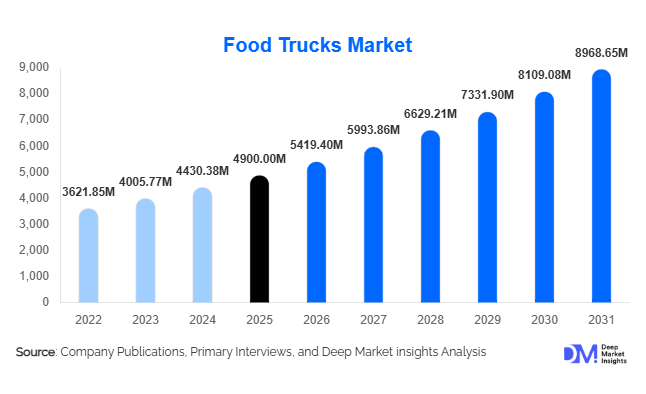
According to Deep Market Insights, the global food trucks market size was valued at USD 4,900 million in 2025 and is projected to grow from USD 5,419.40 million in 2026 to reach USD 8,968.65 million by 2031, expanding at a CAGR of 10.6% during the forecast period (2026–2031). The food trucks market growth is primarily driven by rising urbanization, increasing consumer demand for affordable gourmet dining experiences, and the growing adoption of flexible foodservice business models. Food trucks have evolved from informal street vending operations into organized mobile kitchens supported by digital payments, delivery integrations, and advanced kitchen technologies. Lower startup costs compared to traditional restaurants, combined with strong social media visibility and experiential dining trends, continue to attract entrepreneurs and restaurant brands globally. Increasing participation in festivals, corporate catering, and tourism-driven events further strengthens revenue streams, positioning food trucks as a scalable and resilient segment within the global quick-service restaurant ecosystem.
Key Market Insights
- Food trucks are transitioning toward organized mobile foodservice businesses, supported by digital ordering, cashless payments, and analytics-driven operations.
- Urban business districts and event-based dining remain the largest demand centers due to high consumer footfall and predictable meal-time traffic.
- North America dominates the global market, supported by mature street food culture and structured regulatory frameworks.
- Asia-Pacific is the fastest-growing region, fueled by youth entrepreneurship, urban expansion, and rising middle-class consumption.
- Electric and sustainable food trucks are emerging as cities introduce emission regulations and environmental incentives.
- Technology adoption, including mobile POS systems, location tracking, and delivery platform integration, is improving operational efficiency and profitability.
What are the latest trends in the food trucks market?
Gourmet Street Food and Experiential Dining Expansion
Consumers increasingly seek unique culinary experiences rather than standardized restaurant dining, driving the popularity of gourmet food trucks. Vendors are offering fusion cuisine, vegan menus, and chef-led concepts that combine affordability with premium quality. Food trucks have become central attractions at festivals, night markets, and cultural events, transforming street dining into a social experience. Social media platforms play a critical role in customer acquisition, allowing operators to announce locations, promote limited menus, and build loyal communities. This experiential trend is encouraging restaurant brands to deploy food trucks as extensions of their core business to test new concepts before investing in permanent outlets.
Technology-Enabled Mobile Food Operations
Technology integration is reshaping operational models across the food trucks industry. Mobile ordering applications, QR-based payments, GPS location tracking, and cloud-based POS systems allow operators to optimize routes and reduce wait times. Delivery platform partnerships enable food trucks to generate revenue even when stationary, expanding reach beyond physical footfall. Data analytics tools help vendors forecast demand, manage inventory, and adjust menus dynamically. Digital engagement, including loyalty programs and app-based promotions, is improving customer retention and increasing repeat purchases, particularly among younger urban consumers.
What are the key drivers in the food trucks market?
Lower Capital Investment Compared to Traditional Restaurants
Food trucks require significantly lower upfront investment than brick-and-mortar restaurants, typically costing only a fraction of conventional restaurant setup expenses. This affordability lowers entry barriers for entrepreneurs and small businesses, encouraging rapid market expansion. Operators benefit from reduced rental expenses, flexible operating locations, and scalable business models, enabling faster return on investment. Economic uncertainty in many regions has further strengthened demand for lower-risk hospitality ventures.
Growth of Urban Street Food Culture
Urban consumers increasingly favor fast, affordable, and authentic food options, contributing to strong demand for mobile kitchens. Food festivals, corporate gatherings, and tourism activities have expanded consumption occasions beyond traditional lunch and dinner hours. Younger demographics value variety and convenience, driving frequent visits to food truck hubs and curated street food markets. Municipal governments are also supporting organized vending zones, improving infrastructure and legitimizing operations.
What are the restraints for the global market?
Regulatory and Licensing Complexities
Regulations governing food truck operations vary widely across cities and countries, creating operational challenges for fleet expansion. Restrictions on parking zones, operating hours, and permit approvals can limit scalability. Compliance costs related to health certifications, inspections, and local regulations remain a barrier for small operators entering new markets.
Operational and Weather Dependency Risks
Unlike fixed restaurants, food trucks rely heavily on outdoor environments, making revenues vulnerable to adverse weather conditions and seasonal fluctuations. Limited storage space and logistical constraints also restrict menu diversity and operational efficiency. These factors can lead to inconsistent revenue streams compared to traditional foodservice establishments.
What are the key opportunities in the food trucks industry?
Electrification and Sustainable Mobile Kitchens
The shift toward sustainability presents strong growth opportunities as cities implement emission reduction policies. Electric and hybrid food trucks reduce fuel costs and align with environmental regulations, improving long-term operating economics. Sustainability-focused branding also appeals to environmentally conscious consumers, enhancing competitive differentiation.
Digital Ecosystem and Delivery Integration
Integration with delivery platforms and mobile applications allows food trucks to operate hybrid models combining street sales with online orders. This improves asset utilization and stabilizes revenues during off-peak hours. Data-driven route optimization and predictive analytics further enhance efficiency, enabling operators to identify high-demand locations and maximize sales potential.
Report Scope
| Report Metric | Details |
|---|---|
| Market Size in 2025 | USD 4900 Million |
| Market Size in 2026 | USD 5419.40 Million |
| Market Size in 2031 | USD 8968.65 Million |
| CAGR | 10.6% (2026-2031) |
| Base Year for Estimation | 2025 |
| Historical Data | 2022-2024 |
| Forecast Period | 2026-2031 |
| Report Coverage | Revenue Forecast, Competitive Landscape, Supply Chain Disruption, Growth Factors, Environment & Regulatory Landscape and Trends |
| Geographies Covered | North America, Europe, APAC, Middle East and Africa, LATAM |
| Countries Covered | U.S., Canada, U.K., Germany, France, Spain, Italy, Russia, Nordic, Benelux, Rest of Europe, China, Korea, Japan, India, Australia, Singapore, Taiwan, South East Asia, Rest of Asia-Pacific, UAE, Turky, Saudi Arabia, South Africa, Egypt, Nigeria, Rest of MEA, Brazil, Mexico, Argentina, Chile, Colombia, Rest of LATAM |
Explore more data points, trends and opportunities Download Free Sample Report
Product Type Insights
The motorized food truck segment continues to account for the largest share of the global food trucks market, primarily driven by its superior operational mobility, scalability, and revenue optimization capabilities. Motorized trucks enable vendors to strategically relocate based on consumer footfall patterns, seasonal demand fluctuations, and event-based opportunities, allowing operators to maximize daily sales across multiple locations. The growing integration of advanced kitchen equipment, digital payment infrastructure, and GPS-enabled location tracking further strengthens the operational efficiency of motorized units. Additionally, increasing participation in food festivals, urban pop-up markets, and corporate events has reinforced the dominance of fully equipped mobile kitchens capable of delivering restaurant-quality food in diverse environments.Food trailers are witnessing significant adoption, particularly among catering-focused operators and businesses requiring expanded cooking capacity without the higher acquisition cost associated with motorized vehicles. The segment’s growth is largely supported by demand for large-scale event catering, weddings, and private functions where stationary operations are sufficient and cost efficiency becomes a critical advantage. Trailers also allow restaurant operators to extend kitchen operations during peak demand periods, serving as auxiliary cooking facilities that enhance production volume and service speed.Push carts and mobile kiosks continue to maintain relevance across developing economies and densely populated urban centers where regulatory frameworks favor smaller mobile units. The leading growth driver for this segment is affordability, enabling first-time entrepreneurs and small-scale vendors to enter the organized foodservice ecosystem with minimal capital investment. These formats are particularly effective in transit hubs, markets, and pedestrian-heavy commercial zones, supporting micro-entrepreneurship while gradually transitioning informal street food vendors into structured business models.
Application Insights
Quick-service food operations represent the leading application segment within the global food trucks market, driven by rising consumer preference for convenient, fast, and affordable meal options. The primary growth driver for this segment is high customer turnover supported by standardized menus, streamlined food preparation processes, and optimized service models that reduce waiting times. Urban lifestyles characterized by busy work schedules and increasing on-the-go consumption habits continue to accelerate demand for mobile quick-service concepts, positioning food trucks as competitive alternatives to traditional quick-service restaurants.Event catering applications are expanding rapidly as food trucks become integral components of experiential dining environments. Large-scale festivals, corporate gatherings, weddings, and cultural events increasingly prefer mobile vendors due to their flexibility, thematic customization, and ability to serve diverse cuisines simultaneously. The growth of entertainment-driven consumer spending and outdoor social events has significantly strengthened this application segment, creating stable revenue streams for operators through pre-booked engagements.Gourmet and fusion cuisine applications are gaining strong traction among urban millennials and Gen Z consumers seeking unique culinary experiences that combine premium ingredients with creative presentation. Food trucks provide chefs with a lower-risk platform to experiment with innovative menu concepts compared to traditional restaurant investments. This trend is further supported by social media influence, where visually appealing dishes drive organic marketing and customer engagement.Beverage-focused trucks specializing in coffee, specialty beverages, desserts, and artisanal drinks are emerging as high-margin niche applications. Growth in this segment is driven by increasing café culture adoption, rising demand for specialty beverages, and comparatively lower operational complexity compared to full-scale kitchens. These mobile beverage units benefit from flexible placement near offices, universities, and entertainment districts, allowing consistent daily demand generation.
Distribution Channel Insights
Direct walk-up sales remain the dominant distribution channel globally, supported by impulse purchasing behavior and the experiential appeal of street-side dining. The leading driver for this channel is immediate customer interaction, which enhances brand visibility, builds loyalty, and enables operators to adjust menus dynamically based on consumer feedback. Strategic placement in high-footfall areas such as business districts, tourist zones, and nightlife clusters continues to sustain strong revenue generation through physical sales.Online delivery platforms are increasingly transforming the operational landscape of food truck businesses by extending service reach beyond geographic limitations. Integration with food delivery applications allows operators to maintain consistent order volumes even during off-peak foot traffic periods. Digital ordering systems also improve operational forecasting and inventory management, supporting profitability and reducing food waste.Corporate catering contracts and long-term event partnerships are becoming essential distribution avenues that provide predictable income streams and operational stability. Businesses increasingly collaborate with food truck operators to offer rotating dining options for employees, enhancing workplace experiences without investing in permanent foodservice infrastructure.Social media-driven discovery channels play a crucial role in customer acquisition, enabling small and independent vendors to compete effectively with established brands. Platforms focused on location updates, menu promotions, and influencer collaborations significantly enhance customer engagement while reducing reliance on traditional advertising expenditure.
End-User Insights
Independent entrepreneurs represent the largest end-user segment, supported by relatively low entry barriers, flexible operating models, and growing interest in culinary entrepreneurship. The leading driver for this segment is the ability to launch food businesses with substantially lower capital investment compared to brick-and-mortar restaurants while maintaining creative and operational independence. Increasing availability of financing programs, shared commissary kitchens, and digital marketing tools further accelerates entrepreneur participation globally.Restaurant chains are increasingly deploying food trucks as strategic brand extension and market-testing platforms. Mobile units allow established foodservice brands to experiment with new geographic markets, promote limited-time menu offerings, and strengthen customer engagement through experiential marketing campaigns. This approach minimizes expansion risk while providing valuable consumer insights prior to permanent restaurant investments.Event management companies are emerging as one of the fastest-growing end users, leveraging food trucks to enhance event personalization and diversify catering options. The rising popularity of themed events and experiential entertainment formats has strengthened collaboration between organizers and mobile food vendors.Institutional buyers, including corporate campuses, universities, hospitals, and technology parks, are increasingly adopting mobile foodservice solutions to deliver diverse dining choices without incurring infrastructure development costs. Rotational food truck programs improve employee and student satisfaction while enabling institutions to maintain operational flexibility.
Explore more data points, trends and opportunities Download Free Sample Report
Food Trucks Market Segmentations
By Vehicle Type
- Motorized Food Trucks
- Food Trailers
- Push Carts Mobile Kiosks
- Electric Hybrid Food Trucks
By Cuisine Type
- Fast Food Street Food
- Gourmet Fusion Cuisine
- Beverage Dessert Trucks
- Ethnic Regional Cuisine
- Vegan Health-Focused Menus
By Application
- Street Urban Retail Vending
- Corporate Institutional Catering
- Festivals Event Catering
- Tourism Entertainment Locations
- Private Functions Weddings
By Distribution Channel
- Direct Walk-Up Sales
- Online Delivery Platforms
- Corporate Contracts
- Event Partnerships
- Social Media App-Based Ordering
By End User
- Entrepreneurs SMEs
- Quick Service Restaurant Brands
- Event Management Companies
- Institutional Buyers
Regional Insights
North America
North America continues to lead the global food trucks market, accounting for approximately 38% of total demand, supported by a mature mobile dining ecosystem and strong consumer acceptance of street food culture. The United States remains the dominant contributor due to favorable municipal policies, established licensing frameworks, and high participation in organized food truck events. Regional growth is primarily driven by increasing consumer demand for convenience dining, expansion of urban food truck parks, and rising adoption of digital ordering technologies. Cities such as Los Angeles, Austin, and New York function as innovation hubs where culinary experimentation and multicultural cuisine offerings attract diverse customer bases. Additionally, growing preference for small-format dining businesses among entrepreneurs, coupled with strong festival and entertainment industries, continues to sustain regional expansion. Canada demonstrates steady growth fueled by tourism-driven consumption, seasonal festivals, and urban revitalization initiatives that encourage outdoor dining experiences.
Europe
Europe accounts for nearly 20% of global market share, led by the United Kingdom, Germany, and France. Regional growth is driven by expanding tourism activity, increasing popularity of outdoor markets, and a strong cultural inclination toward street-based culinary experiences. Regulatory modernization across several European cities has simplified licensing processes, encouraging new operators to enter the market. Sustainability trends play a significant role in regional adoption, with consumers increasingly favoring eco-friendly food trucks utilizing energy-efficient equipment, biodegradable packaging, and locally sourced ingredients. The expansion of organized street food festivals and seasonal markets across urban centers continues to strengthen demand while supporting artisanal and gourmet food concepts.
Asia-Pacific
Asia-Pacific represents the fastest-growing regional market, holding approximately 27% share in 2025, driven by rapid urbanization, expanding middle-class populations, and rising youth entrepreneurship. Regional growth is strongly supported by increasing disposable incomes, evolving consumer lifestyles, and widespread adoption of digital payment and food delivery platforms. Countries such as India, China, South Korea, and Thailand are witnessing accelerated adoption as food trucks offer scalable business opportunities aligned with startup ecosystems. India is emerging as a high-growth market due to expanding metropolitan populations, growing café and street food culture formalization, and supportive state-level entrepreneurship initiatives. Additionally, social media influence and demand for global cuisines among younger consumers continue to drive innovation across the region.
Latin America
Latin America holds approximately 7% market share, with Brazil and Mexico leading regional adoption. Growth is primarily driven by the formalization of traditional street food culture into organized mobile foodservice businesses. Increasing tourism activity, urban cultural events, and rising middle-class spending on dining experiences are strengthening market expansion. Government initiatives supporting small businesses and culinary entrepreneurship are encouraging vendors to transition toward licensed food truck operations. The growing presence of music festivals, sports events, and public entertainment gatherings further enhances demand for flexible catering solutions.
Middle East & Africa
The Middle East & Africa region accounts for nearly 8% of global demand, led by strong adoption in the United Arab Emirates and Saudi Arabia. Regional growth is driven by economic diversification strategies focused on tourism, entertainment, and hospitality development. Large-scale events, cultural festivals, and destination-based entertainment zones create strong demand for mobile food vendors capable of serving high visitor volumes efficiently. Government-backed SME development programs and entrepreneurship initiatives are lowering entry barriers for new operators, while increasing urbanization and a young consumer demographic support sustained long-term growth. Expanding mall precincts, waterfront developments, and outdoor leisure destinations across major cities are expected to further accelerate food truck adoption throughout the forecast period.
Key Players in the Food Trucks Market
- Roaming Hunger
- Best Food Trucks
- Prestige Food Trucks
- M&R Specialty Trailers and Trucks
- United Food Truck United LLC
- The Fud Trailer Company
- VS Veicoli Speciali
- Food Truck Company Netherlands
- Cruising Kitchens
- Legion Food Trucks
- Southwest Mobile Storage
- Quality Food Trucks
- Futuristo Trailers
- MSM Catering Trucks
- Shanghai Silang Industrial Equipment