Food Traceability Market Size
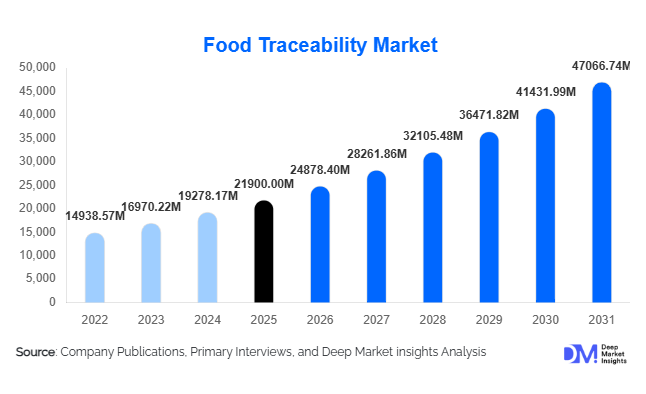
According to Deep Market Insights, the global food traceability market size was valued at USD 21,900 million in 2025 and is projected to grow from USD 24,878.40 million in 2026 to reach USD 47,066.74 million by 2031, expanding at a CAGR of 13.6% during the forecast period (2026–2031). The food traceability market growth is primarily driven by increasing regulatory mandates for food safety, rising consumer demand for transparency, and rapid adoption of digital technologies such as blockchain, IoT, and cloud-based supply chain platforms.
Key Market Insights
- Food traceability systems are transitioning from compliance-driven tools to strategic assets, enabling real-time visibility and supply chain optimization.
- Blockchain and IoT technologies are gaining rapid adoption, offering enhanced transparency, fraud prevention, and real-time monitoring.
- North America dominates the global market, supported by stringent regulatory frameworks and advanced technological infrastructure.
- Asia-Pacific is the fastest-growing region, driven by increasing exports, regulatory reforms, and supply chain modernization.
- Cloud-based traceability platforms are witnessing strong uptake, particularly among SMEs due to cost efficiency and scalability.
- Rising global food trade and export compliance requirements are significantly boosting demand for traceability solutions.
What are the latest trends in the food traceability market?
Blockchain-Enabled Transparency Transforming Supply Chains
Blockchain technology is increasingly being integrated into food traceability systems to provide immutable and transparent records across the supply chain. This technology ensures that every transaction, from farm to fork, is securely recorded and accessible to all stakeholders. Companies are leveraging blockchain to prevent food fraud, enhance recall efficiency, and strengthen consumer trust. Retailers and food brands are also enabling QR code-based product tracking, allowing consumers to verify origin, quality, and sustainability credentials. Partnerships between technology providers and food companies are accelerating blockchain adoption, particularly in export-oriented supply chains where traceability verification is critical for regulatory compliance.
IoT and Smart Monitoring Driving Real-Time Traceability
The integration of IoT sensors and smart devices is revolutionizing food traceability by enabling real-time monitoring of temperature, humidity, and transportation conditions. This is particularly crucial for perishable goods such as seafood, dairy, and fresh produce. Smart packaging solutions and connected logistics systems are improving visibility and reducing spoilage. Companies are increasingly adopting predictive analytics powered by IoT data to optimize supply chains and reduce waste. Mobile-based traceability platforms are also enhancing accessibility, allowing stakeholders to track products and manage inventory seamlessly across multiple locations.
What are the key drivers in the food traceability market?
Stringent Food Safety Regulations
Governments across the globe are implementing strict food safety regulations to ensure public health and prevent contamination incidents. Regulatory frameworks mandate end-to-end traceability, compelling food manufacturers, retailers, and logistics providers to adopt advanced systems. These regulations are particularly stringent in developed regions, driving widespread adoption and technological innovation in traceability solutions.
Rising Incidence of Food Fraud and Contamination
The increasing frequency of food recalls and contamination cases has heightened the need for robust traceability systems. Companies are investing in traceability to mitigate risks, protect brand reputation, and reduce financial losses. The ability to quickly identify and isolate affected products is becoming a critical requirement in modern food supply chains.
Growing Consumer Demand for Transparency
Consumers are increasingly demanding information about the origin, quality, and sustainability of food products. This shift in consumer preference is driving companies to adopt traceability solutions that provide detailed product information. Transparency is becoming a key differentiator, influencing purchasing decisions and brand loyalty.
What are the restraints for the global market?
High Implementation Costs
The adoption of advanced traceability technologies such as blockchain and IoT requires significant investment in infrastructure, integration, and maintenance. This poses a challenge, particularly for small and medium enterprises, limiting widespread adoption in cost-sensitive markets.
Lack of Standardization Across Regions
Variations in regulatory requirements and traceability standards across countries create interoperability challenges. The absence of unified global standards complicates data sharing and integration, hindering seamless implementation across international supply chains.
What are the key opportunities in the food traceability industry?
Expansion in Emerging Markets
Developing regions such as Asia-Pacific, Latin America, and Africa present significant growth opportunities due to increasing food exports and regulatory reforms. Governments are investing in food safety infrastructure, creating demand for traceability solutions. Export-oriented industries in these regions are adopting traceability systems to meet international standards, driving market expansion.
Integration with Advanced Technologies
The convergence of blockchain, artificial intelligence, and IoT is opening new avenues for innovation in food traceability. These technologies enable predictive analytics, automated compliance, and enhanced supply chain efficiency. Companies leveraging these technologies are gaining a competitive advantage by offering value-added services beyond basic traceability.
Growth of Cold Chain and Logistics Infrastructure
The rapid expansion of cold chain logistics, particularly in emerging markets, is creating demand for real-time monitoring and traceability solutions. Investments in smart warehouses and temperature-controlled transportation are driving adoption, especially for perishable food segments.
Report Scope
| Report Metric | Details |
|---|---|
| Market Size in 2025 | USD 21900.00 Million |
| Market Size in 2026 | USD 24878.40 Million |
| Market Size in 2031 | USD 47066.74 Million |
| CAGR | 13.6% (2026-2031) |
| Base Year for Estimation | 2025 |
| Historical Data | 2022-2024 |
| Forecast Period | 2026-2031 |
| Report Coverage | Revenue Forecast, Competitive Landscape, Supply Chain Disruption, Growth Factors, Environment & Regulatory Landscape and Trends |
| Geographies Covered | North America, Europe, APAC, Middle East and Africa, LATAM |
| Countries Covered | U.S., Canada, U.K., Germany, France, Spain, Italy, Russia, Nordic, Benelux, Rest of Europe, China, Korea, Japan, India, Australia, Singapore, Taiwan, South East Asia, Rest of Asia-Pacific, UAE, Turky, Saudi Arabia, South Africa, Egypt, Nigeria, Rest of MEA, Brazil, Mexico, Argentina, Chile, Colombia, Rest of LATAM |
Explore more data points, trends and opportunities Download Free Sample Report
Technology Type Insights
Barcodes continue to dominate the technology segment, accounting for approximately 32% of the global market share in 2025, primarily due to their cost-efficiency, simplicity, and well-established integration across supply chains. Their widespread adoption across both developed and emerging markets is driven by minimal infrastructure requirements and compatibility with legacy systems, making them particularly attractive for small and medium-sized enterprises that seek affordable traceability solutions. Barcodes enable basic tracking and identification functions, which remain essential for inventory control, logistics coordination, and regulatory compliance. Despite their limitations in terms of data storage and real-time capabilities, they retain strong relevance due to their scalability and ease of implementation.However, the market is undergoing a technological transition as advanced solutions such as RFID (Radio Frequency Identification), blockchain, and IoT-based traceability systems gain traction. RFID technology is witnessing increased adoption owing to its ability to provide automated, non-line-of-sight tracking and enhanced data accuracy. This technology significantly reduces human error and improves operational efficiency, particularly in large-scale logistics and warehousing operations. Meanwhile, blockchain is emerging as a transformative force, offering immutable and transparent records across the supply chain. Its ability to enhance trust, prevent fraud, and enable end-to-end visibility is driving adoption among stakeholders seeking secure and verifiable traceability systems.IoT-based systems are rapidly evolving as a high-growth segment, especially in cold chain logistics and perishable food supply chains. The leading driver for this segment is the growing need for real-time monitoring and data analytics to maintain product quality, ensure compliance with food safety standards, and reduce spoilage. IoT-enabled sensors allow continuous tracking of temperature, humidity, and environmental conditions, enabling proactive decision-making and minimizing risks associated with product degradation. As global food supply chains become increasingly complex, the integration of IoT with cloud platforms and analytics tools is expected to redefine traceability standards, driving significant growth in this segment over the forecast period.
Application Insights
Product tracking and tracing represent the leading application segment, holding around 30% of the market share. The primary driver behind this dominance is its critical role in ensuring regulatory compliance and enabling efficient recall management. Governments and regulatory bodies across the globe are enforcing stricter food safety standards, requiring companies to maintain detailed records of product movement across the supply chain. This has made tracking and tracing systems indispensable for food manufacturers, distributors, and retailers. The ability to quickly identify the source of contamination and execute targeted recalls not only minimizes financial losses but also protects brand reputation and consumer trust.In addition to compliance, businesses are increasingly leveraging tracking and tracing solutions to enhance operational efficiency and supply chain transparency. These systems provide real-time insights into inventory levels, shipment status, and product origin, enabling better decision-making and resource optimization. As supply chains become more globalized, the importance of seamless data exchange and interoperability between stakeholders continues to grow, further reinforcing the demand for advanced traceability applications.Supply chain visibility applications are also witnessing increased adoption as organizations strive to achieve end-to-end transparency. Enhanced visibility enables stakeholders to track products at every stage, identify bottlenecks, and improve coordination across the supply chain. The growing emphasis on sustainability and ethical sourcing is further driving the demand for visibility solutions, as consumers increasingly seek information about product origin and production practices.Recall management solutions are experiencing notable growth due to the rising frequency of food safety incidents and the associated regulatory scrutiny. The leading driver for this segment is the need to minimize the impact of recalls by enabling rapid identification and removal of affected products from the market. Advanced recall management systems leverage real-time data and analytics to streamline recall processes, reduce response times, and ensure compliance with regulatory requirements. As food safety concerns continue to rise, the adoption of these solutions is expected to accelerate significantly.
Deployment Mode Insights
Cloud-based deployment leads the market with approximately 55% share, driven by its scalability, flexibility, and cost-effectiveness. The leading driver for this segment is the increasing demand for accessible and integrated traceability solutions that can be deployed بسرعة without significant capital investment. Cloud platforms enable organizations to store and process large volumes of data, facilitate real-time collaboration among stakeholders, and integrate seamlessly with existing systems. This makes them particularly attractive for small and medium-sized enterprises, which often lack the resources to invest in complex on-premise infrastructure.The adoption of cloud-based solutions is further supported by advancements in cybersecurity and data protection, which have addressed many concerns related to data privacy and system reliability. Additionally, cloud deployment enables continuous updates and scalability, allowing businesses to adapt to changing regulatory requirements and market dynamics. As digital transformation accelerates across industries, cloud-based traceability systems are expected to remain the preferred choice for organizations seeking agility and innovation.On-premise solutions, while accounting for a smaller share, continue to be preferred by large enterprises that require greater control over their data and systems. These solutions offer higher levels of customization and security, making them suitable for organizations with complex operational requirements and stringent compliance standards. Industries with sensitive data or strict regulatory environments often opt for on-premise deployment to ensure complete control over their infrastructure. Despite the growing popularity of cloud solutions, the demand for on-premise systems is expected to remain steady, particularly among established players with significant IT investments.
End-Use Insights
Food manufacturers dominate the end-use segment with around 34% market share, driven by their central role in ensuring product quality, safety, and compliance. The leading driver for this segment is the increasing regulatory pressure to maintain comprehensive traceability records and adhere to stringent food safety standards. Manufacturers are responsible for multiple stages of the production process, making traceability systems essential for monitoring raw materials, processing conditions, and finished products. The adoption of advanced technologies enables manufacturers to enhance efficiency, reduce waste, and ensure consistent product quality.Retailers and supermarkets are among the fastest-growing segments, fueled by rising consumer demand for transparency and accountability. Modern consumers are increasingly interested in understanding the origin, production methods, and safety of the products they purchase. This has prompted retailers to invest in traceability systems that provide detailed product information and enhance customer trust. Additionally, traceability solutions help retailers optimize inventory management, reduce shrinkage, and improve overall operational efficiency.Logistics and cold chain providers are also witnessing strong growth, supported by the expansion of global food trade and the increasing demand for temperature-sensitive products. The leading driver for this segment is the need for real-time monitoring and control of environmental conditions to ensure product integrity במהלך transportation and storage. Advanced traceability systems equipped with IoT sensors and analytics tools enable logistics providers to maintain optimal conditions, minimize spoilage, and comply with regulatory requirements. As global supply chains continue to expand, the role of logistics and cold chain providers in ensuring product quality and safety is becoming increasingly critical.
Explore more data points, trends and opportunities Download Free Sample Report
Food Traceability Market Segmentations
By Technology Type
- Barcodes
- RFID
- Blockchain Technology
- IoT & Sensors
- GPS & NFC Technologies
- Cloud-Based Traceability Platforms
By Application
- Product Tracking & Tracing
- Quality Monitoring
- Supply Chain Visibility
- Recall Management
- Compliance & Certification
By End-Use Industry
- Food Manufacturers
- Retailers & Supermarkets
- Food Service Providers
- Logistics & Cold Chain Providers
- Government & Regulatory Bodies
Regional Insights
North America
North America holds the largest share of the food traceability market, accounting for approximately 34% in 2025. The United States dominates the region, driven by stringent food safety regulations and a high level of technological adoption. Key regulatory frameworks such as the Food Safety Modernization Act (FSMA) have mandated comprehensive traceability systems, compelling companies to invest in advanced solutions. The region’s strong technological infrastructure and presence of major industry players further support market growth. Canada also contributes significantly, benefiting from robust regulatory standards and increasing consumer demand for transparency. Additionally, the growing focus on sustainability, digital transformation, and supply chain optimization continues to drive adoption across the region.Another important driver in North America is the high incidence of food recalls, which has heightened awareness among stakeholders regarding the importance of traceability systems. Companies are increasingly adopting technologies such as blockchain and IoT to enhance visibility and ensure rapid response to safety incidents. The region’s advanced retail sector and strong e-commerce growth are also contributing to increased demand for traceability solutions, as businesses strive to meet evolving consumer expectations.
Europe
Europe accounts for around 28% of the global market, with countries such as Germany, France, and the United Kingdom leading adoption. The region’s strict food safety standards and well-established regulatory framework are key drivers of market growth. The European Union has implemented comprehensive traceability requirements, mandating that all food products be traceable at every stage of the supply chain. This has created a strong foundation for the widespread adoption of traceability technologies.High consumer awareness and demand for transparency are also significant growth drivers in Europe. Consumers are increasingly concerned about food quality, origin, and sustainability, prompting companies to invest in advanced traceability systems. The region’s focus on sustainability and environmental responsibility further supports market expansion, as traceability solutions enable better monitoring of resource usage and waste reduction. Additionally, the growing adoption of digital technologies and Industry 4.0 initiatives is driving innovation in traceability systems, positioning Europe as a key market for advanced solutions.
Asia-Pacific
Asia-Pacific is the fastest-growing region, with a CAGR exceeding 15%, driven by rapid economic development, increasing food exports, and ongoing supply chain modernization. China and India are major contributors, benefiting from large agricultural sectors and expanding food processing industries. Government initiatives aimed at improving food safety standards and enhancing regulatory frameworks are playing a crucial role in driving adoption. The increasing frequency of food safety incidents in the region has also heightened awareness and accelerated the implementation of traceability systems.Technological advancements and digital transformation are key drivers in Asia-Pacific, with countries such as Japan and Australia leading the adoption of advanced solutions. The region’s growing middle-class population and rising disposable incomes are driving demand for high-quality and safe food products, further supporting market growth. Additionally, the expansion of e-commerce and cross-border trade is increasing the complexity of supply chains, necessitating the adoption of robust traceability systems to ensure efficiency and compliance.
Latin America
Latin America holds approximately 8% market share, with Brazil and Mexico emerging as key markets. The region’s expanding food export industry is a major driver of traceability adoption, as exporters must comply with international standards and regulations. Governments are increasingly focusing on improving food safety systems and strengthening regulatory frameworks, further supporting market growth.The modernization of supply chains and increasing investment in technology are also contributing to the adoption of traceability solutions in Latin America. As the region seeks to enhance its competitiveness in global markets, companies are investing in advanced technologies to improve efficiency, reduce waste, and ensure product quality. Additionally, growing consumer awareness and demand for transparency are driving the adoption of traceability systems across the region.
Middle East & Africa
The Middle East & Africa region accounts for nearly 6% of the market, with growth driven by increasing food imports and government initiatives to enhance food safety systems. Countries such as the United Arab Emirates and South Africa are leading adoption, supported by investments in supply chain infrastructure and technological advancements. The region’s reliance on imported food products has made traceability systems essential for ensuring quality and safety.Government regulations and initiatives aimed at improving food security and safety are key drivers in this region. Investments in smart logistics, cold chain infrastructure, and digital technologies are further supporting market growth. Additionally, the rising awareness among consumers regarding food quality and safety is prompting businesses to adopt advanced traceability solutions. As the region continues to develop its food supply chain capabilities, the demand for traceability systems is expected to grow steadily.
Key Players in the Food Traceability Market
- IBM Corporation
- SAP SE
- Oracle Corporation
- Honeywell International Inc.
- Zebra Technologies
- Cognex Corporation
- Optel Group
- SGS SA
- Bureau Veritas
- Intertek Group
- Trimble Inc.
- DNV Group
- FoodLogiQ
- Trace One
- TE Food International