Flour Market Size
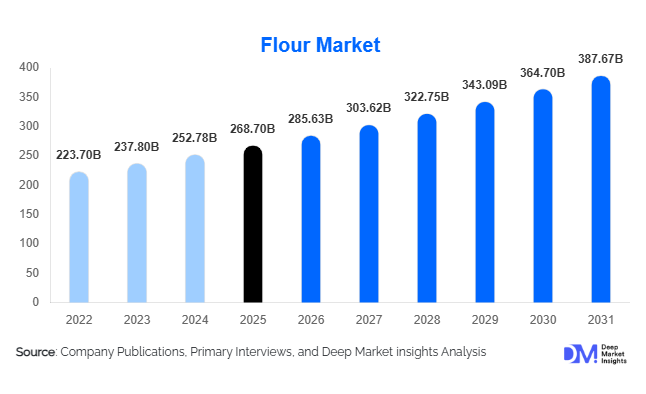
According to Deep Market Insights, the global flour market size was valued at USD 268.7 billion in 2025 and is projected to grow from USD 285.63 billion in 2026 to reach USD 387.67 billion by 2031, expanding at a CAGR of 6.3% during the forecast period (2026–2031). The flour market growth is primarily driven by increasing demand for bakery and convenience foods, rising consumption of processed and packaged products, and expanding applications of specialty flour in health-oriented food categories. Rapid urbanization, growth in foodservice industries, and increasing investments in industrial milling infrastructure are also supporting long-term market expansion globally.
Key Market Insights
- Wheat flour continues to dominate the global market, accounting for the largest share due to its extensive use in bread, bakery products, noodles, and processed foods.
- Specialty and gluten-free flour segments are expanding rapidly, supported by rising consumer preference for health-focused, clean-label, and protein-enriched products.
- Asia-Pacific dominates the global flour market, led by China and India owing to their large population base, rising packaged food consumption, and expanding food processing sectors.
- North America remains a leading premium flour market, driven by strong demand for organic, oat, almond, and high-fiber flour products.
- Government-led flour fortification initiatives are accelerating demand, particularly across Africa, Asia, and Latin America to improve nutritional security.
- Advanced milling technologies and automation are transforming production efficiency, improving quality consistency, reducing wastage, and supporting large-scale industrial food manufacturing.
Flour Market Latest Trends
Rising Demand for Functional and Specialty Flour
Consumer demand for healthier food ingredients is significantly reshaping the global flour market. Functional flour products such as oat flour, almond flour, chickpea flour, and multigrain flour are witnessing strong adoption due to increasing health awareness and growing concerns related to obesity, diabetes, and gluten sensitivity. Manufacturers are increasingly introducing protein-enriched, fiber-rich, and fortified flour formulations targeted toward health-conscious consumers and sports nutrition applications. Clean-label and minimally processed flour variants are also becoming more popular across developed economies, particularly in North America and Europe. Specialty flour is gaining traction in bakery, plant-based foods, and nutraceutical applications, enabling manufacturers to diversify beyond conventional wheat flour categories and improve profitability through premium pricing strategies.
Digitalization and Automation in Milling Operations
The flour industry is increasingly adopting automated milling systems, AI-driven grain quality assessment, and digital supply chain management technologies to improve production efficiency and operational scalability. Large flour manufacturers are investing in precision milling equipment, automated packaging lines, and smart inventory management systems to reduce wastage and ensure product consistency. Real-time grain monitoring and predictive procurement technologies are helping companies manage raw material volatility more effectively. Sustainability-focused innovations such as energy-efficient milling machinery and water-saving processing systems are also gaining importance as manufacturers seek to reduce operational costs and environmental impact. The integration of digital technologies across grain sourcing, processing, and distribution is expected to remain a major competitive differentiator over the forecast period.
Flour Market Drivers
Growing Consumption of Bakery and Convenience Foods
The rapid expansion of bakery, packaged food, and convenience meal industries is a major driver for the global flour market. Urbanization, changing dietary patterns, and increasingly busy lifestyles are boosting demand for bread, cakes, biscuits, pizza bases, instant noodles, frozen foods, and ready-to-cook meals. Industrial food manufacturers require high-volume flour supplies with consistent quality specifications, encouraging investments in modern milling infrastructure. Emerging economies across Asia-Pacific, Latin America, and Africa are witnessing substantial growth in packaged food consumption, further accelerating flour demand. Quick-service restaurants, café chains, and frozen bakery products are also contributing significantly to industrial flour consumption worldwide.
Rising Health Awareness and Gluten-Free Demand
Health-conscious consumers are increasingly seeking alternatives to refined wheat flour, driving demand for whole grain, organic, gluten-free, and protein-rich flour products. Specialty flour categories such as oat flour, almond flour, and chickpea flour are benefiting from rising adoption of functional foods and plant-based diets. The growing prevalence of celiac disease and gluten intolerance is also encouraging manufacturers to expand gluten-free product portfolios. Governments and food companies are simultaneously promoting fortified flour products enriched with vitamins, minerals, and dietary fiber to address nutritional deficiencies. This trend is expanding the role of flour beyond traditional staple foods into nutraceuticals, sports nutrition, and wellness-oriented applications.
Global Market Restraints
Volatility in Raw Material Prices
The flour market remains highly dependent on the pricing and availability of agricultural commodities such as wheat, corn, rice, and oats. Climate-related disruptions, geopolitical conflicts, fertilizer price inflation, and international trade restrictions continue to create volatility in global grain prices. These fluctuations directly impact flour production costs and profit margins for milling companies. Transportation and energy costs also contribute to pricing instability, particularly in import-dependent regions. Smaller manufacturers often struggle to absorb rising input costs, making raw material volatility one of the most significant challenges for long-term operational stability.
Shift Toward Low-Carbohydrate Diets
Increasing consumer preference for low-carbohydrate and grain-free dietary patterns presents a challenge for conventional flour products, particularly refined wheat flour. Health trends such as ketogenic diets and reduced carbohydrate consumption are influencing purchasing decisions across developed markets. Consumers are increasingly scrutinizing processed food ingredients and seeking alternative formulations perceived as healthier. This trend is encouraging manufacturers to reformulate products and diversify into functional flour categories. However, conventional flour producers may face slower growth rates in mature markets where health-focused dietary shifts continue to gain momentum.
Flour Industry Key Opportunities
Expansion of Flour Fortification Programs
Government-backed flour fortification initiatives are creating significant growth opportunities for flour manufacturers globally. Countries across Africa, Asia, and Latin America are implementing mandatory fortification regulations involving iron, folic acid, zinc, and vitamins to combat malnutrition and micronutrient deficiencies. These programs are generating consistent institutional demand from public procurement agencies, school feeding programs, and food security initiatives. Manufacturers investing in advanced fortification technologies and nutrient-retention systems are expected to benefit from long-term demand growth. Fortified flour products are also gaining acceptance among health-conscious consumers seeking enhanced nutritional value in staple foods.
Emerging Demand from Processed Food Industries
The rapid expansion of food processing industries in emerging economies presents substantial opportunities for industrial flour suppliers. Countries such as India, Indonesia, Vietnam, Nigeria, and Brazil are experiencing strong growth in packaged bakery products, frozen foods, noodles, and snack manufacturing. Rising disposable income and organized retail penetration are accelerating processed food consumption across urban populations. Flour manufacturers expanding production capacity in these high-growth regions can benefit from increasing industrial demand and favorable demographic trends. Investments in automated milling facilities and regional supply chain infrastructure are expected to support further market penetration and export-oriented growth strategies.
Report Scope
| Report Metric | Details |
|---|---|
| Market Size in 2025 | USD 268.70 Billion |
| Market Size in 2026 | USD 285.63 Billion |
| Market Size in 2031 | USD 387.67 Billion |
| CAGR | 6.3% (2026-2031) |
| Base Year for Estimation | 2025 |
| Historical Data | 2022-2024 |
| Forecast Period | 2026-2031 |
| Report Coverage | Revenue Forecast, Competitive Landscape, Supply Chain Disruption, Growth Factors, Environment & Regulatory Landscape and Trends |
| Geographies Covered | North America, Europe, APAC, Middle East and Africa, LATAM |
| Countries Covered | U.S., Canada, U.K., Germany, France, Spain, Italy, Russia, Nordic, Benelux, Rest of Europe, China, Korea, Japan, India, Australia, Singapore, Taiwan, South East Asia, Rest of Asia-Pacific, UAE, Turky, Saudi Arabia, South Africa, Egypt, Nigeria, Rest of MEA, Brazil, Mexico, Argentina, Chile, Colombia, Rest of LATAM |
Explore more data points, trends and opportunities Download Free Sample Report
Product Type Insights
Wheat flour dominates the global flour market, accounting for nearly 58% of total market revenue due to its extensive application across bakery products, noodles, pasta, and household cooking. Bread flour, all-purpose flour, and whole wheat flour remain the most widely consumed categories globally because of their functional versatility and affordability. Rice flour and corn flour are witnessing increasing demand in gluten-free and ethnic food applications, particularly across Asia-Pacific and Latin America. Specialty flour categories such as almond flour, coconut flour, oat flour, and chickpea flour are expanding rapidly due to rising consumer preference for health-oriented and high-protein foods. Multigrain and fortified flour products are also gaining traction as manufacturers respond to growing demand for nutritionally enhanced ingredients. Organic flour continues to emerge as a premium segment, particularly in North America and Europe where clean-label food consumption remains strong.
Application Insights
Bakery products remain the largest application segment within the flour market, contributing approximately 42% of global flour demand in 2025. Bread, cakes, biscuits, pastries, pizza bases, and frozen bakery items continue to drive large-scale industrial flour consumption worldwide. Noodles and pasta applications are expanding significantly across Asia-Pacific due to increasing convenience food demand and rising urban populations. Snacks and extruded food products are also emerging as important application areas as processed food manufacturers continue diversifying product portfolios. Flour demand from ready-to-eat meals and convenience foods is accelerating globally due to changing consumer lifestyles and increasing workforce participation. Functional flour applications in nutraceuticals, sports nutrition, and plant-based foods are witnessing strong momentum, particularly for oat, chickpea, and almond flour. Batter coatings and infant nutrition products also represent growing specialty application areas for premium flour manufacturers.
Distribution Channel Insights
B2B industrial sales dominate the global flour market, accounting for nearly 64% of total market revenue due to strong procurement demand from bakeries, packaged food manufacturers, restaurants, and institutional buyers. Large industrial food companies typically purchase flour in bulk quantities to support high-volume food production operations. Supermarkets and hypermarkets remain the leading retail channels for consumer flour sales, offering a broad range of conventional and specialty flour products. Online retail platforms are rapidly emerging as important distribution channels for premium flour categories, particularly organic and gluten-free variants. Direct supply agreements between millers and foodservice operators are increasing as restaurants and bakery chains seek consistent product quality and long-term pricing stability. Traditional grocery stores continue to play an important role in emerging economies where unorganized retail channels still account for significant household food purchases.
End-Use Industry Insights
The bakery industry remains the largest end-use sector for flour globally, accounting for approximately 39% of overall market demand. Industrial bakeries continue expanding production capacity to meet rising consumption of packaged bread, cakes, pastries, and biscuits across both developed and emerging economies. The packaged food industry is another major consumer of flour, particularly within frozen foods, ready-to-eat meals, noodles, and snack manufacturing applications. Foodservice and HoReCa industries are witnessing strong flour demand growth due to the expansion of café chains, quick-service restaurants, and pizza outlets globally. Household consumption remains stable across developing countries where flour-based staple foods continue to dominate daily diets. Nutraceutical and health food industries are increasingly incorporating specialty flour products such as oat flour, almond flour, and chickpea flour into sports nutrition, plant-based foods, and diabetic-friendly formulations.
Explore more data points, trends and opportunities Download Free Sample Report
Flour Market Segmentations
By Product Type
- Wheat Flour
- Rice Flour
- Corn Flour & Maize Flour
- Oat Flour
- Rye Flour
- Barley Flour
- Soy Flour
- Chickpea/Besan Flour
- Coconut Flour
- Almond Flour
- Cassava & Tapioca Flour
- Multigrain & Specialty Flour
By Nature
- Conventional Flour
- Organic Flour
- Non-GMO Flour
- Clean-Label Flour
By Application
- Bakery Products
- Noodles & Pasta
- Snacks & Extruded Foods
- Ready-to-Eat & Convenience Foods
- Batter & Coatings
- Infant Nutrition
- Animal Feed
- Industrial Food Processing
By Distribution Channel
- B2B Industrial Sales
- Supermarkets & Hypermarkets
- Convenience Stores
- Specialty Stores
- Online Retail
- Traditional Grocery Stores
By End-Use Industry
- Bakery Industry
- Packaged Food Industry
- Foodservice & HoReCa Industry
- Household Consumption
- Nutraceutical & Health Food Industry
- Animal Nutrition Industry
Regional Insights
Asia-Pacific
Asia-Pacific dominates the global flour market, accounting for nearly 39% of total market revenue in 2025. China and India represent the largest consumption centers due to their extensive population bases, rising processed food demand, and rapidly expanding bakery industries. China continues investing heavily in modern milling technologies and packaged food production, while India benefits from increasing demand for packaged atta, instant noodles, bakery products, and convenience foods. Southeast Asian countries including Indonesia, Vietnam, and Thailand are also witnessing strong flour demand growth due to urbanization and increasing organized retail penetration. Asia-Pacific is expected to remain the fastest-growing regional market during the forecast period.
North America
North America accounts for approximately 24% of the global flour market, supported by high bakery consumption and strong demand for specialty flour products. The United States dominates regional demand due to large-scale production of bread, frozen bakery products, pizza, cookies, and snack foods. Gluten-free and organic flour segments are witnessing substantial growth in both the United States and Canada due to increasing health awareness and clean-label food trends. Advanced milling infrastructure and technological adoption also contribute to strong operational efficiency across the regional flour industry.
Europe
Europe remains a mature but highly profitable flour market led by Germany, France, Italy, and the United Kingdom. The region accounts for nearly 22% of global market revenue due to strong artisanal bakery traditions and premium flour consumption patterns. Demand for whole grain, organic, and fortified flour products continues to rise across Western Europe as consumers increasingly prioritize nutritional quality and sustainable sourcing. Eastern European countries benefit from strong wheat production and export-oriented flour processing activities, supporting regional competitiveness in international grain trade.
Latin America
Latin America is experiencing steady flour market growth led by Brazil, Mexico, and Argentina. Increasing consumption of bakery products, tortillas, packaged snacks, and processed foods is driving regional flour demand. Brazil continues expanding industrial food manufacturing capacity, while Mexico remains a major consumer of corn flour and wheat flour products used in tortillas and bakery applications. Rising urbanization and changing dietary patterns are expected to support long-term market expansion across the region.
Middle East & Africa
The Middle East & Africa region represents one of the fastest-growing flour markets globally due to rising population growth, urban food consumption, and government-backed food security initiatives. Countries including Saudi Arabia, Egypt, Nigeria, and South Africa remain major flour-consuming markets. Several African countries have implemented mandatory flour fortification programs to improve public nutrition, supporting institutional demand growth. The Middle East continues to rely heavily on flour imports to meet domestic food requirements, creating substantial opportunities for international grain exporters and milling companies.
Key Players in the Flour Market
- Archer Daniels Midland Company
- Cargill Incorporated
- Ardent Mills
- General Mills
- Conagra Brands
- Associated British Foods
- Gruma
- King Arthur Baking Company
- Bay State Milling Company
- George Weston Limited
- Wilmar International
- Olam Group
- GoodMills Group
- Nisshin Seifun Group
- Hodgson Mill