Fermentation-Based Natural Vanillin Market Size
According to Deep Market Insights, the global fermentation-based natural vanillin market size was valued at USD 685 million in 2025 and is projected to grow from USD 748.71 million in 2026 to reach USD 1,167.92 million by 2031, expanding at a CAGR of 9.3% during the forecast period (2026–2031). The market growth is primarily driven by increasing clean-label demand, rising reformulation of food and beverage products to eliminate synthetic additives, and growing sustainability concerns associated with petrochemical-derived vanillin and volatile vanilla bean supply chains.
Key Market Insights
- Ferulic acid-based fermentation dominates production, accounting for nearly 48% of the 2025 market share due to scalable feedstock availability and stable yield efficiency.
- Food & beverage applications represent the largest demand segment, contributing approximately 67% of global revenue in 2025.
- Powder/crystalline vanillin leads by form, capturing nearly 55% share owing to superior stability and ease of formulation in bakery and dairy products.
- North America holds the largest regional share (32% in 2025), driven by strict clean-label standards and high processed food consumption.
- Asia-Pacific is the fastest-growing region, expanding at over 11% CAGR due to rising processed food production in China and India.
- Top five players collectively control approximately 54% of the global market, indicating moderate consolidation with strong competition in biotechnology innovation.
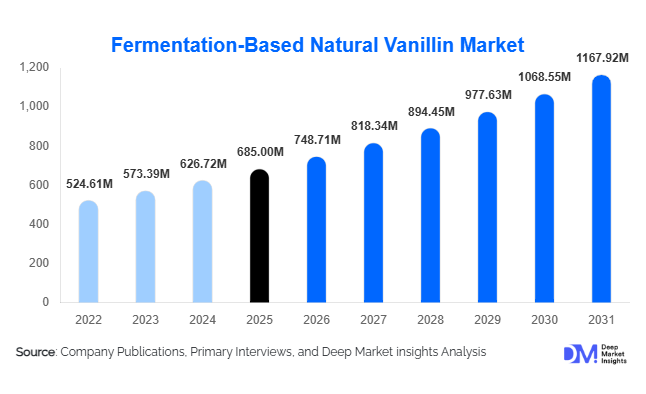
What are the latest trends in the fermentation-based natural vanillin market?
Precision Fermentation and Strain Engineering Advancements
Recent investments in microbial strain engineering and metabolic pathway optimization are significantly improving vanillin yield per substrate unit. Biotechnology firms are deploying CRISPR-enabled yeast and bacterial strains to enhance productivity and reduce impurity formation. This technological shift is lowering production costs by 15–20%, narrowing the price gap with synthetic vanillin. Continuous fermentation systems and bioreactor automation are also improving scalability and operational efficiency, making large-volume production more commercially viable for multinational flavor houses.
Clean-Label Reformulation Across FMCG Portfolios
Major global food manufacturers are actively reformulating product lines to replace artificial flavors with naturally derived alternatives. Fermentation-based vanillin qualifies as “natural flavor” under U.S. and EU regulations, making it a strategic replacement ingredient in bakery, confectionery, beverages, and dairy alternatives. Private-label brands are increasingly adopting natural vanillin to strengthen premium positioning. This trend is particularly evident in plant-based beverages and protein products where vanillin is used to mask off-notes while maintaining natural claims.
What are the key drivers in the fermentation-based natural vanillin market?
Rising Clean-Label and Regulatory Compliance Requirements
Consumer preference for natural ingredients has accelerated demand for fermentation-based vanillin. Over 60% of new premium bakery launches globally emphasize natural flavor labeling. Regulatory scrutiny on synthetic additives has further encouraged food manufacturers to shift toward fermentation-derived alternatives, reinforcing long-term demand growth.
Volatility in Natural Vanilla Bean Prices
Vanilla bean cultivation is concentrated in limited geographies and remains highly vulnerable to climatic disruptions and geopolitical instability. Price fluctuations exceeding 40% in certain years have pushed manufacturers to seek stable supply alternatives. Fermentation-based vanillin offers predictable pricing and supply security while maintaining natural labeling status.
Sustainability and ESG Commitments
Corporate ESG frameworks are influencing ingredient sourcing decisions. Fermentation-based vanillin reduces reliance on land-intensive vanilla cultivation and petrochemical feedstocks. Lower carbon footprint and scalable production make it attractive to global FMCG companies committed to sustainability reporting and carbon neutrality targets.
What are the restraints for the global market?
Higher Cost Compared to Synthetic Vanillin
Despite technological improvements, fermentation-based vanillin remains 2–3 times more expensive than petrochemical-derived alternatives. This price premium limits adoption in cost-sensitive emerging markets and low-margin product categories.
Regulatory and Labeling Variability
Natural flavor definitions differ across regions, creating compliance complexity for exporters. Harmonization challenges between North America, Europe, and Asia can delay product approvals and increase administrative costs for suppliers.
What are the key opportunities in the fermentation-based natural vanillin industry?
Expansion into Emerging Food Processing Hubs
Rapid industrialization of food manufacturing in India, China, Brazil, and Southeast Asia presents significant growth opportunities. Government-backed biotechnology incentives and increasing processed food exports from these countries are encouraging local fermentation investments.
Premium Fragrance and Personal Care Applications
Sustainable aroma compounds are gaining traction in fine fragrances and clean beauty formulations. Fermentation-based vanillin offers traceable sourcing and natural labeling advantages, positioning it strongly in premium cosmetic and perfumery applications.
Report Scope
| Report Metric | Details |
|---|---|
| Market Size in 2025 | USD 685 Million |
| Market Size in 2026 | USD 748.71 Million |
| Market Size in 2031 | USD 1167.92 Million |
| CAGR | 9.3% (2026-2031) |
| Base Year for Estimation | 2025 |
| Historical Data | 2022-2024 |
| Forecast Period | 2026-2031 |
| Report Coverage | Revenue Forecast, Competitive Landscape, Supply Chain Disruption, Growth Factors, Environment & Regulatory Landscape and Trends |
| Geographies Covered | North America, Europe, APAC, Middle East and Africa, LATAM |
| Countries Covered | U.S., Canada, U.K., Germany, France, Spain, Italy, Russia, Nordic, Benelux, Rest of Europe, China, Korea, Japan, India, Australia, Singapore, Taiwan, South East Asia, Rest of Asia-Pacific, UAE, Turky, Saudi Arabia, South Africa, Egypt, Nigeria, Rest of MEA, Brazil, Mexico, Argentina, Chile, Colombia, Rest of LATAM |
Explore more data points, trends and opportunities Download Free Sample Report
Production Source Insights
Ferulic acid-based fermentation dominates the global bio-vanillin market, accounting for approximately 48% of total market share in 2025. The leading segment driver is the cost efficiency and abundant availability of rice bran and corn bran feedstocks, which significantly reduce production costs while ensuring consistent supply. This pathway also aligns with sustainability objectives by utilizing agro-industrial by-products, making it attractive for manufacturers pursuing circular economy strategies and carbon footprint reduction goals.Eugenol-based production holds a comparatively smaller share due to feedstock limitations and price volatility, as eugenol is largely derived from clove oil and other essential oil sources with limited scalability. However, it remains relevant in specialty fragrance and high-purity applications.
Glucose-based bioconversion is emerging as a flexible and scalable platform technology, supported by advancements in microbial engineering and precision fermentation. This method enables higher yield optimization and consistent product quality, making it attractive for large-scale industrial adoption.Lignin-derived bio-vanillin remains a niche segment but represents a high-potential future growth avenue. The leading growth driver for this segment is its alignment with circular bioeconomy and waste valorization initiatives, particularly in regions with advanced pulp and paper industries seeking to monetize lignin by-products.
Application Insights
Food & beverage applications account for nearly 67% of total market revenue in 2025, making it the dominant application segment. The leading segment driver is the rising consumer preference for natural flavoring agents in processed and packaged foods, coupled with clean-label reformulation trends.Within this segment, bakery and confectionery represent the largest sub-segment due to extensive use of vanillin in cakes, cookies, chocolates, and candies. Growing demand for premium desserts and indulgence products continues to stimulate consumption. Dairy and plant-based beverages follow, driven by the expansion of flavored milk, yogurt, and alternative protein drinks.
Fragrances and personal care contribute approximately 18% of total revenue, supported by increasing demand for naturally derived aroma compounds in perfumes, body care, and cosmetic formulations. Pharmaceutical, nutraceutical, and animal nutrition applications collectively account for the remaining share, benefiting from vanillin’s antioxidant properties and flavor-masking capabilities in oral formulations.
Form Insights
Powder/crystalline vanillin leads the market with around 55% share in 2025. The leading segment driver is its superior stability, longer shelf life, ease of storage, and simplified transportation logistics, making it highly preferred for bulk manufacturing in food processing industries.Liquid formats are widely adopted in beverage and dairy formulations where rapid solubility and uniform blending are critical. Meanwhile, encapsulated vanillin is gaining traction in premium bakery, nutraceutical, and functional food applications. The growth driver for this sub-segment is the increasing need for controlled-release functionality and improved flavor retention during high-temperature processing.
Distribution Channel Insights
Direct B2B contracts dominate the market with approximately 58% share, reflecting long-term procurement agreements between flavor manufacturers and multinational food producers. The leading segment driver is the need for stable supply, price predictability, and customized formulation support in large-scale food production.Ingredient distributors play a vital role in serving mid-sized and regional manufacturers, offering technical support and smaller order volumes. Digital procurement platforms are gradually emerging as alternative sourcing channels, particularly among small and specialty brands seeking flexible supply arrangements and transparent pricing structures.
Explore more data points, trends and opportunities Download Free Sample Report
Fermentation-Based Natural Vanillin Market Segmentations
By Production Source
- Ferulic Acid-Based Fermentation
- Eugenol-Based Fermentation
- Glucose/Sugar-Based Bioconversion
- Lignin-Derived Biovanillin
By Form
- Powder/Crystalline
- Liquid
- Encapsulated/Granular
By Application
- Food & Beverages (Bakery, Dairy, Confectionery, Beverages, Savory)
- Fragrances & Personal Care
- Pharmaceuticals & Nutraceuticals
- Animal Nutrition
- Industrial & Specialty Applications
By Distribution Channel
- Direct B2B Sales
- Ingredient Distributors
- E-commerce & Specialty Platforms
Regional Insights
North America
North America accounts for approximately 32% of global revenue in 2025, led by the United States. Regional growth is primarily driven by high consumption of processed and convenience foods, strong clean-label adoption, and stringent regulatory frameworks that encourage the use of bio-based ingredients. The presence of major flavor houses and advanced biotechnology infrastructure further supports innovation and large-scale fermentation production capacity in the region.
Europe
Europe holds nearly 28% of global market share, with Germany and France serving as leading consumer markets. Growth in this region is supported by strict EU clean-label regulations, sustainability mandates, and increasing consumer demand for natural and traceable ingredients. Additionally, strong policy support for bio-based industries and circular economy initiatives accelerates the adoption of fermentation-derived vanillin.
Asia-Pacific
Asia-Pacific is the fastest-growing regional market, expanding at over 11% CAGR. China and India are major growth engines due to expanding processed food production, rising disposable incomes, and rapid urbanization. Government-backed biotechnology initiatives such as “Made in China 2025” and “Make in India” significantly support domestic fermentation manufacturing capabilities. The region also benefits from abundant agricultural feedstock availability and cost-competitive production infrastructure.
Latin America
Brazil and Mexico represent key markets within Latin America. Regional growth is driven by expanding confectionery exports, growing beverage production, and increasing demand for flavored dairy products. Improving food processing infrastructure and rising middle-class consumption further contribute to steady market expansion.
Middle East & Africa
The UAE and South Africa are emerging demand centers in this region. Growth is primarily supported by rising imports of processed foods, expanding premium retail sectors, and increasing consumption of personal care and fragrance products. Additionally, gradual modernization of food manufacturing capabilities across Gulf Cooperation Council (GCC) countries supports future demand growth.
Key Players in the Fermentation-Based Natural Vanillin Market
- Givaudan
- Firmenich
- Symrise AG
- International Flavors & Fragrances Inc.
- Solvay SA
- Evolva Holding SA
- Borregaard ASA
- Advanced Biotech
- Ennloys Biotech
- Lesaffre
- Omega Ingredients
- Aurochemicals
- De Monchy Aromatics
- Apple Flavor & Fragrance
- Shandong Longda Bio-Products