Fashion Sneakers Market Size
According to Deep Market Insights, the global fashion sneakers market size was valued at USD 92 billion in 2025 and is projected to grow from USD 98.26 billion in 2026 to reach USD 136.53 billion by 2031, expanding at a CAGR of 6.8% during the forecast period (2026–2031). The market growth is primarily driven by the global rise of athleisure culture, increasing consumer preference for comfort-oriented footwear, and the growing influence of streetwear and celebrity-driven fashion trends. The convergence of lifestyle and performance footwear has transformed sneakers into an essential fashion statement across demographics, supporting sustained demand across both premium and mass-market segments.
Key Market Insights
- Athleisure and casualization of fashion are driving sneakers adoption across work, leisure, and social settings globally.
- Mid-range sneakers dominate the market, balancing affordability with brand appeal and accounting for over 40% of total demand.
- North America leads the global market, supported by a strong sneaker culture and high consumer spending.
- Asia-Pacific is the fastest-growing region, driven by urbanization, rising disposable incomes, and an expanding youth population.
- Limited-edition collaborations and celebrity endorsements continue to create high-margin opportunities for brands.
- Sustainability and eco-friendly materials are emerging as key differentiators influencing purchasing decisions.
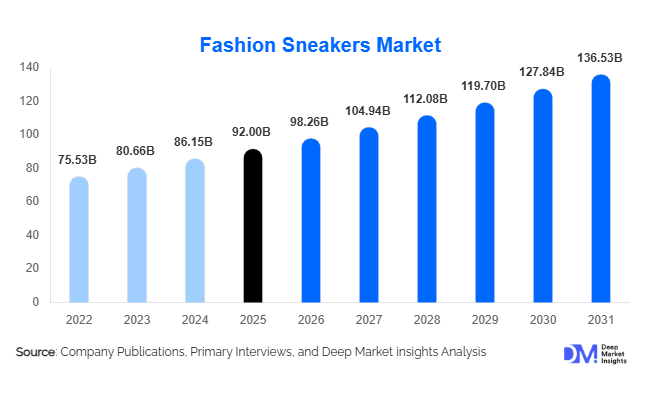
What are the latest trends in the fashion sneakers market?
Sustainability and Eco-Friendly Sneakers
Sustainability is becoming a central theme in the fashion sneakers market, with brands increasingly adopting recycled materials, bio-based components, and circular production models. Consumers are showing strong preference for environmentally responsible products, pushing companies to innovate in materials such as recycled plastics, plant-based leather alternatives, and biodegradable soles. Many brands are introducing take-back programs and closed-loop recycling initiatives to reduce environmental impact. This trend is particularly prominent among Gen Z consumers, who prioritize ethical consumption and transparency in supply chains. Sustainability is no longer a niche segment but a mainstream expectation, influencing both product design and brand positioning globally.
Rise of Limited-Edition Drops and Sneaker Culture
The growing influence of sneaker culture, driven by collaborations with celebrities, designers, and artists, has transformed sneakers into collectible fashion items. Limited-edition releases create scarcity-driven demand, enabling brands to command premium pricing and enhance brand equity. Digital platforms and resale marketplaces have further amplified this trend, allowing consumers to trade and invest in exclusive sneakers. This phenomenon is particularly strong in North America and the Asia-Pacific, where youth culture and social media engagement play a critical role in shaping demand. The “drop model” is now a key revenue driver, contributing significantly to brand profitability and consumer engagement.
What are the key drivers in the fashion sneakers market?
Growth of Athleisure and Casual Wear
The global shift toward casual and comfortable clothing has significantly boosted demand for fashion sneakers. Athleisure trends have blurred the boundaries between sportswear and everyday fashion, making sneakers suitable for multiple occasions, including workplaces with relaxed dress codes. This shift has expanded the consumer base and increased purchase frequency, particularly in urban markets.
Expansion of E-commerce and Direct-to-Consumer Channels
The rapid growth of e-commerce platforms and direct-to-consumer (D2C) strategies has enabled brands to reach wider audiences and improve profit margins. Online channels offer personalized shopping experiences, dynamic pricing, and global accessibility, making them a critical driver of market growth. Social media integration and influencer marketing further enhance consumer engagement and brand visibility.
What are the restraints for the global market?
Market Saturation in Developed Regions
In mature markets such as North America and Europe, high penetration levels and intense competition have led to market saturation. This limits growth potential and forces brands to rely heavily on innovation, branding, and product differentiation to maintain market share.
Volatility in Raw Material Costs
Fluctuating prices of key raw materials such as rubber, leather, and synthetic fabrics pose challenges for manufacturers. These cost variations impact profit margins and pricing strategies, particularly for mid-range and budget segments, potentially slowing overall market growth.
What are the key opportunities in the fashion sneakers industry?
Expansion in Emerging Markets
Emerging economies such as India, Indonesia, and Brazil present significant growth opportunities due to rising disposable incomes, rapid urbanization, and increasing exposure to global fashion trends. These markets are witnessing strong demand for affordable and mid-range sneakers, making them attractive for both global and local brands.
Technology Integration and Customization
Advancements in 3D printing, AI-driven design, and data analytics are enabling brands to offer personalized sneakers tailored to individual preferences. Customization enhances consumer engagement and allows companies to differentiate themselves in a highly competitive market. Smart sneakers with integrated technology also represent a growing niche segment.
Report Scope
| Report Metric | Details |
|---|---|
| Market Size in 2025 | USD 92 Billion |
| Market Size in 2026 | USD 98.26 Billion |
| Market Size in 2031 | USD 136.53 Billion |
| CAGR | 6.8% (2026-2031) |
| Base Year for Estimation | 2025 |
| Historical Data | 2022-2024 |
| Forecast Period | 2026-2031 |
| Report Coverage | Revenue Forecast, Competitive Landscape, Supply Chain Disruption, Growth Factors, Environment & Regulatory Landscape and Trends |
| Geographies Covered | North America, Europe, APAC, Middle East and Africa, LATAM |
| Countries Covered | U.S., Canada, U.K., Germany, France, Spain, Italy, Russia, Nordic, Benelux, Rest of Europe, China, Korea, Japan, India, Australia, Singapore, Taiwan, South East Asia, Rest of Asia-Pacific, UAE, Turky, Saudi Arabia, South Africa, Egypt, Nigeria, Rest of MEA, Brazil, Mexico, Argentina, Chile, Colombia, Rest of LATAM |
Explore more data points, trends and opportunities Download Free Sample Report
Product Type Insights
Low-top sneakers continue to dominate the global fashion sneakers market, accounting for approximately 38% of the total share in 2025. The segment’s leadership is primarily driven by its unmatched versatility, allowing seamless integration across casual, semi-formal, and even smart-casual wardrobes. The increasing adoption of hybrid dressing styles, where consumers combine formal and casual elements, has significantly boosted demand for low-top designs. Additionally, their lightweight structure, ease of pairing with diverse apparel, and wide availability across price points further reinforce their global appeal.
Meanwhile, chunky and platform sneakers are witnessing strong momentum, particularly among younger demographics influenced by retro revival trends and streetwear culture. These styles benefit from high visibility in influencer marketing and social media platforms, making them fashion-forward statement pieces. Slip-on and knit sneakers are also expanding steadily, supported by rising demand for convenience-driven footwear and the growing preference for breathable, flexible materials in urban environments.
Material Insights
Textile-based sneakers hold a leading share of approximately 34% in 2025, driven by their superior breathability, lightweight properties, and cost efficiency. The increasing popularity of knit and mesh-based designs aligns with consumer demand for comfort-centric footwear, especially in warmer climates and high-mobility urban lifestyles. Additionally, advancements in textile engineering, such as stretchable knits and moisture-wicking fabrics, are enhancing product performance and aesthetic appeal.
Leather sneakers continue to maintain a strong foothold in the premium and luxury segments, supported by their durability, structured design, and timeless appeal. However, the fastest growth is observed in sustainable materials, including recycled plastics and bio-based alternatives. This growth is fueled by stringent environmental regulations, brand commitments to carbon neutrality, and rising consumer awareness regarding sustainable consumption, making eco-friendly materials a key future growth driver.
End-User Insights
The men’s segment leads the fashion sneakers market with approximately 45% share in 2025, driven by higher average spending, strong affinity toward sneaker collections, and early adoption of streetwear and athleisure trends. Male consumers also exhibit higher participation in limited-edition and collectible sneaker markets, further boosting segment revenues.
However, the women’s segment is emerging as the fastest-growing category, supported by increasing workforce participation, rising disposable incomes, and expanding product portfolios tailored specifically for women. Brands are investing in gender-specific designs, colorways, and marketing campaigns to capture this demand. The kids’ segment remains stable, driven by frequent replacement cycles due to rapid growth phases and strong parental inclination toward branded and durable footwear.
Price Range Insights
The mid-range segment (USD 50–120) dominates the market with approximately 42% share in 2025, primarily due to its ability to balance affordability with brand value and product quality. This segment benefits from high-volume sales, frequent product refresh cycles, and a strong presence across both online and offline retail channels. It caters to a broad consumer base, particularly in emerging markets where price sensitivity remains a key factor.
Premium and luxury segments are witnessing steady growth, driven by increasing consumer willingness to invest in high-quality, branded footwear. Collaborations with designers, celebrities, and luxury houses are further elevating the appeal of these segments, enabling brands to command higher margins and strengthen brand positioning.
Distribution Channel Insights
Offline retail channels continue to dominate the market, accounting for approximately 55% of total sales in 2025. The segment’s leadership is driven by experiential shopping, where consumers can physically evaluate product comfort, fit, and design before purchase. Brand-exclusive outlets and specialty stores play a crucial role in building brand identity and customer loyalty.
However, online channels are expanding rapidly, supported by increasing internet penetration, smartphone usage, and evolving consumer purchasing behavior. E-commerce platforms offer convenience, competitive pricing, and a wider product assortment, making them particularly attractive to younger consumers. Direct-to-consumer (D2C) strategies are gaining prominence, allowing brands to enhance margins, collect consumer data, and deliver personalized experiences.
Usage Occasion Insights
Casual everyday wear remains the dominant usage segment, capturing nearly 48% of the market share in 2025. The shift toward comfort-oriented lifestyles and relaxed dress codes across workplaces has significantly contributed to this dominance. Sneakers are increasingly replacing traditional footwear in daily use, reinforcing their position as a wardrobe staple. The athleisure and streetwear segments are experiencing rapid growth, driven by fitness trends and the blending of sportswear with fashion. Limited-edition and collectible sneakers represent a smaller but high-value niche, supported by exclusivity, brand collaborations, and a thriving resale market, which has transformed sneakers into investment assets for certain consumer groups.
Explore more data points, trends and opportunities Download Free Sample Report
Fashion Sneakers Market Segmentations
By Product Type
- Low-top Sneakers
- Mid-top Sneakers
- High-top Sneakers
- Slip-on Sneakers
- Platform Sneakers
- Chunky/Dad Sneakers
- Knit/Athleisure Sneakers
By Material Type
- Leather
- Textile (Mesh, Knit, Canvas)
- Rubber-Based Composites
- Sustainable Materials
By End User
- Men
- Women
- Kids
By Price Range
- Economy (Below USD 50)
- Mid-Range (USD 50–120)
- Premium (USD 120–250)
- Luxury (Above USD 250)
By Distribution Channel
- Online Retail
- Brand Stores
- Department Stores
- Specialty Stores
Regional Insights
North America
North America accounts for approximately 32% of the global market share in 2025, with the United States being the largest contributor. The region’s dominance is driven by a deeply entrenched sneaker culture, high disposable incomes, and strong brand presence. Frequent product launches, celebrity endorsements, and the popularity of limited-edition drops significantly influence consumer demand. Additionally, the well-established e-commerce ecosystem and advanced retail infrastructure support high sales volumes. The growing adoption of athleisure and increasing preference for premium and collectible sneakers further reinforce regional growth.
Europe
Europe holds around 25% of the market share, led by countries such as Germany, the United Kingdom, France, and Italy. The region’s growth is driven by strong fashion consciousness, high adoption of luxury sneakers, and increasing emphasis on sustainability. European consumers are particularly responsive to eco-friendly products, prompting brands to innovate in sustainable materials and production processes. The presence of leading fashion houses and collaborations between luxury brands and sneaker manufacturers further drives demand. Additionally, urbanization and a strong retail network contribute to steady market expansion.
Asia-Pacific
Asia-Pacific represents nearly 30% of the global market and is the fastest-growing region, with a CAGR exceeding 8%. China dominates both production and consumption, benefiting from large-scale manufacturing capabilities and a rapidly growing middle class. India is emerging as a key growth market, driven by urbanization, rising disposable incomes, and the increasing influence of global fashion trends. Japan and South Korea contribute significantly through high brand awareness and strong demand for premium and limited-edition sneakers. The expansion of e-commerce platforms and the increasing youth population are key drivers accelerating growth across the region.
Latin America
Latin America is witnessing steady growth, led by Brazil and Mexico. The region benefits from a young and fashion-conscious population, increasing urbanization, and rising middle-class income levels. Demand is particularly strong for mid-range sneakers, which offer affordability and brand appeal. The expansion of retail networks and the growing penetration of online platforms are further supporting market growth. Additionally, cultural influences such as sports and music trends play a significant role in shaping consumer preferences.
Middle East & Africa
The Middle East & Africa region is experiencing gradual growth, with key markets including the UAE and Saudi Arabia driving demand. High disposable incomes and a strong preference for luxury and premium products support the growth of high-end sneaker segments in the Middle East. Increasing retail investments, expansion of shopping malls, and rising tourism further contribute to demand. In Africa, the market is supported by its role as a manufacturing and export hub, particularly in countries with developing textile industries. Urbanization and improving economic conditions are expected to drive long-term growth across the region.