Fairtrade Chocolate Market Size
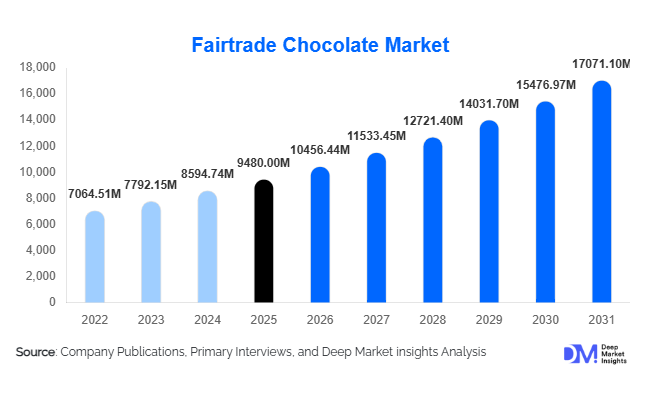
According to Deep Market Insights, the global fairtrade chocolate market size was valued at USD 9,480 million in 2025 and is projected to grow from USD 10,456.44 million in 2026 to reach USD 17,071.10 million by 2031, expanding at a CAGR of 10.3% during the forecast period (2026–2031). The fairtrade chocolate market growth is driven by rising consumer awareness regarding ethical sourcing, increasing demand for sustainably produced cocoa, and strong adoption of certified products across premium confectionery segments. Growing transparency requirements in global supply chains and retailer commitments toward responsible sourcing are further strengthening market expansion.
Key Market Insights
- Ethically sourced cocoa is becoming a mainstream purchasing criterion, especially among millennials and Gen Z consumers prioritizing sustainability.
- Premium and organic chocolate segments are driving certification adoption, allowing brands to command higher price premiums.
- Europe dominates global consumption, supported by mature ethical consumption patterns and regulatory backing for sustainable sourcing.
- Asia-Pacific is the fastest-growing regional market, fueled by rising disposable income and premium chocolate adoption.
- Private-label retailers are expanding Fairtrade-certified offerings, increasing accessibility across mass-market consumers.
- Digital traceability technologies, including blockchain-based cocoa tracking, are improving transparency and consumer trust.
What are the latest trends in the fairtrade chocolate market?
Ethical Premiumization of Chocolate Products
Consumers are increasingly associating ethical sourcing with premium quality, transforming Fairtrade certification from a niche ethical label into a value-added quality marker. Premium chocolate brands are integrating Fairtrade certification alongside organic, vegan, and single-origin claims. This convergence is reshaping product positioning across supermarkets and specialty stores. Brands are introducing limited-origin cocoa bars, high-cocoa-content offerings, and artisanal formats that emphasize farmer welfare and environmental sustainability. The willingness of consumers to pay price premiums of 15–25% for certified products has strengthened margins for manufacturers while improving income stability for cocoa farmers.
Technology-Enabled Supply Chain Transparency
Traceability solutions are emerging as a defining trend within the fairtrade chocolate industry. Companies are deploying QR-based packaging, blockchain verification systems, and digital farmer registries to provide transparency regarding cocoa sourcing. These technologies allow consumers to trace products back to cooperatives and farming communities, strengthening brand loyalty. Retailers are increasingly demanding verified sourcing data to meet ESG reporting standards. This technological shift is reducing certification fraud risks and enabling real-time monitoring of sustainability metrics, making transparency a competitive differentiator.
What are the key drivers in the fairtrade chocolate market?
Rising Consumer Demand for Ethical Consumption
Global consumers are increasingly aligning purchasing behavior with social and environmental values. Awareness campaigns highlighting farmer income inequality and child labor concerns in cocoa farming have significantly influenced buying patterns. Ethical consumption trends across Europe and North America have accelerated adoption of Fairtrade-certified chocolates, particularly within supermarkets and specialty retail channels. Younger demographics demonstrate stronger loyalty toward socially responsible brands, supporting long-term market growth.
Retailer and Corporate Sustainability Commitments
Large retailers and multinational confectionery brands are committing to responsible sourcing targets, pushing Fairtrade-certified cocoa procurement. Many supermarket chains now allocate dedicated shelf space to ethical chocolate ranges. Corporate ESG targets and investor scrutiny are encouraging manufacturers to integrate certification programs into procurement strategies, accelerating supply-side adoption.
Expansion of Premium Chocolate Consumption in Emerging Markets
Rising middle-class populations in Asia-Pacific and Latin America are driving demand for premium confectionery products. Urban consumers increasingly view ethical labels as indicators of authenticity and quality. Growth of modern retail infrastructure and e-commerce platforms is enabling wider availability of Fairtrade-certified chocolate products across developing economies.
What are the restraints for the global market?
Higher Production and Certification Costs
Fairtrade certification requires compliance audits, farmer training programs, and premium payments to cooperatives, increasing production costs compared with conventional chocolate. Smaller manufacturers often face challenges maintaining price competitiveness in cost-sensitive markets. These higher costs can limit penetration in developing economies where affordability remains a primary purchasing factor.
Limited Certified Cocoa Supply
Supply constraints remain a structural challenge. Certified cocoa production depends on cooperative participation and compliance with sustainability standards. Climate variability, aging cocoa farms, and productivity limitations in West Africa restrict supply expansion, creating volatility in certified cocoa availability and pricing.
What are the key opportunities in the fairtrade chocolate industry?
Expansion into Emerging Markets
Rapid urbanization and income growth across India, China, and Southeast Asia present major opportunities for Fairtrade chocolate brands. Ethical consumption awareness is increasing through digital media and international retail exposure. Companies entering these markets early can establish premium positioning and brand loyalty before competition intensifies. Localization strategies such as smaller pack sizes and affordable premium offerings are expected to accelerate adoption.
Government and ESG Policy Support
Regulatory frameworks promoting sustainable sourcing and corporate transparency are creating favorable conditions for Fairtrade products. Policies focused on deforestation-free supply chains and responsible sourcing compliance encourage companies to adopt certification programs. Public procurement policies favoring sustainable goods also create institutional demand opportunities.
Product Innovation and Functional Chocolate
Innovation combining Fairtrade certification with functional benefits such as high-antioxidant cocoa, plant-based formulations, and reduced-sugar recipes represents a significant growth avenue. Health-conscious consumers increasingly seek indulgent products aligned with wellness goals. This convergence of ethical and health positioning is expected to unlock new premium segments.
Report Scope
| Report Metric | Details |
|---|---|
| Market Size in 2025 | USD 9480 Million |
| Market Size in 2026 | USD 10456.44 Million |
| Market Size in 2031 | USD 17071.10 Million |
| CAGR | 10.3% (2026-2031) |
| Base Year for Estimation | 2025 |
| Historical Data | 2022-2024 |
| Forecast Period | 2026-2031 |
| Report Coverage | Revenue Forecast, Competitive Landscape, Supply Chain Disruption, Growth Factors, Environment & Regulatory Landscape and Trends |
| Geographies Covered | North America, Europe, APAC, Middle East and Africa, LATAM |
| Countries Covered | U.S., Canada, U.K., Germany, France, Spain, Italy, Russia, Nordic, Benelux, Rest of Europe, China, Korea, Japan, India, Australia, Singapore, Taiwan, South East Asia, Rest of Asia-Pacific, UAE, Turky, Saudi Arabia, South Africa, Egypt, Nigeria, Rest of MEA, Brazil, Mexico, Argentina, Chile, Colombia, Rest of LATAM |
Explore more data points, trends and opportunities Download Free Sample Report
Product Type Insights
Dark chocolate continues to dominate the global fairtrade chocolate market, accounting for approximately 42% of the total market share in 2025. The leadership of this segment is primarily driven by increasing consumer preference for healthier indulgence options, as dark chocolate contains higher cocoa content and lower sugar levels compared to other variants. Growing scientific awareness regarding antioxidant benefits, coupled with rising demand for clean-label and ethically sourced food products, has strengthened consumer perception of dark chocolate as a premium yet responsible choice. Additionally, manufacturers increasingly leverage dark chocolate formulations to communicate origin transparency, farmer traceability, and sustainability commitments, which align strongly with Fairtrade certification principles. Milk chocolate holds nearly 35% share, supported by mass-market appeal and continued innovation in flavor combinations and portion-controlled formats that attract younger consumers and family households. Meanwhile, white chocolate and specialty variants collectively represent around 23% of the market, benefiting from premiumization trends, artisanal product launches, flavored inclusions, and seasonal gifting innovations that enhance value-added product differentiation.
Application Insights
Retail consumption remains the largest application segment, contributing nearly 58% of total market demand in 2025, primarily driven by expanding consumer awareness of ethical sourcing and the increasing availability of Fairtrade-certified products across organized retail channels. The leading driver for this segment is the growing integration of sustainability-focused private-label offerings by supermarkets and hypermarkets, which make certified chocolate more accessible to mainstream consumers at competitive price points. Rising impulse purchases, gifting culture, and premium snack consumption further reinforce retail dominance. Foodservice applications are witnessing accelerated expansion as cafés, bakeries, hotels, and premium dessert chains increasingly incorporate ethically sourced chocolate into menus to meet sustainability expectations among urban consumers. Industrial usage accounts for nearly 27% share, supported by large confectionery and bakery manufacturers adopting certified cocoa ingredients to strengthen ESG positioning, enhance brand reputation, and comply with responsible sourcing commitments demanded by global retailers and investors.
Distribution Channel Insights
Supermarkets and hypermarkets lead the distribution landscape with approximately 46% market share in 2025, supported by strong retailer-led sustainability initiatives and enhanced shelf visibility for certified products. The primary growth driver for this channel is the strategic expansion of private-label Fairtrade ranges, enabling retailers to capture value-conscious ethical consumers while reinforcing corporate sustainability goals. Online retail channels represent the fastest-growing distribution segment, expanding at a CAGR exceeding 13%, driven by direct-to-consumer ethical brands, subscription-based chocolate models, and improved digital storytelling around farmer impact and traceability. Specialty stores continue to maintain relevance in premium urban markets, where informed consumers actively seek certified, artisanal, and high-quality chocolate products supported by personalized retail experiences and curated product assortments.
Certification Type Insights
Fairtrade International certification dominates the certification landscape, accounting for nearly 64% of certified chocolate sales, largely due to its globally recognized standards, transparent pricing mechanisms, and strong consumer trust developed over decades. The leading driver of this segment is the standardized compliance framework that assures minimum pricing protections and social premiums for cocoa farmers, making it highly attractive for multinational brands seeking credible sustainability validation. Dual-certified products combining Fairtrade and organic certifications are gaining momentum as consumers increasingly associate ethical sourcing with health and environmental sustainability. This convergence of ethical and wellness-driven purchasing behavior is encouraging manufacturers to expand multi-certified product portfolios to capture premium consumer segments.
End-Use Insights
Household consumption represents the largest end-use segment, accounting for approximately 61% of total demand, driven primarily by increasing at-home indulgence trends, expanding retail availability, and strong seasonal gifting demand across developed markets. The leading growth driver is the normalization of ethical consumption behavior, where consumers actively incorporate sustainable products into daily purchasing decisions rather than treating them as niche alternatives. Foodservice demand is emerging as the fastest-growing end-use segment, supported by the expansion of premium cafés, specialty dessert outlets, and hospitality brands integrating ethical sourcing policies into procurement strategies. Industrial end-use continues to strengthen as European chocolate manufacturers and global confectionery producers increasingly rely on certified cocoa sourcing to meet sustainability targets, regulatory expectations, and corporate ESG reporting requirements.
Explore more data points, trends and opportunities Download Free Sample Report
Fairtrade Chocolate Market Segmentations
By Product Type
- Dark Chocolate
- Milk Chocolate
- White Chocolate
- Flavored/Specialty Chocolate
By Application
- Retail/Household Consumption
- Foodservice
- Industrial
By Distribution Channel
- Supermarkets & Hypermarkets
- Online Retail / D2C
- Specialty Stores
- Convenience Stores
By Certification Type
- Fairtrade International
- Fairtrade + Organic
Regional Insights
Europe
Europe leads the global fairtrade chocolate market with approximately 41% market share in 2025, supported by a deeply embedded ethical consumption culture and strong regulatory as well as retailer-driven sustainability mandates. Regional growth is driven by high consumer awareness regarding fair labor practices, widespread adoption of certified private-label products by major supermarket chains, and stringent sustainability expectations across supply chains. Countries such as Germany, the United Kingdom, Switzerland, and the Netherlands serve as key demand centers due to mature premium chocolate markets and strong institutional support for ethical trade initiatives. Switzerland records one of the highest per-capita chocolate consumption rates globally, while U.K. retailers actively promote Fairtrade-certified offerings through marketing campaigns and long-term sourcing commitments, further reinforcing regional dominance.
North America
North America accounts for nearly 26% of global demand, led by the United States and Canada. Regional market expansion is primarily driven by premiumization trends, increasing consumer willingness to pay for ethically sourced products, and ESG-focused procurement strategies adopted by large retailers and foodservice operators. Growth is further supported by the rapid expansion of organic and natural food categories, rising transparency expectations among consumers, and increased brand storytelling around farmer welfare and environmental responsibility. Urban populations, particularly in metropolitan areas, demonstrate strong adoption of sustainable food products, enabling fairtrade chocolate brands to scale through specialty retail and e-commerce platforms.
Asia-Pacific
Asia-Pacific represents the fastest-growing regional market, expanding at a CAGR exceeding 12%, fueled by rising disposable incomes, expanding middle-class populations, and increasing exposure to Western consumption patterns. Regional growth is driven by rapid modernization of retail infrastructure, growing e-commerce penetration, and heightened awareness of premium imported confectionery products. China and Japan show strong demand for premium gifting chocolates, while Australia demonstrates mature ethical consumption trends similar to European markets. India is emerging as a high-potential market due to expanding modern retail networks, digital commerce growth, and rising consumer awareness regarding sustainability and responsibly sourced products among younger urban consumers.
Latin America
Latin America, led by Brazil and Mexico, is witnessing steady growth supported by the expansion of premium confectionery markets and increasing regional appreciation for ethically produced chocolate. Market development is driven by rising domestic consumption alongside strong export-oriented cocoa industries transitioning toward certified production standards. Local manufacturers are increasingly introducing Fairtrade-certified finished chocolate products, allowing producing countries to capture greater value within domestic markets while strengthening international trade positioning.
Middle East & Africa
The Middle East and Africa region is experiencing gradual but notable growth driven by luxury retail expansion, rising tourism, and increasing premium food consumption in countries such as the United Arab Emirates and Saudi Arabia. High-income consumers and gifting culture significantly support premium chocolate demand across the Gulf region. In Africa, while the region remains primarily a cocoa-producing hub, urban markets such as South Africa are witnessing growing awareness of ethical consumption and locally processed certified chocolate products. Investments in sustainable farming initiatives and value-chain development are expected to gradually stimulate regional consumption alongside export growth.
Key Players in the Fairtrade Chocolate Market
- Mondelez International
- Nestlé S.A.
- Lindt & Sprüngli
- Ferrero Group
- Hershey Company
- Divine Chocolate Ltd.
- Alter Eco Foods
- Tony’s Chocolonely
- Green & Black’s
- Endangered Species Chocolate
- Equal Exchange
- Theo Chocolate
- Seed & Bean
- Chocolats Halba
- Maltesers (Mars Incorporated)