Fabric Freshener Market Size
According to Deep Market Insights, the global Fabric Freshener Market size was valued at USD 4,500 million in 2025 and is projected to grow from USD 4,824 million in 2026 to reach USD 6,829.38 million by 2031, expanding at a CAGR of 7.20% during the forecast period (2026–2031). The market growth is primarily driven by rising consumer emphasis on home hygiene, convenience-oriented lifestyle products, and innovation in premium and eco-friendly fragrance formulations. Increasing urbanization, growth of e-commerce distribution, and expanding applications in residential and hospitality sectors are further accelerating demand worldwide.
Key Market Insights
- Perfumed fabric fresheners dominate the market, accounting for nearly 55% of global revenue in 2025, supported by consumer preference for lasting fragrance and premium scent profiles.
- Asia-Pacific is the fastest-growing region, projected to expand at over 7% CAGR, driven by urban population growth, rising disposable incomes, and modern retail penetration.
- Household use leads end-user demand with approximately 39% share in 2025, reflecting strong adoption across residential apartments and family homes.
- Online retail channels are witnessing double-digit growth as digital shopping and direct-to-consumer brands reshape the competitive landscape.
- Eco-friendly and low-VOC formulations are rapidly gaining acceptance, driven by regulatory standards and sustainability-conscious consumers.
- Technological integration in fragrances, including micro-encapsulation and long-release aroma systems, is improving product performance and customer satisfaction.
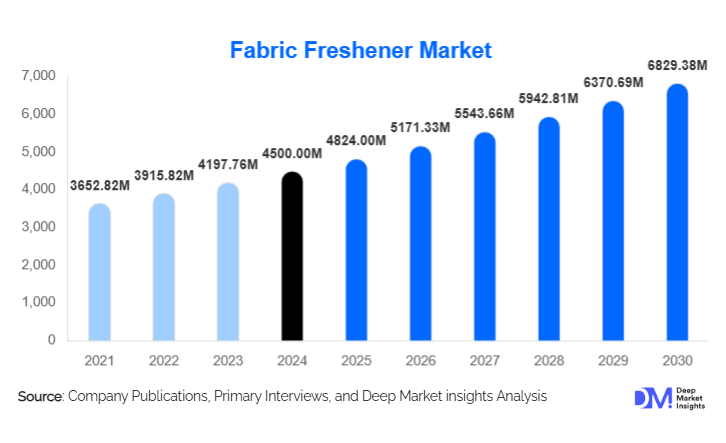
Fabric Freshener Market latest trends
Premiumization and Multi-Functional Product Innovation
Leading brands are moving beyond simple odor-masking to create multi-functional products that combine fragrance enhancement, fabric care, and anti-bacterial performance. Premium formulations are being infused with essential oils, allergen-reducing agents, and long-lasting scent capsules. The emergence of region-specific scents, such as floral for Europe, citrus for North America, and oriental for Asia, is strengthening local brand identity and driving consumer loyalty. This premiumization trend is also boosting margins for manufacturers and reshaping retail assortments in both online and offline channels.
Eco-Conscious and Sustainable Product Development
The shift toward eco-friendly, biodegradable, and low-VOC formulations has become a defining market trend. Consumers increasingly seek products that are safe for fabrics, health, and the environment. Major manufacturers are investing in plant-based solvents, natural fragrances, and recyclable packaging. Brands introducing “green-certified” or “sustainably sourced” variants are witnessing higher acceptance among younger demographics. This sustainability drive not only aligns with regulatory compliance in regions such as the EU but also enhances brand trust globally.
Fabric Freshener Market key drivers
Urbanization and Changing Household Lifestyles
Rapid urbanization has resulted in smaller living spaces and limited ventilation, leading to increased fabric odor issues in homes. Time-constrained consumers are turning toward instant solutions like fabric fresheners that deliver quick, effective odor control without traditional laundering. This behavioral shift is a core growth driver, especially in densely populated urban centers across Asia and Europe.
Rising Focus on Hygiene and Indoor Air Quality
Post-pandemic hygiene awareness has elevated the importance of maintaining clean and pleasant-smelling indoor environments. Consumers are incorporating fabric fresheners as a routine household essential for upholstered furniture, curtains, and clothing. This growing association between fabric care and personal well-being is expanding both penetration and consumption frequency, supporting market growth.
Expansion of E-Commerce and Omni-Channel Retail
The proliferation of e-commerce and direct-to-consumer (D2C) models has transformed product accessibility and brand reach. Online platforms offer consumers the convenience of discovering niche and premium brands, personalized fragrances, and subscription models. Omni-channel strategies, combining physical retail exposure with digital fulfillment, are enabling established players to sustain growth and compete with emerging local entrants.
Fabric Freshener Market restraints
Raw Material Price Volatility
Dependence on petrochemical-based solvents, fragrance oils, and propellants exposes manufacturers to fluctuations in raw material costs. Supply chain disruptions and energy price variations can significantly affect production economics, forcing companies to either absorb higher costs or raise consumer prices, both of which can constrain profitability.
Regulatory Constraints and Environmental Concerns
Tighter regulations governing aerosol emissions, volatile organic compounds (VOCs), and chemical ingredients, especially in North America and Europe, pose compliance challenges. The transition toward greener, low-impact formulations often requires investment in reformulation and testing, increasing operational costs. Consumer skepticism about synthetic chemicals also pressures companies to enhance transparency in ingredient disclosure.
Fabric Freshener Market key opportunities
Emerging Market Expansion
Rising disposable incomes, urban housing growth, and increasing home-care awareness in Asia-Pacific, Latin America, and the Middle East present lucrative opportunities. Local production facilities, regional fragrance customization, and partnerships with e-commerce platforms are helping companies tap underserved markets and build localized value chains.
Technological Integration and Smart Fragrance Delivery
Advances in micro-encapsulation, sustained-release technologies, and “smart scent” systems are enabling longer-lasting and more efficient fragrance diffusion. Innovations such as sensor-activated dispensers and IoT-connected air and fabric care devices are emerging in premium segments, offering new product experiences and upselling opportunities.
Sustainability-Driven Product Differentiation
As consumers increasingly prefer eco-conscious products, brands that prioritize natural ingredients, refillable packaging, and carbon-neutral manufacturing can build long-term loyalty. Integrating sustainability certifications and clean-label positioning is expected to create new growth pathways and pricing power within premium categories.
Report Scope
| Report Metric | Details |
|---|---|
| Market Size in 2025 | USD 4500 Million |
| Market Size in 2026 | USD 4824 Million |
| Market Size in 2031 | USD 6829.38 Million |
| CAGR | 7.20% (2026-2031) |
| Base Year for Estimation | 2025 |
| Historical Data | 2022-2024 |
| Forecast Period | 2026-2031 |
| Report Coverage | Revenue Forecast, Competitive Landscape, Supply Chain Disruption, Growth Factors, Environment & Regulatory Landscape and Trends |
| Geographies Covered | North America, Europe, APAC, Middle East and Africa, LATAM |
| Countries Covered | U.S., Canada, U.K., Germany, France, Spain, Italy, Russia, Nordic, Benelux, Rest of Europe, China, Korea, Japan, India, Australia, Singapore, Taiwan, South East Asia, Rest of Asia-Pacific, UAE, Turky, Saudi Arabia, South Africa, Egypt, Nigeria, Rest of MEA, Brazil, Mexico, Argentina, Chile, Colombia, Rest of LATAM |
Explore more data points, trends and opportunities Download Free Sample Report
Product Type Insights
Perfumed fabric fresheners lead the global market with approximately 55% share in 2025, valued at around USD 2.46 billion. These products dominate due to strong consumer demand for aroma-rich, long-lasting freshness. The segment benefits from continuous fragrance innovation and premium line extensions. In contrast, regular or unscented variants cater mainly to sensitive-skin consumers but represent a smaller share of the market.
End-Use Insights
The household segment accounted for roughly 39% of market revenue in 2025, valued at USD 1.75 billion. Rising awareness of home hygiene, increased fabric usage in interior décor, and the popularity of easy-to-use sprays have bolstered this segment. The hospitality sector, including hotels and resorts, is an emerging high-value application area, with growing adoption of premium and bulk-use fabric fresheners for linen and upholstery maintenance. Additionally, niche end uses in automotive interiors and office spaces are contributing incremental demand.
Distribution Channel Insights
Supermarkets and hypermarkets currently dominate distribution, but online retail is the fastest-growing channel, expected to post a double-digit CAGR during 2026–2031. Digital sales are expanding through brand-owned websites, marketplaces, and social media-driven promotions. Subscription models and customizable fragrance bundles are redefining consumer engagement, while traditional retail maintains its relevance in emerging markets through in-store promotions and bundling with home-care products.
Explore more data points, trends and opportunities Download Free Sample Report
Fabric Freshener Market Segmentations
By Product Type
- Spray-Based Fabric Fresheners
- Aerosol Fabric Fresheners
- Electric Diffuser Fabric Fresheners
- Scent Beads & Capsules
- Fabric Softener-Integrated Fresheners
- Natural & Organic Fabric Fresheners
By Fragrance Type
- Floral
- Fruity
- Woody & Musky
- Fresh & Clean
- Customized/Seasonal Blends
By Distribution Channel
- Supermarkets & Hypermarkets
- Convenience Stores
- Online Retail
- Specialty Household Stores
- Direct-to-Consumer (D2C)
By End Use
- Residential
- Commercial (Hotels, Offices, Gyms)
- Automotive
- Laundry Service Providers
- Healthcare Facilities
Regional Insights
North America
North America represents approximately 33% of the global market (USD 1.5 billion in 2025), driven by strong consumer purchasing power and established brand presence. The U.S. dominates regional consumption, with continued demand for premium fragrance blends and eco-labeled products. E-commerce penetration and product innovation are maintaining steady growth across this mature market.
Europe
Europe accounts for about 23% of the global market share (USD 1.0 billion). Western European markets such as Germany, the U.K., and France are highly regulated and environmentally conscious, creating strong momentum for low-VOC and recyclable packaging solutions. Consumers prefer subtle fragrances and allergen-free variants, aligning with health and sustainability trends.
Asia-Pacific
Asia-Pacific is the fastest-growing region, contributing around 33% of global revenue (USD 1.48 billion in 2025) and projected to grow at a 7–9% CAGR. China leads regional consumption due to its expanding urban middle class, while India shows exceptional growth potential through increased online retail activity. Rising household incomes, apartment living, and lifestyle upgrades continue to boost product adoption.
Latin America
Latin America holds about 6% share (USD 270 million in 2025), led by Brazil and Argentina. Demand is growing for affordable, fragrance-rich sprays distributed through supermarkets and local convenience chains. Economic fluctuations pose minor challenges, but gradual e-commerce adoption supports market expansion.
Middle East & Africa
MEA contributes around 5% of global demand (USD 225 million in 2025), with growth driven by hospitality expansion, urban housing projects, and increasing awareness of fabric hygiene. GCC countries, particularly the UAE and Saudi Arabia, exhibit strong demand for luxury fragrance-based fabric fresheners, reflecting high-income consumer preferences.
Key Players in the Fabric Freshener Market
- Procter & Gamble Co.
- Henkel AG & Co. KGaA
- Reckitt Benckiser Group plc
- Godrej Consumer Products Ltd.
- SC Johnson & Son, Inc.
- Kao Corporation
- Clean Control Corporation
- Grow Fragrance Inc.
- Deb Group Ltd.
- Wipro Enterprises Pvt Ltd.
- Church & Dwight Co., Inc.
- Unilever PLC
- Pigeon Corporation
- The Clorox Company
- Colgate-Palmolive Company