Exotic Fruit Market Size
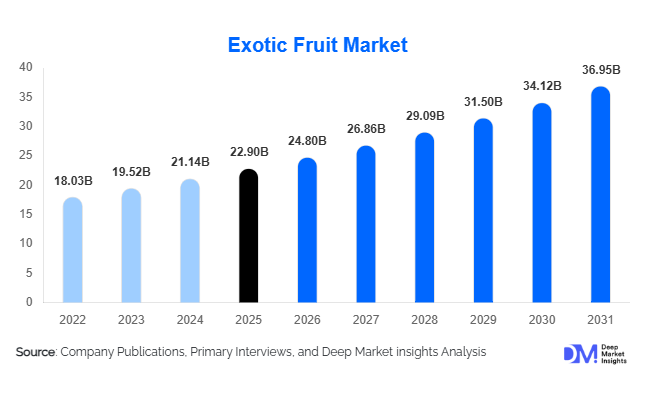
According to Deep Market Insights, the global exotic fruit market size was valued at USD 22.9 billion in 2025 and is projected to grow from USD 24.80 billion in 2026 to reach USD 36.95 billion by 2031, expanding at a CAGR of 8.3% during the forecast period (2026–2031). The exotic fruit market growth is primarily driven by increasing consumer demand for nutrient-rich tropical fruits, expanding global trade of premium fresh produce, rising popularity of functional foods and beverages, and growing integration of exotic fruit ingredients into processed food applications.
Key Market Insights
- Health-conscious consumers are increasingly shifting toward antioxidant-rich tropical fruits, boosting demand for dragon fruit, passion fruit, avocado, guava, and mangosteen globally.
- Asia-Pacific dominates the global exotic fruit market, supported by large-scale tropical fruit cultivation, export-oriented agriculture, and rising regional consumption.
- North America and Europe are major premium import markets, driven by demand for organic, sustainable, and functional fruit categories.
- Food and beverage manufacturers are expanding tropical fruit-based product launches, including smoothies, energy drinks, yogurt products, frozen desserts, and plant-based foods.
- Online grocery and quick-commerce channels are transforming premium fruit distribution, enabling direct-to-consumer imported fruit sales in urban markets.
- Cold chain modernization and packaging technologies are improving shelf life, reducing wastage, and strengthening global fruit trade efficiency.
Exotic Fruit Market Latest Trends
Rising Demand for Functional and Superfruit Products
The exotic fruit industry is increasingly benefiting from rising global demand for functional foods and superfruit ingredients. Consumers are actively seeking fruits rich in vitamins, antioxidants, fiber, and immunity-supporting nutrients, resulting in higher consumption of dragon fruit, passion fruit, kiwi, avocado, and guava. Food manufacturers are integrating tropical fruit ingredients into smoothies, nutritional beverages, sports drinks, dietary supplements, yogurt products, and wellness snacks. Superfruit marketing strategies emphasizing clean-label nutrition and natural health benefits are also strengthening premium product positioning across developed economies.
Growing awareness regarding preventive healthcare and lifestyle-related diseases has further accelerated demand for minimally processed and nutrient-dense fruit products. Retailers are increasingly promoting exotic fruits through wellness campaigns, while beverage companies continue introducing tropical fruit-based functional beverages targeting younger and health-conscious consumers.
Expansion of Processed and Ready-to-Consume Exotic Fruit Products
Manufacturers are increasingly investing in frozen fruits, fruit purees, freeze-dried fruit powders, and ready-to-consume tropical fruit snacks to improve convenience and year-round product availability. Demand for frozen dragon fruit cubes, passion fruit pulp, jackfruit meat substitutes, and tropical fruit smoothie blends is expanding rapidly across foodservice and retail industries. This trend is particularly strong in urban markets where consumers prioritize convenience, longer shelf life, and easy preparation.
Technological advancements in aseptic processing, vacuum drying, and modified atmosphere packaging are improving product stability and export capabilities. Online grocery platforms and premium retail chains are also accelerating adoption of pre-cut and packaged exotic fruits, further expanding accessibility in metropolitan regions.
Exotic Fruit Market Drivers
Increasing Consumer Focus on Healthy Eating
The growing global emphasis on healthy eating and preventive nutrition remains one of the primary growth drivers for the exotic fruit market. Consumers are increasingly incorporating fruits with high vitamin, antioxidant, and fiber content into their daily diets. Dragon fruit, avocado, kiwi, guava, and passion fruit are gaining popularity due to their association with immunity enhancement, digestive health, and natural energy benefits. Millennials and urban consumers are especially driving demand for premium and minimally processed fruit categories.
Growing awareness regarding plant-based diets and clean-label food consumption is further strengthening demand for tropical fruits across both developed and emerging economies. Social media trends promoting smoothie bowls, fruit-based wellness drinks, and visually attractive tropical fruits have also positively influenced purchasing behavior among younger demographics.
Expansion of Global Cold Chain and Retail Infrastructure
The expansion of organized retail networks and cold chain logistics infrastructure has significantly improved global availability of exotic fruits. Supermarkets, hypermarkets, and premium grocery chains are expanding imported fruit assortments to cater to evolving consumer preferences. Refrigerated transportation systems, temperature-controlled warehousing, and improved export packaging technologies are reducing spoilage rates and enabling efficient long-distance transportation.
Emerging economies such as India, Vietnam, Thailand, Peru, and Mexico are investing heavily in export infrastructure, agricultural modernization, and post-harvest technologies to strengthen tropical fruit exports. Increasing penetration of online grocery and quick-commerce platforms is also supporting easier access to imported fruits across urban consumer markets.
Global Market Restraints
High Perishability and Supply Chain Challenges
Exotic fruits remain highly perishable and require efficient refrigerated logistics and controlled storage systems throughout transportation and distribution. Inadequate cold chain infrastructure in developing regions often results in significant post-harvest losses, increasing operational costs for producers and exporters. Seasonal production cycles and inconsistent fruit quality further contribute to supply volatility and pricing fluctuations.
Exporters also face challenges related to transportation delays, inventory wastage, and high packaging costs, particularly when serving distant import markets in Europe and North America. Maintaining freshness and product quality during long-distance trade remains a critical operational challenge for market participants.
Stringent International Trade Regulations
Exotic fruit exporters must comply with strict phytosanitary regulations, pesticide residue standards, traceability requirements, and food safety certifications imposed by importing countries. Regulatory compliance costs can be particularly challenging for small-scale growers and exporters operating in developing economies.
Climate change and irregular weather conditions are also negatively affecting tropical fruit cultivation across major producing countries. Rising incidences of droughts, pests, crop diseases, and unpredictable rainfall patterns are increasing production uncertainty and impacting long-term supply stability.
Exotic Fruit Industry Key Opportunities
Growth of Plant-Based and Vegan Food Applications
The rapid expansion of plant-based food industries presents strong opportunities for exotic fruit producers and processors. Jackfruit is increasingly being used as a meat alternative in vegan and vegetarian products, while tropical fruit ingredients are widely utilized in dairy alternatives, smoothies, wellness beverages, and nutritional snacks. Food manufacturers are investing in innovative product formulations using mango, dragon fruit, guava, and passion fruit concentrates to address rising demand for natural flavors and clean-label ingredients.
Growing consumer preference for minimally processed and plant-based foods is expected to significantly increase utilization of tropical fruit ingredients across foodservice and packaged food industries. Companies investing in value-added fruit processing and functional ingredient development are likely to benefit from long-term demand growth.
Export Expansion and Agricultural Modernization
Several tropical fruit-producing countries are investing heavily in export-oriented agricultural modernization programs. Governments across Asia and Latin America are supporting cold storage development, farmer digitization, irrigation expansion, and food processing infrastructure to strengthen international competitiveness. Countries such as India, Thailand, Vietnam, Peru, and the Philippines are expanding export capacities for dragon fruit, avocado, durian, and mangosteen.
Improved international trade agreements and increasing global demand for premium imported fruits are creating opportunities for exporters, integrated supply chain companies, and food processors. Investments in traceability systems and export certifications are also improving market access to high-value international markets.
Report Scope
| Report Metric | Details |
|---|---|
| Market Size in 2025 | USD 22.90 Billion |
| Market Size in 2026 | USD 24.80 Billion |
| Market Size in 2031 | USD 36.95 Billion |
| CAGR | 8.3% (2026-2031) |
| Base Year for Estimation | 2025 |
| Historical Data | 2022-2024 |
| Forecast Period | 2026-2031 |
| Report Coverage | Revenue Forecast, Competitive Landscape, Supply Chain Disruption, Growth Factors, Environment & Regulatory Landscape and Trends |
| Geographies Covered | North America, Europe, APAC, Middle East and Africa, LATAM |
| Countries Covered | U.S., Canada, U.K., Germany, France, Spain, Italy, Russia, Nordic, Benelux, Rest of Europe, China, Korea, Japan, India, Australia, Singapore, Taiwan, South East Asia, Rest of Asia-Pacific, UAE, Turky, Saudi Arabia, South Africa, Egypt, Nigeria, Rest of MEA, Brazil, Mexico, Argentina, Chile, Colombia, Rest of LATAM |
Explore more data points, trends and opportunities Download Free Sample Report
Fruit Type Insights
Dragon fruit emerged as the leading fruit type segment in the global exotic fruit market, accounting for nearly 18% of total market revenue in 2025. The segment’s dominance is primarily driven by increasing global demand for antioxidant-rich superfruits, rising consumer preference for visually appealing premium fruits, and expanding applications across smoothies, desserts, fruit bowls, and functional beverages. The growing influence of social media-driven food trends and wellness-focused consumption patterns has further strengthened the popularity of dragon fruit across both developed and emerging economies. In addition, expanding cultivation activities across Southeast Asia, Latin America, and India are improving product availability and supporting international trade volumes.Durian continues to witness strong market demand across Southeast Asia and China, especially in frozen, processed, and ready-to-eat formats. Increasing cross-border trade, rising premium gifting culture, and growing popularity of durian-flavored desserts and beverages are supporting expansion of the segment. Jackfruit is rapidly gaining traction globally as a plant-based meat substitute due to its fibrous texture and versatility in vegan food formulations. Meanwhile, passion fruit and guava are increasingly utilized in premium beverages, dairy products, confectionery, and flavored wellness drinks due to their strong flavor profiles and nutritional properties.Mangosteen, rambutan, lychee, kiwi, papaya, and other tropical fruits continue expanding across premium retail channels as consumers increasingly seek novel fruit experiences, imported produce, and nutrient-dense food products. Rising disposable incomes, globalization of food culture, and stronger cold-chain infrastructure are further supporting the commercial expansion of diverse exotic fruit categories worldwide.
Nature Insights
Conventional exotic fruits continue to dominate the global market, accounting for nearly 76% of total revenue in 2025. The leadership of the segment is primarily supported by large-scale cultivation acreage, higher production volumes, broader international trade networks, and comparatively lower retail pricing than organic alternatives. Conventional farming practices continue to ensure year-round product availability across supermarkets, foodservice operators, and processing industries, particularly in price-sensitive emerging markets where affordability remains a major purchasing factor.However, organic exotic fruits represent one of the fastest-growing segments globally as consumers increasingly prioritize pesticide-free, sustainably cultivated, and traceable food products. Rising awareness regarding environmental sustainability, soil health, food safety, and clean-label consumption is significantly accelerating demand for certified organic produce. Premium retailers, specialty grocery chains, and online organic food platforms are actively expanding their organic fruit assortments to cater to rising health-conscious consumer demand.Organic dragon fruit, avocado, passion fruit, and kiwi are particularly witnessing strong growth across Europe and North America, where consumers demonstrate higher willingness to pay premium prices for certified sustainable products. Regulatory support for organic farming, expansion of sustainable agriculture initiatives, and increasing retailer emphasis on ethical sourcing practices are further contributing to the growth of the organic segment. In addition, food manufacturers are increasingly incorporating organic fruit ingredients into premium beverages, baby foods, dairy products, and functional nutrition offerings.
Product Form Insights
Fresh whole fruits account for the largest share of the global exotic fruit market, contributing approximately 52% of total market revenue in 2025. The dominance of the segment is primarily driven by strong consumer preference for minimally processed, nutrient-rich, and naturally fresh food products. Fresh exotic fruits continue to witness extensive demand across households, retail chains, hotels, restaurants, and juice bars due to their broad culinary applications and perceived nutritional superiority. Expanding refrigerated logistics infrastructure and improved import distribution systems are also enhancing the availability of fresh tropical fruits across international markets.Frozen fruit products are rapidly gaining traction owing to improved shelf stability, convenience, reduced food wastage, and growing utilization in smoothies, desserts, bakery products, and processed food applications. The increasing penetration of ready-to-use frozen fruit ingredients among foodservice operators and beverage manufacturers is significantly supporting segment expansion. Fruit purees and concentrates are also experiencing robust growth as beverage and dairy manufacturers increasingly incorporate tropical fruit flavors into premium juices, flavored yogurts, ice creams, and wellness beverages.Freeze-dried exotic fruit powders are emerging as a niche but rapidly expanding category within the functional nutrition and dietary supplement industries. Rising demand for natural flavoring agents, clean-label ingredients, and antioxidant-rich nutritional supplements is accelerating the use of freeze-dried dragon fruit, acai, mango, and passion fruit powders across sports nutrition, nutraceutical, and functional food applications.
Application Insights
Direct consumption remains the leading application segment in the global exotic fruit market, accounting for nearly 38% of total revenue in 2025. The segment’s growth is primarily driven by rising urbanization, increasing consumer preference for healthy snacking, and growing awareness regarding immunity-supporting and nutrient-rich foods. Consumers are increasingly purchasing imported tropical fruits for breakfast meals, smoothies, wellness diets, and convenient ready-to-eat consumption. Expanding availability of exotic fruits through organized retail channels and online grocery platforms is also contributing significantly to direct consumption growth.Beverage processing represents one of the fastest-growing application segments due to increasing incorporation of passion fruit, dragon fruit, guava, mango, and lychee into functional beverages, premium juices, flavored water, cocktails, and energy drinks. Beverage manufacturers are increasingly introducing tropical fruit-based products to cater to rising demand for innovative flavors and health-oriented beverages.Food manufacturers are also integrating exotic fruit ingredients into bakery fillings, frozen desserts, confectionery, yogurt products, sauces, jams, and premium dairy applications. In addition, nutraceutical and dietary supplement applications are emerging strongly due to increasing utilization of antioxidant-rich fruit extracts, freeze-dried powders, and natural bioactive compounds in wellness formulations. Rising consumer interest in preventive healthcare and functional nutrition continues to support expansion of fruit-based nutraceutical applications globally.
Distribution Channel Insights
Supermarkets and hypermarkets dominate the global exotic fruit market, accounting for nearly 41% of total sales in 2025. The segment’s leadership is supported by wider product assortments, advanced refrigeration infrastructure, strong supply chain capabilities, and greater consumer trust regarding product quality and food safety. Organized retail chains continue expanding imported fruit offerings to cater to growing consumer demand for premium and tropical fruit varieties. Attractive in-store displays, improved packaging, and rising penetration of international retail brands are also contributing to higher sales volumes through this channel.Specialty fruit stores continue attracting premium consumers seeking imported, organic, and high-quality tropical fruit varieties. These stores increasingly focus on customized fruit selections, premium gifting solutions, and personalized shopping experiences for affluent urban consumers. Meanwhile, online grocery and quick-commerce channels are among the fastest-growing distribution formats, particularly across metropolitan regions where convenience, fast delivery, and digital purchasing behavior continue expanding rapidly.Foodservice distribution channels are also witnessing steady growth as hotels, restaurants, cafes, bakeries, smoothie chains, and juice bars increasingly incorporate exotic fruits into menus, desserts, cocktails, and wellness beverages. The rising popularity of gourmet dining, premium hospitality experiences, and health-oriented foodservice offerings is significantly supporting demand from commercial buyers. Direct-to-consumer fruit subscription models and premium fruit gifting services are additionally emerging as attractive niche opportunities within urban markets.
End-Use Insights
Residential consumers account for the largest share of the global exotic fruit market, contributing nearly 46% of total demand in 2025. The segment’s dominance is primarily driven by growing awareness regarding healthy eating habits, immunity-supporting foods, premium nutrition, and functional wellness diets. Rising disposable incomes, increasing household penetration of imported fruits, and growing popularity of tropical fruits in home cooking and healthy snacking continue to support residential consumption growth globally.Food and beverage manufacturers represent one of the fastest-growing end-use segments due to rising incorporation of tropical fruit ingredients into smoothies, dairy products, confectionery, plant-based foods, flavored beverages, and functional nutrition products. Manufacturers are increasingly utilizing exotic fruits to introduce innovative flavors, natural coloring agents, and clean-label product formulations that appeal to health-conscious consumers.Commercial foodservice establishments including hotels, cafes, restaurants, bars, and juice chains are also significantly increasing demand for premium tropical fruits. Hospitality operators are increasingly utilizing dragon fruit, avocado, passion fruit, mango, and guava in gourmet dishes, desserts, cocktails, smoothie bowls, and wellness-focused menus to enhance consumer dining experiences. Institutional buyers such as schools, airlines, catering providers, and corporate cafeterias are gradually incorporating healthier fruit-based offerings into meal programs as nutritional awareness continues expanding.
Explore more data points, trends and opportunities Download Free Sample Report
Exotic Fruit Market Segmentations
By Fruit Type
- Dragon Fruit
- Passion Fruit
- Durian
- Mangosteen
- Rambutan
- Lychee
- Jackfruit
- Avocado
- Kiwi
- Papaya
- Guava
- Other Exotic Fruits
By Nature
- Conventional
- Organic
By Product Form
- Fresh Whole Fruits
- Frozen Fruits
- Dried Fruits
- Fruit Pulp & Puree
- Juices & Concentrates
- Canned & Preserved Fruits
- Powdered Exotic Fruit Ingredients
By Application
- Direct Consumption
- Food Processing
- Beverage Processing
- Foodservice & Hospitality
- Nutraceutical & Dietary Supplements
- Cosmetics & Personal Care
By Distribution Channel
- Supermarkets & Hypermarkets
- Specialty Fruit Stores
- Convenience Stores
- Traditional Grocery Stores
- Wholesale Markets
- Online Retail & Quick Commerce
- Foodservice Distribution
Regional Insights
North America
North America accounted for nearly 16% of the global exotic fruit market in 2025, led primarily by the United States. Regional growth is being driven by rising health consciousness, increasing multicultural food consumption, strong purchasing power, and growing consumer preference for nutrient-rich premium produce. Expanding popularity of plant-based diets, smoothie consumption, and wellness-oriented food products continues supporting demand for avocado, dragon fruit, jackfruit, passion fruit, and guava across both retail and foodservice channels.The rapid expansion of organized retail chains, online grocery delivery platforms, and premium foodservice establishments is further accelerating market penetration of imported tropical fruits. Mexico remains a critical production and export hub for avocados and tropical fruits supplying the U.S. market, while favorable trade integration and advanced cold-chain logistics continue strengthening regional supply efficiency. Increasing demand for organic and sustainably sourced fruits is also contributing significantly to regional market expansion.
Europe
Europe represented approximately 15% of the global exotic fruit market in 2025, driven by strong demand from Germany, the United Kingdom, France, Spain, Italy, and the Netherlands. The region’s growth is primarily supported by rising consumer preference for organic, traceable, sustainably sourced, and ethically produced food products. Increasing awareness regarding nutrition, wellness, and environmentally responsible consumption continues encouraging imports of premium exotic fruits across European markets.The Netherlands serves as a major import redistribution hub for tropical fruits across Europe due to its advanced logistics infrastructure and strategic trade positioning. Premium supermarket chains, specialty organic retailers, and foodservice operators are increasingly expanding assortments of avocado, kiwi, dragon fruit, passion fruit, and mangosteen products. Additionally, growing vegan and flexitarian dietary trends, coupled with strong demand for functional foods and clean-label beverages, continue supporting regional consumption growth.
Asia-Pacific
Asia-Pacific dominates the global exotic fruit market with nearly 58% market share in 2025. The region’s leadership is primarily driven by favorable tropical climatic conditions, large-scale fruit cultivation, rising population levels, expanding middle-class income groups, and strong domestic consumption across major producing countries. Thailand, Vietnam, Indonesia, Malaysia, India, and the Philippines remain major cultivation and export centers for durian, rambutan, mangosteen, jackfruit, dragon fruit, and other tropical fruits.The rapid development of cold-chain infrastructure, e-commerce grocery platforms, food processing industries, and export-oriented agriculture across the region continues strengthening overall market growth. Rising tourism activity, expansion of premium hospitality sectors, and increasing demand for tropical fruit-based beverages and desserts are further contributing to regional market expansion.
Latin America
Latin America remains a highly important production and export region for avocado, papaya, guava, dragon fruit, mango, and passion fruit. Regional market growth is strongly supported by favorable climatic conditions, abundant agricultural resources, expanding export-oriented farming activities, and increasing international demand for tropical fruits. Peru, Brazil, Colombia, Ecuador, and Chile continue strengthening export infrastructure, agricultural modernization initiatives, and food processing capabilities to improve global competitiveness.Growing export demand from North America, Europe, and Asia is significantly supporting regional production expansion and foreign investment in fruit cultivation and logistics infrastructure. Government support for agricultural exports, rising adoption of sustainable farming practices, and increasing participation in international trade agreements are further accelerating market development. Expanding fruit processing industries across Latin America are additionally supporting higher production of purees, concentrates, frozen fruits, and value-added tropical fruit products.
Middle East & Africa
The Middle East & Africa region is witnessing steadily rising demand for premium imported tropical fruits, particularly across the UAE, Saudi Arabia, and Qatar where luxury hospitality, tourism, and organized retail sectors continue expanding rapidly. Rising disposable incomes, increasing expatriate populations, and growing consumer interest in healthy premium foods are major factors supporting regional market growth.Increasing investments in cold-chain logistics, food import infrastructure, and premium retail development across GCC countries are further strengthening exotic fruit distribution capabilities within the region. Additionally, rising health awareness, expanding wellness-oriented food consumption, and growing popularity of international cuisines continue supporting long-term regional market expansion.
Key Players in the Exotic Fruit Market
- Fresh Del Monte Produce Inc.
- Dole plc
- Chiquita Brands International
- Calavo Growers Inc.
- Mission Produce Inc.
- Oppy (The Oppenheimer Group)
- Costa Group Holdings
- Naturipe Farms
- Driscoll’s
- Total Produce plc
- Greenyard NV
- Compagnie Fruitière
- Fyffes
- Westfalia Fruit Group
- Zespri International