Escargot Market Size
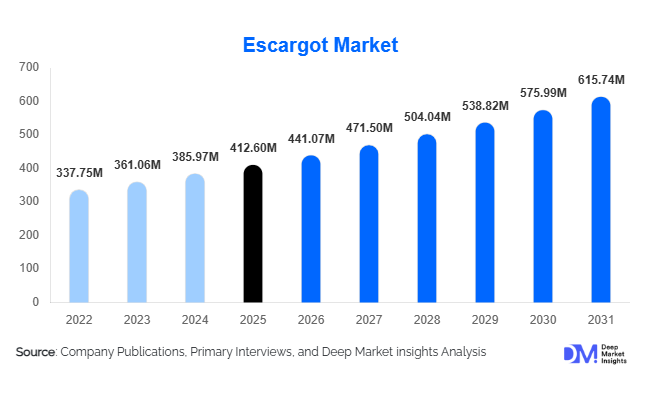
According to Deep Market Insights, the global escargot market size was valued at USD 412.6 million in 2025 and is projected to grow from USD 441.07 million in 2026 to reach USD 615.74 million by 2031, expanding at a CAGR of 6.9% during the forecast period (2026–2031). Market estimates represent an averaged industry assessment with a controlled variance range, reflecting differences in regional reporting standards, informal trade volumes, and processing value additions. Growth of the escargot market is primarily driven by increasing global demand for premium protein sources, expansion of gourmet dining culture, and rising acceptance of alternative seafood products across international cuisines. Increasing exports from Europe and emerging production hubs in Eastern Europe, Africa, and Southeast Asia are strengthening supply chains, while frozen and canned formats are improving accessibility beyond traditional fine-dining markets.
Key Market Insights
- Processed escargot products dominate global trade, supported by extended shelf life and export compatibility.
- Europe remains the consumption hub, accounting for the largest share due to strong culinary heritage.
- Asia-Pacific is the fastest-growing production region, driven by low-cost farming and export-oriented aquaculture expansion.
- Foodservice demand contributes the majority of revenue, particularly premium restaurants and hospitality chains.
- Frozen escargot formats are expanding rapidly, enabling penetration into retail and e-commerce channels.
- Sustainability-focused snail farming practices are attracting investment and regulatory support globally.
What are the latest trends in the escargot market?
Premiumization of Exotic Protein Consumption
Escargot is increasingly positioned as a premium delicacy aligned with gourmet dining and experiential cuisine trends. High-end restaurants and boutique hospitality operators are incorporating escargot into tasting menus and fusion culinary offerings, expanding demand beyond traditional French cuisine. Consumers seeking novel food experiences are driving experimentation with flavored butter variants, ready-to-cook formats, and value-added preparations. This premium positioning allows producers to maintain strong pricing margins compared with conventional seafood categories. Culinary tourism and social media-driven food exploration are also influencing adoption among younger demographics.
Expansion of Processed and Ready-to-Cook Products
The industry is witnessing strong growth in frozen, canned, and pre-seasoned escargot products designed for retail consumers. Improvements in cold-chain logistics and vacuum packaging technologies are enabling exporters to reach markets in North America and Asia-Pacific efficiently. Retail-ready packaging and portion-controlled formats are improving accessibility for home consumers unfamiliar with traditional preparation methods. Manufacturers are investing in automation and standardized processing to ensure consistent quality, which is particularly important for international food safety compliance.
What are the key drivers in the escargot market?
Growth of Fine Dining and Culinary Tourism
The expansion of global gastronomy tourism and premium restaurant culture is a primary driver of escargot consumption. Michelin-starred restaurants and luxury hospitality chains increasingly include escargot as a signature offering, boosting demand across Europe, North America, and emerging Asian markets. Tourism recovery and rising experiential dining trends continue to support consistent foodservice demand.
Rising Demand for Sustainable Alternative Proteins
Snail farming requires significantly lower land, water, and feed inputs compared to livestock production. As sustainability becomes central to food procurement decisions, escargot is gaining recognition as an environmentally efficient protein source. Governments and agricultural bodies are supporting heliciculture (snail farming) as a viable rural income opportunity, particularly in developing economies.
Export Expansion and Supply Chain Formalization
Improved processing infrastructure and international certifications have enabled exporting countries such as Morocco, Turkey, Indonesia, and Poland to scale production. Export-driven demand from France, Spain, Italy, and the United States continues to stabilize pricing and encourage investment in farming operations.
What are the restraints for the global market?
Limited Consumer Awareness Outside Traditional Markets
Despite growing global exposure, escargot consumption remains culturally concentrated. Consumer hesitation and limited familiarity in emerging markets restrict retail adoption, requiring marketing investments and culinary education.
Supply Volatility and Biological Risks
Snail farming is sensitive to climate conditions, disease outbreaks, and seasonal production cycles. Variability in yield and dependence on manual harvesting can create supply fluctuations and pricing instability.
What are the key opportunities in the escargot industry?
Expansion into Retail and E-Commerce Channels
One of the most significant opportunities lies in retail-ready escargot products targeting home chefs and premium grocery consumers. Growth of gourmet e-commerce platforms allows producers to reach niche audiences globally without relying solely on restaurants. Ready-to-cook kits and flavored variants can broaden consumer adoption and increase repeat purchases.
Emerging Production Hubs in Developing Economies
Africa and Southeast Asia present strong opportunities due to favorable climatic conditions and lower labor costs. Governments promoting agricultural diversification are encouraging heliciculture as an export-oriented industry, creating new supply centers capable of meeting rising global demand.
Integration into Functional and High-Protein Food Segments
Escargot’s nutritional profile—rich in protein, iron, and omega fatty acids—positions it for expansion into health-focused food markets. Product innovation targeting protein-conscious consumers and gourmet meal kits could unlock new revenue streams beyond traditional culinary channels.
Report Scope
| Report Metric | Details |
|---|---|
| Market Size in 2025 | USD 412.60 Million |
| Market Size in 2026 | USD 441.07 Million |
| Market Size in 2031 | USD 615.74 Million |
| CAGR | 6.9% (2026-2031) |
| Base Year for Estimation | 2025 |
| Historical Data | 2022-2024 |
| Forecast Period | 2026-2031 |
| Report Coverage | Revenue Forecast, Competitive Landscape, Supply Chain Disruption, Growth Factors, Environment & Regulatory Landscape and Trends |
| Geographies Covered | North America, Europe, APAC, Middle East and Africa, LATAM |
| Countries Covered | U.S., Canada, U.K., Germany, France, Spain, Italy, Russia, Nordic, Benelux, Rest of Europe, China, Korea, Japan, India, Australia, Singapore, Taiwan, South East Asia, Rest of Asia-Pacific, UAE, Turky, Saudi Arabia, South Africa, Egypt, Nigeria, Rest of MEA, Brazil, Mexico, Argentina, Chile, Colombia, Rest of LATAM |
Explore more data points, trends and opportunities Download Free Sample Report
Product Type Insights
Processed escargot accounted for approximately 62% of the global market in 2025, establishing itself as the leading segment due to its export suitability and standardized quality control. Within processed categories, frozen escargot is the dominant choice as it effectively preserves natural flavor and texture while extending shelf life, supporting international trade and long-distance distribution. The convenience of ready-to-cook processed escargot appeals to both retail and foodservice buyers, further boosting demand. Fresh escargot continues to be preferred in Europe, where culinary traditions favor freshly harvested snails, but logistical limitations and shelf-life constraints restrict its broader global adoption. The processed segment is projected to continue its strong growth trajectory as global retailers and distributors increasingly prioritize premium, convenience-based food products that meet modern lifestyle demands.
Species Insights
Helix aspersa represented nearly 48% of global production share in 2025, driven by its rapid reproduction cycle, adaptability to diverse farm environments, and consistent size and flavor profile. These factors make it particularly suited for commercial escargot production and large-scale processing operations. In contrast, Helix pomatia retains its premium positioning within luxury dining segments due to its distinctive taste and texture. However, slower growth rates and more demanding cultivation requirements limit its overall market share despite higher pricing and strong consumer perception of exclusivity. The balance between these species supports a diversified product portfolio, catering to both mass-market convenience and high-end culinary demand.
Distribution Channel Insights
Foodservice channels dominated the escargot market with around 68% share in 2025, reflecting the strong presence of escargot in fine dining restaurants, hotels, and catering services. Luxury hotels and gourmet restaurants drive consistent demand for high-quality escargot, making foodservice the core distribution channel. Meanwhile, online gourmet retail is emerging as the fastest-growing channel, fueled by rising consumer preference for purchasing specialty and premium foods through digital platforms. E-commerce allows smaller producers and boutique brands to reach niche markets directly, creating opportunities for curated offerings, subscription boxes, and international shipping.
End-Use Insights
The restaurant and hospitality segment remains the largest end-use segment for escargot, supported by luxury dining trends, tourism recovery, and increasing global exposure to French cuisine. Gourmet retail is expanding rapidly with the proliferation of premium grocery chains, specialty food stores, and high-end supermarkets, enabling consumers to prepare escargot at home. Additionally, export-oriented processing companies are supplying meal-kit providers, airline catering services, and institutional buyers, establishing new industrial demand channels that diversify market consumption beyond traditional culinary establishments.
Explore more data points, trends and opportunities Download Free Sample Report
Escargot Market Segmentations
By Product Type
- Fresh Escargot
- Frozen Escargot
- Canned Escargot
- Processed & Ready-to-Cook Escargot
By Species
- Helix Aspersa
- Helix Pomatia
- Achatina Fulica
- Other Edible Snail Species
By Distribution Channel
- Foodservice
- Retail Stores & Supermarkets
- Online Retail & E-Commerce Platforms
- Specialty Gourmet Stores
- Export & Wholesale Distribution
By End Use
- Restaurants & Hospitality Industry
- Household Consumption
- Airline & Catering Services
- Gourmet Food Processing Companies
Regional Insights
Europe
Europe accounted for approximately 54% of global escargot consumption in 2025, with France, Spain, Italy, and Portugal as the primary markets. France alone contributes nearly 30% of global demand due to its deep-rooted culinary traditions, strong per-capita consumption, and high consumer awareness of escargot as a delicacy. The region benefits from well-established production facilities, export infrastructure, and favorable regulatory frameworks supporting high-quality farmed and processed escargot. Continued market growth is driven by innovation in ready-to-cook offerings, rising tourism, and expanding presence in gourmet retail outlets across urban centers, which help to introduce escargot to younger, cosmopolitan consumers.
Asia-Pacific
Asia-Pacific held nearly 21% market share and emerged as the fastest-growing region with a CAGR exceeding 8%. Countries such as Indonesia, Vietnam, and Thailand are rapidly expanding production capacities to serve both domestic and export markets, leveraging cost advantages and favorable climate conditions for snail farming. Meanwhile, consumption in China, Japan, and South Korea is increasing as premium dining and luxury hotel sectors incorporate escargot into their menus. Rising disposable incomes, growing awareness of Western cuisine, and the expansion of gourmet supermarkets and e-commerce platforms are key drivers stimulating regional growth.
North America
The United States dominates North American demand, supported by fine dining restaurants, high-end hotels, and gourmet retail imports. Urban metropolitan centers are witnessing increasing culinary diversity, with consumers showing rising interest in specialty seafood and European delicacies. Health-conscious and premium food trends also contribute to the adoption of escargot, while online grocery platforms and specialty food delivery services enable wider access, allowing small-scale producers to enter niche markets. The growth of experiential dining and gastronomic tourism further supports steady regional expansion.
Middle East & Africa
Morocco and Tunisia are major exporters supplying high-quality escargot to European markets, with established processing facilities and favorable climatic conditions for snail farming. In the Middle East, countries such as the UAE and Saudi Arabia are witnessing rising consumption driven by the expansion of luxury hospitality, international fine dining, and gourmet retail chains. Rising disposable incomes, increased tourism, and a growing expatriate population create a favorable environment for the adoption of specialty foods, including escargot. The development of culinary festivals and premium food experiences further supports regional market growth.
Latin America
Latin America remains a niche escargot market, with Brazil and Argentina gradually embracing escargot within premium dining segments. Culinary tourism and the growth of high-end restaurants are driving awareness and acceptance of escargot as a gourmet delicacy. Market expansion is further supported by increasing availability of imported frozen products and local initiatives to develop snail farming for commercial production. Rising urbanization, higher disposable incomes, and exposure to European cuisine are expected to sustain gradual growth in this region.
Key Players in the Escargot Market
- Romanzini Escargots
- Maison Escargot
- Bourgogne Escargots
- Escal S.A.
- Sabarot Wagrom
- France Escargots
- Snails House
- Helix Farm Poland
- La Lumaca Italia
- Greek Snail Farm
- Moroccan Snail Export
- Bon Chef Escargots
- Indo Snail Farm
- Royal Escargots
- Agro Snail Holding