Equine Supplement Products Market Size
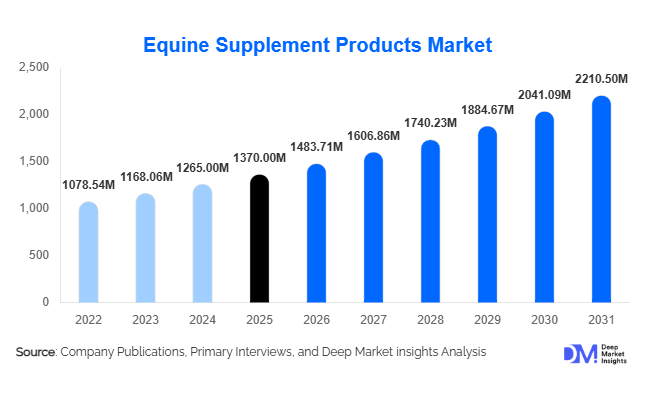
According to Deep Market Insights, the global equine supplement products market size was valued at USD 1,370 million in 2025 and is projected to grow from USD 1,483.71 million in 2026 to reach USD 2,210.50 million by 2031, expanding at a CAGR of 8.3% during the forecast period (2026–2031). Market growth is primarily driven by increasing awareness of preventive equine healthcare, rising commercialization of equestrian sports, and growing expenditure on performance optimization and animal wellness. Horse owners, breeders, and professional training facilities are increasingly adopting scientifically formulated nutritional supplements to enhance endurance, joint health, digestive efficiency, and recovery performance, transforming supplementation into a routine component of equine management worldwide.
Key Market Insights
- Preventive healthcare adoption is accelerating supplement consumption, with veterinarians increasingly recommending daily nutritional regimens for performance and aging horses.
- Joint health supplements dominate global demand, supported by injury prevention requirements in racing and competitive equestrian disciplines.
- North America leads global consumption due to high spending per horse and advanced veterinary infrastructure.
- Asia-Pacific represents the fastest-growing regional market, driven by expanding equestrian sports and rising equine ownership.
- Natural and herbal formulations are gaining traction as owners prioritize clean-label and competition-compliant products.
- E-commerce platforms are reshaping distribution, enabling subscription-based purchasing and personalized nutrition programs.
What are the latest trends in the equine supplement products market?
Personalized Equine Nutrition Programs
The market is increasingly moving toward precision nutrition tailored to individual horse requirements. Advances in veterinary diagnostics, metabolic monitoring, and performance analytics allow supplement manufacturers to develop customized feeding solutions based on workload, breed, age, and health status. Subscription-based supplement models are gaining popularity among professional trainers and individual owners seeking consistent nutritional management. Personalized supplementation improves health outcomes while strengthening customer retention for manufacturers, making it one of the most transformative trends shaping future market expansion.
Shift Toward Natural and Clean-Label Ingredients
Horse owners are increasingly favoring supplements formulated with natural botanicals, probiotics, and organic-certified ingredients. Concerns regarding banned substances in competitive sports and growing awareness of long-term animal wellness are encouraging adoption of herbal calming agents, plant-derived anti-inflammatory compounds, and microbiome-supporting formulations. Manufacturers are responding by investing in ingredient traceability and transparency initiatives, ensuring compliance with international equestrian competition standards while positioning products within premium pricing tiers.
What are the key drivers in the equine supplement products market?
Growth of Equestrian Sports and Racing Industries
The rapid commercialization of equestrian disciplines such as show jumping, endurance racing, and thoroughbred racing is significantly increasing supplement consumption. Performance horses require structured nutrition to sustain stamina, prevent injuries, and accelerate recovery cycles. Professional training facilities now integrate supplements into standardized feeding programs, driving recurring demand globally. Increasing prize money, international competitions, and sponsorship investments further strengthen demand for high-performance nutritional products.
Rising Focus on Preventive Veterinary Care
Veterinary professionals increasingly emphasize prevention over treatment, encouraging routine supplementation to reduce long-term medical costs associated with joint degeneration, digestive disorders, and metabolic stress. Aging horse populations in developed regions particularly support demand for joint, immunity, and recovery supplements. Preventive nutrition strategies are becoming integral to equine healthcare protocols, contributing to stable long-term market growth.
What are the restraints for the global market?
High Product Costs in Developing Regions
Premium equine supplements often carry higher price points due to specialized ingredients and quality assurance processes. This limits adoption among small-scale horse owners and working horse segments in developing economies where affordability remains a key purchasing factor. Price sensitivity continues to restrict full market penetration despite rising awareness.
Regulatory and Competition Compliance Challenges
Strict anti-doping regulations governing equestrian sports require manufacturers to maintain transparent ingredient sourcing and formulation consistency. Variations in regulatory frameworks across countries increase compliance costs and delay product launches. Manufacturers must continuously invest in testing and certification to ensure global acceptance of their products.
What are the key opportunities in the equine supplement products industry?
Expansion in Emerging Equestrian Economies
Rapid development of equestrian infrastructure across Asia-Pacific, the Middle East, and Latin America presents significant growth opportunities. Governments investing in racing tracks, polo clubs, and equestrian tourism are creating new demand for professional horse nutrition products. Early market entrants can benefit from brand establishment and distribution partnerships in underpenetrated regions.
Integration of Veterinary Healthcare and Nutrition
Collaboration between veterinary service providers and supplement manufacturers is creating integrated healthcare ecosystems. Supplements bundled within veterinary wellness programs ensure recurring consumption while improving health outcomes. This model strengthens customer loyalty and supports premium product positioning.
Report Scope
| Report Metric | Details |
|---|---|
| Market Size in 2025 | USD 1370 Million |
| Market Size in 2026 | USD 1483.71 Million |
| Market Size in 2031 | USD 2210.50 Million |
| CAGR | 8.3% (2026-2031) |
| Base Year for Estimation | 2025 |
| Historical Data | 2022-2024 |
| Forecast Period | 2026-2031 |
| Report Coverage | Revenue Forecast, Competitive Landscape, Supply Chain Disruption, Growth Factors, Environment & Regulatory Landscape and Trends |
| Geographies Covered | North America, Europe, APAC, Middle East and Africa, LATAM |
| Countries Covered | U.S., Canada, U.K., Germany, France, Spain, Italy, Russia, Nordic, Benelux, Rest of Europe, China, Korea, Japan, India, Australia, Singapore, Taiwan, South East Asia, Rest of Asia-Pacific, UAE, Turky, Saudi Arabia, South Africa, Egypt, Nigeria, Rest of MEA, Brazil, Mexico, Argentina, Chile, Colombia, Rest of LATAM |
Explore more data points, trends and opportunities Download Free Sample Report
Product Type Insights
The global equine supplement products market is primarily led by joint health supplements, which account for nearly 28% of total demand and continue to represent the most influential product category across both performance and recreational equine management. The dominance of this segment is driven by the increasing incidence of musculoskeletal stress among sport horses, aging equine populations, and the growing industry shift toward preventive healthcare rather than post-injury treatment. Trainers and veterinarians increasingly incorporate joint-support formulations containing glucosamine, chondroitin, hyaluronic acid, and collagen compounds into daily feeding programs to maintain mobility, reduce inflammation risk, and extend competitive lifespan. As equestrian sports intensify globally, maintaining joint integrity has become a critical performance determinant, reinforcing sustained demand for this segment.Digestive health supplements are witnessing accelerated adoption as scientific understanding of the equine gut microbiome expands. Horses possess highly sensitive digestive systems, making them vulnerable to colic, gastric ulcers, and nutrient absorption inefficiencies. Consequently, probiotics, prebiotics, and enzyme-based supplements are gaining widespread acceptance among owners seeking to improve feed conversion efficiency and overall health stability. Performance and energy supplements remain essential within racing, endurance riding, and competitive training environments, where optimized stamina, recovery speed, and muscle function are required to maintain competitive advantage. Meanwhile, hoof and coat supplements are gaining traction among recreational and show-horse owners who increasingly prioritize aesthetic appearance alongside wellness outcomes. Calming supplements and immunity-support products are also expanding steadily, reflecting rising awareness of stress management associated with travel, competitions, and changing environmental conditions, thereby broadening the functional scope of equine supplementation.
Formulation Insights
Powder formulations hold the leading share of approximately 36% of the global equine supplement products market, primarily driven by their flexibility in dosage customization and seamless integration into daily feed regimens. Training facilities, breeding farms, and veterinary professionals prefer powdered supplements because they allow precise nutrient adjustments based on horse age, workload intensity, and health status. The ability to mix powders directly with grain or forage improves compliance and ensures consistent intake, making this format particularly suitable for large-scale equine operations managing multiple animals.Liquid formulations continue to gain strong adoption due to faster absorption rates and improved bioavailability, especially during recovery phases or therapeutic interventions. Liquids are often administered when rapid nutrient delivery is required following intense exercise or medical treatment. Pellets and granules remain widely utilized within commercial farms and structured feeding programs, where operational efficiency and standardized feeding schedules are essential. Paste and gel supplements are commonly used for targeted short-term administration, including electrolyte replenishment, digestive stabilization, or stress management during transport. Additionally, chewable treat-based supplements represent an emerging innovation segment, appealing strongly to recreational owners seeking convenient administration methods that reduce resistance during feeding while enhancing owner-horse interaction experiences.
Distribution Channel Insights
Veterinary clinics and hospitals represent the dominant distribution channel, contributing nearly 30% of global sales, largely due to the strong influence of professional medical recommendations on purchasing behavior. Equine veterinarians play a critical advisory role in supplement selection, particularly for performance horses and rehabilitation cases, where scientifically validated formulations are prioritized. The growing emphasis on evidence-based equine nutrition continues to reinforce veterinary-led distribution dominance.Specialty equine retailers maintain an important market position by offering curated premium product portfolios alongside expert consultation services tailored to specific disciplines such as racing, dressage, and endurance riding. These retailers benefit from strong customer loyalty and niche expertise. Online and e-commerce platforms are emerging as the fastest-growing distribution channel, supported by subscription-based purchasing models, educational content marketing, and direct-to-consumer brand strategies that enhance accessibility for individual horse owners. Digital platforms enable comparative product evaluation and recurring purchasing convenience, significantly expanding market reach beyond traditional equestrian hubs. Feed and farm supply stores continue to provide strong penetration across rural markets, while direct bulk sales to stud farms, racing stables, and professional training facilities ensure stable, high-volume demand streams that support long-term supplier relationships.
End-Use Insights
Professional training and racing facilities account for approximately 38% of total market consumption, making them the leading end-use segment. The dominance of this category is driven by structured nutrition management programs designed to optimize athletic performance, minimize injury risk, and accelerate recovery cycles. High financial investment per horse within competitive racing and sport environments results in significantly higher supplement expenditure compared to other end users. Trainers increasingly adopt specialized supplementation strategies aligned with workload intensity, competition schedules, and veterinary performance monitoring.Stud farms and breeding centers represent a steadily expanding segment as operators focus on improving reproductive efficiency, foal development, and genetic performance outcomes. Nutritional supplementation during gestation, lactation, and early growth stages has gained importance in maximizing long-term horse health and value. Individual horse owners are emerging as one of the fastest-growing consumer groups, supported by rising recreational riding participation and increasing humanization trends in animal care, where horses are treated as long-term companions rather than purely working animals. Equine rehabilitation centers are also gaining prominence as specialized consumers, utilizing targeted joint-support, anti-inflammatory, and recovery formulations to assist injury rehabilitation programs and post-surgical recovery processes, thereby creating new demand avenues within therapeutic nutrition.
Explore more data points, trends and opportunities Download Free Sample Report
Equine Supplement Products Market Segmentations
By Product Type
- Joint Health Supplements
- Digestive Health Supplements
- Performance Energy Supplements
- Hoof Coat Supplements
- Calming Supplements
- Immunity Wellness Supplements
By Formulation
- Powder
- Liquid
- Pellets Granules
- Paste Gel
- Chewable Treat Supplements
By Distribution Channel
- Veterinary Clinics Hospitals
- Specialty Equine Retail Stores
- Online E-commerce Platforms
- Feed Farm Supply Stores
- Direct Institutional Sales
By End Use
- Professional Training Racing Facilities
- Stud Farms Breeding Centers
- Individual Horse Owners
- Equine Rehabilitation Centers
Regional Insights
North America
North America accounts for approximately 34% of the global equine supplement products market, supported by a highly structured equestrian ecosystem and one of the largest horse populations globally. The United States leads regional demand due to advanced veterinary healthcare infrastructure, strong participation in racing and competitive equestrian sports, and widespread adoption of preventive health management practices. Increasing awareness regarding performance optimization and longevity of sport horses continues to drive consistent supplement consumption. High disposable income levels enable owners and training facilities to invest in premium nutrition solutions, while the presence of established supplement manufacturers and strong research activity further accelerates product innovation. Canada contributes to regional growth through expanding recreational riding communities, organized breeding programs, and rising adoption of scientifically formulated equine nutrition solutions.
Europe
Europe represents nearly 29% of global demand and benefits from deeply rooted equestrian traditions and well-regulated animal welfare frameworks. Countries such as the United Kingdom, Germany, France, and the Netherlands maintain strong professional riding cultures supported by competitive events and structured racing industries. Regional growth is driven by stringent animal welfare regulations that encourage preventive healthcare and nutritional supplementation. Germany leads adoption of performance-focused equine nutrition due to its strong sport horse industry, while the United Kingdom’s racing sector sustains consistent demand for energy, joint, and recovery supplements. Increasing emphasis on natural and organic formulations aligned with European sustainability preferences is also shaping product development trends and supporting premium product adoption across the region.
Asia-Pacific
The Asia-Pacific region is the fastest-growing market, expanding at a CAGR exceeding 10%, driven by rapid modernization of equestrian infrastructure and rising awareness of professional horse care practices. China and Australia serve as key growth engines due to expanding racing industries and increased investment in equestrian sports facilities. India and Japan are witnessing growing adoption fueled by equine tourism, polo activities, and rising recreational riding participation. Increasing middle-class income levels, improving veterinary services, and greater exposure to international equine management standards are accelerating supplement penetration. Additionally, government initiatives supporting sports development and rural equine welfare programs are contributing to long-term market expansion across emerging economies in the region.
Latin America
Latin America demonstrates steady market growth led by Brazil, Argentina, and Mexico, where equine culture remains closely tied to agricultural activities, polo sports, and ranching traditions. Regional expansion is driven by gradual professionalization of breeding operations and increased awareness regarding structured nutrition for performance and working horses. Rising export-oriented breeding programs and improving veterinary accessibility are encouraging adoption of joint health and performance supplements. As equestrian sports gain greater international visibility in the region, owners are increasingly investing in preventive healthcare solutions, supporting sustained market penetration.
Middle East & Africa
The Middle East and Africa region is experiencing growing demand for premium equine supplements, particularly in the United Arab Emirates and Saudi Arabia, where endurance racing and luxury equestrian investments continue to expand rapidly. Regional growth is strongly supported by government-backed equestrian initiatives, international competitions, and high-value ownership of Arabian horses requiring specialized nutrition programs. Increasing focus on performance optimization in extreme climatic conditions further drives demand for hydration, immunity, and recovery supplements. South Africa represents a significant African growth market due to organized equestrian sports, improving veterinary services, and rising participation in competitive riding disciplines, collectively strengthening regional market development.
Key Players in the Equine Supplement Products Market
- Cargill Incorporated
- ADM Animal Nutrition
- Nutramax Laboratories Veterinary Sciences
- Zoetis Inc.
- Boehringer Ingelheim Animal Health
- Purina Animal Nutrition LLC
- Kentucky Equine Research
- Alltech Inc.
- Horse Health Products
- Equine America Ltd.
- Vetoquinol SA
- Farnam Companies Inc.
- Hilton Herbs Ltd.
- Finish Line Horse Products Inc.
- NAF (Natural Animal Feeds)