Electric Bicycle Conversion Kit Market Size
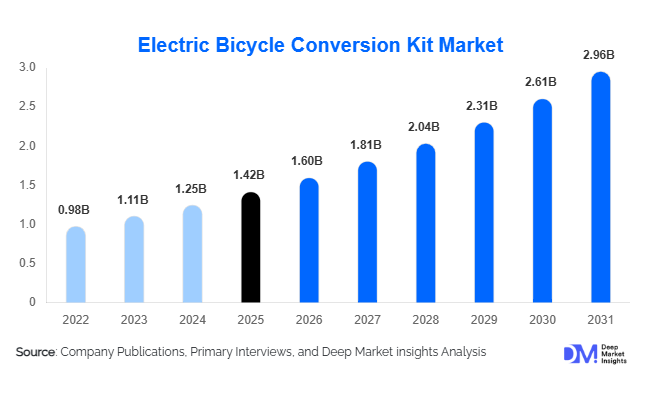
According to Deep Market Insights, the global electric bicycle conversion kit market size was valued at USD 1.42 billion in 2025 and is projected to grow from USD 1.60 billion in 2026 to reach USD 2.96 billion by 2031, expanding at a CAGR of 13.0% during the forecast period (2026–2031). The electric bicycle conversion kit market growth is primarily driven by rising demand for affordable electric mobility solutions, increasing urban congestion, growing environmental awareness, and the expanding adoption of electric bicycles for commuting and last-mile delivery applications.
Key Market Insights
- Electric bicycle conversion kits are increasingly becoming a cost-effective alternative to purchasing new e-bikes, especially among urban commuters and delivery riders.
- Hub motor conversion kits dominate the market due to easy installation, lower maintenance requirements, and compatibility with conventional bicycle platforms.
- Europe leads the global market, supported by strong cycling infrastructure, sustainability policies, and widespread e-bike adoption across Germany, the Netherlands, and France.
- Asia-Pacific is the fastest-growing region, driven by rising urbanization, fuel costs, and government-backed electric mobility initiatives in China and India.
- Commercial last-mile delivery operators are increasingly adopting electric conversion kits to reduce fuel costs and improve operational efficiency in urban logistics.
- Technological advancements, including smart battery systems, torque-sensing motors, IoT integration, and app-controlled connectivity, are reshaping consumer preferences.
Electric Bicycle Conversion Kit Market Trends
Smart and Connected Conversion Systems Gaining Momentum
The electric bicycle conversion kit industry is increasingly shifting toward smart mobility integration. Manufacturers are introducing Bluetooth-enabled displays, mobile application connectivity, GPS tracking, and intelligent battery monitoring systems to improve rider experience and operational efficiency. Consumers are demanding real-time diagnostics, theft protection, route optimization, and predictive maintenance capabilities. This trend is particularly strong among commercial delivery fleets and younger urban commuters seeking digitally connected transportation solutions. Companies are also integrating cloud-based fleet management software to monitor battery health, usage patterns, and rider behavior, creating recurring software-driven revenue opportunities within the market.
Commercial Fleet Electrification Expanding Rapidly
Commercial adoption of electric bicycle conversion kits is accelerating significantly due to the rapid expansion of e-commerce and food delivery industries. Delivery operators are increasingly retrofitting traditional bicycles with electric propulsion systems to reduce fuel costs, improve route efficiency, and meet sustainability goals. Urban logistics operators across Europe, Asia-Pacific, and North America are integrating conversion kits into delivery fleets because they offer lower capital expenditure compared to purchasing new electric bicycles. Municipal governments are also encouraging electric fleet adoption through low-emission transportation initiatives and urban congestion reduction programs, further supporting commercial demand growth.
Electric Bicycle Conversion Kit Market Drivers
Growing Demand for Affordable Electric Mobility
The increasing cost of fuel, rising urban congestion, and expanding environmental awareness are driving consumers toward affordable electric mobility solutions. Electric bicycle conversion kits allow consumers to convert existing bicycles into electric-powered transportation systems at significantly lower costs compared to purchasing new e-bikes. This affordability advantage is particularly attractive in emerging economies and price-sensitive urban markets. Consumers also benefit from retaining their preferred bicycle frames while upgrading transportation capabilities. Growing investment in cycling infrastructure and dedicated bike lanes globally is further encouraging adoption of electric mobility alternatives.
Expansion of E-Commerce and Last-Mile Delivery Networks
The rapid growth of e-commerce and app-based food delivery platforms is creating strong demand for electric bicycle conversion kits among commercial fleet operators. Delivery companies are increasingly seeking low-cost, energy-efficient transportation solutions capable of navigating congested urban areas quickly and sustainably. Electric conversion kits provide operational flexibility and significantly reduce fuel and maintenance expenses compared to traditional delivery vehicles. Countries such as China, India, Germany, the United States, and the Netherlands are witnessing substantial fleet electrification activities driven by urban logistics expansion.
Electric Bicycle Conversion Kit Market Restraints
Regulatory Inconsistencies Across Regions
The electric bicycle conversion kit market faces challenges due to varying e-bike regulations across countries and regions. Differences in power output limits, speed restrictions, road legality classifications, and battery certification requirements create compliance complexities for manufacturers and distributors. Regulatory fragmentation also increases product customization costs and complicates cross-border distribution strategies. Manufacturers operating globally must continuously adapt products to meet evolving legal standards, increasing operational costs and slowing market scalability.
Installation Complexity and Technical Compatibility Issues
Many consumers lack the technical expertise required to properly install advanced electric bicycle conversion kits. Compatibility issues related to bicycle frame design, wheel size, braking systems, and electrical integration can affect product performance and safety. Improper installation may lead to reduced battery efficiency, motor malfunction, and safety concerns. While professional installation services are expanding, they increase total ownership costs and may discourage adoption among cost-sensitive consumers.
Electric Bicycle Conversion Kit Market Opportunities
Government-Supported Sustainable Transportation Programs
Governments worldwide are increasingly investing in sustainable urban transportation systems and low-emission mobility solutions. Financial incentives for electric mobility adoption, dedicated cycling infrastructure projects, and carbon reduction initiatives are creating favorable conditions for electric bicycle conversion kit adoption. Europe continues to lead in policy-driven mobility transformation, while countries such as India and China are rapidly expanding support for electric transportation ecosystems. Manufacturers that align products with government sustainability programs and local regulatory frameworks are expected to benefit significantly from rising public-sector support.
Growth of Smart Mobility and IoT Integration
The integration of IoT, artificial intelligence, and smart connectivity into electric mobility systems presents substantial growth opportunities. Consumers increasingly prefer connected conversion kits that offer smartphone integration, ride analytics, GPS-based security, and battery performance optimization. Commercial fleet operators are also adopting intelligent fleet management platforms capable of monitoring route efficiency, maintenance scheduling, and energy consumption. Companies investing in software ecosystems and smart mobility technologies can strengthen product differentiation and generate long-term recurring revenue opportunities.
Report Scope
| Report Metric | Details |
|---|---|
| Market Size in 2025 | USD 1.42 Billion |
| Market Size in 2026 | USD 1.60 Billion |
| Market Size in 2031 | USD 2.96 Billion |
| CAGR | 13% (2026-2031) |
| Base Year for Estimation | 2025 |
| Historical Data | 2022-2024 |
| Forecast Period | 2026-2031 |
| Report Coverage | Revenue Forecast, Competitive Landscape, Supply Chain Disruption, Growth Factors, Environment & Regulatory Landscape and Trends |
| Geographies Covered | North America, Europe, APAC, Middle East and Africa, LATAM |
| Countries Covered | U.S., Canada, U.K., Germany, France, Spain, Italy, Russia, Nordic, Benelux, Rest of Europe, China, Korea, Japan, India, Australia, Singapore, Taiwan, South East Asia, Rest of Asia-Pacific, UAE, Turky, Saudi Arabia, South Africa, Egypt, Nigeria, Rest of MEA, Brazil, Mexico, Argentina, Chile, Colombia, Rest of LATAM |
Explore more data points, trends and opportunities Download Free Sample Report
Motor Type Insights
Hub motor conversion kits dominate the electric bicycle conversion kit market, accounting for the largest share of global demand due to easier installation, lower maintenance requirements, and affordability. Rear hub motor kits are particularly popular among urban commuters and delivery riders because they provide improved traction and durability. Geared hub motors are widely adopted in city commuting applications because of their lightweight construction and energy efficiency. Mid-drive motor systems are gaining traction in premium and performance-oriented applications, especially among mountain biking enthusiasts and long-distance riders seeking improved torque and climbing performance. Direct-drive hub motors are also witnessing adoption in commercial delivery applications due to their reliability and lower wear rates in high-usage environments.
Battery Type Insights
Lithium-ion batteries dominate the market due to superior energy density, lightweight construction, longer operational lifespan, and faster charging capabilities compared to traditional battery technologies. The 250–500 Wh battery segment accounts for a major share of market demand because it balances affordability, commuting range, and regulatory compliance in key regions such as Europe and Asia-Pacific. Premium conversion systems increasingly utilize higher-capacity battery packs above 500 Wh to support long-distance commuting and cargo delivery applications. Lithium iron phosphate (LFP) batteries are gaining popularity due to enhanced thermal stability and safety characteristics, particularly within commercial fleet applications requiring higher operational reliability.
Application Insights
Urban commuting remains the leading application segment in the electric bicycle conversion kit market due to increasing traffic congestion, rising fuel prices, and growing environmental awareness. Consumers are increasingly retrofitting existing bicycles to support daily transportation needs while reducing commuting expenses. Last-mile delivery applications represent the fastest-growing segment, supported by the rapid expansion of e-commerce and food delivery services globally. Recreational and adventure cycling applications are also witnessing strong demand growth as cycling participation increases across Europe and North America. Additionally, elderly mobility assistance applications are emerging as a growing niche segment, with consumers seeking low-impact personal transportation solutions for short-distance travel and leisure activities.
Distribution Channel Insights
Online retail platforms dominate the electric bicycle conversion kit market by enabling consumers to compare specifications, pricing, reviews, and installation tutorials across multiple brands. Direct-to-consumer sales channels are expanding rapidly as manufacturers increasingly invest in e-commerce infrastructure and digital marketing strategies. Specialty bicycle retailers continue to play an important role in premium product sales and professional installation services, particularly for high-performance mid-drive systems. Wholesale distribution networks remain relevant in commercial fleet procurement and institutional mobility projects. Social media marketing, online cycling communities, and instructional video content are also influencing purchasing decisions, particularly among DIY consumers seeking self-installation solutions.
End-User Insights
Individual consumers represent the largest end-user segment within the electric bicycle conversion kit market due to growing urban commuting demand and increasing consumer preference for affordable electric transportation. Commercial delivery operators are the fastest-growing end-user category, driven by rapid expansion in urban logistics and app-based delivery services. Shared mobility operators and tourism rental providers are also integrating conversion kits into fleet operations to improve sustainability and reduce fleet acquisition costs. Municipal governments, universities, and industrial campuses are increasingly adopting electric bicycle conversion systems for internal transportation and mobility management applications, further supporting market expansion.
Power Output Insights
The 250W–500W power segment dominates the market due to favorable regulatory acceptance across Europe and Asia-Pacific. These systems provide sufficient performance for urban commuting while complying with most regional e-bike regulations. Lower-power systems below 250W are commonly adopted in highly regulated urban markets, prioritizing safety and energy efficiency. Conversion kits above 500W are witnessing rising demand among off-road cyclists, cargo delivery operators, and performance-focused consumers seeking higher acceleration and hill-climbing capabilities. Premium high-power systems are increasingly integrating torque sensors and advanced battery management systems to improve efficiency and riding comfort.
Explore more data points, trends and opportunities Download Free Sample Report
Electric Bicycle Conversion Kit Market Segmentations
By Motor Type
- Hub Motor Conversion Kits
- Mid-Drive Motor Conversion Kits
- Friction Drive Conversion Kits
- All-in-One Wheel Conversion Systems
By Battery Type
- Lithium-Ion Battery Kits
- Lead Acid Battery Kits
- Nickel Metal Hydride Battery Kits
By Application
- Urban Commuting
- Recreational Cycling
- Last-Mile Delivery
- Adventure and Off-Road Cycling
- Elderly and Assisted Mobility
- Campus and Industrial Mobility
By Distribution Channel
- Online Retail Platforms
- Specialty Bicycle Stores
- Direct-to-Consumer Brand Websites
- Automotive and Mobility Retailers
- Wholesale and Distributor Networks
By End User
- Individual Consumers
- Commercial Delivery Operators
- Shared Mobility Operators
- Tourism and Rental Service Providers
- Government and Municipal Fleets
- Corporate Mobility Programs
Regional Insights
Europe
Europe represents the largest regional market for electric bicycle conversion kits, accounting for approximately 36% of global revenue in 2025. Germany, the Netherlands, France, Italy, and the United Kingdom are key contributors due to mature cycling infrastructure, strong environmental regulations, and widespread consumer acceptance of electric mobility. Germany leads regional demand with strong adoption of urban commuting e-bikes and government-supported sustainability programs. The Netherlands remains one of the most bicycle-oriented economies globally, supporting strong retrofit demand. France and Italy are also witnessing rising adoption driven by urban congestion reduction initiatives and financial incentives for sustainable transportation.
Asia-Pacific
Asia-Pacific is the fastest-growing regional market, supported by rapid urbanization, rising fuel prices, and expanding electric mobility investments. China dominates regional demand due to its large-scale bicycle manufacturing ecosystem and extensive urban commuting population. India is emerging rapidly as government programs supporting electric transportation and increasing consumer cost sensitivity accelerate market penetration. Japan and South Korea are witnessing growing adoption of compact and smart conversion systems targeting urban commuters and elderly mobility users. Expanding cycling infrastructure and increasing awareness regarding sustainable transportation continue to strengthen long-term regional growth potential.
North America
North America accounts for a significant share of global demand, led primarily by the United States and Canada. Increasing interest in recreational cycling, urban micro-mobility, and sustainable commuting is supporting market expansion across major metropolitan areas. Delivery fleet electrification and rising consumer demand for customizable e-bike solutions are contributing strongly to market growth. Cities such as New York, Seattle, San Francisco, Toronto, and Vancouver are investing heavily in cycling infrastructure, encouraging adoption of electric retrofit solutions among urban commuters and logistics operators.
Latin America
Latin America is emerging as a promising growth market due to rising fuel prices, urban congestion, and increasing interest in affordable mobility alternatives. Brazil and Mexico represent the largest regional markets, supported by growing urban populations and expanding delivery service industries. Although cycling infrastructure remains underdeveloped in several countries, increasing government focus on sustainable transportation is expected to create favorable conditions for future market expansion.
Middle East & Africa
The Middle East & Africa region is gradually expanding within the electric bicycle conversion kit market due to rising investments in sustainable transportation and smart city development. The United Arab Emirates and South Africa are among the leading regional markets due to increasing demand for urban micro-mobility solutions and tourism-related cycling applications. Government initiatives supporting green transportation and low-emission infrastructure are expected to strengthen long-term regional market development.
Key Players in the Electric Bicycle Conversion Kit Market
- Bafang Electric
- Bosch eBike Systems
- Shimano Inc.
- Swytch Technology
- Tongsheng
- CYC Motor
- Pendix GmbH
- Golden Motor Technology
- Ebikeling
- Dillenger Electric Bikes
- Voilamart
- Yose Power
- Rubbee
- MXUS
- Hilltopper Electric Bike Company