Eel Market Size
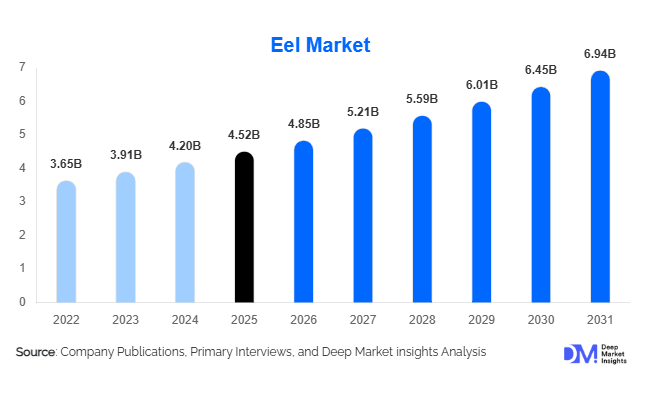
According to Deep Market Insights, the global eel market size was valued at USD 4.52 billion in 2025 and is projected to grow from USD 4.85 billion in 2026 to reach USD 6.94 billion by 2031, expanding at a CAGR of 7.4% during the forecast period (2026–2031). The eel market growth is primarily driven by the rising consumption of premium seafood products, expanding Japanese and Asian cuisine culture globally, increasing investments in sustainable aquaculture systems, and growing demand for nutrient-rich marine protein across both developed and emerging economies.Eel remains one of the most commercially valuable seafood categories globally due to its premium positioning in restaurants, sushi chains, processed seafood products, and specialty retail channels. Demand is particularly strong across East Asia, especially in China, Japan, South Korea, and Taiwan, where eel is deeply integrated into culinary traditions and premium dining culture. The increasing globalization of Japanese cuisine has significantly expanded eel consumption across North America, Europe, and the Middle East, supporting long-term market expansion.
Advancements in aquaculture technologies, including recirculating aquaculture systems (RAS), automated feeding systems, AI-enabled water quality monitoring, and disease management technologies, are improving production efficiency and enabling stable year-round eel supply. Farmed eel production has become increasingly important as governments impose stricter restrictions on wild eel harvesting due to sustainability concerns and declining natural eel populations.The market is also benefiting from expanding cold-chain logistics infrastructure, rising seafood exports from Asia-Pacific, and growing consumer awareness regarding omega-3-rich and high-protein diets. Additionally, eel-derived nutraceuticals, collagen products, and marine wellness applications are emerging as new revenue streams for market participants globally.
Key Market Insights
- Farmed eel production dominates global supply, accounting for the majority of commercial production due to restrictions on wild eel harvesting and growing sustainability concerns.
- Asia-Pacific remains the dominant regional market, led by China, Japan, South Korea, and Taiwan owing to strong cultural consumption patterns and advanced aquaculture infrastructure.
- Processed and ready-to-eat eel products are witnessing rapid growth, supported by rising demand for convenience seafood products and expanding retail distribution channels.
- Japanese cuisine globalization is accelerating international eel consumption, particularly through sushi chains, premium seafood restaurants, and Asian quick-service restaurant formats.
- Technological innovation in aquaculture systems, including AI-based monitoring and recirculating water systems, is improving productivity and reducing operational risks.
- Nutraceutical and wellness applications are emerging as high-growth opportunities, driven by increasing demand for marine collagen, omega-3 supplements, and protein-rich functional foods.
What are the latest trends in the eel market?
Sustainable Aquaculture Expansion Accelerating
The global eel industry is rapidly transitioning toward sustainable aquaculture systems as governments tighten regulations on wild eel harvesting and marine biodiversity protection. Commercial producers are investing heavily in recirculating aquaculture systems, automated oxygen management technologies, water purification infrastructure, and biosecure farming environments to improve survival rates and production efficiency. Sustainable farming certifications and traceability systems are becoming increasingly important for exporters seeking access to premium markets in Europe, Japan, and North America. Companies are also integrating renewable energy systems and environmentally compliant waste management technologies into aquaculture facilities to align with ESG-focused investment trends and international seafood sustainability standards.
Growing Demand for Premium Processed Eel Products
Processed eel products such as vacuum-packed grilled eel, frozen kabayaki eel, smoked eel portions, and ready-to-eat seafood meals are gaining strong global traction. Urban consumers increasingly prefer convenient seafood products with extended shelf life and restaurant-grade quality. Supermarkets, online seafood retailers, and premium foodservice distributors are expanding their processed eel product portfolios to meet rising demand from younger and working consumers. Innovations in vacuum packaging, modified atmosphere packaging, and individually quick frozen technologies are enhancing product preservation and export efficiency. The expansion of global sushi chains and Asian restaurant formats is further driving international demand for standardized processed eel products suitable for commercial foodservice operations.
What are the key drivers in the eel market?
Rising Global Consumption of Premium Seafood
The increasing demand for premium seafood products is one of the major growth drivers for the global eel market. Rising disposable income, urbanization, and evolving consumer preferences toward protein-rich diets are encouraging higher consumption of premium marine food products globally. Eel is widely regarded as a luxury seafood item in East Asian markets, particularly in Japan and South Korea, where grilled eel dishes and sushi preparations remain highly popular. Expanding middle-class populations in Asia-Pacific and growing premium seafood demand in North America and Europe are collectively supporting market growth. Consumers are increasingly willing to pay premium prices for authentic seafood experiences, traceable sourcing, and high nutritional value.
Expansion of Japanese Cuisine and Sushi Chains
The rapid globalization of Japanese cuisine has significantly increased eel demand worldwide. Sushi chains, Japanese restaurants, and premium seafood dining formats are expanding aggressively across major urban markets in North America, Europe, the Middle East, and Southeast Asia. Eel-based dishes such as unagi don, kabayaki, and sushi rolls are becoming increasingly mainstream among affluent and younger consumers. Food delivery platforms and online restaurant aggregators are also contributing to higher consumption frequency by improving accessibility to premium seafood products. International tourism growth and rising exposure to Asian culinary culture through social media are further accelerating global eel market expansion.
What are the restraints for the global market?
Declining Wild Eel Populations and Regulatory Restrictions
One of the major restraints affecting the global eel market is the declining population of wild eel species due to overfishing, habitat degradation, pollution, and climate-related ecosystem disruptions. Several eel species are now subject to conservation measures, export restrictions, fishing quotas, and international trade monitoring systems. Regulatory compliance increases operational complexity for seafood exporters and creates uncertainty within global supply chains. Governments across Europe and Asia have introduced stricter licensing and traceability requirements, which may limit short-term production capacity and increase operational costs for producers and exporters.
High Aquaculture Production Costs
Eel farming remains capital-intensive due to the specialized infrastructure required for water quality control, disease management, oxygen regulation, and temperature stabilization. Rising feed prices, energy costs, and juvenile eel procurement expenses continue to pressure producer profit margins. Smaller aquaculture operators often face difficulties scaling production efficiently because eel breeding remains biologically complex compared to conventional fish farming. Disease outbreaks and mortality risks can further increase financial uncertainty within commercial eel farming operations, especially in regions with limited technological adoption.
What are the key opportunities in the eel industry?
Nutraceutical and Functional Food Applications
The growing global wellness and functional nutrition industry presents significant opportunities for eel-derived products. Eel contains high levels of omega-3 fatty acids, collagen, vitamins A and E, and protein, making it increasingly attractive for marine-based nutraceuticals and wellness supplements. Manufacturers are developing eel oil capsules, collagen extracts, protein powders, and fortified marine nutrition products targeted toward health-conscious consumers. Rising consumer awareness regarding anti-aging nutrition, joint health, and protein supplementation is expected to accelerate adoption of eel-derived nutraceutical products globally.
Export-Oriented Seafood Processing Expansion
Asia-Pacific seafood exporters are increasingly investing in advanced processing infrastructure to support global eel trade expansion. China, Vietnam, Indonesia, and Taiwan are strengthening their positions as major export hubs through investments in cold-chain logistics, automated seafood processing facilities, and international food safety certifications. Export demand from Europe, North America, and the Middle East continues to increase due to growing consumption of premium seafood and Asian cuisine. Companies that establish efficient export networks and sustainability-compliant supply chains are expected to gain substantial competitive advantages over the forecast period.
Report Scope
| Report Metric | Details |
|---|---|
| Market Size in 2025 | USD 4.52 Billion |
| Market Size in 2026 | USD 4.85 Billion |
| Market Size in 2031 | USD 6.94 Billion |
| CAGR | 7.4% (2026-2031) |
| Base Year for Estimation | 2025 |
| Historical Data | 2022-2024 |
| Forecast Period | 2026-2031 |
| Report Coverage | Revenue Forecast, Competitive Landscape, Supply Chain Disruption, Growth Factors, Environment & Regulatory Landscape and Trends |
| Geographies Covered | North America, Europe, APAC, Middle East and Africa, LATAM |
| Countries Covered | U.S., Canada, U.K., Germany, France, Spain, Italy, Russia, Nordic, Benelux, Rest of Europe, China, Korea, Japan, India, Australia, Singapore, Taiwan, South East Asia, Rest of Asia-Pacific, UAE, Turky, Saudi Arabia, South Africa, Egypt, Nigeria, Rest of MEA, Brazil, Mexico, Argentina, Chile, Colombia, Rest of LATAM |
Explore more data points, trends and opportunities Download Free Sample Report
Species Type Insights
The Japanese eel segment continues to dominate the global eel market, accounting for approximately 39% of the overall market share. The dominance of this species is primarily driven by exceptionally strong consumer demand across Japan, China, South Korea, and other East Asian countries where eel has long been considered a premium seafood delicacy. Japanese eel is extensively utilized in traditional culinary preparations such as kabayaki, unagi sushi, grilled seafood platters, rice bowls, and specialty restaurant dishes due to its rich flavor profile, tender texture, high fat content, and strong cultural acceptance among consumers. The growing popularity of Japanese cuisine worldwide has further accelerated international demand for Japanese eel products, particularly across North America and Europe where premium Asian dining experiences continue to gain popularity.Meanwhile, giant mottled eel is gaining increasing traction within Southeast Asian aquaculture operations due to its strong adaptability to tropical farming conditions, favorable growth characteristics, and comparatively lower production costs. Countries including Indonesia, Vietnam, Thailand, and the Philippines are increasingly expanding commercial farming operations for giant mottled eel to strengthen export competitiveness and meet rising regional seafood demand. Furthermore, ongoing research related to genetic improvement programs, artificial breeding technologies, and sustainable aquaculture systems is expected to significantly enhance long-term commercial production efficiency across multiple eel species categories during the forecast period.
Product Form Insights
Processed ready-to-eat eel products represent one of the fastest-growing categories within the global eel market, accounting for nearly 28% of total market revenues. The strong growth of this segment is primarily driven by changing consumer lifestyles, increasing urbanization, rising demand for convenience foods, and growing preference for premium restaurant-quality seafood experiences at home. Consumers across both developed and emerging economies are increasingly seeking convenient seafood products that offer high nutritional value, easy preparation, extended shelf life, and authentic culinary flavors. As a result, frozen grilled eel, smoked eel, canned eel products, marinated eel, vacuum-packed seafood meals, and pre-cooked eel fillets are experiencing substantial growth across retail and foodservice channels globally.Fresh and chilled eel products continue to maintain strong demand across Asian foodservice industries, particularly in Japan, China, and South Korea where freshly prepared eel dishes remain deeply integrated into traditional culinary culture. Restaurants specializing in sushi, grilled seafood, and Japanese cuisine continue to prioritize fresh eel supplies due to superior taste and texture characteristics. At the same time, smoked and dried eel products remain highly popular across European markets where traditional seafood preservation methods continue to influence consumption patterns. Northern and Western European countries maintain consistent demand for artisanal smoked eel products within premium seafood retail and gourmet dining sectors.Growing health awareness among consumers is also supporting product innovation across the eel market. Eel products are increasingly marketed as rich sources of omega-3 fatty acids, protein, vitamins, collagen, and essential nutrients that support heart health, skin health, and overall wellness. Consequently, manufacturers are introducing healthier processed eel variants with reduced sodium content, organic certifications, and sustainable sourcing labels to appeal to evolving consumer preferences. The continued growth of international seafood trade, expanding frozen food industries, and increasing demand for premium convenience seafood products are expected to further strengthen the processed eel segment during the forecast period.
Farming Source Insights
Farmed eel dominates the global eel market, accounting for approximately 72% of total commercial supply. The dominance of this segment is primarily driven by declining wild eel populations, increasing environmental regulations, rising seafood consumption, and the growing need for stable commercial production systems capable of meeting global demand. Aquaculture expansion has become essential for ensuring long-term supply security within the eel industry as natural eel stocks continue to face pressure from overfishing, habitat degradation, climate change, and water pollution.The leading position of the farmed eel segment is also supported by rising global consumer preference for traceable and sustainably sourced seafood products. Foodservice operators, retailers, and seafood importers are increasingly prioritizing certified aquaculture suppliers capable of ensuring product consistency, food safety compliance, and environmental responsibility. Consequently, aquaculture producers are adopting advanced sustainability practices, including water recycling systems, sustainable feed alternatives, and energy-efficient farming technologies to strengthen long-term competitiveness and meet evolving regulatory standards.Although wild-caught eel continues to hold niche demand within traditional culinary applications and premium seafood markets, the segment remains constrained by strict conservation policies, seasonal fishing restrictions, and declining natural availability. Wild eel products are often associated with premium pricing due to limited supply and cultural significance in certain regional cuisines. However, growing environmental concerns and international conservation efforts are expected to continue limiting large-scale expansion of the wild-caught segment over the coming years.
Distribution Channel Insights
Foodservice distributors and restaurant supply chains account for nearly 34% of global eel demand, making this segment the leading distribution channel within the global eel market. The dominance of the foodservice segment is strongly supported by the rapid expansion of sushi restaurant chains, Japanese cuisine establishments, luxury seafood dining outlets, premium hospitality operators, and international fine-dining restaurants across major global cities. Eel remains a highly valued ingredient in premium culinary applications due to its unique flavor, texture, and strong cultural association with traditional Japanese cuisine.The increasing globalization of Asian food culture has significantly contributed to the expansion of eel consumption across international foodservice industries. Consumers in North America, Europe, the Middle East, and Southeast Asia are increasingly seeking authentic Japanese dining experiences, leading to rising demand for eel-based menu offerings in restaurants and hotels. In addition, tourism growth and rising disposable incomes are further supporting spending on premium seafood dining experiences across both developed and emerging economies.Modern retail channels, including supermarkets, hypermarkets, gourmet seafood stores, and specialty Asian grocery chains, are also expanding their premium seafood product portfolios to meet rising consumer interest in healthy protein-rich diets and international cuisine. Retailers are increasingly offering frozen eel fillets, ready-to-cook seafood meals, smoked eel products, and vacuum-packed eel dishes to cater to convenience-focused consumers. Furthermore, online seafood platforms and e-commerce grocery services are emerging as increasingly important sales channels, particularly in urban markets where digital shopping adoption and home-delivery demand continue to rise rapidly.
End-Use Insights
Restaurants and foodservice establishments remain the largest end-use segment within the global eel market, supported by strong and consistent demand from sushi chains, Japanese cuisine restaurants, premium seafood dining operators, luxury hotels, and international hospitality brands. The leadership of this segment is primarily driven by growing consumer spending on premium dining experiences, increasing popularity of Asian cuisine worldwide, and expanding global tourism activities that continue to boost restaurant seafood consumption.Eel is widely regarded as a high-value seafood ingredient in professional culinary applications due to its rich taste, nutritional value, and versatility in various traditional and modern dishes. Japanese restaurants continue to represent the largest commercial consumers of eel products globally, particularly for unagi-based preparations, grilled seafood menus, and sushi offerings. Additionally, upscale dining establishments are increasingly incorporating eel into fusion cuisine and gourmet seafood menus to attract affluent consumers seeking unique culinary experiences.The nutraceutical and functional food industry represents one of the fastest-growing end-use categories within the eel market. Manufacturers are increasingly utilizing eel-derived collagen, omega-3-rich oils, protein extracts, and bioactive compounds in dietary supplements, wellness products, and sports nutrition formulations. Growing health awareness, aging populations, and rising consumer interest in preventive healthcare are significantly supporting demand for marine-derived functional ingredients. Furthermore, cosmetic and pharmaceutical applications are gradually emerging as niche growth opportunities due to increasing interest in marine bioactive compounds for anti-aging skincare, wound healing products, and pharmaceutical research applications.
Explore more data points, trends and opportunities Download Free Sample Report
Eel Market Segmentations
By Species Type
- Japanese Eel
- European Eel
- American Eel
- Giant Mottled Eel
- Shortfin Eel
- Longfin Eel
- Other Freshwater Eel Species
By Product Form
- Live Eel
- Fresh/Chilled Eel
- Frozen Eel
- Smoked Eel
- Dried Eel
- Canned/Preserved Eel
- Roasted/Grilled Eel Products
- Processed Ready-to-Eat Eel
- Eel Fillets & Portions
- Eel Powder/Extract Products
By Farming Source
- Wild-Caught Eel
- Aquaculture/Farmed Eel
- Recirculating Aquaculture Systems (RAS)
- Pond-Based Aquaculture
- Cage Aquaculture
- Integrated Multi-Trophic Aquaculture
By Distribution Channel
- Direct B2B Supply
- Seafood Wholesalers
- Modern Retail & Supermarkets
- Specialty Seafood Stores
- Foodservice Distributors
- Online Seafood Platforms
- Export Trading Companies
By End Use
- Household Consumption
- Restaurants & Foodservice
- Sushi & Japanese Cuisine Chains
- Seafood Processing Industry
- Nutraceutical & Functional Food Industry
- Pharmaceutical & Cosmetic Applications
- Pet Food & Aquafeed Applications
Regional Insights
Asia-Pacific
Asia-Pacific dominates the global eel market, accounting for approximately 68% of total market revenues. The region’s leadership is primarily driven by strong cultural consumption patterns, large-scale aquaculture production, advanced seafood processing infrastructure, and exceptionally high demand for eel-based cuisine across East Asian countries. China remains the largest producer and exporter of eel globally due to its extensive commercial farming operations, advanced aquaculture technologies, cost-efficient production systems, and strong export-oriented seafood industry. The country’s large-scale processing facilities and established international trade networks further strengthen its dominance within the global eel supply chain.Southeast Asian countries including Vietnam, Indonesia, Thailand, and the Philippines are emerging as important aquaculture hubs due to favorable climatic conditions, lower labor costs, rising foreign investments, and expanding seafood export industries. Government support for aquaculture modernization, improvements in cold-chain logistics, and increasing adoption of sustainable farming technologies are further accelerating regional market growth. The strong presence of seafood processing industries, export demand from Japan and China, and expanding regional trade agreements continue to position Asia-Pacific as the dominant growth engine of the global eel market.
North America
North America accounts for nearly 10% of the global eel market, led primarily by the United States and Canada. The region is witnessing steady growth due to the rapidly increasing popularity of Japanese cuisine, expansion of sushi restaurant chains, rising multicultural food consumption trends, and growing consumer demand for premium seafood products. The United States represents one of the fastest-growing import destinations for processed eel products globally as urban consumers increasingly seek authentic Asian culinary experiences and high-quality seafood offerings.Retail expansion is another important growth driver within the region. Supermarkets, gourmet seafood retailers, and online grocery platforms are increasingly offering frozen eel fillets, smoked eel products, and ready-to-cook seafood meals to cater to evolving consumer preferences. Improvements in cold-chain logistics, digital grocery delivery services, and premium seafood marketing strategies are further improving accessibility to eel products across urban markets. Rising tourism, expanding Asian immigrant populations, and increasing adoption of international cuisine trends are expected to continue driving North American eel market growth during the forecast period.
Europe
Europe holds approximately 14% of the global eel market share, with Germany, the Netherlands, France, Spain, Italy, and Scandinavian countries representing major consumption centers. The region maintains strong demand for smoked eel products, gourmet seafood preparations, and premium delicatessen offerings due to long-standing culinary traditions associated with eel consumption. Northern and Western European countries, in particular, continue to maintain stable demand for smoked eel products within specialty seafood retail and restaurant sectors.However, strict conservation frameworks, environmental protection measures, and fishing restrictions continue to influence regional supply dynamics and limit wild eel harvesting activities. As a result, Europe remains highly dependent on imports from Asian aquaculture producers to satisfy growing consumer demand. Investments in sustainable seafood distribution systems, premium retail expansion, and frozen seafood infrastructure are expected to further support long-term market development across the region.
Latin America
Latin America is gradually emerging as a developing market for premium seafood and imported eel products, supported by rising urbanization, increasing disposable incomes, and growing exposure to international food culture. Brazil and Mexico represent the leading regional markets due to expanding hospitality industries, premium restaurant growth, and increasing consumer interest in Japanese and Asian cuisine.Although domestic eel production remains limited, rising imports of processed and frozen eel products are expected to support steady market growth during the forecast period. Growing investments in premium retail development, online grocery platforms, and international foodservice expansion are likely to create additional opportunities for eel suppliers targeting emerging Latin American markets.
Middle East & Africa
The Middle East & Africa region is witnessing moderate but steadily increasing growth within the global eel market, led by the UAE, Saudi Arabia, Qatar, and South Africa. Rising disposable incomes, expanding luxury hospitality sectors, increasing tourism activity, and strong demand for premium imported seafood products are among the primary factors supporting regional market expansion.In Africa, South Africa represents the leading regional market due to its relatively advanced retail infrastructure, growing hospitality sector, and increasing exposure to international cuisine trends. Expanding premium supermarket chains, seafood specialty retailers, and urban restaurant industries are gradually supporting consumer awareness and product accessibility. Furthermore, increasing investments in foodservice modernization, international tourism development, and premium retail expansion are expected to create long-term growth opportunities for imported eel products across the Middle East & Africa region.
Key Players in the Eel Market
- Fujian Tianma Science and Technology Group Co., Ltd.
- Maruha Nichiro Corporation
- Nippon Suisan Kaisha Ltd.
- Chuo Gyorui Co., Ltd.
- Yoshoku Co., Ltd.
- Guangdong Evergreen Group
- Zhejiang Wanli University Aquaculture Group
- Shandong Oriental Ocean Sci-Tech Co., Ltd.
- Avanti Feeds Limited
- Hsin Yung Chien Co., Ltd.
- Lee Fish Group
- Jinjiang Shanhai Aquatic Products
- Kaohsiung Fisheries Group
- Guangdong Gourmet Aquatic Products
- Dalian Zhangzidao Fishery Group