Edible Snail Market Size
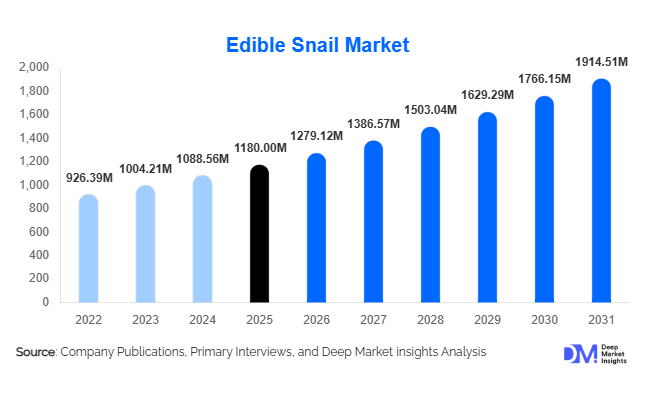
According to Deep Market Insights, the global edible snail market size was valued at USD 1,180 million in 2025 and is projected to grow from USD 1,279.12 million in 2026 to reach USD 1,914.51 million by 2031, expanding at a CAGR of 8.4% during the forecast period (2026–2031). The edible snail market growth is primarily driven by the increasing demand for sustainable protein alternatives, expanding applications in cosmetics and personal care, and the rising popularity of gourmet and premium food experiences across global markets.
Key Market Insights
- Edible snails are emerging as a sustainable protein source, offering low environmental impact compared to conventional livestock farming.
- The cosmetics industry is driving high-value demand, particularly for snail mucin used in skincare and anti-aging formulations.
- Europe dominates the global market, led by strong culinary traditions and high consumption in France, Spain, and Italy.
- Asia-Pacific is the fastest-growing region, fueled by rising disposable incomes and expanding food diversity.
- Intensive snail farming (heliciculture) is gaining traction, ensuring consistent supply and scalability for global exports.
- Premiumization trends in foodservice are boosting demand for gourmet snail-based dishes and ready-to-cook products.
What are the latest trends in the edible snail market?
Expansion of Snail Mucin in Cosmetics
The integration of snail mucin into skincare and cosmetic products is one of the most transformative trends shaping the edible snail market. Known for its regenerative and anti-aging properties, snail mucin is widely used in creams, serums, and masks. The rising global demand for natural and organic beauty products is accelerating this trend, particularly in Asia-Pacific markets such as South Korea and Japan. Cosmetic manufacturers are increasingly investing in snail extraction technologies and forming partnerships with snail farms to secure consistent supply. This trend is elevating the market from a traditional food segment to a high-value, multi-industry ecosystem, significantly enhancing revenue potential for producers.
Shift Toward Sustainable and Controlled Farming
Sustainability concerns are pushing the adoption of intensive and semi-intensive snail farming systems. Compared to livestock, snail farming requires minimal land, water, and feed, making it an environmentally friendly alternative. Producers are increasingly adopting controlled farming environments to improve yield, maintain quality, and ensure year-round production. Technological advancements in breeding, feeding systems, and climate control are further enhancing productivity. This shift is particularly evident in emerging economies, where governments are supporting heliciculture as part of sustainable agriculture initiatives.
What are the key drivers in the edible snail market?
Rising Demand for Alternative Proteins
With increasing awareness of health and sustainability, consumers are actively seeking alternative protein sources. Edible snails offer high protein content, essential amino acids, and low fat, making them an attractive option for health-conscious consumers. This shift is particularly prominent in urban markets and developed regions where dietary diversification is gaining momentum. The growing emphasis on environmentally sustainable food production is further reinforcing the adoption of snail-based protein.
Growth of Global Gourmet Food Culture
The expansion of international cuisine and fine dining experiences is significantly driving demand for edible snails. Dishes such as escargot are gaining popularity beyond traditional European markets, especially in North America and Asia. Restaurants and foodservice providers are introducing innovative snail-based recipes to cater to evolving consumer preferences. The rise of premium dining and culinary tourism is further boosting the market, as consumers seek unique and exotic food experiences.
What are the restraints for the global market?
Limited Consumer Acceptance in Emerging Markets
Despite its nutritional benefits, edible snail consumption remains limited in several regions due to cultural preferences and lack of awareness. In markets such as North America and parts of Asia, snails are still perceived as niche or unconventional food items. This restricts large-scale adoption and requires significant marketing efforts to educate consumers and build acceptance.
Supply Chain and Farming Challenges
Snail farming is highly sensitive to environmental conditions, requiring controlled humidity, temperature, and feed quality. Inconsistent production, disease outbreaks, and regulatory compliance issues can disrupt supply chains. Additionally, export-oriented markets must adhere to stringent food safety standards, increasing operational complexity and costs for producers.
What are the key opportunities in the edible snail industry?
Emerging Market Expansion in Africa and Asia
Countries in Africa and Southeast Asia present significant growth opportunities due to favorable climatic conditions and low production costs. Governments are promoting snail farming as a source of income and sustainable agriculture, enabling new entrants to establish scalable operations. Export demand from Europe further strengthens this opportunity, creating a robust global supply chain.
Value-Added and Processed Snail Products
The development of ready-to-cook, flavored, and packaged snail products is opening new revenue streams. Consumers are increasingly seeking convenience, and processed snail products offer longer shelf life and ease of consumption. This trend is particularly strong in urban markets and online retail channels, where gourmet packaged foods are gaining popularity.
Report Scope
| Report Metric | Details |
|---|---|
| Market Size in 2025 | USD 1180.00 Million |
| Market Size in 2026 | USD 1279.12 Million |
| Market Size in 2031 | USD 1914.51 Million |
| CAGR | 8.4% (2026-2031) |
| Base Year for Estimation | 2025 |
| Historical Data | 2022-2024 |
| Forecast Period | 2026-2031 |
| Report Coverage | Revenue Forecast, Competitive Landscape, Supply Chain Disruption, Growth Factors, Environment & Regulatory Landscape and Trends |
| Geographies Covered | North America, Europe, APAC, Middle East and Africa, LATAM |
| Countries Covered | U.S., Canada, U.K., Germany, France, Spain, Italy, Russia, Nordic, Benelux, Rest of Europe, China, Korea, Japan, India, Australia, Singapore, Taiwan, South East Asia, Rest of Asia-Pacific, UAE, Turky, Saudi Arabia, South Africa, Egypt, Nigeria, Rest of MEA, Brazil, Mexico, Argentina, Chile, Colombia, Rest of LATAM |
Explore more data points, trends and opportunities Download Free Sample Report
Product Type Insights
The edible snail market is structurally anchored by the dominance of Helix Aspersa, which accounts for approximately 42% of the global market share. This leadership position is not incidental but rather the result of a combination of biological efficiency, commercial viability, and strong alignment with global consumption trends. Helix Aspersa is widely preferred by producers due to its remarkable adaptability to diverse farming environments, including both intensive and semi-intensive heliciculture systems. Its relatively short reproductive cycle, high fertility rate, and resilience to environmental fluctuations make it particularly suitable for scalable farming operations. These characteristics translate directly into higher yield consistency and lower operational risk, which are critical factors for commercial producers aiming to meet growing international demand.Other species, including Helix Pomatia and Achatina Fulica, continue to play important but more specialized roles within the market. Helix Pomatia, often considered a delicacy, commands higher prices due to its distinctive taste and larger size, but its slower growth rate and limited farming scalability restrict its widespread adoption. Achatina Fulica, on the other hand, is more commonly found in regions such as Africa and parts of Asia, where it supports both local consumption and export activities. While these species contribute to market diversity, their growth trajectories are closely tied to regional consumption patterns and niche demand segments rather than large-scale global expansion. Overall, the product type landscape is increasingly shaped by the need for efficiency, scalability, and quality consistency, with Helix Aspersa emerging as the clear leader due to its ability to meet these critical market drivers.
Application Insights
The food and beverage segment continues to dominate the edible snail market, contributing approximately 61% of the total market share. This dominance is deeply rooted in historical consumption patterns, particularly in Europe, where snails are considered a traditional delicacy. However, the segment’s sustained growth is increasingly being driven by evolving global food trends, including the rising popularity of gourmet dining, experiential cuisine, and the exploration of alternative protein sources. Consumers are becoming more adventurous in their food choices, seeking unique textures and flavors, which has positioned snail-based dishes as premium offerings in both high-end restaurants and specialty food markets.Pharmaceutical and nutraceutical applications are also gaining traction, supported by ongoing research into the bioactive compounds found in snails. These applications are driven by the increasing focus on preventive healthcare and natural therapeutic solutions. Snail extracts are being explored for their potential antimicrobial, anti-inflammatory, and wound-healing properties, opening new avenues for product development. While still in the early stages compared to food and cosmetics, this segment holds considerable long-term potential as scientific validation and regulatory approvals continue to evolve.
Distribution Channel Insights
The distribution landscape of the edible snail market is characterized by the dominance of wholesale and bulk suppliers, which account for approximately 44% of the total market share. This dominance is primarily driven by the export-oriented nature of the industry, where large volumes of snails are supplied to food processors, distributors, and foodservice providers across international markets. The leading driver for this segment is the need for efficient supply chain management and cost optimization, particularly in regions where production and consumption are geographically separated. Bulk distribution enables economies of scale, reduces transportation costs per unit, and ensures a steady supply to meet the demands of large buyers.Retail channels, including supermarkets and hypermarkets, are gradually expanding their presence, particularly in developed markets. The growth of this segment is driven by increasing consumer awareness and the rising availability of packaged and processed snail products. Retailers are capitalizing on the premium positioning of snails by offering them as specialty items, often accompanied by ready-to-cook kits and gourmet packaging. This not only enhances consumer convenience but also broadens the appeal of snail consumption beyond traditional markets.Online platforms represent a rapidly emerging distribution channel, fueled by the digitalization of food retail and the growing preference for direct-to-consumer purchasing. E-commerce platforms enable producers and niche brands to reach a wider audience, bypassing traditional intermediaries and offering a diverse range of products. The leading driver in this segment is convenience, as consumers can access specialty products that may not be available in local stores. Additionally, online channels support the growth of artisanal and premium snail products, catering to a niche but expanding customer base.
End-Use Insights
Restaurants and foodservice providers constitute the largest end-use segment, accounting for nearly 49% of the market share. This dominance is driven by the central role of snails in fine dining and gourmet cuisine, where they are often featured as signature dishes. The leading driver for this segment is the increasing demand for unique and high-value culinary experiences, particularly among affluent consumers and tourists. Restaurants serve as key influencers in shaping consumer perceptions and introducing new food trends, making them critical to the expansion of the edible snail market.Household consumption is gradually increasing, supported by the availability of processed and ready-to-cook snail products. The leading driver here is convenience, as consumers seek easy-to-prepare gourmet meals that can be enjoyed at home. The expansion of retail and online distribution channels has made these products more accessible, while marketing efforts have helped to demystify snail consumption and reduce cultural barriers. As a result, household adoption is expected to grow steadily, particularly in urban areas.Cosmetic manufacturers are emerging as a high-growth end-use segment, driven by the increasing incorporation of snail-derived ingredients in skincare formulations. This segment is closely linked to the broader growth of the cosmetics application, with demand driven by innovation and product differentiation. Pharmaceutical companies also represent a growing end-use segment, leveraging the therapeutic potential of snail extracts to develop new products. Together, these emerging end-use segments are diversifying the market and reducing its reliance on traditional food consumption.
Explore more data points, trends and opportunities Download Free Sample Report
Edible Snail Market Segmentations
By Species Type
- Helix Aspersa
- Helix Pomatia
- Achatina Fulica
- Otala Lactea
- Other Edible Snail Species
By Product Form
- Fresh Snails
- Frozen Snails
- Canned/Processed Snails
- Dried Snails
- Snail Powder / Extracts
By Farming Type
- Wild Harvested
- Intensive Snail Farming
- Semi-Intensive Farming Systems
By Distribution Channel
- Direct Sales
- Wholesale & Bulk Suppliers
- Retail
- Online & E-commerce Platforms
By End-Use Industry
- Restaurants & Foodservice
- Household Consumption
- Cosmetic Manufacturers
- Pharmaceutical Companies
Regional Insights
North America
North America accounts for approximately 12% of the global edible snail market, with the United States serving as the primary driver of regional demand. The growth of the market in this region is strongly influenced by evolving consumer preferences and the increasing acceptance of alternative protein sources. One of the key drivers of regional growth is the rising popularity of gourmet dining and experiential food consumption, which has led to greater exposure to international cuisines that feature snails as a delicacy. High-end restaurants and specialty food establishments are playing a pivotal role in introducing snail-based dishes to a broader audience.Another significant growth driver is the expanding cosmetics industry, particularly the demand for natural and innovative ingredients in skincare products. Snail mucin has gained traction as a premium ingredient, supported by strong marketing and consumer awareness. Additionally, the region benefits from advanced distribution networks and a well-developed retail infrastructure, which facilitate the availability of snail products across multiple channels. The growing emphasis on health and wellness is also contributing to demand, as consumers seek nutrient-rich and sustainable food options.
Europe
Europe dominates the global edible snail market with a share of approximately 45%, driven by deeply rooted culinary traditions and high consumer acceptance. France, in particular, is a major contributor, accounting for nearly 18% of global demand. The leading driver of growth in this region is the strong cultural significance of snail consumption, which ensures consistent demand across both domestic and international markets. Countries such as Spain and Italy also play a crucial role, supported by their rich gastronomic heritage.The region’s well-established supply chains and processing capabilities further enhance its market position. Europe imports significant volumes of snails from Africa and Eastern Europe to meet demand, creating a robust and interconnected trade network. Additionally, stringent quality standards and regulatory frameworks ensure product consistency and safety, reinforcing consumer trust. The growing demand for premium and organic food products is also driving innovation within the market, encouraging producers to adopt sustainable farming practices and enhance product quality.
Asia-Pacific
Asia-Pacific holds approximately 28% of the global market and is the fastest-growing region, driven by a combination of economic, demographic, and cultural factors. The leading driver of growth in this region is the rising disposable income of consumers, which is enabling greater spending on diverse and premium food products. Countries such as China, Vietnam, and Indonesia are key markets, where snail consumption is supported by traditional dietary practices and increasing urbanization.The cosmetics industry in countries like South Korea and Japan is another major growth driver, with snail mucin widely used in skincare products. The influence of K-beauty trends has significantly boosted demand, both within the region and globally. Additionally, the expansion of aquaculture and farming practices is enhancing local production capabilities, reducing reliance on imports and supporting market growth. The region’s large population base and evolving consumer preferences make it a critical growth engine for the global edible snail market.
Latin America
Latin America represents an emerging market with significant growth potential, driven by improving agricultural practices and increasing awareness of snail consumption. Countries such as Brazil and Chile are leading the region’s development, supported by favorable climatic conditions that are well-suited for snail farming. The leading driver of growth in this region is the expansion of export-oriented production, as producers seek to capitalize on demand from Europe and other high-consumption markets.Government support and investment in agricultural diversification are also contributing to market growth, encouraging farmers to explore alternative income sources such as heliciculture. Additionally, the gradual introduction of snail-based dishes into local cuisines is helping to build domestic demand. While still in the early stages, the region’s combination of natural resources and growing market awareness positions it as a promising contributor to the global market.
Middle East & Africa
The Middle East and Africa region is the fastest-growing market, with a CAGR exceeding 9%, driven by strong production capabilities and increasing global demand. Nigeria stands out as a producer, leveraging its favorable climatic conditions and abundant natural resources to support large-scale snail farming. The leading driver of growth in this region is the expansion of export markets, particularly to Europe and Asia, where demand for edible snails continues to rise.In addition to exports, the region is witnessing increasing domestic consumption, supported by growing awareness of the nutritional benefits of snails. Investment in farming infrastructure and training programs is enhancing production efficiency and quality, enabling producers to meet international standards. The region’s strategic position as a key supplier in the global value chain underscores its importance in sustaining market growth. As global demand continues to expand, the Middle East and Africa are expected to play an increasingly critical role in shaping the future of the edible snail market.
Key Players in the Edible Snail Market
- Groupe Rougié
- Escal S.A.
- Romanzini Escargots
- Snail Farm Ltd.
- La Maison de l’Escargot
- Peconic Escargot
- Helix Snails Ltd.
- Les Escargots de Bourgogne
- Snails House Ltd.
- Achatina Snail Company
- Snail Export Co.
- Agro Snail Farms
- Burgundy Snail Farms
- Mediterranean Escargots
- Global Snail Producers Ltd.