Global Dry Chillies Market Size
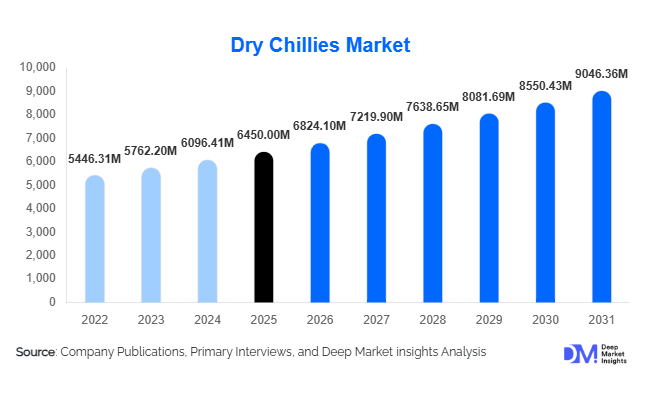
According to Deep Market Insights, the global dry chillies market size was valued at USD 6,450 million in 2026 and is projected to grow from USD 6,824.10 million in 2026 to reach USD 9,046.36 million by 2031, expanding at a CAGR of 5.8% during the forecast period (2026–2031). The dry chillies market growth is primarily driven by increasing global demand for spicy and ethnic cuisines, rising consumption of processed and packaged foods, and expanding international trade of agricultural spices supported by improved logistics and quality standardization across exporting countries.
Key Market Insights
- Whole dried chilies dominate global trade due to strong export demand, long shelf life, and lower processing requirements.
- Asia-Pacific remains the production hub, with India and China collectively supplying a significant share of global dry chili exports.
- Processed chili products are expanding rapidly as food manufacturers increasingly demand flakes, powders, and blends for ready-to-eat meals.
- Organic and residue-free chilies are gaining traction in Europe and North America due to strict food safety regulations and clean-label trends.
- Food processing is the largest end-use segment, driven by sauces, snacks, seasoning blends, and frozen food industries.
- Digital B2B spice trade platforms are transforming procurement, improving price transparency and global market access for exporters.
What are the latest trends in the dry chillies market?
Shift Toward Processed and Value-Added Chili Products
The global dry chillies market is witnessing a strong shift from raw whole chilies to processed forms such as flakes, powders, smoked variants, and blended spice mixes. This trend is driven by the expansion of the packaged food industry, where manufacturers require consistent flavor profiles and easy-to-use ingredients. Foodservice chains and industrial processors increasingly prefer standardized chili inputs, reducing preparation time and ensuring uniform taste. Advanced dehydration and grinding technologies are also improving product quality, color retention, and capsaicin stability, making processed chilies a high-growth segment within the global spice ecosystem.
Rising Demand for Organic and Clean-Label Spices
Consumers in developed markets are increasingly prioritizing organic, pesticide-free, and sustainably sourced spices. This has led to rising demand for certified organic dry chilies, particularly in Europe and North America. Exporters are investing in traceability systems, sustainable farming practices, and certification compliance to meet strict import standards. Retailers are also expanding clean-label spice portfolios, positioning organic chilies as premium products with higher margins. This trend is reshaping sourcing strategies and encouraging long-term contract farming models in major producing countries.
What are the key drivers in the dry chillies market?
Growing Global Demand for Spicy and Ethnic Cuisines
The increasing popularity of Asian, Latin American, and Middle Eastern cuisines has significantly boosted global demand for dry chilies. Consumers across North America and Europe are incorporating spicy flavors into everyday diets, increasing retail and foodservice consumption. This cultural globalization of food habits is one of the strongest long-term drivers of the dry chillies market.
Expansion of Processed Food and HoReCa Industries
The rapid growth of packaged foods, frozen meals, sauces, and snacks is driving large-scale industrial demand for chili powders and flakes. The HoReCa sector is also expanding globally, particularly in urban centers, increasing bulk consumption of spice blends. Food manufacturers rely heavily on dry chilies for flavoring consistency, making the processed food industry a core demand driver.
Strengthening of Export-Oriented Agriculture
Major producing countries such as India, China, and Mexico are strengthening agricultural infrastructure, drying technologies, and export compliance systems. Improved logistics, quality grading, and global trade agreements are enabling higher export volumes and better market integration, supporting overall market expansion.
What are the restraints for the global market?
Climate Dependency and Agricultural Volatility
Dry chili production is highly dependent on weather conditions, including rainfall patterns, temperature fluctuations, and pest outbreaks. Any climatic disruption can significantly reduce yield quality and quantity, leading to price volatility and supply instability in global markets.
Price Fluctuations in Global Spice Trade
The dry chillies market is highly sensitive to supply-demand imbalances and commodity trading fluctuations. Seasonal production cycles and export demand shifts often result in unstable pricing, creating procurement challenges for food manufacturers and reducing margin predictability for exporters.
What are the key opportunities in the dry chillies industry?
Growth in Pharmaceutical and Nutraceutical Applications
The use of capsaicin extracted from dry chilies in pain relief creams, metabolic supplements, and therapeutic applications is creating new high-value demand streams. Pharmaceutical companies are increasingly sourcing standardized chili extracts, expanding the market beyond traditional food applications.
Digital Transformation of Spice Trade
Online B2B spice trading platforms are reducing dependency on intermediaries and improving global market access for small and medium exporters. Digital procurement systems enhance transparency, pricing efficiency, and buyer-seller connectivity, creating new opportunities for global trade expansion.
Expansion of Organic Export Supply Chains
Rising global demand for organic spices presents strong opportunities for exporters investing in certified farming practices, traceability systems, and sustainable agriculture. Countries with strong agricultural bases are increasingly focusing on premium organic export markets to capture higher margins.
Report Scope
| Report Metric | Details |
|---|---|
| Market Size in 2025 | USD 6450.00 Million |
| Market Size in 2026 | USD 6824.10 Million |
| Market Size in 2031 | USD 9046.36 Million |
| CAGR | 5.8% (2026-2031) |
| Base Year for Estimation | 2025 |
| Historical Data | 2022-2024 |
| Forecast Period | 2026-2031 |
| Report Coverage | Revenue Forecast, Competitive Landscape, Supply Chain Disruption, Growth Factors, Environment & Regulatory Landscape and Trends |
| Geographies Covered | North America, Europe, APAC, Middle East and Africa, LATAM |
| Countries Covered | U.S., Canada, U.K., Germany, France, Spain, Italy, Russia, Nordic, Benelux, Rest of Europe, China, Korea, Japan, India, Australia, Singapore, Taiwan, South East Asia, Rest of Asia-Pacific, UAE, Turky, Saudi Arabia, South Africa, Egypt, Nigeria, Rest of MEA, Brazil, Mexico, Argentina, Chile, Colombia, Rest of LATAM |
Explore more data points, trends and opportunities Download Free Sample Report
Product Type Insights
Whole dried chilies continue to dominate the global dry chillies market, accounting for an estimated 42% share of the total market in 2025. The dominance of this segment is primarily supported by strong export demand from leading producing countries such as India and China, where large-scale cultivation and established export infrastructure enable consistent global supply. Whole dried chilies are highly preferred in international trade because they offer longer shelf life, easier storage, and flexibility for downstream processing into powders, flakes, sauces, and seasoning blends. Their suitability for bulk transportation and industrial reprocessing has made them the preferred format among global spice traders, food processors, and industrial buyers. The growing cross-border spice trade and increasing demand from food manufacturing companies continue to strengthen the leadership of this segment.The increasing industrialization of food production is another major factor driving processed chili demand. Large-scale food processing companies require consistent spice formulations for sauces, seasonings, snack coatings, meat marinades, and processed meals, creating substantial demand for chili powders and flakes. In addition, urban consumers are increasingly adopting convenience-oriented cooking practices, leading to higher demand for packaged and ready-to-use spice products through retail and e-commerce channels.The growing popularity of international cuisines, including Mexican, Thai, Indian, Korean, and Sichuan food, is further supporting demand for diverse chili varieties worldwide. As food cultures continue to globalize, manufacturers are expanding their portfolios to include customized spice blends and region-specific chili products. This trend is expected to support sustained growth across both traditional whole chili and processed chili categories over the forecast period.
Application Insights
The food processing industry remains the dominant application segment in the global dry chillies market, contributing more than half of overall global demand. The leadership of this segment is primarily driven by the rapid expansion of processed food manufacturing worldwide. Dry chillies are widely used in sauces, spice blends, snacks, instant noodles, frozen foods, meat products, ready meals, and packaged seasonings, making them an essential ingredient across multiple food categories. The increasing preference for spicy and flavorful food products among consumers has significantly accelerated chili consumption within industrial food production.The HoReCa segment, which includes hotels, restaurants, cafes, catering businesses, and cloud kitchens, is emerging as one of the fastest-growing application areas. The rapid expansion of restaurant chains, food delivery services, and urban foodservice infrastructure is driving increased usage of dry chillies in commercial kitchens. Restaurants increasingly utilize specialty chili varieties and spice blends to differentiate menu offerings and cater to consumer demand for bold flavors and authentic regional cuisines. The continued growth of international tourism and rising consumer spending on dining experiences are expected to further support demand from this segment.The cosmetic industry is also exploring chili extracts for use in topical formulations, skincare products, and hair care applications. Chili-derived compounds are being utilized in products designed to stimulate circulation and improve skin vitality. While still at an early stage, growing consumer interest in natural cosmetic ingredients may create additional long-term growth opportunities for chili extract applications.Export-driven industrial demand remains one of the strongest long-term growth pillars across all application segments. Increasing globalization of food trade, expansion of processed food exports, and rising integration of international spice supply chains continue to drive large-scale procurement of dry chillies by manufacturers and exporters worldwide.
Distribution Channel Insights
B2B distribution continues to dominate the global dry chillies market, accounting for the majority of total market transactions. This dominance is driven by large-scale bulk trading activities between farmers, exporters, spice processors, food manufacturers, and international importers. Industrial buyers require substantial volumes of dry chillies for use in processed foods, sauces, seasoning blends, and packaged spice products, making bulk procurement the most efficient supply mechanism. Major exporting countries such as India, China, Mexico, and Vietnam maintain extensive B2B trading networks that support global spice distribution.The leadership of the B2B segment is further strengthened by the growing scale of international food manufacturing and spice processing industries. Large food companies increasingly establish long-term procurement contracts with suppliers to ensure quality consistency, pricing stability, and uninterrupted raw material supply. Export-oriented spice manufacturers and food processors continue to rely heavily on bulk sourcing channels to meet rising production requirements.Online distribution channels are witnessing rapid growth as digital commerce transforms the global food and grocery industry. E-commerce platforms enable buyers to access a broader range of chili varieties, compare prices, and source products directly from suppliers across regions. Online marketplaces are particularly beneficial for small and medium-sized spice producers seeking access to international customers without relying solely on traditional trading intermediaries. The rising adoption of digital procurement systems by food manufacturers and retailers is expected to further accelerate growth in online chili trading.The increasing integration of technology within supply chains is also improving transparency, inventory management, and product traceability across distribution networks. Blockchain-enabled traceability systems, digital quality monitoring, and automated logistics platforms are gradually being adopted to enhance supply chain efficiency and ensure compliance with international food safety regulations.
End-Use Industry Insights
The food processing industry remains the largest end-use industry in the global dry chillies market and continues to act as the primary driver of long-term consumption growth. Increasing global demand for packaged foods, instant meals, sauces, processed snacks, and seasoning products has significantly accelerated industrial usage of dry chillies. Food manufacturers rely extensively on chili-based ingredients to enhance flavor, improve product differentiation, and meet evolving consumer demand for spicy food products.The leading position of the food processing industry is supported by rapid urbanization, busy consumer lifestyles, and rising consumption of convenience-oriented food products worldwide. Manufacturers increasingly develop innovative spicy snack products, ready-to-cook meals, and ethnic food offerings to capture changing consumer preferences. The growing popularity of international cuisines and fusion food concepts is also encouraging greater use of diverse chili varieties within processed food formulations.Pharmaceutical applications are gradually emerging as high-margin niche opportunities within the dry chillies market. Capsaicin-based formulations are increasingly utilized in pain management products, topical treatments, and therapeutic applications. Rising consumer preference for plant-based medicinal ingredients and growing research into the functional properties of chili compounds are expected to support future growth within this industry.Export-oriented industries are also witnessing substantial expansion as global spice trade integration continues to strengthen. International food manufacturers and seasoning companies increasingly source dry chillies from leading producing nations to support large-scale industrial operations. Expanding trade agreements, improvements in cold-chain logistics, and growing global food consumption are expected to sustain export-driven demand over the forecast period.
Explore more data points, trends and opportunities Download Free Sample Report
Dry Chillies Market Segmentations
By Product Type
- Whole Dried Chillies
- Processed Chillies
- Smoked & Roasted Dry Chillies
- Value-Added Chili Blends & Seasonings
By Variety / Origin
- Indian Varieties
- Chinese Varieties
- Latin American Varieties
- African Varieties
- Hybrid & Specialty Capsicum Varieties
By Nature
- Conventional Dry Chillies
- Organic Dry Chillies
By Distribution Channel
- B2B
- Retail
- Online/E-commerce Platforms
- Export-Import Traders & Commodity Networks
By End-Use Industry
- Food Processing & Packaged Foods
- HoReCa
- Household Consumption
- Pharmaceutical & Nutraceutical Applications
- Cosmetics & Personal Care
Regional Insights
Asia-Pacific
Asia-Pacific dominates the global dry chillies market with an estimated 48% share in 2025, making it the largest regional market globally. India alone contributes nearly 28% of total global supply, followed closely by China, both of which play critical roles in international spice trade. The region benefits from favorable climatic conditions, extensive agricultural land availability, low-cost labor, and deeply established spice cultivation traditions. Strong domestic consumption across India, China, Thailand, Indonesia, and South Korea further supports regional market leadership.The rapid expansion of processed food industries across Asia-Pacific is another major growth driver for the region. Rising urbanization, increasing disposable income, and changing dietary patterns are driving greater consumption of packaged foods and restaurant meals, thereby increasing industrial demand for dry chillies. In addition, strong growth in e-commerce grocery platforms and modern retail channels is improving accessibility to packaged spice products across urban and semi-urban populations.
North America
North America accounts for approximately 18% of the global dry chillies market, with the United States serving as the region’s largest importer and consumer. Demand growth is primarily driven by the increasing popularity of Mexican, Asian, and fusion cuisines, which heavily utilize chili-based ingredients. The growing processed food industry and expanding foodservice sector continue to create substantial industrial demand for dry chillies across the region.The rapid expansion of snack foods, sauces, seasoning blends, and ready-to-eat meals has significantly increased chili consumption within North American food manufacturing. Consumers increasingly prefer spicy flavor profiles and globally inspired food products, encouraging manufacturers to incorporate a wider variety of chili ingredients into product formulations. The region remains heavily dependent on imports from India, Mexico, and China to meet industrial and retail demand.Growing consumer interest in organic spices, clean-label ingredients, and premium culinary products is also supporting market growth in North America. Increasing adoption of online grocery shopping and specialty spice retailing further enhances market accessibility and product diversification.
Europe
Europe represents approximately 22% of the global dry chillies market, led by major importing countries such as Germany, the United Kingdom, and France. The region’s market growth is supported by rising multicultural food consumption, increasing popularity of ethnic cuisines, and expanding processed food industries. European consumers are increasingly incorporating spicy flavors into mainstream diets, supporting demand for chili-based seasonings and processed spice products.The expansion of specialty food retailing, gourmet cooking trends, and premium restaurant concepts is further supporting market growth across Europe. Food manufacturers continue to introduce innovative chili-based sauces, snacks, and ready meals to cater to changing consumer taste preferences.
Latin America
Latin America contributes approximately 7–8% of global market demand, with Mexico serving as both a major producer and exporter of dry chillies. Traditional culinary practices strongly support regional consumption, as chili peppers remain an essential ingredient in Mexican and Latin American cuisines. The region’s expanding processed food sector and growing foodservice industry are also contributing to increased demand.Mexico’s proximity to the United States provides strong export opportunities, particularly for specialty chili varieties used in sauces, snacks, and seasoning products. Rising urbanization and increasing adoption of packaged foods across Latin America are expected to further support long-term market expansion.
Middle East & Africa
The Middle East & Africa region contributes approximately 6–7% of the global dry chillies market. Strong demand for spices in regional cuisines, combined with growing foodservice industries and expanding urban populations, continues to support market growth. Many countries within the region remain heavily dependent on imports from Asian suppliers, particularly India and China, to meet domestic demand.Africa is gradually emerging as a growing export hub, particularly in countries such as Ethiopia and Tanzania, where expanding agricultural investment and improving farming practices are supporting increased chili production. Government initiatives promoting agricultural exports, rising foreign investment in agribusiness, and improving logistics infrastructure are expected to strengthen the region’s long-term market position. Increasing adoption of processed food products and growth in retail distribution networks are also contributing to rising regional consumption.
Key Players in the Dry Chillies Market
- McCormick & Company
- Olam Group
- Everest Spices
- Synthite Industries
- MDH (Mahashian Di Hatti)
- Kancor Ingredients
- Organic India
- Ruchi Global
- Patanjali Foods
- Suma Foods