Dried Tomato Powder Market Size
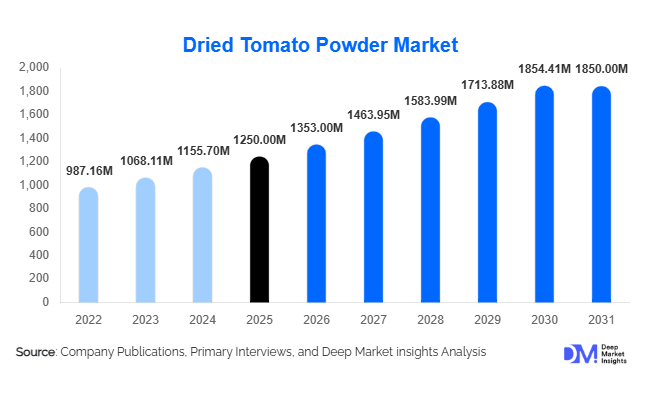
According to Deep Market Insights, the global dried tomato powder market size was valued at USD 1,250 million in 2026 and is projected to grow from USD 1,353 million in 2026 to reach USD 1,850 million by 2031, expanding at a CAGR of 8.2% during the forecast period (2026–2031). The market growth is primarily driven by increasing demand for clean-label food ingredients, rising consumption of convenience and processed foods, and growing adoption of natural vegetable-based flavoring solutions across global food manufacturing industries.
Key Market Insights
- Clean-label ingredient demand is accelerating globally, with manufacturers replacing synthetic additives with tomato-based natural powders.
- Processed and ready-to-eat food expansion is significantly increasing consumption of dried tomato powder in soups, sauces, and instant meals.
- Spray drying technology dominates production, offering cost efficiency and superior product consistency for industrial applications.
- North America leads consumption due to strong food processing industries and high demand for packaged convenience foods.
- Asia-Pacific is the fastest-growing region, driven by urbanization, rising disposable income, and expansion of food manufacturing sectors.
- Nutraceutical applications are emerging as a high-growth segment due to the lycopene and antioxidant content of tomato powder.
What are the latest trends in the dried tomato powder market?
Shift Toward Clean-Label and Organic Ingredients
Food manufacturers are increasingly shifting toward natural and organic ingredient sourcing, replacing artificial flavors and preservatives with plant-derived alternatives. Dried tomato powder is gaining strong traction due to its natural umami flavor, nutritional richness, and compatibility with clean-label product formulations. Organic-certified production is also expanding, particularly in Europe and North America, where regulatory frameworks and consumer awareness strongly support transparency in food labeling.
Technological Advancements in Drying and Flavor Retention
Advancements in spray drying, freeze drying, and micro-encapsulation technologies are improving product quality, solubility, and color retention. These innovations allow manufacturers to produce highly concentrated tomato powders with longer shelf life and enhanced flavor stability. As a result, dried tomato powder is increasingly being used in premium food applications such as gourmet sauces, seasoning blends, and functional food formulations.
What are the key drivers in the dried tomato powder market?
Rising Demand for Convenience and Processed Foods
The global shift toward urban lifestyles has significantly increased demand for convenience foods, including instant soups, sauces, noodles, and ready-to-eat meals. Dried tomato powder is widely used as a base ingredient in these products due to its ease of storage, long shelf life, and strong flavor profile. The expanding global packaged food industry continues to be a major growth driver.
Growing Preference for Natural Flavoring Agents
Consumers are increasingly avoiding synthetic additives and preferring natural flavor enhancers derived from vegetables and fruits. Tomato powder serves as a versatile ingredient in seasoning blends and processed foods, offering both nutritional and sensory benefits. This shift toward natural ingredients is particularly strong in developed markets such as Europe and North America.
What are the restraints for the global market?
Raw Material Price Volatility
Tomato prices are highly dependent on seasonal agricultural output and climate conditions. Fluctuations in raw tomato availability directly impact production costs of dried tomato powder, creating pricing instability for manufacturers and limiting long-term margin predictability.
High Energy and Processing Costs
Advanced dehydration methods such as spray drying and freeze drying require significant energy consumption. These high operational costs restrict small and medium-scale producers from scaling production, creating entry barriers and limiting market competitiveness in cost-sensitive regions.
What are the key opportunities in the dried tomato powder industry?
Expansion in Nutraceutical Applications
The increasing demand for functional foods and dietary supplements presents a strong opportunity for dried tomato powder manufacturers. Rich in lycopene and antioxidants, tomato powder is being incorporated into health supplements targeting cardiovascular health, immunity, and anti-aging benefits. This segment is expected to witness strong double-digit growth over the forecast period.
Growth in Emerging Food Processing Economies
Countries such as India, China, and Brazil are rapidly expanding their food processing industries, supported by government incentives and infrastructure development. This is creating new demand centers for dried tomato powder in seasoning, snack manufacturing, and instant food production. Local production capabilities are also increasing, reducing import dependency and boosting regional supply chains.
Report Scope
| Report Metric | Details |
|---|---|
| Market Size in 2025 | USD 1250 Million |
| Market Size in 2026 | USD 1353 Million |
| Market Size in 2031 | USD 1850 Million |
| CAGR | 8.2% (2026-2031) |
| Base Year for Estimation | 2025 |
| Historical Data | 2022-2024 |
| Forecast Period | 2026-2031 |
| Report Coverage | Revenue Forecast, Competitive Landscape, Supply Chain Disruption, Growth Factors, Environment & Regulatory Landscape and Trends |
| Geographies Covered | North America, Europe, APAC, Middle East and Africa, LATAM |
| Countries Covered | U.S., Canada, U.K., Germany, France, Spain, Italy, Russia, Nordic, Benelux, Rest of Europe, China, Korea, Japan, India, Australia, Singapore, Taiwan, South East Asia, Rest of Asia-Pacific, UAE, Turky, Saudi Arabia, South Africa, Egypt, Nigeria, Rest of MEA, Brazil, Mexico, Argentina, Chile, Colombia, Rest of LATAM |
Explore more data points, trends and opportunities Download Free Sample Report
Segment Analysis
The global dried tomato powder market demonstrates a well-defined segmentation structure based on nature, drying technology, particle size, and application, each contributing uniquely to overall market dynamics and growth trajectory. Among these, the conventional dried tomato powder segment continues to dominate the market, accounting for approximately 68% of the total share. This dominance is primarily attributed to its cost-effectiveness, ease of production, and widespread availability across developing and developed economies alike. Conventional variants are extensively preferred by large-scale food manufacturers due to their affordability and consistent supply, making them highly suitable for bulk applications in processed food production. Additionally, the absence of premium pricing associated with organic certification further strengthens the position of conventional dried tomato powder in price-sensitive markets, particularly across Asia-Pacific and Latin America. The leading driver for this segment remains its strong alignment with mass-market food production, where cost optimization and scalability are critical factors.Beyond food and beverages, the nutraceutical and pharmaceutical segments are gradually expanding, leveraging the antioxidant properties of tomatoes, particularly lycopene. Similarly, the cosmetic and personal care industry is exploring the use of tomato-derived ingredients for their skin-enhancing and anti-aging benefits. While these segments currently represent a smaller share of the market, they offer significant growth potential over the forecast period, driven by increasing consumer awareness and product innovation.
End-Use Insights
The end-use landscape of the dried tomato powder market is predominantly led by the food processing industry, which accounts for the majority of global demand. This dominance is closely linked to the rapid expansion of the global packaged food sector, where dried tomato powder serves as a key ingredient in enhancing flavor, color, and nutritional value. Its application in sauces, ready meals, instant soups, and seasoning mixes continues to grow as manufacturers strive to meet evolving consumer preferences for convenience and taste. The integration of dried tomato powder into a wide variety of processed foods underscores its versatility and functional importance, making it a cornerstone ingredient in modern food manufacturing.Export-driven demand also plays a crucial role in shaping the end-use dynamics of the market. Regions such as North America and Europe rely heavily on imports of dehydrated vegetable ingredients due to limited domestic production and high consumption levels. This trend is creating significant opportunities for exporting countries, particularly in Asia-Pacific and Latin America, where favorable climatic conditions and cost advantages support large-scale tomato cultivation and processing.
Explore more data points, trends and opportunities Download Free Sample Report
Dried Tomato Powder Market Segmentations
By Nature
- Conventional Dried Tomato Powder
- Organic Dried Tomato Powder
By Drying Technology
- Spray Drying
- Freeze Drying
- Sun Drying / Air Drying
By Particle Size
- Fine Powder
- Coarse Powder
- Granulated Powder
By Application
- Food & Beverages
- Seasoning & Spice Blends
- Soups & Sauces
- Ready-to-Eat Meals
- Snack & Bakery Products
- Nutraceuticals & Dietary Supplements
By End-Use Industry
- Food Processing Industry
- Food Service Industry (HORECA)
- Nutraceutical Industry
- Cosmetics & Personal Care
- Export & Bulk Ingredient Trade
By Distribution Channel
- B2B Direct Sales
- Food Ingredient Distributors
- Online B2B Platforms
- Retail & Specialty Stores
Regional Insights
North America
North America accounts for approximately 32% of the global dried tomato powder market share in 2025, establishing itself as one of the leading regional markets. The growth of this region is primarily driven by the high consumption of processed and convenience foods, particularly in the United States and Canada. The presence of a well-established food processing industry, coupled with advanced manufacturing technologies, supports the widespread adoption of dried tomato powder across various applications. Additionally, increasing consumer preference for natural and clean-label ingredients is encouraging manufacturers to replace synthetic additives with plant-based alternatives such as tomato powder.Another significant growth driver in North America is the rising demand for ready-to-eat and ready-to-cook meals, fueled by busy lifestyles and changing dietary habits. The region also benefits from strong distribution networks, robust supply chains, and continuous product innovation, all of which contribute to sustained market expansion. Furthermore, the growing popularity of plant-based and health-oriented diets is boosting the use of tomato-derived ingredients in both food and nutraceutical applications.
Europe
Europe holds nearly 28% of the global market share, driven by strong demand from key countries such as Germany, France, Italy, and the United Kingdom. The region’s growth is significantly influenced by its emphasis on sustainability, organic food consumption, and stringent food safety regulations. European consumers exhibit a strong preference for high-quality, traceable, and environmentally friendly products, which is encouraging the adoption of dried tomato powder, particularly in organic and premium segments.The presence of a mature food industry and a rich culinary tradition further supports the use of tomato-based ingredients in various applications. Additionally, regulatory frameworks promoting clean labeling and reduced use of artificial additives are driving manufacturers to incorporate natural alternatives such as dried tomato powder. Increasing demand for convenience foods, coupled with a growing focus on health and wellness, continues to propel market growth across the region.
Asia-Pacific
Asia-Pacific is the fastest-growing region in the dried tomato powder market, led by countries such as China, India, and Japan. Rapid urbanization, rising disposable income, and changing dietary patterns are key factors driving the demand for processed and convenience foods in the region. The expansion of the food processing industry, supported by government initiatives and foreign investments, is further accelerating market growth.Moreover, the growing popularity of international cuisines and the expansion of quick-service restaurants are contributing to increased demand for tomato-based ingredients. As consumer preferences continue to evolve, the Asia-Pacific region is expected to witness significant growth opportunities in both domestic consumption and export markets.
Latin America
Latin America is emerging as a promising market for dried tomato powder, with Brazil and Mexico serving as key contributors. The region benefits from favorable climatic conditions that support large-scale tomato cultivation, providing a strong foundation for the development of the processing industry. Increasing investments in food processing infrastructure and rising demand for packaged foods are driving market growth across the region.Another important growth driver is the region’s expanding export capabilities, particularly to North America and Europe. The availability of cost-competitive labor and raw materials enables producers to offer competitively priced products in the global market. Additionally, changing consumer lifestyles and increasing urbanization are contributing to the growing demand for convenience foods, further supporting the adoption of dried tomato powder.
Middle East & Africa
The Middle East and Africa region is witnessing gradual but steady growth in the dried tomato powder market. This growth is primarily driven by increasing dependence on food imports, particularly in countries with limited agricultural production capacity. The expanding hospitality and tourism sectors, especially in Gulf Cooperation Council (GCC) countries, are also contributing to rising demand for processed and packaged food products.In addition, rapid urbanization and population growth are leading to increased consumption of convenience foods, thereby boosting the demand for dried tomato powder. South Africa serves as a key market within the region, supported by its relatively developed food processing industry. Meanwhile, ongoing investments in infrastructure and supply chain development are expected to enhance market accessibility and distribution efficiency, creating new growth opportunities in the coming years.