Global Dried Seafood Market Size
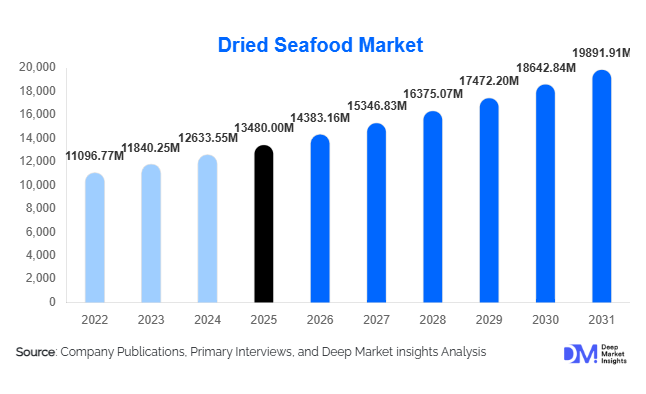
According to Deep Market Insights, the global dried seafood market size was valued at USD 13,480 million in 2026 and is projected to grow from USD 14,383.16 million in 2027 to reach USD 18,891.91 million by 2031, expanding at a CAGR of 6.7% during the forecast period (2026–2031). The market growth is primarily driven by rising demand for shelf-stable protein-rich food products, expansion of global seafood trade networks, increasing adoption of advanced drying technologies, and growing consumer preference for convenient and minimally processed seafood ingredients across both developed and emerging economies.
Key Market Insights
- Asia-Pacific dominates global consumption and production, supported by strong culinary traditions and large-scale seafood processing infrastructure.
- Dried fish remains the leading product segment, accounting for the largest share due to affordability and widespread dietary integration.
- Demand is shifting toward premium and value-added products such as vacuum-packed, flavored, and freeze-dried seafood items.
- North America is emerging as the fastest-growing regional market due to rising ethnic food consumption and health-focused snacking trends.
- E-commerce and modern retail channels are expanding rapidly, improving accessibility of premium dried seafood products globally.
- Sustainability and traceability standards are becoming critical purchasing factors, especially in Europe and North America.
Global Dried Seafood Market Latest Trends
Premiumization and Value-Added Product Expansion
The dried seafood market is witnessing a clear shift from commodity-based offerings toward premium and branded products. Consumers are increasingly seeking high-quality, hygienically processed, and ready-to-eat dried seafood items. Manufacturers are responding with flavored variants, vacuum-sealed packaging, and gourmet seafood snacks targeting urban populations. This premiumization trend is particularly strong in Japan, South Korea, the United States, and Western Europe, where consumers are willing to pay higher prices for certified, traceable, and sustainably sourced seafood products.
Technology Integration in Seafood Processing
Advanced drying technologies such as freeze-drying, vacuum drying, and hybrid dehydration systems are improving product quality, shelf life, and nutritional retention. Automation in sorting, grading, and packaging is reducing labor dependency while improving efficiency and consistency. AI-based quality inspection and moisture control systems are also gaining traction, especially in export-oriented processing facilities. These technologies are enabling manufacturers to meet stringent international food safety standards while scaling production capacity.
Growth of Online and Direct-to-Consumer Channels
E-commerce platforms and digital grocery channels are significantly transforming distribution dynamics. Consumers increasingly prefer online purchasing due to wider product variety, transparent pricing, and access to imported seafood brands. Direct-to-consumer models adopted by manufacturers are also enhancing profit margins and strengthening brand visibility in international markets.
Global Dried Seafood Market Drivers
Rising Demand for Shelf-Stable Protein Foods
Increasing global demand for high-protein, low-fat, and shelf-stable food products is a major growth driver. Dried seafood offers long shelf life without refrigeration, making it highly suitable for urban households, travel consumption, and regions with limited cold-chain infrastructure. Rising health awareness is further boosting demand for natural protein sources.
Expansion of International Seafood Trade
Global seafood trade expansion is significantly supporting dried seafood market growth. Export-oriented production hubs in China, Vietnam, India, and Thailand are supplying large volumes to North America, Europe, and the Middle East. Favorable trade agreements and improved logistics are enabling efficient cross-border distribution.
Technological Advancements in Drying Processes
Improvements in drying technologies have enhanced product safety, flavor retention, and nutritional value. Modern processing systems reduce contamination risks and improve batch consistency, enabling manufacturers to meet international food safety regulations and premium export requirements.
Global Dried Seafood Market Restraints
Raw Material Supply Volatility
Fluctuations in marine catch volumes due to overfishing, climate change, and seasonal variability pose a significant challenge to market stability. Supply inconsistencies impact pricing and production planning, particularly for small and mid-sized processors.
Strict Regulatory and Compliance Requirements
Increasing food safety standards, sustainability certifications, and import regulations in major markets such as the EU and the U.S. increase compliance costs. Smaller manufacturers often face challenges in meeting HACCP, traceability, and environmental certification requirements.
Global Dried Seafood Market Opportunities
Expansion of Premium Export-Oriented Processing
Emerging economies are investing heavily in export-oriented seafood processing facilities. Countries such as Vietnam, Indonesia, and India are upgrading infrastructure to meet international demand for high-quality dried seafood, creating significant export revenue opportunities.
Rising Demand for Functional and Nutraceutical Applications
Dried seafood is increasingly used in nutraceuticals, protein supplements, and functional food formulations. Marine-based proteins and bioactive compounds are gaining popularity in health-focused product categories, opening new revenue streams beyond traditional consumption.
Report Scope
| Report Metric | Details |
|---|---|
| Market Size in 2025 | USD 13480.00 Million |
| Market Size in 2026 | USD 14383.16 Million |
| Market Size in 2031 | USD 19891.91 Million |
| CAGR | 6.7% (2026-2031) |
| Base Year for Estimation | 2025 |
| Historical Data | 2022-2024 |
| Forecast Period | 2026-2031 |
| Report Coverage | Revenue Forecast, Competitive Landscape, Supply Chain Disruption, Growth Factors, Environment & Regulatory Landscape and Trends |
| Geographies Covered | North America, Europe, APAC, Middle East and Africa, LATAM |
| Countries Covered | U.S., Canada, U.K., Germany, France, Spain, Italy, Russia, Nordic, Benelux, Rest of Europe, China, Korea, Japan, India, Australia, Singapore, Taiwan, South East Asia, Rest of Asia-Pacific, UAE, Turky, Saudi Arabia, South Africa, Egypt, Nigeria, Rest of MEA, Brazil, Mexico, Argentina, Chile, Colombia, Rest of LATAM |
Explore more data points, trends and opportunities Download Free Sample Report
Product Type Insights
Dried fish remains the dominant product segment in the global dried seafood market, accounting for approximately 46.8% of total market share in 2025. Its leadership is primarily driven by its affordability, long shelf life, extensive availability across both developed and developing economies, and deep integration into traditional culinary practices. Dried fish serves as a staple source of protein in numerous Asian, African, and Latin American countries, making it a preferred choice among households, foodservice operators, and institutional buyers. The segment also benefits from well-established production and distribution networks, minimal refrigeration requirements, and increasing demand for convenient shelf-stable food products. Growing consumer preference for protein-rich, preservative-free food options further strengthens the segment's market position.Dried shrimp represents one of the fastest-growing product categories owing to its widespread use as a flavor enhancer in soups, sauces, instant noodles, snack foods, and ready-to-cook meals. Rising seafood consumption, increasing popularity of Asian cuisine worldwide, and expanding processed food manufacturing continue to support demand. Similarly, dried squid is witnessing healthy growth due to rising consumption of seafood snacks, particularly across East Asia and increasingly in North America and Europe, where premium protein snacks are gaining popularity. Premium products such as dried sea cucumber and specialty shellfish occupy a comparatively smaller share in terms of volume but contribute significantly to market value due to their premium pricing, medicinal perception, and strong demand across luxury dining establishments and traditional Asian healthcare markets. Growing disposable incomes and premium food consumption trends continue to enhance demand for these high-value seafood products.
Application Insights
Direct human consumption continues to dominate the global dried seafood market, accounting for more than half of overall demand. The segment's leadership is primarily driven by the widespread consumption of dried seafood as a staple ingredient in traditional cuisines, soups, snacks, side dishes, and home-cooked meals across Asia-Pacific, Africa, and several coastal economies. Consumers increasingly prefer dried seafood because of its extended shelf life, nutritional value, ease of storage, and convenience, making it an ideal protein source for both urban and rural populations. Cultural food traditions, expanding retail availability, and rising demand for minimally processed, protein-rich foods continue to reinforce the segment's dominant position.The processed food segment is expected to witness the fastest growth throughout the forecast period as food manufacturers increasingly incorporate dried seafood into instant noodles, seasoning blends, ready meals, frozen foods, soups, sauces, and snack formulations. The expansion of the global convenience food industry, coupled with growing demand for natural umami ingredients, is accelerating adoption among food processors. Meanwhile, pet food applications are gaining momentum as premium pet nutrition increasingly incorporates marine protein ingredients to improve digestibility and nutritional value. Nutraceutical applications also present promising growth opportunities, supported by increasing consumer awareness regarding marine-derived proteins, collagen, omega fatty acids, and other bioactive compounds extracted from dried seafood products.
Distribution Channel Insights
Wholesale distributors continue to account for the largest share of the global dried seafood market, supported by their critical role in supplying bulk quantities to retailers, foodservice providers, exporters, seafood processors, and institutional buyers. The dominance of this channel is driven by well-established international seafood trading networks, efficient bulk procurement systems, and strong relationships between producers and commercial buyers, particularly across Asia-Pacific where large-scale seafood processing and export activities remain concentrated.Supermarkets and hypermarkets continue to expand their market presence as organized retail infrastructure grows across emerging economies and consumers increasingly seek standardized, packaged, and quality-certified seafood products. Specialty seafood stores also maintain strong demand for premium and regional varieties. Meanwhile, online retail has emerged as one of the fastest-growing distribution channels, driven by increasing internet penetration, digital payment adoption, improved cold-chain logistics for complementary products, and growing consumer preference for home delivery. E-commerce platforms enable manufacturers to directly reach consumers while offering wider product assortments, premium imported seafood, subscription-based purchasing models, and greater product transparency, making online retail a significant growth driver for premium dried seafood sales globally.
Explore more data points, trends and opportunities Download Free Sample Report
Dried Seafood Market Segmentations
By Product Type
- Dried Fish
- Dried Shrimp
- Dried Squid
- Dried Sea Cucumber
- Dried Shellfish
- Others
By Application
- Direct Human Consumption
- Processed Food & Food Ingredients
- Nutraceuticals & Dietary Supplements
- Pet Food
- Foodservice & Hospitality
By Distribution Channel
- Wholesale Distributors
- Supermarkets & Hypermarkets
- Convenience Stores
- Specialty Seafood Stores
- Online Retail/E-commerce
- Others
Regional Insights
Asia-Pacific
Asia-Pacific dominates the global dried seafood market, accounting for approximately 54.6% of the global market share in 2025. The region's leadership is supported by its extensive seafood harvesting capabilities, abundant marine resources, well-developed aquaculture industry, and highly integrated seafood processing infrastructure. China remains the largest producer and consumer, while Japan, South Korea, Vietnam, Thailand, Indonesia, the Philippines, and India contribute significantly through both domestic consumption and export activities. Strong cultural preference for dried seafood products, increasing urbanization, rising disposable incomes, expanding packaged food industries, and growing regional seafood exports continue to drive market expansion. Government investments in fisheries modernization, improvements in seafood preservation technologies, and increasing global demand for Asian seafood products further strengthen regional growth throughout the forecast period.
Europe
Europe represents a significant import-oriented market led by Spain, Italy, Germany, France, Portugal, and the United Kingdom. Regional demand is supported by established consumption of dried cod, anchovies, and specialty seafood products, alongside growing popularity of Asian, Mediterranean, and international cuisines. Increasing consumer preference for premium seafood, healthier protein alternatives, and sustainably sourced marine products continues to support market expansion. The growth of ethnic food retailing, expanding foodservice industries, rising demand for gourmet seafood ingredients, and increasing imports from Asia-Pacific further contribute to regional market growth. Additionally, stringent quality standards and growing consumer awareness regarding traceability encourage the adoption of premium packaged dried seafood products across European markets.
North America
North America continues to experience steady growth, with the United States accounting for the largest regional share, followed by Canada and Mexico. Market expansion is driven by increasing multicultural populations, rising consumption of Asian and international cuisines, and growing demand for healthy, high-protein snack alternatives. Consumers are increasingly incorporating dried seafood into convenient meal preparations, specialty cooking, and functional diets focused on lean protein intake. The expansion of Asian grocery chains, online seafood retail platforms, premium foodservice establishments, and specialty supermarkets has significantly improved product accessibility. Rising awareness of seafood's nutritional benefits and growing demand for minimally processed foods further support long-term market growth across the region.
Latin America
Latin America is emerging as a promising market, with Brazil, Chile, Peru, Ecuador, and Mexico serving as key contributors. Growth is supported by expanding seafood production, increasing exports, modernization of retail infrastructure, and gradual shifts toward protein-rich dietary patterns. Urbanization, improving disposable incomes, and the expansion of organized retail channels are increasing consumer access to packaged dried seafood products. In addition, the region's strong fisheries sector, growing seafood processing investments, and expanding international trade relationships are enhancing production capacity while creating new opportunities for domestic consumption and export-oriented market development.
Middle East & Africa
The Middle East & Africa is expected to witness steady market expansion, led by the Gulf Cooperation Council (GCC) countries, South Africa, Nigeria, and Egypt. Rising disposable incomes, rapid urbanization, expanding tourism and hospitality industries, and increasing demand for premium imported seafood products are supporting regional growth. Large expatriate populations from Asia continue to sustain strong consumption of traditional dried seafood products, while improving retail infrastructure and growing supermarket penetration are enhancing product availability. Increasing investments in food imports, diversification of food supply chains, expanding e-commerce platforms, and rising consumer preference for convenient shelf-stable protein sources are expected to further accelerate market growth across the region during the forecast period.
Key Players in the Global Dried Seafood Market
- Maruha Nichiro Corporation
- Nippon Suisan Kaisha (Nissui)
- Thai Union Group
- Kyokuyo Co., Ltd.
- Dongwon Industries
- Austevoll Seafood ASA
- Oceana Group Limited
- Royal Greenland
- Lerøy Seafood Group