Dried Mango Market Size
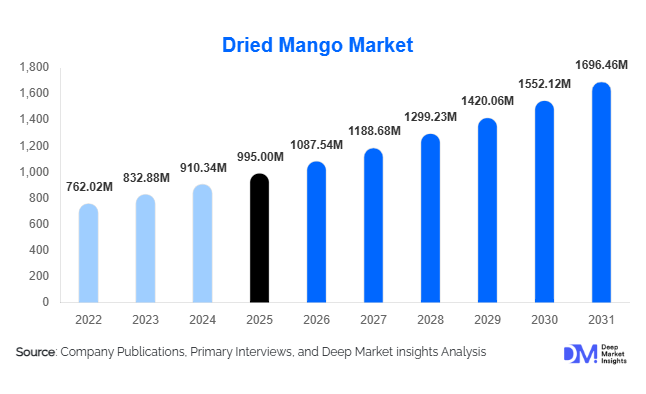
According to Deep Market Insights, the global dried mango market size was valued at USD 995 million in 2025 and is projected to grow from USD 1,087.54 million in 2026 to reach USD 1,696.46 million by 2031, expanding at a CAGR of 9.3% during the forecast period (2026–2031). The dried mango market growth is primarily driven by rising global demand for healthy snack alternatives, expanding adoption of clean-label food ingredients, and increasing utilization of dried fruit in functional foods and packaged snack formulations. Growing consumer preference for natural sweetness, longer shelf-life foods, and convenient on-the-go nutrition continues to strengthen demand across retail and industrial applications worldwide.
Key Market Insights
- Healthy snacking trends are accelerating demand, as consumers increasingly replace processed confectionery with fruit-based alternatives.
- Asia-Pacific dominates global production, supported by abundant mango cultivation and expanding food processing infrastructure.
- North America leads consumption, driven by premium snack adoption and strong retail distribution networks.
- Organic and clean-label dried mango products are growing fastest, commanding higher price premiums across developed markets.
- E-commerce and direct-to-consumer channels are reshaping global distribution and enabling niche brands to scale internationally.
- Technological innovation in dehydration methods, including freeze-drying and vacuum drying, is improving product quality and shelf stability.
What are the latest trends in the dried mango market?
Shift Toward Clean-Label and Organic Products
Consumers worldwide are increasingly prioritizing ingredient transparency and natural food processing methods. This trend has accelerated the demand for unsweetened, preservative-free, and organically certified dried mango products. Retailers are expanding shelf space dedicated to organic dried fruits as health-conscious consumers seek snacks free from artificial additives and excess sugar. Producers are investing in certification programs and traceable sourcing systems to meet stringent import standards in Europe and North America. Organic dried mango varieties are gaining traction particularly among premium consumers willing to pay higher prices for sustainably sourced and minimally processed foods.
Expansion of Dried Mango as a Functional Food Ingredient
Dried mango is increasingly used beyond direct snacking applications, particularly within functional foods and plant-based formulations. Food manufacturers incorporate dried mango into granola mixes, protein bars, dairy alternatives, and fortified snack products due to its natural sweetness and nutritional profile. The growth of plant-based diets and wellness-oriented food innovation has elevated dried mango from a traditional export commodity to a value-added ingredient category. This trend is encouraging long-term supply agreements between processors and packaged food manufacturers, stabilizing demand patterns globally.
What are the key drivers in the dried mango market?
Rising Demand for Convenient Healthy Snacks
Urbanization and changing lifestyles are driving consumption of portable, ready-to-eat snacks that combine nutrition with convenience. Dried mango offers extended shelf life while retaining fiber, antioxidants, and vitamins, positioning it as an attractive alternative to processed snack foods. Younger demographics and working professionals are key consumers supporting sustained category expansion. Retail brands increasingly market dried mango as a guilt-free indulgence aligned with wellness lifestyles, further strengthening global demand.
Growth in Global Mango Processing Infrastructure
Mango-producing countries such as India, Thailand, and the Philippines are investing in value-added agricultural processing to reduce post-harvest waste and enhance export revenues. Modern dehydration facilities and improved logistics networks enable consistent year-round supply. Government initiatives supporting food processing industries are accelerating industrial-scale production, allowing exporters to meet growing international demand while maintaining quality standards.
What are the restraints for the global market?
Raw Material Price Volatility
The dried mango industry remains highly dependent on seasonal mango harvests, which are influenced by climate variability, rainfall patterns, and agricultural disease risks. Fluctuations in fresh mango supply directly impact processing costs and pricing stability, creating margin pressures for manufacturers and exporters. Supply disruptions can also affect contract fulfillment for large international buyers.
High Processing and Energy Costs
Advanced dehydration technologies such as freeze-drying require significant energy consumption and capital investment. Smaller processors often face challenges scaling production while maintaining competitive pricing. Rising global energy costs further contribute to operational expenses, particularly for exporters operating energy-intensive drying facilities.
What are the key opportunities in the dried mango industry?
Premiumization Through Organic and Specialty Variants
Premium dried mango products, including organic-certified, low-sugar, and flavored variants, present strong growth opportunities. Consumers increasingly seek differentiated snack experiences such as chili-infused or lime-seasoned dried mango, enabling brands to expand margins and attract new consumer segments. Premium packaging and storytelling around origin sourcing are also enhancing brand value.
Expansion into Emerging Consumer Markets
Rapid urbanization and rising disposable incomes across Southeast Asia, the Middle East, and Latin America are creating new demand centers. Modern retail expansion and digital grocery platforms are improving product accessibility. Governments promoting agro-processing industries are encouraging domestic value addition, supporting local dried fruit manufacturing ecosystems and export competitiveness.
Report Scope
| Report Metric | Details |
|---|---|
| Market Size in 2025 | USD 995 Million |
| Market Size in 2026 | USD 1087.54 Million |
| Market Size in 2031 | USD 1696.46 Million |
| CAGR | 9.3% (2026-2031) |
| Base Year for Estimation | 2025 |
| Historical Data | 2022-2024 |
| Forecast Period | 2026-2031 |
| Report Coverage | Revenue Forecast, Competitive Landscape, Supply Chain Disruption, Growth Factors, Environment & Regulatory Landscape and Trends |
| Geographies Covered | North America, Europe, APAC, Middle East and Africa, LATAM |
| Countries Covered | U.S., Canada, U.K., Germany, France, Spain, Italy, Russia, Nordic, Benelux, Rest of Europe, China, Korea, Japan, India, Australia, Singapore, Taiwan, South East Asia, Rest of Asia-Pacific, UAE, Turky, Saudi Arabia, South Africa, Egypt, Nigeria, Rest of MEA, Brazil, Mexico, Argentina, Chile, Colombia, Rest of LATAM |
Explore more data points, trends and opportunities Download Free Sample Report
Product Type Insights
Sweetened dried mango continues to dominate the global dried mango market, representing approximately 38% of total demand. Its sustained popularity is primarily driven by consumer preference for enhanced flavor profiles, particularly in North American and European snack markets where sweet and indulgent snacks are widely embraced. In contrast, natural and unsweetened variants are witnessing rapid growth as health consciousness rises and sugar-reduction trends gain momentum among younger demographics, fitness-oriented consumers, and wellness-focused urban populations. Organic dried mango has emerged as the fastest-growing subsegment, propelled by increasing premium retail positioning, widespread adoption of organic certification by exporters, and growing consumer demand for clean-label, sustainably sourced products in developed markets. The shift toward healthier snacking, combined with rising disposable incomes and a willingness to pay for premium and ethically produced foods, further strengthens growth prospects for both natural and organic variants.
Application Insights
Direct snacking remains the primary application for dried mango, contributing nearly 48% of global consumption. Its convenience, portability, and nutrient-rich profile make it an ideal standalone packaged snack, enabling it to move beyond its traditional role as an ingredient in culinary applications. Bakery and confectionery applications are also seeing steady growth, with manufacturers incorporating dried mango into premium desserts, granola bars, cereals, and chocolate inclusions to cater to consumers seeking natural fruit integrations in indulgent products. Additionally, functional foods and nutraceutical applications are emerging rapidly, driven by growing consumer awareness of health, immunity, and wellness. Dried mango is increasingly integrated into immunity-boosting snacks, breakfast blends, plant-based formulations, and fortified meal replacements. The surge in functional food applications is underpinned by the fruit’s rich vitamin, antioxidant, and fiber content, enabling manufacturers to differentiate their offerings and respond to the global shift toward preventive health and wellness-oriented diets.
Distribution Channel Insights
Supermarkets and hypermarkets remain the largest distribution channels, accounting for approximately 41% of sales. Their extensive reach, high product visibility, and ability to support impulse purchases contribute to consistent consumer demand. E-commerce channels are expanding at a significant pace, particularly in North America, Europe, and Asia-Pacific, as increasingly health-conscious and tech-savvy consumers seek the convenience of online ordering and home delivery. Specialty health stores serve as critical outlets for premium, organic, and clean-label products, while foodservice and B2B ingredient channels maintain stable bulk demand from manufacturers of snack bars, breakfast cereals, confectionery, and desserts. The evolution of omnichannel retail strategies, combined with targeted marketing and promotions, further supports distribution growth across multiple consumer touchpoints.
End-Use Industry Insights
The food processing industry continues to be the leading end-use sector, accounting for nearly 44% of global demand. Dried mango is extensively incorporated into snack bars, breakfast cereals, confectionery, desserts, and ready-to-eat meal solutions. Retail consumer demand is rising steadily due to the growing adoption of healthy packaged snacks and premium fruit-based offerings. The nutraceutical and functional food sectors are emerging as the fastest-growing end-use segments, capitalizing on dried mango’s natural vitamins, antioxidants, and fiber content to create wellness-oriented products. These include immune-boosting blends, plant-based snack formulations, and fortified breakfast items. Growth in this sector is also supported by regulatory frameworks promoting functional foods and by increasing consumer willingness to pay a premium for health-enhancing and clean-label ingredients.
Explore more data points, trends and opportunities Download Free Sample Report
Dried Mango Market Segmentations
By Product Type
- Sweetened Dried Mango
- Natural/Unsweetened Dried Mango
- Organic Dried Mango
- Flavored/Infused Dried Mango
By Form
- Slices & Strips
- Chunks & Cubes
- Whole Pieces
- Powder/Granules
By Application
- Direct Snacking
- Bakery & Confectionery
- Breakfast Cereals & Snacks
- Dairy & Frozen Desserts
- Nutraceutical & Functional Foods
- Beverage Applications
By Distribution Channel
- Supermarkets & Hypermarkets
- Online Retail/E-commerce
- Specialty Health Stores
- Foodservice & B2B Ingredients
By End-Use Industry
- Food Processing Industry
- Retail Consumer Market
- HoReCa
- Nutraceutical & Health Food Industry
Regional Insights
North America
North America accounts for approximately 28% of the global dried mango market, with the United States serving as the primary driver of regional demand. Growth is fueled by strong consumer preference for natural, organic, and health-oriented snack alternatives. The highly developed retail infrastructure enables efficient distribution through supermarkets, hypermarkets, and online platforms. Additional growth drivers include increasing awareness of functional foods, higher disposable incomes, rising adoption of convenient snacking habits, and expanding presence of premium and organic product lines in urban centers. Canada also shows steady growth, driven by health-focused retail channels, higher purchasing power, and a growing trend toward plant-based and clean-label snacks. The region benefits from strong e-commerce penetration and promotional campaigns emphasizing immunity and wellness, further accelerating adoption of dried mango products.
Europe
Europe contributes nearly 22% of global dried mango demand, with Germany, the United Kingdom, France, and the Netherlands serving as major import hubs. Market expansion is largely driven by strict food safety regulations, which encourage the import of high-quality, certified products, thereby supporting premium pricing. European consumers increasingly prefer sustainably sourced, organic, and ethically produced dried mango, aligning with regional environmental awareness and health-conscious lifestyles. Key growth drivers include the rising focus on healthy snacking, sugar-reduction initiatives, and the proliferation of modern retail formats such as hypermarkets, discounters, and specialty health stores in urban areas. The surge in functional food consumption, coupled with premiumization trends and e-commerce growth, is also bolstering regional market adoption.
Asia-Pacific
Asia-Pacific dominates global dried mango production, accounting for around 36% of the market. Countries such as India, Thailand, and the Philippines are key exporters, benefiting from abundant mango supply, favorable climatic conditions, and cost-efficient processing capabilities. Domestic consumption is rising rapidly, particularly in China and India, driven by urbanization, expanding middle-class populations, and growing health consciousness. The development of modern retail channels, robust e-commerce infrastructure, and a cultural shift toward convenient, nutritious snacks further support market growth. Additionally, local innovations in dried fruit snack formats, inclusion in functional foods, and integration into breakfast and wellness products act as major catalysts for consumption within the region.
Latin America
Latin America, particularly Mexico and Brazil, functions as both a significant production hub and a growing consumption market. Mexico leverages geographic proximity to North America, enabling efficient exports and trade. Domestic market growth is supported by modernizing retail infrastructure, rising disposable incomes, and growing demand for convenient snack solutions. Brazil is witnessing similar expansion, underpinned by strong mango production, retail modernization, and increasing health-oriented consumer preferences. Regional growth drivers include government initiatives promoting fruit exports, expansion of cold chain logistics, and a rise in tourism-related consumption. These factors collectively enhance market accessibility, quality assurance, and product availability across both domestic and international markets.
Middle East & Africa
The Middle East and Africa represents an emerging market for dried mango, led by the UAE and Saudi Arabia. Rapid urbanization, rising disposable incomes, and the expansion of modern retail formats are primary growth drivers. Increased tourism and hospitality activities drive higher consumption of premium imported snacks, while local consumers demonstrate growing interest in health-conscious and high-quality products. Market adoption is further supported by the proliferation of supermarkets, hypermarkets, and e-commerce platforms, as well as targeted marketing emphasizing the nutritional and wellness benefits of dried mango. Importers and distributors are increasingly investing in diverse product portfolios to cater to the evolving tastes of the health-aware and premium-focused consumer segment.
Key Players in the Dried Mango Market
- National Raisin Company
- Traina Foods Inc.
- Paradise Fruits Solutions GmbH
- Bergin Fruit and Nut Company
- Sunbeam Foods Pty Ltd
- NutraDry
- Graceland Fruit Inc.
- Jain Farm Fresh Foods Ltd.
- Brothers International Food Holdings LLC
- Royal Ridge Fruits
- Vietnam Dried Fruit JSC
- Thai Ao Chi Fruits Co. Ltd.
- Philippine Dried Mangoes Inc.
- Mango King Processing Inc.
- Chin Huay Public Company Limited