Dried Chilli Powder Market Size
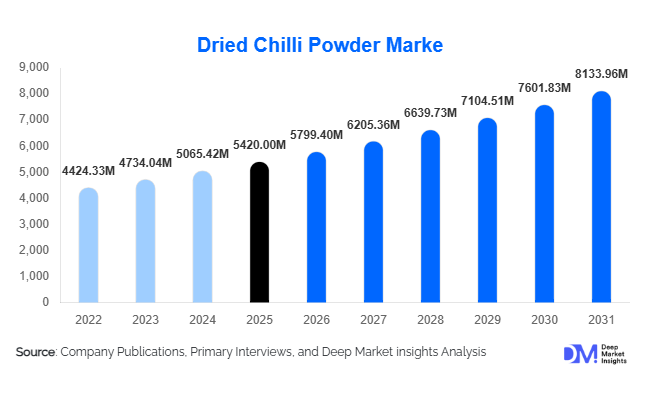
According to Deep Market Insights, the global dried chilli powder market size was valued at USD 5,420 million in 2025 and is projected to grow from USD 5,799.40 million in 2026 to reach approximately USD 8,133.96 million by 2031, expanding at a CAGR of 7.0% during the forecast period (2026–2031). Growth in the dried chilli powder market is primarily supported by increasing global consumption of spicy cuisines, rapid expansion of processed food manufacturing, and rising demand for natural flavoring ingredients across foodservice and packaged food industries.
Dried chilli powder has evolved from a traditional culinary ingredient into a standardized industrial spice used across ready meals, sauces, snacks, meat processing, and seasoning blends. Rising urbanization and changing dietary preferences toward convenience foods have significantly accelerated consumption volumes worldwide. Emerging economies across Asia-Pacific and Latin America continue to dominate production, while North America and Europe drive premiumization through organic, traceable, and specialty chilli variants.
The market is also benefiting from the growing clean-label movement, where manufacturers increasingly replace synthetic flavor enhancers with natural spice ingredients. Export-oriented cultivation in countries such as India, China, Mexico, and Peru is strengthening global supply chains, while advancements in drying, grinding, and sterilization technologies are improving product consistency and shelf stability. As global cuisine diversification expands through migration and digital food culture, dried chilli powder demand is expected to remain structurally strong across both retail and industrial applications.
Key Market Insights
- Industrial food processing accounts for the largest demand share, driven by seasoning blends, snacks, and ready-to-eat foods.
- Asia-Pacific dominates global production and consumption, supported by strong culinary dependence on spices.
- Organic and premium chilli powders are the fastest-growing product category due to clean-label preferences.
- Export-driven trade from India and China shapes global pricing trends.
- Automation in drying and grinding technologies is improving yield efficiency and product uniformity.
- Foodservice expansion globally is accelerating bulk demand for standardized spice ingredients.
What are the latest trends in the dried chilli powder market?
Premiumization and Origin-Specific Chilli Varieties
Consumers increasingly prefer origin-certified chilli powders such as Kashmiri, Guntur, Chipotle, and Korean gochugaru varieties. Food manufacturers are marketing spice blends based on heat level, color intensity, and aroma profiles, transforming chilli powder from a commodity ingredient into a differentiated culinary product. Geographic indication (GI) tagging and traceability programs are enabling exporters to command premium pricing while improving farmer incomes. Specialty chilli powders with controlled Scoville heat units are gaining adoption among packaged food brands seeking consistent flavor profiles.
Technology-Driven Processing and Food Safety Compliance
Modern processing technologies including cryogenic grinding, steam sterilization, and low-temperature dehydration are improving color retention and microbial safety. Export markets increasingly demand compliance with strict food safety regulations, prompting investments in automated processing plants. Blockchain-based supply tracking and AI-enabled quality grading systems are emerging within large-scale spice exporters to ensure traceability and contamination control. These innovations are particularly important for supplying multinational food companies requiring standardized spice inputs.
What are the key drivers in the dried chilli powder market?
Expansion of Processed and Convenience Foods
The rapid growth of ready-to-eat meals, instant noodles, frozen foods, and snack seasonings is a primary driver of dried chilli powder consumption. Food manufacturers rely on chilli powder as a cost-effective flavor enhancer that delivers consistent taste across large production batches. Global processed food production continues expanding at over 6% annually, directly increasing industrial spice procurement volumes.
Globalization of Spicy Cuisine
The worldwide popularity of Asian, Mexican, and fusion cuisines has increased chilli consumption beyond traditional markets. Restaurants and food chains increasingly integrate spicy menu options to attract younger consumers seeking bold flavors. Social media-driven food experimentation and cross-cultural culinary exposure have accelerated adoption across Europe and North America.
Shift Toward Natural Ingredients
Clean-label trends are encouraging manufacturers to replace artificial additives with natural spices. Chilli powder provides both flavor and natural coloring properties, making it attractive for sauces, meat marinades, and snack coatings. Organic and pesticide-residue-controlled chilli powder production is expanding rapidly to meet regulatory and consumer expectations.
What are the restraints for the global market?
Raw Material Price Volatility
Chilli cultivation is highly dependent on climate conditions such as rainfall variability and pest outbreaks. Supply fluctuations frequently lead to price spikes, affecting manufacturer margins and contract pricing stability. Export-dependent markets are particularly exposed to agricultural yield uncertainties.
Quality Standardization Challenges
Variation in pungency levels, color value, and contamination risks such as aflatoxins remain challenges for exporters. Meeting stringent import regulations in Europe and North America requires continuous investment in testing infrastructure and farmer training programs, increasing operational costs for smaller producers.
What are the key opportunities in the dried chilli powder industry?
Organic and Sustainable Spice Production
The expansion of organic food consumption presents significant growth potential. Certified organic chilli powder commands premium pricing and enables access to high-value export markets. Governments and cooperatives are supporting sustainable farming practices including reduced pesticide use and water-efficient irrigation, creating long-term supply stability.
Emerging Regional Demand in Africa and Southeast Asia
Rapid urbanization and growth of quick-service restaurants across Africa and Southeast Asia are generating new demand centers. Rising disposable income and expansion of packaged food retail channels are increasing spice consumption per capita, creating opportunities for exporters and local processors.
Technology Integration in Processing and Supply Chains
Automation, AI-based grading, and digital trading platforms are improving operational efficiency across the spice value chain. Investment in modern drying infrastructure reduces post-harvest losses and enhances export competitiveness, enabling producers to scale global supply.
Report Scope
| Report Metric | Details |
|---|---|
| Market Size in 2025 | USD 5420 Million |
| Market Size in 2026 | USD 5799.40 Million |
| Market Size in 2031 | USD 8133.96 Million |
| CAGR | 7% (2026-2031) |
| Base Year for Estimation | 2025 |
| Historical Data | 2022-2024 |
| Forecast Period | 2026-2031 |
| Report Coverage | Revenue Forecast, Competitive Landscape, Supply Chain Disruption, Growth Factors, Environment & Regulatory Landscape and Trends |
| Geographies Covered | North America, Europe, APAC, Middle East and Africa, LATAM |
| Countries Covered | U.S., Canada, U.K., Germany, France, Spain, Italy, Russia, Nordic, Benelux, Rest of Europe, China, Korea, Japan, India, Australia, Singapore, Taiwan, South East Asia, Rest of Asia-Pacific, UAE, Turky, Saudi Arabia, South Africa, Egypt, Nigeria, Rest of MEA, Brazil, Mexico, Argentina, Chile, Colombia, Rest of LATAM |
Explore more data points, trends and opportunities Download Free Sample Report
Product Type Insights
The global chilli powder market demonstrates strong segmentation across product types, with conventional dried chilli powder continuing to dominate industry revenues and consumption patterns. Conventional chilli powder accounted for nearly 68% of the global market share in 2025, largely due to its affordability, widespread availability, and compatibility with large-scale industrial food production. Food manufacturers prefer conventional variants because they provide consistent color intensity, pungency levels, and shelf stability, all of which are critical for standardized product formulation across processed foods, snacks, sauces, and ready meals. The scalability of conventional chilli cultivation, particularly in major producing countries such as India and China, further reinforces its cost advantage and ensures stable supply chains for global buyers.The leading growth driver for this segment remains the expanding global processed food industry, which increasingly relies on standardized spice ingredients to maintain uniform taste profiles across geographically dispersed production facilities. Industrial buyers prioritize predictable heat units, moisture levels, and microbial safety compliance, making conventional chilli powder the preferred choice for bulk procurement contracts. Additionally, rising consumption of spicy snacks, instant noodles, frozen foods, and ready-to-eat meals has amplified demand for high-volume chilli powder supplies, particularly in emerging economies where urbanization and time-constrained lifestyles are reshaping food consumption behavior.Organic chilli powder represents the fastest-growing product category, supported by evolving consumer awareness regarding pesticide residues, sustainability practices, and clean-label food trends. Premium food brands and export-oriented spice processors increasingly invest in certified organic cultivation systems to meet strict regulatory requirements in developed markets such as Europe and North America. Import regulations emphasizing traceability, chemical residue monitoring, and environmental sustainability are encouraging exporters to transition toward organic farming models. As a result, organic chilli powder commands higher price premiums and attracts health-conscious consumers seeking natural and minimally processed ingredients.Smoked and specialty chilli powders are gaining traction within gourmet cooking applications and premium foodservice segments. These varieties, including smoked paprika-style powders and region-specific chilli blends, are increasingly used in artisanal sauces, barbecue seasonings, and processed meat formulations. Their popularity reflects broader culinary experimentation and the globalization of flavor preferences. Consumers are becoming more receptive to differentiated taste experiences, encouraging manufacturers to diversify spice portfolios beyond traditional heat-based offerings.Blended chilli powders designed for seasoning mixes also continue expanding rapidly, particularly within snack manufacturing and convenience food categories. Manufacturers increasingly combine chilli powder with garlic, onion, herbs, and flavor enhancers to create ready-to-use spice blends that simplify industrial production processes. This integration reduces formulation complexity while ensuring flavor consistency across large production volumes. As snack innovation accelerates globally, blended chilli powders are expected to play a growing role in flavor customization strategies adopted by food brands.
Application Insights
Application-wise, food processing remains the dominant demand center for chilli powder globally, contributing approximately 44% of total market share in 2025. The leading driver behind this dominance is the rapid expansion of packaged and convenience foods, which require standardized seasoning solutions capable of delivering uniform flavor intensity across millions of units. Chilli powder functions as both a flavoring and coloring agent, making it indispensable in snack coatings, spice mixes, sauces, frozen foods, and ready meals. Food processors prioritize ingredients that offer long shelf life, stable pungency, and compatibility with automated manufacturing systems, further reinforcing chilli powder’s role as a core industrial spice.Snack seasoning and ready-meal manufacturing represent particularly strong growth areas. Global demand for flavored chips, extruded snacks, instant noodles, and frozen prepared dishes continues to surge as consumers increasingly seek convenient meal solutions. Chilli powder enhances sensory appeal by delivering heat, aroma, and visual vibrancy, allowing brands to differentiate products in highly competitive retail environments. The expansion of private-label food brands and regional snack innovation further accelerates usage volumes.Household retail consumption remains highly significant, particularly across Asia-Pacific markets where chilli powder forms a daily cooking essential. Traditional cuisines in countries such as India, Thailand, Indonesia, and Korea rely heavily on chilli-based seasoning, sustaining strong baseline demand independent of industrial growth cycles. Increasing urban retail penetration, e-commerce grocery adoption, and branded spice packaging are transforming household purchasing behavior, shifting consumers toward standardized and hygienically processed spice products.Sauces, condiments, and meat processing applications are expanding rapidly across Western markets. The popularity of spicy sauces, marinades, and ethnic cuisines has encouraged food manufacturers to incorporate chilli powder into diversified product portfolios. Meat processors utilize chilli powder for flavor enhancement, preservation support, and product differentiation in sausages, cured meats, and ready-to-cook protein products. The growing acceptance of global culinary influences continues to expand chilli powder usage beyond traditional regional boundaries.Pharmaceutical and nutraceutical applications, although still niche, are emerging as promising growth areas. Capsaicin—the bioactive compound responsible for chilli heat—is increasingly used in topical pain relief products, metabolic health supplements, and functional foods. Scientific research highlighting potential anti-inflammatory and metabolism-support benefits is encouraging innovation in health-focused product formulations, gradually expanding chilli powder’s role beyond culinary applications.
Distribution Channel Insights
Distribution channels within the chilli powder market are strongly dominated by business-to-business (B2B) supply networks, accounting for nearly 62% of global sales. The primary driver behind this dominance is large-scale procurement by food manufacturers, restaurant chains, spice blending companies, and foodservice operators. Bulk purchasing agreements ensure consistent supply volumes, stable pricing structures, and standardized quality specifications, all of which are essential for industrial-scale food production. Contract farming arrangements and long-term supplier relationships further strengthen B2B channel stability.Retail distribution channels, including supermarkets, hypermarkets, specialty stores, and online grocery platforms, are expanding rapidly as consumer cooking habits evolve. Increased interest in home cooking, influenced by digital recipe platforms and culinary content on social media, has elevated retail spice consumption worldwide. Packaged chilli powder products emphasizing purity, origin labeling, and premium quality positioning are gaining strong consumer acceptance, particularly among urban households.E-commerce platforms are playing an increasingly transformative role in spice distribution by enabling direct-to-consumer sales and improving accessibility to specialty and imported chilli varieties. Online marketplaces allow smaller spice brands to reach global audiences without extensive physical retail infrastructure. Subscription-based grocery models and quick-commerce delivery services further support retail expansion by improving convenience and product availability.Export trading companies and commodity exchanges remain essential intermediaries within cross-border spice trade. These entities facilitate quality inspections, logistics coordination, currency risk management, and compliance with international food safety regulations. Given the geographically concentrated nature of chilli cultivation, efficient global trade networks are critical for ensuring supply continuity to importing regions with limited domestic production.
End-Use Industry Insights
The processed food industry represents the largest end-use sector for chilli powder, supported by global packaged food revenues exceeding USD 3 trillion annually. The leading growth driver in this segment is the industrial need for flavor standardization across mass-produced food products. Chilli powder provides consistent taste intensity, color uniformity, and formulation flexibility, enabling manufacturers to maintain brand identity across multiple markets. Rising consumption of frozen foods, ready meals, instant snacks, and convenience products continues to reinforce demand from this sector.Quick-service restaurants (QSRs) represent the fastest-growing end-use segment, expanding at over 8% annually worldwide. The rapid global expansion of fast-food chains and casual dining outlets has significantly increased demand for standardized spice blends used in marinades, coatings, sauces, and seasoning mixes. Spicy menu innovations and localized flavor customization strategies adopted by multinational restaurant brands further amplify chilli powder consumption.Meat processing and ready-to-cook meal manufacturers increasingly rely on chilli powder for flavor enhancement and product differentiation. As protein consumption rises globally, processed meat producers incorporate spice blends to create regionally inspired flavor profiles while maintaining production efficiency. Chilli powder’s antimicrobial properties and ability to enhance visual appeal also contribute to its widespread use in processed meat applications.Export-driven demand remains strong, particularly from spice-importing regions such as the United States, Germany, and the United Kingdom, where climatic limitations restrict domestic chilli cultivation. Import dependency ensures sustained international trade flows, encouraging producing countries to invest in processing infrastructure, quality certification systems, and value-added spice products aimed at premium export markets.
Explore more data points, trends and opportunities Download Free Sample Report
Dried Chilli Powder Marke Segmentations
By Product Type
- Conventional Dried Chilli Powder
- Organic Dried Chilli Powder
- Smoked Chilli Powder
- Blended & Seasoned Chilli Powder
- Specialty Regional Variants
By Application
- Household Consumption
- Food Processing Industry
- Foodservice & HoReCa
- Ready-to-Eat & Packaged Foods
- Spice Blends & Seasonings Manufacturing
By Distribution Channel
- Supermarkets & Hypermarkets
- Convenience & Grocery Stores
- Online Retail & E-commerce
- Wholesale & Bulk Supply
- Direct B2B Industrial Supply
By End-Use Industry
- Food Manufacturing
- Restaurant & Catering Industry
- Snack & Processed Food Industry
- Sauces, Condiments & Marinades Industry
- Household Cooking
Regional Insights
Asia-Pacific
Asia-Pacific holds the dominant position in the global chilli powder market, accounting for approximately 46% market share in 2025. The primary growth driver in this region is the combination of large-scale agricultural production and deeply rooted culinary consumption patterns. India leads global production and exports due to favorable agro-climatic conditions, extensive farming expertise, and established spice processing infrastructure. China and Vietnam also contribute significantly through expanding cultivation areas and export-oriented processing industries.Strong domestic consumption supports market stability, as chilli powder forms an essential ingredient in daily cooking across many Asian cuisines. Rapid urbanization and rising disposable incomes are accelerating demand for packaged foods, instant meals, and ready-to-cook products, all of which require standardized spice inputs. Additionally, government initiatives supporting agricultural exports and improvements in cold-chain logistics are strengthening the region’s global competitiveness. The growth of organized retail and online grocery platforms further enhances accessibility to branded spice products, supporting sustained regional expansion.
North America
North America accounts for nearly 18% of global demand, with the United States serving as the primary consumption hub. The leading regional growth driver is the increasing popularity of ethnic cuisines, particularly Mexican, Asian, and fusion foods, which rely heavily on chilli-based seasonings. Changing consumer taste preferences toward bold and spicy flavors have significantly increased chilli powder usage across packaged foods and restaurant menus.Innovation within the processed food sector also supports market expansion, as manufacturers introduce new spicy snack varieties, sauces, and ready meals tailored to evolving consumer preferences. Demand for organic and clean-label spices is growing rapidly, driven by health-conscious consumers seeking transparency and sustainability in food sourcing. Since domestic chilli production remains limited relative to consumption needs, import dependency continues to stimulate international trade flows into the region.
Europe
Europe represents approximately 16% of global market share, with Germany, Spain, and the United Kingdom emerging as major importing nations. The primary driver of regional growth is stringent food safety and quality regulations, which encourage adoption of premium-grade and certified chilli powders. European consumers increasingly prioritize traceability, organic certification, and sustainable sourcing practices, prompting importers to collaborate closely with compliant exporters.Multicultural dietary trends are reshaping food consumption patterns across Europe, as migration and globalization introduce diverse culinary influences into mainstream markets. The rising popularity of international cuisines has expanded chilli powder usage across retail cooking, restaurant menus, and processed food manufacturing. Growth in plant-based foods and ready-to-eat meal categories further supports demand, as manufacturers utilize spices to enhance flavor complexity in alternative protein products.
Middle East & Africa
The Middle East and Africa region is emerging as a fast-growing market, supported primarily by rapid expansion of the foodservice and hospitality industries. Countries such as the United Arab Emirates and Saudi Arabia are witnessing strong growth in restaurants, catering services, and tourism-driven dining establishments, all of which require consistent spice supplies. Increasing urban populations and rising disposable incomes are encouraging greater consumption of packaged and convenience foods.In Africa, agricultural diversification initiatives are encouraging local chilli cultivation to reduce import dependency and strengthen food security. Governments and development organizations are investing in smallholder farming programs, irrigation improvements, and spice processing facilities. As regional supply chains mature, locally produced chilli powder is expected to gain greater commercial significance, supporting long-term market growth.
Latin America
Latin America, led by Mexico and Peru, functions as both a major producer and consumer market within the global chilli powder industry. The leading growth driver in this region is the strong cultural integration of chilli-based ingredients into traditional cuisines, ensuring consistent domestic demand. Mexico remains a key exporter of specialty chilli varieties used globally in sauces, spice blends, and processed foods.Growing international appreciation for Latin American flavors is expanding export opportunities for regional producers. Investments in value-added processing, branding, and geographical indication certifications are helping suppliers capture premium market segments abroad. Simultaneously, rising urbanization and retail modernization within Latin America are supporting increased consumption of packaged spices and convenience foods, reinforcing regional market expansion.
Key Players in the Dried Chilli Powder Market
- Everest Food Products Pvt. Ltd.
- MDH Spices
- Olam Food Ingredients
- McCormick & Company, Inc.
- Ajinomoto Co., Inc.
- Associated British Foods plc
- DS Group
- Badia Spices Inc.
- House Foods Group Inc.
- Sensient Technologies Corporation
- Kerry Group plc
- Baria Pepper Company Ltd.
- VKC Nuts Pvt. Ltd.
- Eastmade Spices & Herbs Pvt. Ltd.
- Mahashian Di Hatti Pvt. Ltd.