Dim Sum Market Size
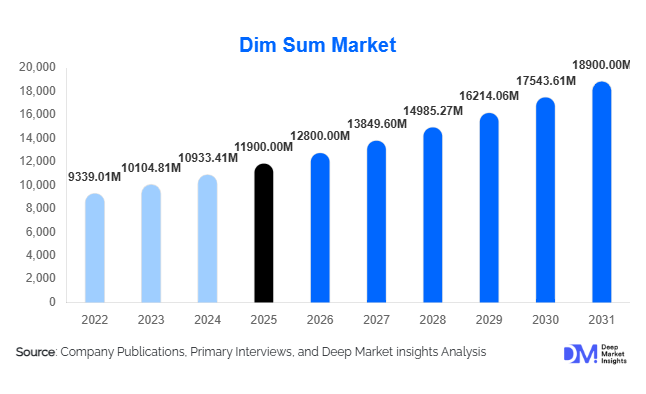
According to Deep Market Insights, the global dim sum market size was valued at USD 11,900 million in 2025 and is projected to grow from USD 12,800 million in 2026 to reach USD 18,900 million by 2031, expanding at a CAGR of 8.2% during the forecast period (2026–2031). The dim sum market growth is primarily driven by the increasing globalization of Asian cuisine, rising demand for convenient ready-to-cook meals, and the rapid expansion of frozen food retail channels across developed and emerging economies.
Key Market Insights
- Frozen dim sum dominates global consumption, supported by growing supermarket penetration and advancements in cold chain logistics.
- Asia-Pacific remains the largest market, accounting for nearly half of global demand due to strong cultural consumption and manufacturing capabilities.
- North America is the fastest-growing region, driven by increasing acceptance of Asian cuisine and retail expansion.
- Cantonese dim sum continues to lead globally, maintaining dominance due to authenticity and widespread recognition.
- Health-oriented innovations, including plant-based and low-sodium variants, are reshaping product development strategies.
- E-commerce and quick commerce platforms are significantly improving product accessibility and boosting household consumption.
What are the latest trends in the dim sum market?
Rise of Frozen and Ready-to-Cook Dim Sum
The increasing preference for convenience foods has led to a surge in demand for frozen and ready-to-cook dim sum products. Consumers are seeking restaurant-quality meals that can be prepared quickly at home, driving strong retail sales across supermarkets and online platforms. Technological advancements such as cryogenic freezing and modified atmosphere packaging are improving product shelf life while preserving taste and texture. This trend is particularly prominent in North America and Europe, where busy lifestyles and dual-income households are fueling demand for easy meal solutions.
Health and Plant-Based Innovation
Health-conscious consumers are influencing product innovation within the dim sum market. Manufacturers are introducing plant-based dumplings, gluten-free wrappers, and low-sodium fillings to cater to dietary preferences. The growing vegan population and rising awareness of clean-label ingredients are encouraging companies to invest in alternative proteins and organic formulations. This shift is enabling brands to target premium segments and differentiate themselves in a competitive market landscape.
What are the key drivers in the dim sum market?
Globalization of Asian Cuisine
Dim sum has evolved from a traditional Chinese culinary offering into a globally recognized food category. Increasing exposure through international travel, media, and restaurant chains has significantly boosted its popularity across Western markets. Restaurants and QSR chains are incorporating dim sum into mainstream menus, expanding consumer reach and driving repeat consumption.
Growth of Frozen Food Industry
The expansion of the global frozen food sector is a key driver of dim sum market growth. Consumers are increasingly opting for ready-to-cook meals due to time constraints and lifestyle changes. Frozen dim sum products offer convenience, consistency, and affordability, making them highly appealing across both developed and emerging markets.
What are the restraints for the global market?
Dependence on Cold Chain Infrastructure
The dim sum market relies heavily on efficient cold chain logistics for storage and transportation. Limited infrastructure in developing regions restricts market penetration and increases operational costs for manufacturers and distributors. Maintaining product quality across long supply chains remains a key challenge.
Raw Material Price Volatility
Fluctuations in the prices of key ingredients such as wheat, pork, seafood, and packaging materials can impact profit margins. Manufacturers often face challenges in maintaining consistent pricing while ensuring product quality, especially in price-sensitive markets.
What are the key opportunities in the dim sum industry?
Expansion in Emerging Retail Markets
Emerging economies in Southeast Asia, the Middle East, and Latin America are witnessing rapid growth in modern retail infrastructure. This creates opportunities for frozen dim sum manufacturers to expand distribution networks and reach new consumer bases. Investments in cold storage and logistics are further supporting this expansion.
Digital and E-Commerce Distribution Channels
The rise of online grocery platforms and quick commerce services is transforming dim sum distribution. Brands can now directly reach consumers through digital channels, reducing dependency on traditional retail networks. Cloud kitchens and virtual restaurant models are also leveraging digital platforms to expand dim sum offerings globally.
Report Scope
| Report Metric | Details |
|---|---|
| Market Size in 2025 | USD 11900 Million |
| Market Size in 2026 | USD 12800 Million |
| Market Size in 2031 | USD 18900 Million |
| CAGR | 8.2% (2026-2031) |
| Base Year for Estimation | 2025 |
| Historical Data | 2022-2024 |
| Forecast Period | 2026-2031 |
| Report Coverage | Revenue Forecast, Competitive Landscape, Supply Chain Disruption, Growth Factors, Environment & Regulatory Landscape and Trends |
| Geographies Covered | North America, Europe, APAC, Middle East and Africa, LATAM |
| Countries Covered | U.S., Canada, U.K., Germany, France, Spain, Italy, Russia, Nordic, Benelux, Rest of Europe, China, Korea, Japan, India, Australia, Singapore, Taiwan, South East Asia, Rest of Asia-Pacific, UAE, Turky, Saudi Arabia, South Africa, Egypt, Nigeria, Rest of MEA, Brazil, Mexico, Argentina, Chile, Colombia, Rest of LATAM |
Explore more data points, trends and opportunities Download Free Sample Report
Product Type Insights
The global dim sum market continues to be strongly influenced by product type preferences, with steamed dim sum firmly maintaining its leadership position, accounting for approximately 38% of the overall market share in 2025. This dominance is primarily attributed to its deep-rooted cultural significance, particularly across Asian markets, where traditional offerings such as dumplings, siu mai, and baozi have long been staples of everyday and celebratory dining. Steamed dim sum is widely perceived as a healthier alternative compared to other preparation methods due to its minimal use of oil, preservation of natural flavors, and retention of nutritional value. This health-conscious perception is becoming increasingly relevant not only in Asia but also across Western markets, where consumers are actively seeking low-fat, clean-label, and minimally processed food options. The rising global awareness around wellness and balanced diets is therefore acting as a key driver for the leading steamed segment, further reinforced by innovations in plant-based fillings and gluten-free wrappers that cater to evolving dietary preferences.In addition to traditional varieties, manufacturers are continuously expanding their portfolios to include premium and artisanal steamed dim sum offerings, incorporating high-quality ingredients such as seafood, organic vegetables, and exotic meats. This premiumization trend is helping brands capture higher margins while appealing to affluent and experience-driven consumers. Furthermore, the increasing presence of dim sum in international cuisines and fusion menus is contributing to its broader acceptance beyond traditional consumption settings.
Application Insights
The application landscape of the dim sum market is predominantly led by restaurants and casual dining chains, which collectively account for nearly 44% of the global market share. This segment’s dominance is deeply rooted in the cultural essence of dim sum as a communal dining experience, traditionally enjoyed in group settings where a variety of dishes are shared among diners. The social and interactive nature of dim sum consumption continues to resonate strongly with consumers, particularly in regions with established Chinese culinary traditions. Restaurants play a crucial role in preserving authenticity, offering freshly prepared dim sum with a wide range of choices that cater to diverse taste preferences.Household consumption represents the fastest-growing application segment, fueled by the increasing availability of frozen and ready-to-cook dim sum products. The shift toward home dining, accelerated by changing lifestyles and the rise of remote work, is encouraging consumers to recreate restaurant-style experiences at home. The leading driver for this segment is the growing demand for convenience and time-saving meal solutions. Advances in food preservation technologies, improved packaging, and extended shelf life are enabling manufacturers to offer high-quality frozen dim sum that retains taste and texture. Additionally, the proliferation of modern retail channels and e-commerce platforms is making these products more accessible to consumers. Cooking tutorials, recipe content, and social media influence are also inspiring consumers to experiment with dim sum preparation at home, further boosting segment growth.
Distribution Channel Insights
Distribution channels play a critical role in shaping the accessibility and growth of the dim sum market, with supermarkets and hypermarkets emerging as the dominant segment, accounting for approximately 41% of the global market share. These retail formats offer a wide assortment of dim sum products, ranging from fresh and chilled items to frozen and ready-to-eat variants, catering to diverse consumer preferences. The leading segment driver for supermarkets and hypermarkets is their ability to provide convenience, product variety, and competitive pricing under one roof. The presence of private-label brands is further enhancing affordability and encouraging trial among price-sensitive consumers. Additionally, in-store promotions, sampling activities, and strategic product placement are driving impulse purchases and increasing consumer awareness.Specialty Asian food stores continue to play a vital role in the distribution landscape, particularly in maintaining authenticity and catering to niche consumer segments. These stores are often preferred by consumers seeking traditional and region-specific dim sum products that may not be widely available in mainstream retail outlets. The key driver for this segment is the demand for authenticity and cultural connection, especially among Asian diaspora communities. Specialty stores often source products directly from trusted suppliers and offer a curated selection that emphasizes quality and heritage.
Form Insights
The global dim sum market is distinctly segmented by form, with frozen dim sum emerging as the dominant category, accounting for approximately 52% of the total market share. This leadership position is primarily attributed to its extended shelf life, logistical efficiency, and compatibility with modern retail infrastructure. Frozen dim sum products are highly favored by both retailers and consumers due to their ability to maintain product quality over longer periods without significant compromise in taste or texture. The growing penetration of cold chain logistics across both developed and developing economies has further strengthened the distribution capabilities of frozen dim sum, enabling manufacturers to expand their geographic reach. Additionally, advancements in freezing technologies such as individual quick freezing (IQF) have enhanced product integrity, making frozen dim sum nearly indistinguishable from freshly prepared variants in terms of flavor and mouthfeel.Leading Segment Driver: The dominance of frozen dim sum is primarily driven by the rapid expansion of global cold chain infrastructure, increasing demand for long shelf-life products, and the rising preference for convenient meal solutions among urban consumers. These factors collectively position frozen dim sum as the most scalable and commercially viable segment within the market.
End-Use Insights
The dim sum market is significantly influenced by its diverse end-use applications, with the restaurant and foodservice sector emerging as the largest contributor to overall demand. This segment continues to dominate due to the strong consumer preference for dining experiences that emphasize authenticity, variety, and cultural immersion. Restaurants specializing in Asian cuisine, particularly Chinese and Cantonese offerings, have played a pivotal role in popularizing dim sum across global markets. The increasing trend of menu diversification among restaurants has also contributed to the growth of this segment, as establishments incorporate dim sum items to attract a broader customer base and enhance their culinary offerings.The expansion of quick-service restaurants (QSRs) and casual dining chains has further accelerated the adoption of dim sum in the foodservice sector. These establishments are leveraging dim sum’s versatility and portion-controlled nature to cater to evolving consumer preferences for shareable and snackable food options. Additionally, the rise of cloud kitchens and food delivery platforms has significantly boosted the accessibility of dim sum, enabling consumers to enjoy restaurant-quality products in the comfort of their homes. The integration of digital ordering systems and mobile applications has further streamlined the ordering process, enhancing consumer convenience and driving higher sales volumes.Leading Segment Driver: The restaurant and foodservice sector leads the market due to its ability to deliver authentic culinary experiences, combined with the rapid expansion of food delivery ecosystems and the growing popularity of Asian cuisine across global markets.
Explore more data points, trends and opportunities Download Free Sample Report
Dim Sum Market Segmentations
Product Type
- Steamed Dim Sum
- Fried Dim Sum
- Baked Dim Sum
- Boiled Dim Sum
- Specialty/Modern Dim Sum
Form
- Frozen Dim Sum
- Chilled/Refrigerated Dim Sum
- Fresh Dim Sum
- Ready-to-Eat Dim Sum
Distribution Channel
- Supermarkets & Hypermarkets
- Convenience Stores
- Online Retail & Quick Commerce
- Specialty Asian Stores
- Foodservice & HoReCa
End-Use
- Household Consumption
- Restaurants & Casual Dining
- Quick Service Restaurants (QSRs)
- Hotels & Catering Services
- Institutional Catering
Regional Insights
Asia-Pacific
Asia-Pacific dominates the global dim sum market, accounting for approximately 46% of the total market share in 2025. The region’s leadership is deeply rooted in its cultural heritage, with dim sum being an integral part of traditional cuisines, particularly in China. China alone contributes nearly 28% of the global market, driven by strong domestic consumption, a vast population base, and well-established production capabilities. The presence of numerous local manufacturers, coupled with a highly developed supply chain, enables large-scale production and distribution of dim sum products across the country.The expansion of the foodservice sector, particularly in urban centers, is also contributing to regional growth. The proliferation of restaurants, cafes, and street food vendors offering dim sum has created a vibrant and competitive market landscape. Furthermore, government initiatives supporting the food processing industry and investments in cold chain logistics are expected to further strengthen the market in the region.
North America
North America accounts for around 24% of the global dim sum market, with the United States contributing approximately 19%. The region’s growth is primarily driven by the increasing adoption of Asian cuisine, supported by a diverse and multicultural population. The presence of a large Asian diaspora has played a crucial role in introducing and popularizing dim sum among mainstream consumers.A significant driver of growth in North America is the expansion of the frozen food segment, which aligns well with consumer preferences for convenience and long shelf-life products. The well-established retail infrastructure, including large supermarket chains and online grocery platforms, facilitates the widespread availability of frozen dim sum products. Additionally, advancements in packaging and preservation technologies have enhanced product quality, making frozen dim sum an attractive option for consumers.Moreover, the growing trend of experiential dining and interest in global cuisines are encouraging restaurants to incorporate dim sum into their menus. This trend is particularly evident in urban areas, where consumers are more open to trying new and diverse food options.
Europe
Europe holds approximately 18% of the global dim sum market share, with key markets including the United Kingdom, Germany, and France. The region’s growth is driven by increasing consumer exposure to international cuisines and the rising popularity of Asian food. The United Kingdom, in particular, stands out as a major market due to its strong acceptance of Asian cuisine and the widespread availability of frozen dim sum products in retail outlets.The increasing influence of food tourism and cultural exchange is also contributing to market growth. European consumers are becoming more adventurous in their food choices, leading to higher demand for authentic and fusion dim sum products. The rise of Asian restaurants and food festivals across the region has further enhanced consumer awareness and acceptance.Health and sustainability trends are also shaping the market in Europe, with consumers showing a preference for organic, plant-based, and ethically sourced food products. This has prompted manufacturers to innovate and introduce healthier dim sum options, aligning with evolving consumer expectations.
Latin America
Latin America represents about 7% of the global dim sum market, with Brazil and Mexico emerging as key growth markets. The region is experiencing steady growth, driven by rapid urbanization and increasing exposure to international cuisines. As urban populations expand, consumers are becoming more open to trying new and diverse food options, including dim sum.A key driver of growth in Latin America is the expansion of the middle-class population, which is leading to higher disposable incomes and increased spending on dining and convenience foods. The growing presence of international restaurant chains and foodservice operators is also contributing to the rising popularity of dim sum in the region.Retail development and the gradual expansion of cold chain infrastructure are further supporting market growth. While the market is still in its early stages compared to more developed regions, increasing investments in food distribution and logistics are expected to enhance product availability and accessibility in the coming years.
Middle East & Africa
The Middle East & Africa accounts for nearly 5% of global dim sum demand, with key markets including the United Arab Emirates and Saudi Arabia. The region’s growth is primarily driven by a strong presence of expatriate populations and a thriving tourism industry, both of which contribute to the demand for diverse and international cuisines.One of the major drivers of growth in this region is the rapid expansion of the foodservice sector, particularly in urban hubs such as Dubai and Riyadh. The increasing number of restaurants, hotels, and catering services offering Asian cuisine has significantly boosted the availability and popularity of dim sum. Additionally, the region’s growing hospitality industry, supported by large-scale events and tourism initiatives, is creating new opportunities for market expansion.Overall, while the Middle East & Africa currently holds a smaller share of the global market, its growth potential remains significant, driven by favorable demographic trends, economic development, and increasing consumer openness to international food offerings.
Company Market Share
Key Players in the Dim Sum Market
- Ajinomoto
- CJ CheilJedang
- Nestlé
- General Mills
- Unilever
- Charoen Pokphand Foods
- Kerry Group
- Sanquan Food
- Synear Food
- Wei Chuan Foods
- Want Want China Holdings
- Kawan Food
- MTR Foods
- InnovAsian Cuisine
- Tai Pei Foods