DHA Baby Nutrition Market Size
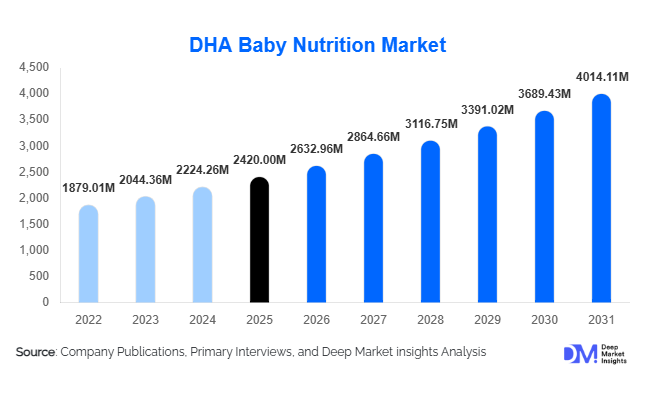
According to Deep Market Insights,the global DHA baby nutrition market size was valued at USD 2,420 million in 2025 and is projected to grow from USD 2,632.96 million in 2026 to reach USD 4,014.11 million by 2031, expanding at a CAGR of 8.8% during the forecast period (2026–2031). The market growth is primarily driven by increasing awareness about the importance of docosahexaenoic acid (DHA) for infant brain development, growing demand for fortified infant formula, and the rapid expansion of premium baby nutrition products across emerging economies.
Key Market Insights
- DHA-fortified infant formula remains the dominant product category, accounting for the majority of market demand due to its close nutritional resemblance to breast milk.
- Algal-derived DHA is gaining strong adoption as a sustainable and vegetarian source of omega-3 fatty acids in infant nutrition.
- Asia-Pacific dominates the global market, supported by large birth populations and increasing per-child spending on healthcare and nutrition.
- Premium baby nutrition products are expanding rapidly, driven by rising health awareness among millennial parents.
- Online retail and e-commerce platforms are transforming distribution channels, enabling direct-to-consumer sales and digital education on infant nutrition.
- Technological innovation in DHA extraction and microencapsulation is improving product stability and absorption efficiency.
What are the latest trends in the DHA baby nutrition market?
Rising Demand for Plant-Based DHA Sources
The growing preference for sustainable and plant-derived ingredients has accelerated demand for algal-based DHA in baby nutrition products. Microalgae cultivation technologies are enabling manufacturers to produce high-purity DHA that is free from marine contaminants such as heavy metals and pollutants. This shift toward plant-based DHA aligns with global consumer trends favoring clean-label and environmentally sustainable ingredients. As a result, many infant formula manufacturers are reformulating their products to include algal DHA as a primary omega-3 source. The growing adoption of vegetarian and vegan diets among consumers is further supporting the transition toward algae-derived DHA in baby foods and infant formula products.
Premiumization of Infant Nutrition Products
Premium baby nutrition products are becoming increasingly popular among parents seeking higher-quality nutritional solutions for infants. DHA-enriched organic formulas, hypoallergenic formulations, and specialized nutrition for premature infants are gaining widespread attention. Parents are increasingly willing to pay premium prices for products that support cognitive development and overall infant health. This trend is particularly evident in developed markets such as the United States, Germany, and Japan, where consumers prioritize scientifically validated nutrition products. In addition, premium products often include complementary ingredients such as probiotics, prebiotics, and vitamins alongside DHA, creating more comprehensive infant nutrition solutions.
What are the key drivers in the DHA baby nutrition market?
Increasing Awareness of Infant Brain Development
One of the primary drivers of the DHA baby nutrition market is the growing recognition of DHA as an essential nutrient for infant brain and eye development. DHA plays a critical role in neurological development during the early stages of life, particularly during the first two years when brain growth is most rapid. Pediatricians and healthcare organizations worldwide recommend DHA supplementation in infant diets to support cognitive function, visual development, and immune health. This increasing awareness has encouraged infant formula manufacturers to incorporate DHA into nearly all modern infant nutrition products.
Growth of the Global Infant Formula Industry
The global infant formula industry continues to expand due to rising urbanization, increasing female workforce participation, and changing lifestyles. Working parents often rely on infant formula products as convenient alternatives or supplements to breastfeeding. As manufacturers attempt to replicate the nutritional composition of breast milk, DHA has become a standard ingredient in most infant formulas. The expansion of the infant formula market in countries such as China, India, and Brazil is significantly contributing to overall demand for DHA ingredients.
What are the restraints for the global market?
High Production Costs of DHA Ingredients
The production of high-quality DHA ingredients requires advanced biotechnology processes, particularly when derived from microalgae. Cultivating microalgae, extracting DHA, and maintaining product purity involve significant technological investment and operational costs. These high production costs can increase the overall price of DHA-enriched infant nutrition products, potentially limiting affordability in price-sensitive markets.
Strict Regulatory Requirements for Infant Nutrition
Infant nutrition products are among the most strictly regulated food categories worldwide. Governments impose stringent safety standards, ingredient approvals, labeling requirements, and quality control processes to ensure infant health protection. Compliance with these regulations can increase research, development, and certification costs for manufacturers, creating barriers for new entrants seeking to enter the market.
What are the key opportunities in the DHA baby nutrition industry?
Expansion in Emerging Economies
Emerging economies present significant opportunities for DHA baby nutrition products due to rising birth rates and improving healthcare awareness. Countries such as India, Indonesia, Brazil, and Vietnam are experiencing rapid growth in middle-class populations and disposable income levels. Parents in these regions are increasingly investing in high-quality infant nutrition products to support early childhood development. Government initiatives promoting maternal and infant health are also boosting demand for nutritionally fortified baby foods.
Technological Innovation in Nutritional Formulations
Advancements in biotechnology and ingredient encapsulation are improving the stability, bioavailability, and shelf life of DHA in infant nutrition products. Microencapsulation technologies protect DHA from oxidation while ensuring effective absorption in infants. Companies are also investing in precision fermentation techniques for DHA production, enabling more sustainable and scalable manufacturing processes. These technological innovations are expected to drive future growth and expand the range of DHA-fortified infant nutrition products available globally.
Report Scope
| Report Metric | Details |
|---|---|
| Market Size in 2025 | USD 2420 Million |
| Market Size in 2026 | USD 2632.96 Million |
| Market Size in 2031 | USD 4014.11 Million |
| CAGR | 8.8% (2026-2031) |
| Base Year for Estimation | 2025 |
| Historical Data | 2022-2024 |
| Forecast Period | 2026-2031 |
| Report Coverage | Revenue Forecast, Competitive Landscape, Supply Chain Disruption, Growth Factors, Environment & Regulatory Landscape and Trends |
| Geographies Covered | North America, Europe, APAC, Middle East and Africa, LATAM |
| Countries Covered | U.S., Canada, U.K., Germany, France, Spain, Italy, Russia, Nordic, Benelux, Rest of Europe, China, Korea, Japan, India, Australia, Singapore, Taiwan, South East Asia, Rest of Asia-Pacific, UAE, Turky, Saudi Arabia, South Africa, Egypt, Nigeria, Rest of MEA, Brazil, Mexico, Argentina, Chile, Colombia, Rest of LATAM |
Explore more data points, trends and opportunities Download Free Sample Report
Product Type Insights
DHA-fortified infant formula continues to dominate the global DHA baby nutrition market, accounting for approximately 58% of total demand. This leadership is fueled by the widespread preference for infant formulas that closely mimic the nutritional profile of breast milk, providing essential omega-3 fatty acids critical for early brain and visual development. Complementary baby foods fortified with DHA, including cereals, purees, and snack products, are witnessing increasing adoption among parents seeking balanced nutrition for infants beyond six months. Additionally, DHA-based dietary supplements, such as drops, syrups, and capsules, are experiencing steady growth, driven by pediatrician recommendations and heightened awareness of dietary gaps in infants and toddlers.
Application Insights
The primary application of DHA baby nutrition products remains in infant formulas, which are enriched with DHA to support cognitive and visual development during the critical early months of life. The baby food sector is also expanding rapidly, with manufacturers producing DHA-enriched cereals, fruit purees, and toddler snacks that help meet growing nutritional requirements as children transition to solid foods. Furthermore, the nutraceutical segment is gaining traction, fueled by rising parental interest in targeted dietary supplements for infants and toddlers. These applications collectively underpin steady market expansion across regions, driven by both health-conscious consumers and professional healthcare recommendations.
Distribution Channel Insights
Supermarkets and hypermarkets remain the dominant distribution channels for DHA baby nutrition products, benefiting from extensive retail networks, strong consumer trust, and easy product accessibility. Pharmacies and drugstores continue to play a crucial role, particularly for infant DHA supplements recommended by pediatricians. In recent years, online retail platforms have emerged as one of the fastest-growing channels, offering convenience, a wide product selection, detailed nutritional information, and user reviews that guide parental purchasing decisions.
Age Group Insights
Infants aged 0–6 months represent the largest consumer segment for DHA baby nutrition products, reflecting the critical importance of DHA during rapid early brain development. Strong demand is seen in this age group for DHA-fortified infant formulas and supplements. The 6–12 months age group is also growing steadily as parents introduce complementary DHA-enriched foods to support ongoing development. Toddlers aged 12–36 months form an emerging segment, increasingly consuming DHA-enriched snacks and supplements to support cognitive growth and overall wellness during early childhood.
Explore more data points, trends and opportunities Download Free Sample Report
DHA Baby Nutrition Market Segmentations
By Product Type
- DHA-Fortified Infant Formula
- DHA-Fortified Baby Foods
- DHA Dietary Supplements for Infants
- DHA-Enhanced Toddler Nutrition Products
By Source Type
- Algal-Based DHA
- Fish Oil-Based DHA
- Krill Oil-Based DHA
- Fermentation-Derived DHA
By Application
- Infant Formula Manufacturing
- Baby Food Manufacturing
- Nutraceutical Infant Supplements
- Clinical Infant Nutrition
By Distribution Channel
- Supermarkets and Hypermarkets
- Pharmacies and Drugstores
- Online Retail
- Specialty Baby Stores
- Hospital and Healthcare Channels
Regional Insights
North America
North America holds roughly 26% of the global DHA baby nutrition market, with the United States leading regional consumption due to heightened consumer awareness about infant nutrition, high disposable incomes, and strong trust in DHA-fortified infant formulas. Canada contributes to stable regional growth, supported by stringent food safety regulations, robust healthcare standards, and increasing adoption of fortified complementary foods. The growing focus on pediatric nutrition and increasing recommendations by healthcare professionals further drive market expansion in the region.
Europe
Europe commands around 21% of the global market, underpinned by strong demand for premium infant nutrition products. Countries such as Germany, France, the Netherlands, and the United Kingdom benefit from well-established infant formula manufacturing industries and rigorous regulatory frameworks that ensure high-quality nutrition. The rising consumer preference for organic and fortified baby foods, coupled with increasing awareness of early cognitive development, is boosting market growth across both infant formulas and DHA-enriched complementary foods.
Asia-Pacific
Asia-Pacific is the largest regional market, accounting for approximately 42% of global demand. China leads the region due to substantial spending on premium infant formulas, increasing urbanization, and strong consumer trust in fortified baby nutrition products. India is emerging as one of the fastest-growing markets, driven by expanding retail networks, rising healthcare awareness, and a growing middle class investing in high-quality infant nutrition. Japan, South Korea, and Australia also contribute significantly, with parents actively seeking scientifically formulated DHA-enriched products to enhance early childhood development. The region’s rapid economic growth and rising parental education on infant nutrition continue to propel market expansion.
Latin America
Latin America accounts for nearly 6% of the global DHA baby nutrition market. Brazil and Mexico are key contributors, fueled by increasing healthcare awareness, higher disposable incomes, and growing preference for premium and fortified infant nutrition products. Expanding modern retail chains and the rising penetration of online sales channels are further supporting market growth across infant formula and complementary DHA-enriched foods in the region.
Middle East & Africa
The Middle East and Africa region holds approximately 5% of the global market, with countries such as Saudi Arabia, the United Arab Emirates, and South Africa leading consumption. Key growth drivers include rising birth rates, expanding retail and e-commerce infrastructure, increasing disposable incomes, and growing parental awareness of the importance of DHA in early development. Adoption of fortified infant formulas and supplements is further accelerated by healthcare initiatives and professional recommendations, ensuring steady market expansion across the region.
Key Players in the DHA Baby Nutrition Market
- Nestlé S.A.
- Danone S.A.
- Abbott Laboratories
- Reckitt Benckiser Group plc
- Royal FrieslandCampina N.V.
- Meiji Holdings Co., Ltd.
- Morinaga Milk Industry Co., Ltd.
- China Feihe Limited
- Yili Group
- Hero Group
- DSM-Firmenich
- BASF SE
- Arla Foods Ingredients
- Aker BioMarine ASA
- GC Rieber VivoMega