Deodorants Market Size
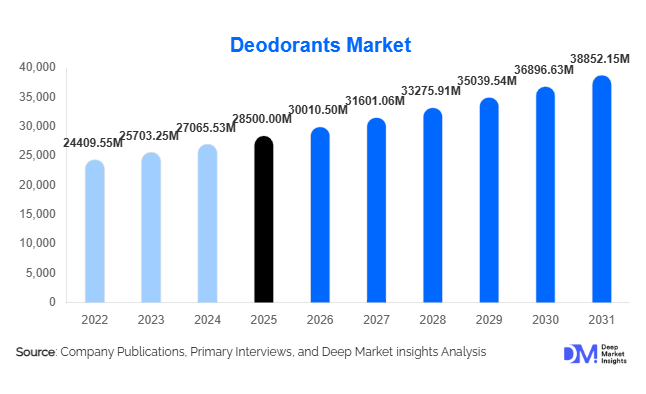
According to Deep Market Insights, the global deodorants market size was valued at USD 28,500 million in 2025 and is projected to grow from USD 30,010.50 million in 2026 to reach USD 38,852.15 million by 2031, expanding at a CAGR of 5.3% during the forecast period (2026–2031). The deodorants market growth is primarily driven by rising awareness of personal hygiene, increasing urbanization, and the growing demand for premium and natural grooming products. The market is evolving beyond basic odor control, with consumers seeking multifunctional products offering skincare benefits, long-lasting protection, and sustainable formulations.
Key Market Insights
- Natural and aluminum-free deodorants are gaining strong traction, driven by health-conscious consumers seeking safer alternatives.
- Asia-Pacific dominates the global market, supported by rapid urbanization and rising disposable incomes in countries such as India and China.
- Mass-market products account for the largest share, although premium segments are expanding steadily in developed regions.
- E-commerce is the fastest-growing distribution channel, enabling direct-to-consumer brands to scale rapidly.
- Male grooming and unisex products are emerging as key growth segments, reshaping traditional gender-based product positioning.
- Sustainability trends, including refillable packaging and eco-friendly aerosols, are influencing product innovation.
What are the latest trends in the deodorants market?
Shift Toward Natural and Clean-Label Products
Consumers are increasingly prioritizing ingredient transparency and safety, driving demand for natural and organic deodorants. Products free from aluminum, parabens, and synthetic fragrances are witnessing strong growth, particularly in North America and Europe. Brands are focusing on plant-based formulations, essential oils, and probiotic ingredients that support skin microbiome health. Certifications such as organic and cruelty-free labeling are becoming key differentiators, enabling premium pricing and stronger brand loyalty. This trend is reshaping product development pipelines and encouraging established players to reformulate existing offerings.
Premiumization and Multifunctional Innovation
The deodorants market is witnessing a shift toward premium products offering additional benefits such as skincare, fragrance layering, and extended protection (48–72 hours). Consumers are increasingly willing to pay higher prices for products that combine deodorant functionality with moisturizing, anti-bacterial, and dermatological benefits. Luxury brands are introducing designer fragrances in deodorant formats, while niche brands are innovating with personalized and subscription-based offerings. This trend is particularly strong in developed markets, where higher disposable incomes support premium consumption.
What are the key drivers in the deodorants market?
Rising Awareness of Personal Hygiene
Growing awareness of personal grooming and hygiene is a major driver of deodorant adoption globally. Increased exposure to global lifestyle trends, social media influence, and workplace grooming standards are encouraging daily usage. Emerging markets are witnessing significant growth as consumers transition from traditional hygiene practices to modern personal care products, expanding the overall consumer base.
Expansion of Retail and E-commerce Channels
The growth of organized retail and e-commerce platforms has significantly improved product accessibility. Online channels allow consumers to explore a wide variety of brands, compare prices, and access reviews, driving higher purchase frequency. Direct-to-consumer brands are leveraging digital marketing and subscription models to build customer loyalty and reduce distribution costs, further accelerating market growth.
What are the restraints for the global market?
Health Concerns Over Chemical Ingredients
Concerns regarding the safety of certain ingredients, particularly aluminum compounds in antiperspirants, are restraining market growth. Increasing consumer awareness and regulatory scrutiny are pushing manufacturers to reformulate products, which can increase production costs and impact profit margins.
Environmental Impact of Packaging
Aerosol deodorants, which dominate the market, face criticism due to their environmental impact. Issues related to emissions and non-recyclable packaging materials are prompting regulatory intervention and shifting consumer preferences toward sustainable alternatives such as roll-ons and sticks. Companies must invest in eco-friendly packaging solutions to remain competitive.
What are the key opportunities in the deodorants industry?
Growth in Emerging Markets
Emerging economies in Asia-Pacific, Africa, and Latin America present significant growth opportunities due to rising urbanization, increasing disposable incomes, and expanding middle-class populations. Deodorant penetration in these regions remains relatively low, offering substantial headroom for growth. Localized pricing strategies and smaller packaging formats can help brands capture mass-market demand effectively.
Technological Innovation and Product Differentiation
Advancements in formulation technology, including microbiome-friendly deodorants and long-lasting protection, are creating new growth avenues. Smart packaging, refillable systems, and sustainable product designs are gaining traction, aligning with consumer preferences for eco-friendly solutions. Companies investing in R&D and innovation can achieve competitive differentiation and premium positioning.
Report Scope
| Report Metric | Details |
|---|---|
| Market Size in 2025 | USD 28500 Million |
| Market Size in 2026 | USD 30010.50 Million |
| Market Size in 2031 | USD 38852.15 Million |
| CAGR | 5.3% (2026-2031) |
| Base Year for Estimation | 2025 |
| Historical Data | 2022-2024 |
| Forecast Period | 2026-2031 |
| Report Coverage | Revenue Forecast, Competitive Landscape, Supply Chain Disruption, Growth Factors, Environment & Regulatory Landscape and Trends |
| Geographies Covered | North America, Europe, APAC, Middle East and Africa, LATAM |
| Countries Covered | U.S., Canada, U.K., Germany, France, Spain, Italy, Russia, Nordic, Benelux, Rest of Europe, China, Korea, Japan, India, Australia, Singapore, Taiwan, South East Asia, Rest of Asia-Pacific, UAE, Turky, Saudi Arabia, South Africa, Egypt, Nigeria, Rest of MEA, Brazil, Mexico, Argentina, Chile, Colombia, Rest of LATAM |
Explore more data points, trends and opportunities Download Free Sample Report
Product Type Insights
Aerosol deodorants continue to dominate the global market, accounting for approximately 38% share in 2025. This leadership is primarily driven by its ease of application, quick-drying nature, and widespread availability across both developed and emerging markets. Consumers favor aerosols for their convenience, uniform coverage, and suitability for on-the-go usage, particularly in urban environments with fast-paced lifestyles. Additionally, aggressive marketing campaigns and strong shelf presence in supermarkets have reinforced their dominance. However, environmental concerns related to propellants and packaging waste are gradually influencing consumer behavior, prompting a shift toward alternative formats.
Roll-on deodorants are gaining traction due to their eco-friendly positioning and controlled application, making them particularly popular in Europe and the Asia-Pacific. Stick deodorants are also witnessing increased adoption, especially in North America, where consumers value their long-lasting performance and minimal residue. Emerging formats such as gels, creams, and wipes are carving out niche segments, catering to specific use cases such as travel, sports, and sensitive skin applications. These innovations reflect a broader trend toward product diversification and customization, enabling brands to address varied consumer preferences.
Application Insights
Personal daily use remains the dominant application segment, contributing nearly 70% of total market demand in 2025. This dominance is driven by the integration of deodorants into daily hygiene routines across all demographics, supported by increasing awareness of personal grooming and social etiquette. The segment benefits from consistent, repeat purchases and widespread product accessibility, making it the backbone of market revenue.
The sports and active lifestyle segment is the fastest-growing application area, fueled by rising global participation in fitness activities, gym memberships, and outdoor sports. Consumers in this segment demand high-performance products offering extended protection and sweat control, driving innovation in long-lasting and antiperspirant formulations. Meanwhile, clinical applications are emerging as a niche but promising segment, supported by growing awareness of dermatological conditions such as hyperhidrosis. Medical-grade deodorants and dermatologist-recommended products are gaining acceptance, particularly in developed markets, adding a new dimension to application-based demand.
Distribution Channel Insights
Supermarkets and hypermarkets hold the largest share of approximately 40% in 2025, primarily due to their extensive product assortment, strong brand visibility, and consumer preference for one-stop shopping experiences. Bulk purchasing behavior and promotional discounts further strengthen the dominance of this channel, particularly in emerging economies where price sensitivity is high. The physical retail environment also enables consumers to compare products directly, influencing purchase decisions.
However, online retail is the fastest-growing distribution channel, expanding at a rate exceeding 10% annually. The growth of e-commerce is driven by increasing internet penetration, smartphone usage, and the convenience of home delivery. Digital platforms enable brands to engage directly with consumers through personalized recommendations, targeted advertising, and subscription-based purchasing models. Specialty stores and pharmacies also play a critical role, particularly for premium, natural, and clinical deodorants, where consumers seek expert guidance and assurance of product quality. The evolving omnichannel landscape is reshaping distribution strategies across the industry.
End-User Insights
The male segment leads the global deodorants market with approximately 45% market share in 2025, driven by increasing awareness of personal grooming and the expansion of male-specific product lines. Marketing campaigns targeting male consumers, combined with the growing influence of social media and celebrity endorsements, have significantly boosted adoption rates. This segment continues to benefit from rising disposable incomes and changing cultural perceptions around male grooming.
Female consumers represent a stable and significant share of the market, particularly in the premium segment, where demand for skincare-integrated and fragrance-enhanced deodorants is strong. Women are increasingly opting for products that combine odor protection with skin benefits such as moisturizing and sensitivity care. Meanwhile, the unisex segment is emerging as the fastest-growing category, reflecting a shift toward inclusive branding and gender-neutral product positioning. This trend is particularly prominent among younger consumers who prioritize functionality and sustainability over traditional gender distinctions.
Explore more data points, trends and opportunities Download Free Sample Report
Deodorants Market Segmentations
By Product Type
- Aerosol Deodorants
- Roll-on Deodorants
- Stick Deodorants
- Gel Deodorants
- Cream Deodorants
- Wipes & Pads
By Application
- Personal Daily Use
- Sports & Active Lifestyle
- Clinical/Medical Use
By Distribution Channel
- Supermarkets & Hypermarkets
- Convenience Stores
- Pharmacies & Drugstores
- Online Retail
- Specialty Stores
By End-User
- Male
- Female
- Unisex
Regional Insights
North America
North America accounts for approximately 28% of the global deodorants market in 2025, with the United States representing the largest contributor. The region’s growth is driven by high consumer awareness, strong purchasing power, and a well-established personal care industry. A key driver is the increasing demand for premium, natural, and aluminum-free deodorants, as consumers prioritize health and sustainability. Additionally, the presence of leading global brands and continuous product innovation, particularly in clean-label and dermatologically tested formulations, supports market expansion. Advanced retail infrastructure and high penetration of e-commerce platforms further enhance accessibility and consumer engagement.
Europe
Europe holds around 25% market share, led by countries such as Germany, the United Kingdom, and France. The region’s growth is strongly influenced by stringent regulatory frameworks and sustainability initiatives, which drive innovation in eco-friendly and recyclable packaging solutions. European consumers exhibit a strong preference for organic, vegan, and cruelty-free products, encouraging brands to invest in clean-label formulations. Additionally, increasing environmental awareness and government policies promoting sustainable consumption are key drivers of regional demand. The mature retail landscape and high adoption of premium products further contribute to steady market growth.
Asia-Pacific
Asia-Pacific dominates the global deodorants market with approximately 32% share in 2025, driven by rapid urbanization, population growth, and rising disposable incomes. Key markets such as China, India, and Japan are experiencing strong demand growth due to expanding middle-class populations and increasing awareness of personal hygiene. In India, the market is growing at a double-digit pace, supported by a young demographic and increasing penetration of affordable deodorant products. China’s growth is fueled by premiumization and the rising influence of international brands. The region also benefits from expanding retail networks and the rapid adoption of e-commerce platforms, making it the fastest-growing and most dynamic market globally.
Latin America
Latin America accounts for approximately 8% of the global market, with Brazil and Mexico as the primary contributors. The region’s growth is driven by climatic conditions and cultural emphasis on personal grooming, which results in high product usage frequency. Increasing urbanization and the expansion of modern retail channels are further supporting market growth. Additionally, the rising middle class and improving economic conditions are enabling greater consumption of mid-range and premium deodorant products. Local manufacturing and strong brand presence also contribute to market stability in the region.
Middle East & Africa
The Middle East & Africa region holds approximately 7% share and is the fastest-growing market, with a CAGR of around 6.5%. Growth in this region is primarily driven by extreme climatic conditions, increasing urbanization, and rising disposable incomes. Countries such as the UAE, Saudi Arabia, and South Africa are key markets, supported by a growing expatriate population and expanding retail infrastructure. The demand for long-lasting and high-performance deodorants is particularly strong due to high temperatures. Additionally, increasing awareness of personal hygiene and the expansion of international brands into the region are accelerating market growth.
Key Players in the Deodorants Market
- Unilever
- Procter & Gamble
- L’Oréal
- Beiersdorf
- Henkel
- Colgate-Palmolive
- Church & Dwight
- Godrej Consumer Products
- Natura & Co
- Amway
- Edgewell Personal Care
- Lion Corporation
- CavinKare
- Oriflame
- Avon