Date Palm Market Size
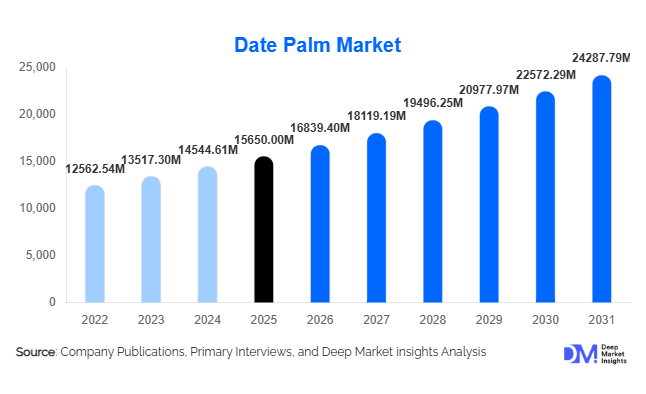
According to Deep Market Insights, the global date palm market size was valued at USD 15,650 million in 2025 and is projected to grow from USD 16,839.40 million in 2026 to reach USD 24,287.79 million by 2031, expanding at a CAGR of 7.6% during the forecast period (2026–2031). The market growth is primarily driven by the increasing demand for natural sweeteners, rising health consciousness among consumers, and the expanding application of dates across food processing and nutraceutical industries. The shift toward clean-label ingredients and functional foods is further accelerating adoption, particularly in developed economies.
Key Market Insights
- Date-based sweeteners are gaining strong traction, replacing refined sugar in bakery, beverages, and health foods.
- Processed date products are witnessing rapid growth, driven by convenience and industrial applications.
- Middle East & Africa dominates global production, supported by favorable climatic conditions and government-backed agriculture programs.
- Asia-Pacific is the fastest-growing consumption region, led by rising demand in India, China, and Southeast Asia.
- Organic and premium varieties such as Medjool are expanding, catering to health-conscious and premium consumers.
- Technological advancements in processing and packaging are improving shelf life, quality, and global trade efficiency.
What are the latest trends in the date palm market?
Rising Popularity of Natural Sweeteners
Consumers are increasingly shifting away from refined sugars toward natural alternatives, positioning dates as a key ingredient in modern diets. Date syrup, paste, and sugar are being widely adopted across bakery, confectionery, and beverage industries. This trend is strongly supported by growing awareness of lifestyle diseases such as diabetes and obesity, encouraging the use of low-processed, nutrient-rich sweeteners. Food manufacturers are reformulating products to include date-based ingredients, enhancing both nutritional value and label transparency. The clean-label movement is further strengthening this shift, as consumers actively seek recognizable and minimally processed ingredients in packaged foods.
Expansion of Value-Added Date Products
The market is witnessing a surge in innovation, particularly in value-added products such as energy bars, snack bites, and functional beverages. Companies are leveraging advanced processing technologies such as freeze-drying and enzymatic extraction to enhance product quality and shelf life. Date-based snacks are gaining popularity among health-conscious consumers and fitness enthusiasts, while nutraceutical applications are expanding due to the fruit’s rich mineral and antioxidant content. This trend is transforming the market from traditional consumption to a diversified, high-value product ecosystem.
What are the key drivers in the date palm market?
Growing Demand for Functional and Nutrient-Rich Foods
The increasing focus on health and wellness is a major driver of the date palm market. Dates are rich in fiber, vitamins, and essential minerals, making them a preferred choice among consumers seeking functional foods. Their natural energy-boosting properties make them particularly popular in sports nutrition and healthy snacking segments. This demand is further amplified by rising disposable incomes and evolving dietary patterns globally.
Expansion of the Global Food Processing Industry
The rapid growth of the food processing sector is significantly boosting demand for date-based ingredients. Dates are widely used as natural sweeteners, binders, and flavor enhancers in bakery products, dairy formulations, and packaged snacks. The increasing demand for convenience foods and ready-to-eat products is further driving industrial consumption. Food manufacturers are increasingly integrating date derivatives into product formulations to cater to clean-label and health-focused consumer preferences.
What are the restraints for the global market?
Climate Dependency and Water Scarcity
Date palm cultivation is highly dependent on specific climatic conditions, particularly arid and semi-arid environments. Water scarcity and climate change pose significant challenges to production, potentially impacting yield and supply stability. Variability in weather patterns and increasing desertification can further constrain long-term growth prospects.
Price Volatility and Quality Variability
Fluctuations in production volumes, pest infestations, and supply chain inefficiencies can lead to price volatility and inconsistent product quality. These challenges can affect the reliability of supply for large-scale food manufacturers, posing a barrier to widespread industrial adoption.
What are the key opportunities in the date palm industry?
Expansion into Emerging Markets
Rapid urbanization and increasing disposable incomes in Asia-Pacific and Latin America present significant growth opportunities. Countries such as India, China, and Brazil are witnessing rising demand for dates due to changing dietary preferences and increased awareness of their health benefits. Improved logistics and trade agreements are enabling exporters to penetrate these high-growth markets more effectively.
Innovation in Functional and Nutraceutical Products
The growing nutraceutical industry offers substantial opportunities for date-based products. Dates are increasingly being used in supplements, protein bars, and functional beverages due to their natural nutrient profile. Continued innovation in this space is expected to unlock new revenue streams and expand the market’s application scope.
Report Scope
| Report Metric | Details |
|---|---|
| Market Size in 2025 | USD 15650.00 Million |
| Market Size in 2026 | USD 16839.40 Million |
| Market Size in 2031 | USD 24287.79 Million |
| CAGR | 7.6% (2026-2031) |
| Base Year for Estimation | 2025 |
| Historical Data | 2022-2024 |
| Forecast Period | 2026-2031 |
| Report Coverage | Revenue Forecast, Competitive Landscape, Supply Chain Disruption, Growth Factors, Environment & Regulatory Landscape and Trends |
| Geographies Covered | North America, Europe, APAC, Middle East and Africa, LATAM |
| Countries Covered | U.S., Canada, U.K., Germany, France, Spain, Italy, Russia, Nordic, Benelux, Rest of Europe, China, Korea, Japan, India, Australia, Singapore, Taiwan, South East Asia, Rest of Asia-Pacific, UAE, Turky, Saudi Arabia, South Africa, Egypt, Nigeria, Rest of MEA, Brazil, Mexico, Argentina, Chile, Colombia, Rest of LATAM |
Explore more data points, trends and opportunities Download Free Sample Report
Product Type Insights
The global dates market is increasingly shaped by the strong dominance of processed date products, which account for approximately 34% of the overall market share. This leading position is primarily driven by the growing industrial demand for convenient, versatile, and shelf-stable ingredients across multiple food manufacturing applications. Processed date products—including date paste, syrup, powder, and chopped dates—offer significant advantages over raw forms due to their ease of incorporation into large-scale production processes. Food manufacturers prefer these formats because they reduce preparation time, ensure consistency in taste and texture, and provide extended shelf life, all of which are critical in maintaining efficiency and cost-effectiveness in modern food supply chains.While processed dates lead the market, fresh and dried dates continue to maintain substantial shares, particularly in regions where traditional consumption patterns remain deeply rooted. Fresh dates are highly valued for their natural taste and nutritional profile, especially in producing countries across the Middle East and North Africa. Dried dates, on the other hand, benefit from longer storage life and ease of transportation, making them a staple in both domestic consumption and international trade. These traditional segments are supported by cultural preferences, seasonal demand spikes during religious festivals, and consistent use in household diets.At the same time, value-added date products are gaining significant traction globally, emerging as a dynamic growth segment within the market. Innovations such as date-based snacks, energy bars, and functional food ingredients are increasingly appealing to health-conscious consumers seeking convenient yet nutritious options. The rising popularity of plant-based diets and natural food formulations is further accelerating innovation in this category, as manufacturers explore new applications and product formats to cater to evolving dietary trends. As a result, the product type landscape is gradually shifting toward higher-value offerings, with processed and value-added products expected to play a central role in future market expansion.
Application Insights
The food and beverages segment dominates the global dates market, accounting for nearly 68% of total application share. This leadership position is underpinned by the extensive use of dates and their derivatives across a wide range of food categories, including bakery products, confectionery, dairy alternatives, cereals, and beverages. Dates serve as a natural sweetener, flavor enhancer, and binding agent, making them highly versatile ingredients in both traditional and modern food formulations. The increasing demand for clean-label and additive-free products has significantly boosted the adoption of date-based ingredients, particularly in health-oriented and premium food segments.Beyond food and beverages, the nutraceutical segment is emerging as a high-growth application area, driven by the expanding global focus on preventive healthcare and dietary supplementation. Date extracts and powders are increasingly used in health supplements due to their natural energy-boosting properties and high micronutrient content. The shift toward plant-based and natural nutraceutical ingredients has further accelerated demand in this segment, as consumers seek alternatives to synthetic supplements. This trend is particularly evident in developed markets, where awareness of functional ingredients continues to rise.The cosmetics and personal care segment is also gaining traction as a niche yet promising application area. The antioxidant and moisturizing properties of dates make them suitable for use in skincare and haircare formulations. Manufacturers are increasingly incorporating date extracts into products such as creams, lotions, and serums, capitalizing on the growing demand for natural and organic beauty products. As consumers become more conscious of ingredient transparency and sustainability, the use of plant-derived components like dates is expected to expand further in the cosmetics industry.Overall, while the food and beverages segment remains the primary driver of demand, the diversification of applications into nutraceuticals and personal care is broadening the market’s scope and creating new growth opportunities across multiple industries.
Distribution Channel Insights
The distribution landscape of the dates market is characterized by the dominance of direct or B2B channels, which account for approximately 52% of total market share. This segment is primarily driven by bulk procurement from food manufacturers, processors, and industrial buyers who rely on consistent and large-volume supplies of date products. The efficiency, cost advantages, and long-term supply agreements associated with B2B transactions make this channel particularly attractive for both suppliers and buyers. Additionally, the growing industrial use of processed date products has further strengthened the importance of direct distribution networks.Retail channels, including supermarkets, hypermarkets, and specialty stores, are also experiencing steady growth, driven by rising consumer demand for packaged and branded date products. The increasing availability of diverse product formats, such as flavored dates, organic variants, and snack packs, has enhanced the visibility and accessibility of dates in retail environments. Consumers are increasingly seeking convenience and product differentiation, prompting retailers to expand their offerings and invest in attractive packaging and branding strategies.E-commerce is emerging as a particularly dynamic distribution channel, especially in developed and urban markets. The rapid growth of online grocery platforms and direct-to-consumer sales models has transformed the way consumers purchase date products. Digital channels offer greater product variety, competitive pricing, and the convenience of home delivery, making them an attractive option for modern consumers. The increasing penetration of smartphones and internet connectivity, coupled with the expansion of online marketplaces, is expected to further accelerate the growth of this segment.As the distribution ecosystem continues to evolve, the interplay between traditional B2B channels and modern retail and e-commerce platforms will play a crucial role in shaping the future of the dates market.
End-Use Insights
The food processing industry represents the largest end-use segment in the global dates market, accounting for approximately 49% of total demand. This dominance is driven by the widespread incorporation of date-based ingredients into a variety of processed food products. From bakery goods and confectionery to ready-to-eat meals and health snacks, dates are increasingly used as natural sweeteners, flavor enhancers, and functional ingredients. The growing industrial demand for clean-label and plant-based components has further reinforced the importance of dates in food processing applications.Household consumption continues to play a significant role, particularly in traditional markets across the Middle East, Africa, and parts of Asia. Dates are a staple food in many cultures, consumed regularly as part of daily diets and during religious and festive occasions. This consistent demand provides a stable foundation for the market, even as industrial applications expand.The nutraceutical and foodservice sectors are emerging as high-growth end-use segments, reflecting changing consumer lifestyles and dietary preferences. In the nutraceutical sector, dates are increasingly used in health supplements and functional foods, while in the foodservice industry, they are gaining popularity as ingredients in gourmet dishes, desserts, and beverages. The expansion of these sectors is creating new avenues for market growth and diversification.
Explore more data points, trends and opportunities Download Free Sample Report
Date Palm Market Segmentations
By Product Type
- Fresh Dates
- Dried Dates
- Processed Date Products
By Application
- Food & Beverages
- Nutraceuticals & Dietary Supplements
- Personal Care & Cosmetics
- Animal Feed
By Distribution Channel
- Direct/B2B
- Supermarkets/Hypermarkets
- Convenience Stores
- Specialty Stores
- Online Retail
Regional Insights
Middle East & Africa
The Middle East & Africa region dominates the global dates market, accounting for approximately 38% of total share. This leadership is largely attributed to the region’s favorable climatic conditions, which are ideal for date cultivation, as well as its long-standing agricultural heritage. Countries such as Saudi Arabia, the United Arab Emirates, Iran, and Egypt are among the world’s largest producers and exporters of dates, benefiting from extensive cultivation areas and well-established supply chains.A key driver of regional growth is strong government support for agriculture and export-oriented production. Many countries in the region have implemented policies and initiatives aimed at enhancing productivity, improving quality standards, and expanding export markets. Investments in modern farming techniques, irrigation systems, and post-harvest processing facilities have significantly boosted production efficiency and output.Additionally, the region’s strategic position as a global export hub plays a crucial role in its market dominance. Middle Eastern and African countries supply dates to markets across Asia, Europe, and North America, supported by well-developed trade networks and logistics infrastructure. Cultural and religious significance also drives strong domestic consumption, particularly during events such as Ramadan, further reinforcing the region’s leadership position.
Asia-Pacific
Asia-Pacific holds approximately 27% of the global market share and is the fastest-growing region, with a CAGR exceeding 9%. The region’s growth is primarily driven by rising population levels, increasing disposable incomes, and changing dietary habits. India stands out as a major importer of dates, with high consumption levels driven by cultural and religious practices, as well as growing awareness of their health benefits.A major driver in this region is the increasing adoption of healthy and natural food products. As consumers become more health-conscious, there is a growing preference for nutrient-rich foods and natural sweeteners, which has significantly boosted demand for dates. In countries such as China and those in Southeast Asia, rising urbanization and expanding middle-class populations are further contributing to market growth.The expansion of modern retail infrastructure and e-commerce platforms is also playing a critical role in enhancing product accessibility and availability. As distribution networks improve, consumers are gaining greater access to a wide variety of date products, including premium and value-added offerings, which is expected to sustain the region’s rapid growth trajectory.
Europe
Europe accounts for nearly 14% of the global dates market, characterized by strong demand for high-quality and premium products. Countries such as Germany, France, and the United Kingdom are key markets, driven by increasing consumer interest in healthy eating and natural ingredients.The primary growth driver in Europe is the rising demand for organic and clean-label food products. Consumers in the region are highly conscious of ingredient transparency and sustainability, leading to increased adoption of organic dates and minimally processed products. This trend is further supported by stringent food safety regulations and certification standards, which encourage the use of high-quality ingredients.Additionally, the growing popularity of plant-based diets and functional foods is driving demand for date-based ingredients in various applications. As consumers seek alternatives to refined sugars and artificial additives, dates are increasingly being incorporated into a wide range of food products, from snacks to bakery items.
North America
North America represents approximately 13% of the global market share, with the United States leading regional demand. The market in this region is driven by increasing health consciousness and the growing popularity of natural and functional foods.A key growth driver is the rising demand for natural sweeteners as consumers move away from refined sugar and artificial ingredients. Dates are widely used in health-focused products such as energy bars, smoothies, and plant-based snacks, reflecting broader dietary trends. The strong presence of health and wellness movements, coupled with high consumer awareness, is further supporting market expansion.The region also benefits from a well-developed food processing industry and advanced distribution networks, which facilitate the widespread availability of date products. The growth of e-commerce and specialty health food stores is enhancing market penetration and providing consumers with greater access to diverse product offerings.
Latin America
Latin America holds a smaller share of around 8% but is gradually emerging as a promising market for date products. Countries such as Brazil and Mexico are witnessing increasing demand, driven by rising awareness of the nutritional benefits of dates and growing exposure to global food trends.The primary driver of growth in this region is the expanding middle-class population and increasing disposable incomes, which are enabling consumers to explore new and premium food products. Additionally, the influence of international cuisines and dietary trends is encouraging the adoption of dates in both household consumption and foodservice applications.Improving import networks and trade relationships are also facilitating the availability of date products across the region. As awareness continues to grow and distribution channels expand, Latin America is expected to experience steady market growth in the coming years.
Key Players in the Date Palm Market
- Al Barakah Dates Factory
- Al Foah Company
- Bateel International
- Hadiklaim Date Growers Cooperative
- Phoenix Agrotech
- Bard Valley Natural Delights
- Rayana Dates
- Al Mohamadia Dates
- Kingdom Dates
- Al Madinah Dates Company
- Maghadi Dates
- Sahara Date Company
- Haifa Dates
- Lion Dates Impex
- Ario Co.