Date Fruit Market Size
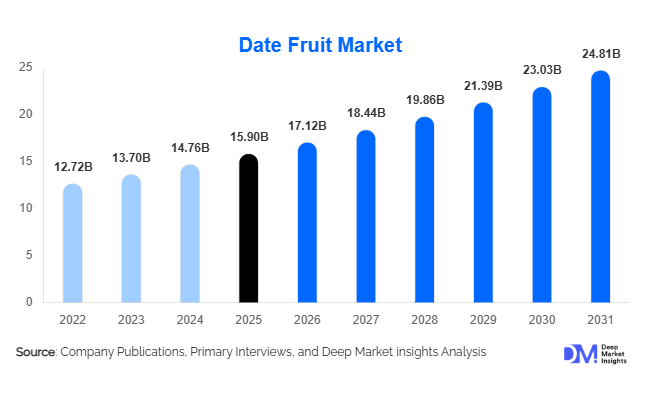
According to Deep Market Insights, the global date fruit market size was valued at USD 15.9 billion in 2025 and is projected to grow from USD 17.12 billion in 2026 to reach USD 24.81 billion by 2031, expanding at a CAGR of 7.7% during the forecast period (2026–2031). Market expansion is supported by rising global demand for natural sweeteners, increasing adoption of plant-based and clean-label foods, and growing consumption of nutrient-dense dried fruits across both developed and emerging economies. Dates are increasingly positioned as functional foods due to their high fiber, antioxidant, and mineral content, which aligns with consumer preferences shifting toward healthier snack alternatives and sugar substitutes.
Key Market Insights
- Growing demand for natural and minimally processed foods is accelerating global consumption of dates as a clean-label ingredient.
- Middle East and Africa dominate global production, while Asia-Pacific and Europe are emerging as high-growth consumption markets.
- Date-based ingredients such as syrup, paste, and powder are witnessing rapid adoption in bakery, dairy alternatives, and energy foods.
- Export-driven trade flows from Saudi Arabia, UAE, Iran, Tunisia, and Algeria continue to shape global pricing dynamics.
- Health-focused snacking trends are driving retail expansion across supermarkets, online channels, and specialty organic stores.
- Food processing innovation is expanding applications of dates into functional nutrition, sports foods, and plant-based formulations.
What are the latest trends in the date fruit market?
Shift Toward Natural Sweeteners and Sugar Replacement
Dates are increasingly being used as a natural alternative to refined sugar across multiple food categories. Food manufacturers are incorporating date paste, syrup, and powder into baked goods, snack bars, dairy alternatives, and beverages to meet clean-label requirements. Consumers are actively reducing artificial sweetener intake, encouraging brands to reformulate products using fruit-derived sweetness. This trend is especially strong in North America and Europe, where regulatory scrutiny and consumer awareness surrounding sugar consumption are reshaping product development pipelines. The rise of vegan and plant-based diets further strengthens this transition, as dates provide both sweetness and functional binding properties in processed foods.
Premiumization and Variety-Based Branding
The market is witnessing premium positioning around specific date varieties such as Medjool, Deglet Noor, Ajwa, and Barhi. Producers are investing in branding strategies emphasizing origin authenticity, organic cultivation, and premium quality grading. Luxury packaging, geographic indication labeling, and organic certification programs are helping exporters capture higher margins. Premium varieties are increasingly sold through e-commerce and specialty retail formats, targeting health-conscious consumers willing to pay higher prices for traceability and quality assurance.
What are the key drivers in the date fruit market?
Rising Global Demand for Functional Foods
Dates contain natural sugars, fiber, potassium, magnesium, and antioxidants, making them attractive within functional food categories. The growing global wellness movement has elevated demand for nutrient-rich snacks that provide energy without artificial additives. Athletes, fitness consumers, and health-conscious populations increasingly consume dates as natural energy boosters. This shift is driving strong growth across packaged date snacks and ingredient applications.
Expansion of Processed Food Applications
Food manufacturers are increasingly integrating dates into cereals, confectionery, dairy substitutes, and bakery products. Date syrup and paste have become versatile ingredients due to their texture-enhancing and binding properties. Industrial adoption has expanded beyond traditional consumption markets, supporting steady demand growth even in regions with limited cultural consumption history.
Export-Oriented Agricultural Development
Governments in major producing countries are investing heavily in irrigation infrastructure, processing facilities, and export logistics to strengthen agricultural diversification. National food security programs and agri-export strategies are expanding cultivation acreage and improving yield efficiency, supporting long-term global supply growth.
What are the restraints for the global market?
Climate Sensitivity and Water Dependency
Date palm cultivation depends heavily on arid climates combined with reliable irrigation systems. Rising water scarcity and climate variability in producing regions pose risks to yield stability and long-term supply consistency.
Price Volatility and Quality Standardization Issues
Variations in grading standards, harvesting practices, and storage infrastructure create inconsistencies in global pricing. Smaller producers often lack advanced post-harvest technology, limiting export competitiveness and affecting uniformity across international markets.
What are the key opportunities in the date fruit industry?
Growth of Date-Based Ingredients Industry
Date-derived ingredients represent one of the largest opportunities for value addition. Manufacturers are investing in date sugar, concentrates, and functional powders targeting bakery, sports nutrition, and infant food sectors. These processed formats significantly increase shelf life and expand industrial usage beyond traditional consumption.
Expansion into Emerging Asian Markets
Rising disposable income and urbanization across India, China, Indonesia, and Southeast Asia are driving demand for healthy snacks. Dates are gaining popularity during festive seasons and as everyday nutrition products, presenting opportunities for exporters and private-label brands.
Organic and Sustainable Farming Initiatives
Organic cultivation and sustainable water management practices are attracting premium buyers globally. Certifications such as organic, fair trade, and sustainability labels enable producers to access higher-value retail channels and international health food markets.
Report Scope
| Report Metric | Details |
|---|---|
| Market Size in 2025 | USD 15.90 Billion |
| Market Size in 2026 | USD 17.12 Billion |
| Market Size in 2031 | USD 24.81 Billion |
| CAGR | 7.7% (2026-2031) |
| Base Year for Estimation | 2025 |
| Historical Data | 2022-2024 |
| Forecast Period | 2026-2031 |
| Report Coverage | Revenue Forecast, Competitive Landscape, Supply Chain Disruption, Growth Factors, Environment & Regulatory Landscape and Trends |
| Geographies Covered | North America, Europe, APAC, Middle East and Africa, LATAM |
| Countries Covered | U.S., Canada, U.K., Germany, France, Spain, Italy, Russia, Nordic, Benelux, Rest of Europe, China, Korea, Japan, India, Australia, Singapore, Taiwan, South East Asia, Rest of Asia-Pacific, UAE, Turky, Saudi Arabia, South Africa, Egypt, Nigeria, Rest of MEA, Brazil, Mexico, Argentina, Chile, Colombia, Rest of LATAM |
Explore more data points, trends and opportunities Download Free Sample Report
Product Type Insights
Whole dates continue to dominate the global market, accounting for nearly 62% of total revenue share in 2025, primarily supported by deeply rooted cultural consumption patterns across the Middle East, North Africa, and South Asia where dates remain a staple food during religious occasions and daily diets. The leading segment growth is driven by strong household consumption, long shelf life, and minimal processing requirements that preserve nutritional value and authenticity, making whole dates the preferred format among both traditional consumers and health-conscious buyers. In parallel, processed dates, including paste, powder, and syrup, are emerging as high-growth product categories as food manufacturers increasingly incorporate natural sweeteners into bakery, confectionery, snack bars, and dairy alternatives. Industrial demand for sugar replacement ingredients is accelerating adoption across developed markets. Organic dates are expanding rapidly, particularly in Europe and North America, where consumers prioritize pesticide-free and sustainably sourced products. Premium varieties such as Medjool dates command higher price realization due to superior size, texture, and taste profile, contributing significantly to value growth despite comparatively lower volume share, while premiumization trends continue to reshape pricing dynamics across export markets.
Nature Insights
Conventional dates account for approximately 78% of global market share, supported by large-scale commercial farming operations, established supply chains, and price competitiveness that enables mass-market accessibility across developing economies. The leading segment driver remains cost efficiency combined with high agricultural output from major producing countries, ensuring consistent global supply. However, organic dates are witnessing double-digit growth as consumers increasingly favor clean-label, chemical-free, and environmentally sustainable food products. Expansion of organic-certified farmland, stricter food safety regulations, and rising transparency requirements in global trade are encouraging producers to shift toward organic cultivation practices. Organic-certified dates are increasingly entering mainstream supermarkets, specialty health stores, and online platforms, particularly in developed markets where premium pricing is supported by strong consumer willingness to pay for sustainability and traceability.
Distribution Channel Insights
Offline retail channels, including supermarkets, hypermarkets, specialty stores, and traditional grocery outlets, held nearly 68% market share in 2025, supported by established purchasing habits, product familiarity, and impulse buying behavior in major consuming regions. The leading segment growth is driven by strong in-store visibility, bulk purchasing preferences, and seasonal retail promotions during festive periods such as Ramadan and Diwali. Meanwhile, online retail represents the fastest-growing distribution segment as digital commerce platforms enable wider product accessibility and cross-border trade. Growth is fueled by premium gifting formats, subscription-based health food purchases, and direct-to-consumer brand strategies that allow producers to capture higher margins. E-commerce platforms are also enabling smaller producers and specialty brands to access international markets without traditional distribution constraints, significantly transforming global supply dynamics.
Application Insights
Direct consumption remains the leading application segment with around 55% market share, driven primarily by cultural traditions, nutritional awareness, and convenience-based snacking behavior. The leading segment driver is the perception of dates as a natural energy source rich in fiber, minerals, and antioxidants, supporting everyday consumption as well as religious fasting practices. Food processing applications are expanding rapidly as manufacturers increasingly utilize dates as natural sweeteners and texture enhancers in bakery products, energy bars, cereals, and plant-based foods. Rising consumer demand for reduced-sugar formulations and clean-label ingredients is accelerating industrial usage. Beverage applications, including smoothies, plant-based milk alternatives, and functional drinks, are emerging as niche yet fast-growing segments as innovation in health beverages expands globally, creating additional long-term demand channels.
End-Use Industry Insights
The food and beverage industry represents the largest end-use segment, contributing nearly 70% of global demand, supported by extensive usage across bakery, confectionery, snack, and dairy alternative categories. The leading segment driver is the increasing substitution of refined sugar with fruit-based ingredients as manufacturers respond to rising health concerns and regulatory pressure surrounding added sugars. Bakery and confectionery applications are growing steadily at over 8% annually as producers integrate date paste and syrup into clean-label product formulations. Nutraceutical and sports nutrition industries are among the fastest-growing end users, driven by consumer preference for natural energy foods and functional nutrition products aligned with active lifestyles. Export-oriented retail demand remains strong, particularly during festive and gifting seasons, which significantly influence global trade volumes and seasonal sales cycles. Additionally, new applications are emerging within plant-based dairy, vegan snacks, and functional food categories, expanding the long-term commercial potential of dates beyond traditional consumption markets.
Explore more data points, trends and opportunities Download Free Sample Report
Date Fruit Market Segmentations
By Product Type
- Whole Dates
- Pitted Dates
- Date Paste
- Date Syrup
- Chopped & Processed Dates
- Organic Dates
By Nature
- Conventional Dates
- Organic Dates
By Application
- Food Processing Industry
- Bakery & Confectionery
- Dairy & Frozen Desserts
- Snacks & Energy Foods
- Beverages & Natural Sweeteners
- Nutraceuticals & Functional Foods
By Distribution Channel
- B2B / Industrial Supply
- Supermarkets & Hypermarkets
- Convenience Stores
- Online Retail & E-Commerce
- Specialty & Health Food Stores
By End Use
- Household Consumption
- Food & Beverage Manufacturers
- Hospitality & Foodservice
- Nutraceutical Manufacturers
Regional Insights
Middle East & Africa
The Middle East and Africa dominate global production and consumption, accounting for approximately 46% of global market share in 2025. Saudi Arabia, UAE, Iran, Egypt, Algeria, and Tunisia remain leading cultivation and export hubs due to favorable climatic conditions and longstanding agricultural expertise. Regional growth is driven by strong domestic consumption supported by religious traditions, particularly Ramadan-related demand, alongside government-led agricultural modernization initiatives aimed at improving food security and economic diversification. Investments in irrigation efficiency, desert farming technologies, and post-harvest infrastructure are enhancing productivity and export quality. Saudi Arabia continues to lead global production volumes, while Tunisia strengthens its position in premium export markets targeting European consumers seeking high-quality and organic-certified varieties.
Asia-Pacific
Asia-Pacific holds nearly 24% market share, driven by major consumption markets including India, Pakistan, Indonesia, and Malaysia. Regional growth is supported by rising population levels, expanding middle-class income groups, and increasing awareness of healthy snacking alternatives. India represents one of the world’s largest importing countries due to strong festive consumption and growing urban demand for nutritious convenience foods. Rapid expansion of organized retail and e-commerce platforms is improving product availability across metropolitan and tier-two cities. Additionally, increasing adoption of dates in processed foods and traditional sweets is supporting sustained consumption growth, positioning Asia-Pacific as the fastest-growing regional market with projected expansion exceeding 9% CAGR.
Europe
Europe represents a highly import-dependent market led by France, Germany, the United Kingdom, and the Netherlands. Regional growth is primarily driven by rising adoption of organic foods, vegan diets, and natural sweeteners as consumers increasingly shift toward healthier and sustainable dietary patterns. Expansion of specialty health food retailers and private-label premium offerings is strengthening demand for high-quality packaged dates and processed date ingredients. Regulatory emphasis on clean labeling and reduced sugar consumption further encourages food manufacturers to incorporate dates into reformulated products, supporting long-term market expansion across bakery, snack, and plant-based food categories.
North America
North America is characterized by strong consumption growth led by the United States, where dates are increasingly incorporated into snack bars, breakfast products, and functional nutrition formulations. Regional growth is driven by rising health awareness, demand for natural energy sources, and increasing popularity of plant-based diets. Domestic production in California contributes to supply stability and supports innovation in processed date ingredients. Expansion of organic retail chains and wellness-focused consumer trends continues to accelerate demand for premium and organic date varieties, while food manufacturers increasingly utilize date-based sweeteners to meet clean-label product development goals.
Latin America
Latin America represents an emerging market led by Brazil and Mexico, where awareness of healthy snacking and natural food ingredients is gradually increasing. Regional growth is supported by expanding supermarket penetration, urbanization, and rising disposable incomes among middle-class consumers. Import volumes are steadily rising as international brands expand distribution networks and introduce premium packaged date products. Although growth remains moderate compared to mature markets, increasing exposure to global dietary trends and growing demand for functional foods are expected to strengthen long-term consumption potential across the region.
Key Players in the Date Fruit Market
- Bateel International
- Al Barakah Dates Factory LLC
- Al Foah Company
- Hadiklaim Date Growers Cooperative
- Atul Rajasthan Date Palm Ltd.
- Haifa Dates
- Rayana Dates
- Kingdom Dates
- GNS Pakistan
- Al Madinah Dates Company
- Maghreb Dates
- Bayara Holding
- SunDate Co.
- Dalmia Continental Pvt. Ltd.
- Best Food Company LLC