Daily Foods Market Size
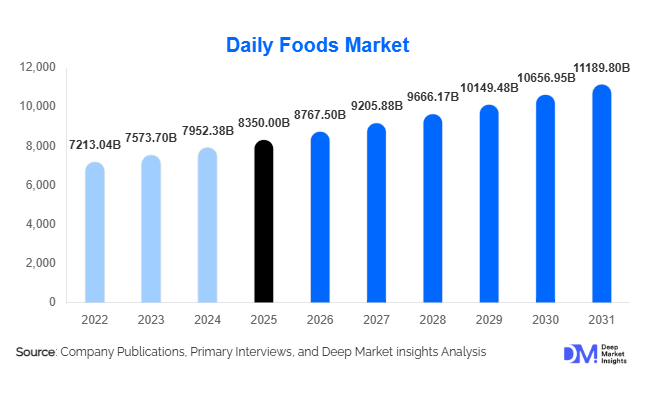
According to Deep Market Insights, the global daily foods market size was valued at USD 8,350.0 billion in 2025 and is projected to grow from USD 8,767.50 billion in 2026 to reach USD 11,189.80 billion by 2031, expanding at a CAGR of 5.0% during the forecast period (2026–2031). The market growth is primarily driven by rising global population, increasing urbanization, and the growing demand for convenient, nutritious, and accessible food products. Expansion of organized retail, rapid penetration of e-commerce grocery platforms, and rising consumer preference for health-oriented and functional foods are further accelerating market expansion globally.
Key Market Insights
- Staple foods continue to dominate global consumption, accounting for the largest share due to their essential role in daily diets across both developed and developing economies.
- Packaged and processed food demand is rising rapidly, driven by urban lifestyles, time constraints, and increasing working populations worldwide.
- Asia-Pacific dominates the global market, supported by large population bases in China and India and rising disposable incomes.
- Middle East & Africa is the fastest-growing region, driven by population growth, food security initiatives, and increasing imports of essential food products.
- Online grocery and quick commerce are transforming distribution, enabling faster delivery, broader product availability, and improved customer convenience.
- Sustainability and health trends are reshaping product innovation, with increased focus on organic, plant-based, and minimally processed food offerings.
What are the latest trends in the daily foods market?
Shift Toward Health-Focused and Functional Foods
Consumers across the globe are increasingly prioritizing health, nutrition, and wellness, leading to a strong shift toward functional foods and fortified daily consumption products. Demand for low-fat dairy, high-protein beverages, plant-based alternatives, and immunity-boosting foods has surged significantly. Manufacturers are incorporating probiotics, vitamins, and natural ingredients into everyday food items to cater to evolving dietary preferences. This trend is particularly strong in developed markets, while emerging economies are rapidly catching up as awareness improves. The rise of clean-label products, free from artificial preservatives and additives, is also influencing purchasing decisions, pushing companies to innovate in formulation and transparency.
Digital Transformation of Food Distribution
The rapid growth of e-commerce and quick commerce platforms is reshaping how consumers purchase daily food products. Online grocery platforms, subscription-based deliveries, and app-based ordering systems are gaining widespread adoption, especially in urban areas. Consumers now expect faster delivery times, real-time tracking, and personalized recommendations, which has led to the integration of AI-driven logistics and demand forecasting systems. Retailers are investing heavily in last-mile delivery infrastructure, dark stores, and warehouse automation to improve efficiency. This digital transformation is not only expanding market reach but also enabling smaller brands to compete with established players through direct-to-consumer models.
What are the key drivers in the daily foods market?
Rapid Urbanization and Changing Lifestyles
Urbanization continues to be a major driver of the daily foods market, as more consumers shift toward city-based living and fast-paced lifestyles. With increasing working populations and time constraints, demand for ready-to-eat meals, processed foods, and convenient packaging formats is rising significantly. Urban consumers prioritize ease of access, shelf life, and quick preparation, which is fueling growth in packaged food categories globally.
Expansion of Organized Retail and E-Commerce
The growth of supermarkets, hypermarkets, and online grocery platforms has significantly improved product accessibility and availability. Organized retail chains offer a wide variety of products, competitive pricing, and enhanced customer experience, driving higher consumption levels. Meanwhile, e-commerce platforms are expanding into tier-2 and tier-3 cities, enabling broader market penetration and supporting consistent demand growth across regions.
Increasing Health Awareness Among Consumers
Rising awareness about nutrition and healthy eating habits is driving demand for organic, natural, and minimally processed foods. Consumers are actively seeking products with higher nutritional value, leading to premiumization in categories such as dairy, beverages, and packaged foods. This shift is encouraging manufacturers to invest in research and development for healthier product formulations.
What are the restraints for the global market?
Volatility in Raw Material Prices
The daily foods market is highly dependent on agricultural commodities such as grains, dairy inputs, and edible oils. Price fluctuations caused by climate change, geopolitical tensions, and supply chain disruptions can significantly impact production costs and profit margins. This volatility creates pricing challenges for manufacturers and can affect affordability for consumers.
Supply Chain Inefficiencies and Food Wastage
In many developing regions, inadequate storage facilities, lack of cold chain infrastructure, and inefficient logistics lead to high levels of food wastage. These inefficiencies limit product availability and increase operational costs, posing a major challenge for market expansion. Addressing these issues requires significant investments in infrastructure and supply chain modernization.
What are the key opportunities in the daily foods market?
Expansion of Functional and Premium Food Segments
The growing demand for functional foods presents a major opportunity for market players to introduce innovative, value-added products. Categories such as plant-based proteins, fortified beverages, and organic packaged foods are expected to witness strong growth. Companies investing in research and development can capture premium consumer segments and improve profit margins.
Growth of Digital and Quick Commerce Ecosystems
The rapid expansion of online grocery platforms and quick commerce services offers significant opportunities for both established players and new entrants. By leveraging digital technologies, companies can enhance customer engagement, optimize inventory management, and improve delivery efficiency. Emerging markets, in particular, present untapped potential for online food retail expansion.
Emerging Market Penetration and Rural Expansion
Developing regions such as South Asia, Southeast Asia, and Africa offer substantial growth potential due to rising population and increasing disposable incomes. Expanding distribution networks in rural and semi-urban areas, along with offering affordable product variants, can help companies tap into these high-growth markets. Government initiatives supporting food security and local production further enhance these opportunities.
Report Scope
| Report Metric | Details |
|---|---|
| Market Size in 2025 | USD 8350.00 Billion |
| Market Size in 2026 | USD 8767.50 Billion |
| Market Size in 2031 | USD 11189.80 Billion |
| CAGR | 5% (2026-2031) |
| Base Year for Estimation | 2025 |
| Historical Data | 2022-2024 |
| Forecast Period | 2026-2031 |
| Report Coverage | Revenue Forecast, Competitive Landscape, Supply Chain Disruption, Growth Factors, Environment & Regulatory Landscape and Trends |
| Geographies Covered | North America, Europe, APAC, Middle East and Africa, LATAM |
| Countries Covered | U.S., Canada, U.K., Germany, France, Spain, Italy, Russia, Nordic, Benelux, Rest of Europe, China, Korea, Japan, India, Australia, Singapore, Taiwan, South East Asia, Rest of Asia-Pacific, UAE, Turky, Saudi Arabia, South Africa, Egypt, Nigeria, Rest of MEA, Brazil, Mexico, Argentina, Chile, Colombia, Rest of LATAM |
Explore more data points, trends and opportunities Download Free Sample Report
Product Type Insights
The global daily foods market is fundamentally shaped by the consistent and essential nature of food consumption, with staple foods continuing to dominate the overall product mix. In 2025, staple foods account for approximately 35% of the total market share, reflecting their indispensable role in meeting basic nutritional requirements across both developing and developed economies. The dominance of staples such as rice, wheat, maize, and other grains is particularly evident in densely populated regions, where affordability and accessibility remain key determinants of consumption patterns. The sustained leadership of this segment is primarily driven by population growth, government-supported food distribution systems, and the cultural centrality of staple diets, especially across Asia-Pacific and parts of Africa.Packaged and processed foods are emerging as the fastest-growing product category, reflecting a structural shift in global consumption patterns. Rapid urbanization, changing lifestyles, and increasing workforce participation, particularly among women, have significantly boosted demand for convenient, ready-to-eat, and easy-to-prepare food options. The leading segment driver in this category is convenience, as time-constrained consumers increasingly prioritize products that reduce meal preparation time without compromising on taste or quality. Furthermore, advancements in food processing technologies, improved packaging solutions, and extended shelf life are enhancing product appeal and accessibility across diverse consumer segments.Beverages and edible oils also play a crucial role in the daily foods market, contributing significantly to overall revenue generation. The beverages segment is witnessing steady expansion driven by the growing demand for functional drinks, health beverages, and traditional consumption patterns such as tea and coffee. Edible oils, on the other hand, are essential cooking ingredients, with demand driven by population growth, changing dietary habits, and increasing consumption of fried and processed foods. The leading driver for edible oils lies in their indispensability in cooking applications, coupled with rising awareness of healthier oil variants such as olive oil and sunflower oil.
Distribution Channel Insights
The distribution landscape of the global daily foods market is characterized by the continued dominance of offline retail channels, which account for nearly 70% of total sales in 2025. Traditional grocery stores, supermarkets, and hypermarkets remain the primary purchasing points for consumers due to their widespread presence, established trust, and the ability to offer a tactile shopping experience. The leading driver for this segment is consumer familiarity and accessibility, particularly in rural and semi-urban areas where digital penetration remains relatively limited. Additionally, offline channels enable bulk purchasing and immediate product availability, which are critical factors in daily food consumption.Despite the dominance of offline channels, online retail is emerging as the fastest-growing distribution segment, driven by rapid digital transformation across global markets. Increasing internet penetration, widespread smartphone adoption, and evolving consumer preferences are significantly reshaping purchasing behavior. The leading driver for the online segment is convenience, as consumers increasingly prefer doorstep delivery, flexible payment options, and the ability to compare products and prices effortlessly.Moreover, the convergence of offline and online channels through omnichannel retail strategies is transforming the overall distribution ecosystem. Retailers are increasingly leveraging digital tools to enhance in-store experiences, offer click-and-collect services, and optimize supply chain operations, thereby ensuring seamless customer engagement across multiple touchpoints.
End-Use Insights
Household consumption remains the dominant end-use segment in the global daily foods market, contributing approximately 75% of the total market share. The leading driver for this segment is the fundamental necessity of daily food intake, which ensures consistent and non-discretionary demand across all demographics. Population growth, rising disposable incomes, and evolving dietary preferences are further strengthening household consumption patterns. Additionally, the increasing trend of home cooking, driven by health consciousness and cost considerations, is supporting sustained demand within this segment.The institutional segment, which includes hotels, restaurants, catering services, and corporate food providers, is experiencing robust growth, supported by the recovery and expansion of the hospitality industry. The leading driver for this segment is the rising trend of dining out and food delivery, particularly in urban areas where busy lifestyles limit the time available for home cooking. The proliferation of quick-service restaurants (QSRs), fine dining establishments, and casual dining formats is significantly contributing to the segment’s expansion.Export-driven demand is also playing an increasingly important role in shaping the end-use landscape. The growing global appetite for processed and packaged foods, particularly from emerging markets, is creating new opportunities for exporters. The leading driver in this context is globalization, which has facilitated cross-border trade and expanded market access for food manufacturers. Improved logistics infrastructure, trade agreements, and compliance with international quality standards are further supporting export growth.
Explore more data points, trends and opportunities Download Free Sample Report
Daily Foods Market Segmentations
By Product Type
- Staple Foods
- Dairy Products
- Packaged & Processed Foods
- Beverages
- Fresh Foods
- Edible Oils & Fats
By Distribution Channel
- Offline Retail
- Online Retail
By Consumer Type
- Household Consumption
- Institutional Consumption
By Price Segment
- Economy
- Mid-Range
- Premium & Organic
By Processing Level
- Unprocessed
- Minimally Processed
- Semi-Processed
- Fully Processed
Regional Insights
Asia-Pacific
Asia-Pacific dominates the global daily foods market, accounting for approximately 45% of the total market share in 2025. The region’s leadership is primarily driven by its large and rapidly growing population, with countries such as China and India serving as major consumption hubs. One of the key drivers of regional growth is urbanization, which is transforming dietary patterns and increasing demand for packaged and convenience foods. As more consumers migrate to urban areas, their reliance on organized retail and ready-to-eat products continues to rise.Rising disposable incomes across emerging economies are further enhancing purchasing power, enabling consumers to diversify their diets and increase spending on higher-quality food products. Government initiatives aimed at strengthening food security, improving agricultural productivity, and expanding food distribution networks are also playing a crucial role in supporting market growth. Additionally, the rapid expansion of e-commerce platforms and digital payment systems is facilitating greater access to a wide range of food products, particularly in urban and semi-urban areas.Another significant driver in the Asia-Pacific region is the cultural diversity of diets, which sustains demand across multiple product categories, including staples, fresh foods, and traditional beverages. The increasing adoption of modern retail formats, coupled with investments in cold chain infrastructure, is further enhancing supply chain efficiency and product availability.
North America
North America accounts for around 20% of the global daily foods market, with the United States being the primary contributor. The region’s growth is driven by high consumer spending power and a strong preference for convenience-oriented food products. One of the key drivers in North America is the increasing demand for premium, organic, and health-focused food items, reflecting a shift toward healthier lifestyles and clean-label products.The region benefits from a highly developed supply chain infrastructure, which ensures efficient distribution and minimizes product wastage. Additionally, the widespread adoption of online grocery platforms and digital retail technologies is significantly enhancing consumer access and convenience. Innovation in food processing, packaging, and product development is also a major growth driver, enabling companies to cater to evolving consumer preferences.Another important factor contributing to regional growth is the rising demand for plant-based and alternative protein products, driven by environmental concerns and changing dietary habits. The strong presence of leading food manufacturers and continuous investment in research and development further support market expansion in North America.
Europe
Europe holds approximately 18% of the global market share, with key markets including Germany, France, and the United Kingdom. The region is characterized by a strong emphasis on food quality, safety, and sustainability. One of the primary drivers of growth in Europe is the increasing demand for organic and ethically sourced food products, as consumers become more conscious of environmental and health-related issues.Stringent regulatory frameworks governing food production and labeling are also shaping market dynamics, ensuring high standards of quality and transparency. These regulations, while posing compliance challenges for manufacturers, are enhancing consumer trust and driving demand for certified products. Additionally, the growing popularity of plant-based diets and alternative food products is contributing to market diversification.Europe’s well-established retail infrastructure, combined with the rapid growth of online grocery platforms, is further supporting market expansion. The region is also witnessing increasing innovation in sustainable packaging and waste reduction practices, which are becoming critical factors influencing consumer purchasing decisions.
Middle East & Africa
The Middle East & Africa region represents one of the fastest-growing markets for daily foods, with a projected growth rate exceeding 6.5% CAGR. A key driver of growth in this region is rapid population expansion, which is significantly increasing food demand. Urbanization is also playing a crucial role, particularly in countries such as the UAE and Saudi Arabia, where changing lifestyles are driving demand for packaged and convenience foods.Food security initiatives are a major growth driver across the region, as governments invest heavily in agricultural development, food storage, and supply chain infrastructure to reduce dependence on imports. However, imports continue to play a vital role in meeting demand, particularly in countries with limited agricultural capacity. The expansion of modern retail formats, including supermarkets and hypermarkets, is improving product accessibility and enhancing consumer choice.Additionally, rising disposable incomes and increasing exposure to global food trends are influencing consumption patterns, leading to higher demand for diverse and premium food products. The growing hospitality and tourism sectors are also contributing to increased demand from institutional end-users.
Latin America
Latin America holds a significant share of the global daily foods market, with Brazil and Mexico emerging as key contributors. The region’s growth is driven by increasing urbanization and the expansion of the middle-class population, which is boosting consumer spending on food products. One of the primary drivers in Latin America is the rising demand for packaged and processed foods, as consumers seek convenience and longer shelf life.The development of modern retail infrastructure, including supermarkets and e-commerce platforms, is enhancing product availability and accessibility. Additionally, improvements in logistics and supply chain networks are supporting efficient distribution across both urban and rural areas. The region is also benefiting from strong agricultural production, which ensures a steady supply of raw materials for food processing industries.Changing dietary preferences, influenced by globalization and increasing health awareness, are further shaping market dynamics. Consumers are gradually shifting toward healthier and more diverse food options, creating opportunities for product innovation and market expansion. Government initiatives aimed at supporting agricultural development and food processing industries are also contributing to sustained growth in the region.
Key Players in the Daily Foods Market
- Nestlé S.A.
- PepsiCo, Inc.
- The Coca-Cola Company
- Unilever PLC
- Danone S.A.
- Mondelez International, Inc.
- General Mills, Inc.
- Kellogg Company
- Tyson Foods, Inc.
- Kraft Heinz Company
- Archer Daniels Midland Company
- Cargill, Incorporated
- BRF S.A.
- JBS S.A.
- Conagra Brands, Inc.