Cumin Seed Market Size
According to Deep Market Insights, the global cumin seed market size was valued at USD 1,890 million in 2025 and is projected to grow from USD 2,054.43 million in 2026 to reach USD 3,117.73 million by 2031, expanding at a CAGR of 8.7% during the forecast period (2026–2031). The cumin seed market growth is primarily driven by increasing global consumption of ethnic cuisines, rising demand for natural and functional food ingredients, and expanding applications in food processing, pharmaceuticals, and personal care industries. The growing preference for clean-label and organic spices is further supporting market expansion, while export-driven demand from developing economies continues to shape global trade dynamics.
Key Market Insights
- Food & beverage applications dominate the market, accounting for over 70% of total demand, driven by widespread use in spice blends, ready meals, and condiments.
- Asia-Pacific leads global production and supply, with India contributing the majority of global exports and shaping international pricing trends.
- Organic cumin is the fastest-growing segment, supported by increasing consumer demand for clean-label and sustainably sourced products.
- B2B/direct sales channels dominate distribution, accounting for nearly 65% of the market due to bulk procurement by food processors.
- Pharmaceutical and nutraceutical applications are expanding rapidly, leveraging cumin’s digestive and antioxidant properties.
- Technological advancements in processing and sterilization are improving product quality and enabling compliance with stringent export standards.
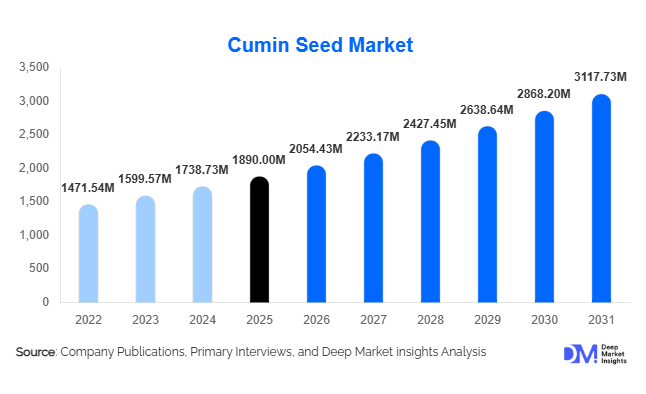
What are the latest trends in the cumin seed market?
Shift Toward Organic and Clean-Label Spices
Consumers are increasingly prioritizing health, transparency, and sustainability in food consumption, leading to a strong shift toward organic cumin seeds. Certified organic cumin commands premium pricing and is gaining traction in developed markets such as North America and Europe. Food manufacturers are reformulating products to meet clean-label standards, driving demand for pesticide-free and traceable cumin supplies. Retailers are also expanding shelf space for organic spices, further boosting visibility and adoption. This trend is encouraging farmers to transition toward organic cultivation, supported by government subsidies and certification programs.
Rising Demand for Value-Added Cumin Products
The market is witnessing a growing preference for value-added cumin products such as oils, extracts, roasted cumin, and sterilized variants. These products offer higher margins and cater to diverse industries, including pharmaceuticals, nutraceuticals, and cosmetics. Steam sterilization and advanced processing techniques are being widely adopted to enhance product safety and shelf life. Additionally, blended spice formulations incorporating cumin are gaining popularity in ready-to-cook and ready-to-eat food segments, further expanding market opportunities.
What are the key drivers in the cumin seed market?
Growing Global Demand for Ethnic and Processed Foods
The increasing globalization of food culture has significantly boosted the demand for spices like cumin. Cuisines from Asia, the Middle East, and Latin America are gaining popularity worldwide, driving consistent consumption. The expansion of the food processing industry, particularly in ready-to-eat meals and packaged foods, is further amplifying demand for cumin as a key flavoring ingredient.
Health Benefits and Functional Food Applications
Cumin seeds are recognized for their health benefits, including digestive support, antioxidant properties, and anti-inflammatory effects. This has led to increased usage in functional foods, dietary supplements, and herbal formulations. Consumers in developed markets are increasingly incorporating cumin into their diets for its perceived health benefits, driving demand across both retail and industrial channels.
What are the restraints for the global market?
Price Volatility Due to Climatic Dependence
Cumin production is highly sensitive to weather conditions, making supply levels unpredictable. Variations in rainfall, temperature, and crop yields can lead to significant price fluctuations, affecting both producers and buyers. This volatility poses challenges for long-term contracts and pricing stability in the global market.
Stringent Quality and Regulatory Standards
Export markets, particularly in Europe and North America, enforce strict regulations regarding pesticide residues and contamination. Failure to meet these standards can result in shipment rejections and financial losses. Compliance requires investment in advanced processing and quality control systems, which can be challenging for smaller producers.
What are the key opportunities in the cumin seed industry?
Expansion of Organic Farming and Premium Segments
The growing demand for organic and sustainably sourced spices presents a significant opportunity for producers. Companies investing in certified organic farming and traceability systems can access premium markets and establish long-term partnerships with global food brands. This segment is expected to grow at a faster pace compared to conventional cumin.
Growth in Emerging Markets and Export Opportunities
Emerging economies in Latin America, Africa, and Southeast Asia are witnessing increasing consumption of spices due to urbanization and changing dietary patterns. Export-oriented strategies targeting these regions can unlock new revenue streams. Government initiatives promoting agricultural exports are further supporting market expansion.
Report Scope
| Report Metric | Details |
|---|---|
| Market Size in 2025 | USD 1890.00 Million |
| Market Size in 2026 | USD 2054.43 Million |
| Market Size in 2031 | USD 3117.73 Million |
| CAGR | 8.7% (2026-2031) |
| Base Year for Estimation | 2025 |
| Historical Data | 2022-2024 |
| Forecast Period | 2026-2031 |
| Report Coverage | Revenue Forecast, Competitive Landscape, Supply Chain Disruption, Growth Factors, Environment & Regulatory Landscape and Trends |
| Geographies Covered | North America, Europe, APAC, Middle East and Africa, LATAM |
| Countries Covered | U.S., Canada, U.K., Germany, France, Spain, Italy, Russia, Nordic, Benelux, Rest of Europe, China, Korea, Japan, India, Australia, Singapore, Taiwan, South East Asia, Rest of Asia-Pacific, UAE, Turky, Saudi Arabia, South Africa, Egypt, Nigeria, Rest of MEA, Brazil, Mexico, Argentina, Chile, Colombia, Rest of LATAM |
Explore more data points, trends and opportunities Download Free Sample Report
Product Type Insights
The global cumin seed market demonstrates a clearly structured segmentation across product types, with whole cumin seeds maintaining a dominant position in 2025, accounting for approximately 52% of total global demand. This dominance is primarily attributed to the inherent advantages of whole seeds, including extended shelf life, superior aroma retention, and reduced susceptibility to contamination or flavor degradation during storage and transportation. Whole cumin seeds are extensively preferred in bulk trade and traditional culinary practices, particularly in regions where spices are stored for long durations and ground fresh during cooking. Additionally, the relatively lower processing requirements of whole seeds make them cost-effective for exporters and large-scale suppliers, further strengthening their position in international trade flows. The leading growth driver for whole cumin seeds is the increasing global demand for authentic ethnic cuisines and traditional cooking practices, where whole spices are preferred for tempering and slow cooking methods. The expansion of food export-import networks and rising consumption of natural, minimally processed ingredients have further reinforced this segment’s dominance. Moreover, food manufacturers and spice blending companies continue to rely on whole cumin seeds as a raw material base due to their stability and versatility across multiple applications. Ground cumin represents the second most significant product category, gaining strong traction due to its convenience and immediate usability in modern food processing systems. This form is widely integrated into packaged food products, spice mixes, ready-to-eat meals, and instant seasoning blends. The primary driver of growth in this segment is the rapid expansion of the processed food industry, coupled with changing consumer lifestyles that favor convenience-oriented cooking solutions. Urbanization, time-constrained households, and increasing penetration of packaged food products have all contributed to sustained demand for pre-ground spice formats that ensure consistency in flavor and ease of use. Cumin oil and extracts, while representing a smaller share of the market, are emerging as high-value segments driven by their concentrated bioactive properties. These derivatives are increasingly utilized in pharmaceuticals, nutraceuticals, and cosmetic formulations due to their antimicrobial, anti-inflammatory, and antioxidant characteristics. The key growth driver for this segment is the rising global shift toward plant-based and functional ingredients in health and wellness products. Increasing awareness of natural remedies and preventive healthcare solutions has further accelerated the adoption of cumin-derived essential oils in therapeutic applications and skincare formulations.
Application Insights
The food and beverage industry remains the dominant application segment, accounting for over 72% of global cumin seed consumption. Cumin is a fundamental spice used across a wide range of culinary traditions, including Asian, Middle Eastern, Latin American, and Mediterranean cuisines. Its widespread usage in spice blends, processed foods, sauces, soups, and ready meals ensures consistent demand across both household and industrial applications. The leading driver for this segment is the globalization of food culture, where diverse culinary preferences are increasingly integrated into mainstream consumption patterns. The rapid expansion of the processed food sector, particularly in urbanized economies, has significantly strengthened cumin’s role as a core seasoning ingredient. The pharmaceutical and nutraceutical segment is experiencing rapid growth, supported by increasing consumer preference for natural health supplements and plant-based medicinal ingredients. Cumin’s digestive, anti-inflammatory, and antioxidant properties make it a valuable component in traditional medicine systems as well as modern nutraceutical formulations. The primary driver in this segment is the global shift toward preventive healthcare and natural wellness solutions, as consumers increasingly seek alternatives to synthetic pharmaceuticals. The growing integration of herbal extracts into dietary supplements and functional foods further enhances demand within this category. The personal care industry is also witnessing steady adoption of cumin oil and extracts, particularly in skincare and haircare formulations. Its antimicrobial and detoxifying properties make it suitable for inclusion in natural cosmetic products. The key driver for growth in this segment is the rising demand for clean-label, chemical-free personal care solutions, as consumers become more conscious of product ingredients and environmental sustainability. Animal feed applications, although relatively niche, are gradually gaining traction due to cumin’s potential benefits in improving digestion and overall gut health in livestock. The primary growth driver here is the increasing focus on natural feed additives as alternatives to synthetic growth promoters, aligning with broader trends in sustainable and organic livestock production.
Distribution Channel Insights
Direct and business-to-business (B2B) channels dominate the cumin seed market, accounting for nearly 65% of total sales volume. This dominance is largely driven by bulk procurement practices adopted by food manufacturers, spice processors, and institutional buyers who require large, consistent supplies of raw cumin seeds. The leading driver for this segment is the efficiency and cost-effectiveness of bulk purchasing, which ensures stable pricing, quality consistency, and long-term supply agreements between producers and industrial users. Additionally, strong global trade networks and established export-import relationships between producing and consuming countries further reinforce the dominance of B2B distribution. Retail channels, including supermarkets, hypermarkets, convenience stores, and specialty grocery outlets, are steadily expanding due to increasing consumer preference for branded and packaged spice products. The primary driver of growth in this segment is rising urbanization and the shift toward organized retail ecosystems that offer standardized quality and convenient purchasing options. Consumers are increasingly inclined toward packaged spices that ensure hygiene, traceability, and consistent flavor profiles. E-commerce has emerged as a rapidly growing distribution channel, particularly in urban and semi-urban regions. Online platforms offer consumers access to a wide variety of spice brands, organic options, and specialty products that may not be readily available in physical retail stores. The key driver of this segment is the digital transformation of retail, supported by increased internet penetration, mobile commerce adoption, and evolving consumer shopping behavior that favors convenience and doorstep delivery.
End-Use Insights
The food processing industry represents the largest end-use segment, contributing approximately 48% of the global cumin seed market. This dominance is primarily due to the extensive use of cumin in packaged foods, spice blends, sauces, and ready-to-eat meals. The leading driver for this segment is the rapid industrialization of food production systems, where standardized flavoring ingredients are essential for maintaining product consistency and consumer satisfaction across large-scale manufacturing. The foodservice industry is the fastest-growing end-use segment, fueled by the global expansion of restaurants, quick-service chains, and international cuisine outlets. The key growth driver is the increasing popularity of dining out and the diversification of culinary offerings across global markets. Cumin’s role as a foundational spice in numerous ethnic cuisines ensures its strong presence in professional kitchens and hospitality establishments. The pharmaceutical and cosmetic industries are also witnessing rising adoption of cumin-based ingredients, particularly in natural health and wellness formulations. The primary driver in these sectors is the growing demand for plant-based active ingredients that align with clean-label and organic product trends. This shift is encouraging manufacturers to incorporate cumin extracts into a broader range of therapeutic and cosmetic applications.
Explore more data points, trends and opportunities Download Free Sample Report
Cumin Seed Market Segmentations
By Product Type
- Whole Cumin Seeds
- Ground/Powdered Cumin
- Cumin Oil & Extracts
By Processing Type
- Raw
- Cleaned & Graded
- Roasted
- Sterilized
By Application
- Food & Beverages
- Pharmaceuticals & Nutraceuticals
- Personal Care & Cosmetics
- Animal Feed Additives
By Distribution Channel
- Direct/B2B Sales
- Supermarkets/Hypermarkets
- Convenience Stores
- Online Retail
By End-Use Industry
- Food Processing Industry
- Foodservice
- Household Consumption
- Pharmaceutical Industry
- Cosmetic Industry
Regional Insights
Asia-Pacific
Asia-Pacific dominates the global cumin seed market with approximately 62% market share in 2025. India stands as the largest producer and exporter, contributing more than 70% of global production due to its favorable agro-climatic conditions, extensive agricultural base, and strong traditional cultivation practices. The leading driver of regional growth is the deeply rooted culinary culture that extensively uses cumin across daily cooking, combined with strong export-oriented farming systems. Government support through agricultural development programs and spice board initiatives further strengthens production capacity and export competitiveness. Additionally, China and Southeast Asian countries are witnessing rising demand driven by expanding food processing industries and increasing consumption of packaged and convenience foods.
North America
North America accounts for approximately 12% of the global cumin seed market, with the United States being the largest importer. The primary driver of regional growth is the increasing popularity of ethnic cuisines, particularly Mexican, Indian, and Middle Eastern foods, which heavily utilize cumin as a core spice. Rising multicultural demographics and the growth of Hispanic and Asian populations have further contributed to sustained demand. Additionally, the expanding packaged food industry and rising preference for organic and natural spices are reinforcing market growth across the region.
Europe
Europe holds nearly 10% of the global market share, with major importing countries including Germany, the United Kingdom, and the Netherlands. The key driver in this region is the strong regulatory emphasis on food safety, quality standards, and organic certification, which has significantly shaped consumer preferences. European consumers increasingly favor natural, sustainably sourced spices, contributing to rising demand for certified organic cumin products. Additionally, the popularity of Mediterranean and international cuisines continues to support steady market expansion.
Middle East & Africa
The Middle East & Africa region accounts for approximately 9% of global demand, driven primarily by strong cultural and traditional usage of cumin in everyday cuisine. The UAE serves as a major trading and re-export hub, facilitating the distribution of cumin across regional and global markets. The leading growth driver is the sustained demand from hospitality, tourism, and foodservice sectors, particularly in Gulf Cooperation Council countries where diverse culinary traditions are widely embraced.
Latin America
Latin America represents around 7% of the global cumin seed market, with Mexico and Brazil emerging as key growth markets. Mexico, in particular, demonstrates strong demand due to the integral role of cumin in traditional and modern Mexican cuisine. The primary driver of growth in this region is the expansion of the food processing industry and increasing consumption of packaged spice blends. Rising urbanization and modernization of retail infrastructure are further supporting market penetration and accessibility of cumin-based products.
Key Players in the Cumin Seed Market
- McCormick & Company
- Olam Group
- Everest Spices
- MDH Spices
- Ajinomoto (Spice Division)
- DS Group
- Synthite Industries
- Virdhara International
- Rapid Organic
- Sun Impex
- Dhaval Agri Exports
- Arihant Agro Products
- Shalimar Food Industries
- VKC Nuts
- Shreeji Expeller Industries