Cranberry Market Size
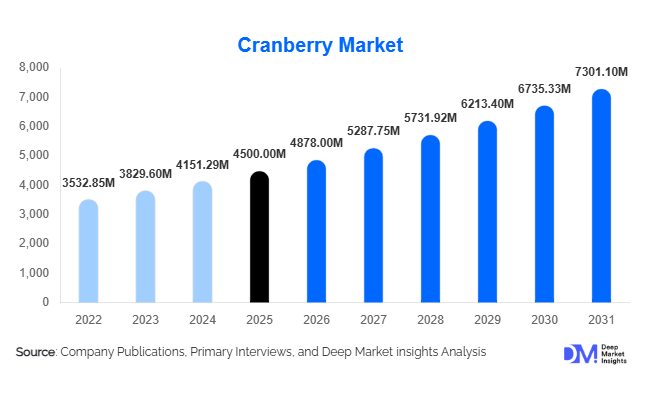
According to Deep Market Insights, the global cranberry market size was valued at USD 4,500 million in 2025 and is projected to grow from USD 4,878 million in 2026 to reach USD 7,301.10 million by 2031, expanding at a CAGR of 8.4% during the forecast period (2026–2031). The cranberry market growth is primarily driven by increasing consumer demand for functional foods, rising awareness of antioxidant-rich diets, and expanding applications of cranberry ingredients across food, beverage, nutraceutical, and personal care industries. Growing global trade, particularly exports from North America, and innovation in processed cranberry products such as juices, powders, and dried snacks are further accelerating market expansion.
Key Market Insights
- Dried cranberries dominate the product segment, accounting for over 30% of global demand due to convenience and long shelf life.
- Food & beverage applications lead the market, contributing nearly 68% of total revenue, driven by strong demand for juices and healthy snacks.
- North America dominates the global market, supported by large-scale production and export capabilities.
- Asia-Pacific is the fastest-growing region, fueled by rising health awareness and increasing consumption of imported functional foods.
- Nutraceutical applications are expanding rapidly, driven by demand for supplements targeting immunity and urinary tract health.
- Technological advancements in drying and extraction are enhancing product quality and expanding industrial usage.
What are the latest trends in the cranberry market?
Shift Toward Functional and Clean-Label Products
The cranberry market is witnessing a strong shift toward functional and clean-label products. Consumers are increasingly seeking natural ingredients with proven health benefits, positioning cranberries as a key component in health-oriented diets. The demand for organic and minimally processed cranberries is rising, particularly in developed markets such as North America and Europe. Manufacturers are focusing on transparency, eliminating artificial additives, and promoting cranberry products as natural sources of antioxidants and vitamins. This trend is also driving innovation in product formulations, including low-sugar cranberry juices and additive-free dried cranberries.
Expansion of Ready-to-Drink and Snack Formats
Convenience-driven consumption patterns are fueling the growth of ready-to-drink (RTD) cranberry beverages and snack products. Cranberry-infused drinks, energy beverages, and snack bars are gaining popularity among urban consumers. The rise of on-the-go lifestyles and demand for healthy snacking options are encouraging manufacturers to introduce innovative product formats. Packaging innovations, including resealable pouches and eco-friendly materials, are further supporting market growth while aligning with sustainability trends.
What are the key drivers in the cranberry market?
Rising Health Awareness and Functional Food Demand
The increasing prevalence of lifestyle-related health conditions has significantly boosted demand for functional foods. Cranberries are widely recognized for their antioxidant properties and benefits in supporting urinary tract health and immunity. This has led to increased consumption of cranberry juices, extracts, and supplements, particularly among health-conscious consumers and aging populations.
Growth of Processed Food and Beverage Industry
The rapid expansion of the global processed food and beverage industry is a major driver for the cranberry market. Cranberries are extensively used in bakery products, cereals, beverages, and snacks, making them a versatile ingredient. The rising demand for convenience foods and ready-to-consume products is further driving the use of cranberry-based ingredients across multiple applications.
What are the restraints for the global market?
Climate Dependency and Supply Constraints
Cranberry production is highly dependent on specific climatic conditions, making it vulnerable to environmental changes. Factors such as frost, water availability, and climate variability can significantly impact crop yields, leading to supply fluctuations and price volatility.
Competition from Alternative Superfruits
The cranberry market faces competition from other superfruits such as blueberries, pomegranates, and acai berries, which offer similar health benefits. These alternatives often compete for shelf space and consumer attention, potentially limiting cranberry market growth in certain segments.
What are the key opportunities in the cranberry industry?
Expansion in Emerging Markets
Emerging economies in Asia-Pacific and Latin America present significant growth opportunities for the cranberry market. Rising disposable incomes, urbanization, and increasing awareness of health benefits are driving demand for premium and imported food products. Establishing local distribution networks and processing facilities can help companies tap into these high-growth markets.
Innovation in Nutraceutical and Pharmaceutical Applications
The growing demand for dietary supplements and natural remedies is creating opportunities for cranberry-based nutraceutical products. Cranberry extracts are widely used in supplements for urinary tract health and immune support. Continued research and development in this area can unlock new applications and expand market reach.
Report Scope
| Report Metric | Details |
|---|---|
| Market Size in 2025 | USD 4500.00 Million |
| Market Size in 2026 | USD 4878.00 Million |
| Market Size in 2031 | USD 7301.10 Million |
| CAGR | 8.4% (2026-2031) |
| Base Year for Estimation | 2025 |
| Historical Data | 2022-2024 |
| Forecast Period | 2026-2031 |
| Report Coverage | Revenue Forecast, Competitive Landscape, Supply Chain Disruption, Growth Factors, Environment & Regulatory Landscape and Trends |
| Geographies Covered | North America, Europe, APAC, Middle East and Africa, LATAM |
| Countries Covered | U.S., Canada, U.K., Germany, France, Spain, Italy, Russia, Nordic, Benelux, Rest of Europe, China, Korea, Japan, India, Australia, Singapore, Taiwan, South East Asia, Rest of Asia-Pacific, UAE, Turky, Saudi Arabia, South Africa, Egypt, Nigeria, Rest of MEA, Brazil, Mexico, Argentina, Chile, Colombia, Rest of LATAM |
Explore more data points, trends and opportunities Download Free Sample Report
Product Type Insights
The global cranberry market exhibits a diversified product landscape, with dried cranberries emerging as the most dominant product category, accounting for approximately 32% of the global market share in 2025. This leadership is primarily driven by their extended shelf life, ease of transportation, and versatility in food applications. Dried cranberries are extensively incorporated into bakery products such as muffins, cookies, and granola bars, as well as breakfast cereals and snack mixes. Their naturally sweetened and tart flavor profile also enhances consumer appeal, particularly in health-conscious markets where demand for convenient yet nutritious snack options continues to rise. The increasing shift toward on-the-go snacking and portion-controlled foods has further reinforced the dominance of dried cranberries in global consumption patterns.Fresh cranberries, while retaining strong cultural and seasonal significance-especially in North American markets-account for a comparatively smaller share due to their highly perishable nature. Limited shelf life, transportation challenges, and seasonal availability restrict their penetration into global markets. However, fresh cranberries continue to hold importance in traditional culinary applications and holiday-based consumption patterns, particularly in sauces, juices, and festive dishes. Their demand is also supported by rising interest in minimally processed and natural foods among health-conscious consumers.Cranberry juice concentrates and cranberry powders represent rapidly expanding product segments, driven by increasing utilization in functional beverages, nutraceutical formulations, and dietary supplements. These processed formats offer enhanced stability, longer shelf life, and ease of integration into industrial food production. The growing demand for antioxidant-rich beverages and immune-boosting supplements has significantly contributed to the rising adoption of cranberry extracts in powdered and concentrated forms. Additionally, innovations in freeze-drying and spray-drying technologies have improved product quality and bioactive retention, further accelerating market expansion. The shift toward value-added and functional ingredients continues to redefine product dynamics within the global cranberry industry.
Application Insights
The food and beverage sector remains the dominant application segment in the cranberry market, accounting for nearly 68% of total global revenue. This dominance is largely driven by the widespread use of cranberries in juices, flavored beverages, jams, sauces, and baked goods. Among these, cranberry-based beverages, including ready-to-drink (RTD) juices and functional drinks, represent the most significant growth engine. Rising consumer awareness regarding preventive healthcare, hydration, and natural antioxidants has fueled demand for cranberry-infused beverages. The increasing preference for clean-label and naturally sourced ingredients has also strengthened the position of cranberries in the beverage industry.The nutraceutical and dietary supplement segment is witnessing rapid expansion, supported by increasing global awareness of preventive healthcare and immunity-boosting nutrition. Cranberries are widely recognized for their high antioxidant content and their association with urinary tract health benefits, which has led to their incorporation in capsules, tablets, gummies, and functional powders. This segment is projected to grow at a significantly higher rate compared to traditional food applications, as consumers increasingly prioritize wellness-oriented consumption patterns. The aging global population and rising prevalence of lifestyle-related health conditions further contribute to this accelerated demand.The personal care and cosmetics segment, although smaller in comparison, is emerging as a promising application area. Cranberry extracts are increasingly being used in skincare formulations due to their rich antioxidant, anti-aging, and skin-repair properties. They are incorporated into creams, serums, masks, and natural cosmetic products aimed at improving skin elasticity and reducing oxidative stress. The growing trend toward clean beauty and plant-based ingredients has further encouraged cosmetic manufacturers to explore cranberry-derived bioactive compounds. This segment is expected to expand steadily as consumers shift toward sustainable and naturally derived personal care solutions.
Distribution Channel Insights
Business-to-business (B2B) channels dominate the cranberry market, accounting for approximately 55% of global distribution. This dominance is primarily driven by bulk procurement from food processors, beverage manufacturers, nutraceutical companies, and industrial buyers. The efficiency of large-scale supply chains, long-term contracts, and stable pricing structures makes B2B channels highly suitable for cranberry ingredient distribution. Additionally, increasing industrial demand for processed cranberry derivatives such as concentrates, powders, and extracts further reinforces the strength of this channel.Supermarkets and hypermarkets remain the leading business-to-consumer (B2C) distribution channels, offering consumers easy access to a wide variety of cranberry-based products. These retail outlets benefit from high footfall, strong brand visibility, and extensive product assortments. The growing urban population and increasing organized retail penetration in emerging economies have further strengthened the presence of cranberries in modern retail environments. Promotional activities, seasonal displays, and health-focused marketing strategies also contribute to sustained consumer engagement in this channel.Online retail is the fastest-growing distribution channel in the cranberry market, driven by the rapid expansion of e-commerce platforms and changing consumer purchasing behavior. The convenience of doorstep delivery, product variety, competitive pricing, and access to global brands have significantly boosted online sales. The COVID-19 pandemic accelerated the adoption of digital shopping platforms, and this trend continues to persist as consumers increasingly prefer digital-first purchasing experiences. Subscription-based nutraceutical sales and direct-to-consumer (DTC) models are also contributing to the strong growth of this segment.
End-Use Industry Insights
The beverage industry is the leading end-use segment, contributing approximately 34% of total cranberry consumption. This dominance is driven by the strong global demand for fruit-based beverages and functional drinks enriched with natural antioxidants. Cranberry juice is widely recognized for its health benefits, including urinary tract support and immune system enhancement, making it a preferred ingredient in both premium and mass-market beverage formulations. The increasing shift toward sugar-free, organic, and functional beverages further strengthens cranberry usage in this sector.The nutraceutical industry represents the fastest-growing end-use segment, with a CAGR exceeding 9%. This growth is fueled by rising health awareness, increasing disposable incomes, and the global shift toward preventive healthcare. Cranberries are widely used in dietary supplements due to their bioactive compounds, particularly proanthocyanidins, which are associated with various health benefits. The expanding aging population and rising incidence of chronic diseases such as diabetes and cardiovascular disorders further amplify demand for cranberry-based nutraceutical products.The cosmetics and personal care industry is emerging as a niche yet rapidly expanding end-use segment. Cranberry extracts are increasingly being incorporated into skincare and haircare formulations due to their antioxidant and anti-inflammatory properties. The demand for natural and plant-based cosmetic ingredients has led to increased research and product development activities in this area. As consumers continue to prioritize clean beauty and sustainable formulations, cranberries are expected to gain stronger traction in premium cosmetic applications.
Explore more data points, trends and opportunities Download Free Sample Report
Cranberry Market Segmentations
Product Type
- Fresh Cranberries
- Dried Cranberries
- Frozen Cranberries
- Cranberry Juice Concentrates
- Cranberry Powder & Extracts
Application
- Food & Beverages
- Nutraceuticals & Dietary Supplements
- Pharmaceuticals
- Personal Care & Cosmetics
Distribution Channel
- B2B
- Supermarkets/Hypermarkets
- Convenience Stores
- Online Retail
- Specialty Stores
Regional Insights
North America
North America dominates the global cranberry market, accounting for approximately 42% of total market share in 2025. The region’s leadership is primarily driven by the United States, which is both the largest producer and exporter of cranberries globally. The presence of advanced agricultural practices, efficient irrigation systems, and well-established processing infrastructure significantly contributes to high production efficiency. Strong domestic consumption, particularly during festive seasons such as Thanksgiving, also supports market growth. Additionally, increasing demand for functional beverages and nutraceutical products further reinforces regional dominance. Government support for cranberry farming and strong export networks to Europe and Asia-Pacific markets serve as additional growth drivers.
Europe
Europe holds approximately 25% of the global cranberry market, supported by strong demand from countries such as Germany, the United Kingdom, and France. The region’s growth is driven by increasing consumer preference for functional foods, natural antioxidants, and clean-label products. High awareness of preventive healthcare and dietary supplementation has significantly boosted cranberry consumption in both food and nutraceutical applications. Additionally, stringent food safety regulations and a strong focus on organic and sustainable sourcing have encouraged the adoption of premium cranberry products. The rising popularity of plant-based diets and functional beverages further supports market expansion in the region.
Asia-Pacific
Asia-Pacific is the fastest-growing regional market, with a CAGR exceeding 9.5%. Growth is primarily driven by rising health awareness, rapid urbanization, and changing dietary habits in countries such as China, India, and Japan. Increasing disposable incomes and expanding middle-class populations are significantly contributing to higher consumption of processed and functional food products. China is emerging as a major importer of cranberries, driven by growing demand in the food processing and nutraceutical industries. The expansion of e-commerce platforms and increasing penetration of Western dietary trends further accelerate regional market growth.
Latin America
Latin America is witnessing moderate but steady growth, led by countries such as Brazil and Mexico. Rising urbanization, improving retail infrastructure, and increasing disposable incomes are driving demand for processed food and beverage products, including cranberries. The region is also experiencing growing awareness of health and wellness trends, which is gradually increasing the adoption of functional foods and beverages. Expansion of food service industries and increasing imports of specialty food ingredients further contribute to market development.
Middle East & Africa
The Middle East and Africa region is gradually expanding in the cranberry market, primarily driven by increasing imports and rising consumer awareness of health benefits. Demand is concentrated in urban centers with higher income levels, where consumers are increasingly adopting Western dietary patterns and functional foods. Growth is also supported by expanding retail infrastructure, tourism-driven food service demand, and rising penetration of international food brands. Although the market is still in its developing stage, long-term growth potential remains strong due to increasing health consciousness and improving economic conditions.
Key Players in the Cranberry Market
- Ocean Spray Cranberries Inc.
- Decas Cranberry Products Inc.
- Cape Cod Select LLC
- Fruit d’Or
- Habelman Bros. Company
- Atoka Cranberries Inc.
- Badger State Fruit Processing Inc.
- Muskoka Lakes Farm & Winery
- Graceland Fruit Inc.
- Shoreline Fruit LLC
- Northland Cranberries Inc.
- Cranberry Network LLC
- Valley Processing Inc.
- Honestly Cranberry
- Evergreen Juice Company