Craft Chocolate Market Size
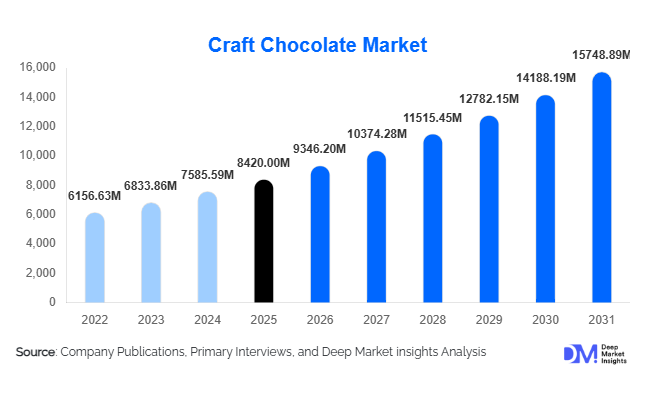
According to Deep Market Insights, the global craft chocolate market size was valued at USD 8,420 million in 2025 and is projected to grow from USD 9,346.20 million in 2026 to reach USD 15,748.89 million by 2031, expanding at a CAGR of 11.0% during the forecast period (2026–2031). The craft chocolate market growth is driven by rising consumer demand for premium, ethically sourced, and artisanal food products, alongside increasing awareness of single-origin cocoa and transparent supply chains. Consumers are shifting away from mass-produced confectionery toward small-batch, bean-to-bar chocolate offerings emphasizing flavor complexity, sustainability certifications, and clean-label ingredients.
The market is witnessing strong traction across North America and Europe, where premium food consumption trends and ethical sourcing movements have accelerated adoption. Meanwhile, Asia-Pacific is emerging as a high-growth region due to rising disposable income and expanding gourmet retail culture. Craft chocolate manufacturers are leveraging direct trade relationships with cocoa farmers, enhancing traceability while improving farmer incomes. Innovation in flavor infusions, limited-edition releases, and functional chocolate varieties containing superfoods or reduced sugar content further supports market expansion. Growth of specialty retail channels, e-commerce platforms, and experiential chocolate tourism has also strengthened global demand, positioning craft chocolate as a premium lifestyle product rather than a traditional confectionery category.
Key Market Insights
- Premiumization of confectionery consumption is driving rapid adoption of artisanal and bean-to-bar chocolate globally.
- Ethical sourcing and direct trade models are reshaping cocoa supply chains and brand differentiation.
- North America leads global demand, supported by strong specialty food retail penetration.
- Asia-Pacific represents the fastest-growing region, fueled by urban middle-class expansion.
- Dark chocolate variants dominate due to health perception and higher cocoa content preferences.
- E-commerce and specialty boutiques are transforming distribution dynamics for small producers.
What are the latest trends in the craft chocolate market?
Single-Origin and Transparency-Focused Chocolate
Consumers increasingly prefer chocolates that communicate origin stories, farmer relationships, and cocoa varietals. Single-origin labeling enables producers to highlight terroir-driven flavor characteristics similar to specialty coffee and wine markets. Transparency around sourcing, fermentation practices, and ethical wages has become a core purchasing factor. Brands now provide QR-enabled traceability and storytelling packaging to strengthen emotional connections with consumers.
Functional and Health-Oriented Craft Chocolate
Health-conscious consumers are supporting growth in high-cocoa dark chocolate, low-sugar formulations, vegan chocolates, and products enriched with adaptogens, nuts, or superfoods. Craft producers are experimenting with alternative sweeteners and organic ingredients, positioning chocolate as a permissible indulgence aligned with wellness trends. This shift expands craft chocolate consumption beyond gifting occasions into everyday premium snacking.
What are the key drivers in the craft chocolate market?
Growing Premium Food Consumption
Global consumers are trading up toward premium food experiences, particularly in developed economies. Craft chocolate benefits from willingness to pay higher prices for authenticity, artisanal quality, and sustainability credentials. Specialty grocery chains and gourmet retailers have expanded shelf space dedicated to craft chocolate brands, accelerating visibility and sales.
Ethical and Sustainable Cocoa Sourcing
Concerns regarding cocoa farmer income inequality and environmental sustainability are pushing buyers toward ethically produced chocolate. Direct trade and fair compensation initiatives enhance brand trust while differentiating craft producers from mass-market competitors. Sustainability certifications and regenerative agriculture programs are becoming key growth enablers.
Expansion of Specialty Retail and E-Commerce
Online direct-to-consumer channels allow small-scale chocolate makers to access global markets without large distribution infrastructure. Subscription chocolate boxes, tasting kits, and online storytelling platforms significantly increase customer engagement and repeat purchases.
What are the restraints for the global market?
High Production Costs
Craft chocolate production involves small-batch processing, premium cocoa beans, and manual quality control, resulting in significantly higher production costs compared to industrial chocolate. This limits affordability and restricts adoption in price-sensitive markets.
Volatility in Cocoa Prices
Fluctuating cocoa prices and climate-related supply disruptions impact profitability for craft producers who rely heavily on specific origin beans. Limited hedging capacity among smaller producers increases exposure to raw material price risks.
What are the key opportunities in the craft chocolate industry?
Emerging Market Premiumization
Rapid urbanization and rising disposable incomes in India, China, Southeast Asia, and the Middle East are creating new consumer segments willing to experiment with gourmet foods. Premium chocolate gifting culture and modern retail expansion present strong entry opportunities for craft brands.
Chocolate Tourism and Experiential Retail
Bean-to-bar factory tours, tasting workshops, and chocolate pairing experiences are emerging as experiential revenue streams. Craft chocolate tourism enhances brand loyalty and increases consumer education regarding flavor profiles and ethical sourcing.
Technology Integration in Production and Traceability
Blockchain-enabled sourcing verification, AI-driven flavor analysis, and precision roasting technologies allow producers to maintain consistency while scaling production. Digital traceability enhances transparency and supports premium pricing strategies.
Report Scope
| Report Metric | Details |
|---|---|
| Market Size in 2025 | USD 8420 Million |
| Market Size in 2026 | USD 9346.20 Million |
| Market Size in 2031 | USD 15748.89 Million |
| CAGR | 11% (2026-2031) |
| Base Year for Estimation | 2025 |
| Historical Data | 2022-2024 |
| Forecast Period | 2026-2031 |
| Report Coverage | Revenue Forecast, Competitive Landscape, Supply Chain Disruption, Growth Factors, Environment & Regulatory Landscape and Trends |
| Geographies Covered | North America, Europe, APAC, Middle East and Africa, LATAM |
| Countries Covered | U.S., Canada, U.K., Germany, France, Spain, Italy, Russia, Nordic, Benelux, Rest of Europe, China, Korea, Japan, India, Australia, Singapore, Taiwan, South East Asia, Rest of Asia-Pacific, UAE, Turky, Saudi Arabia, South Africa, Egypt, Nigeria, Rest of MEA, Brazil, Mexico, Argentina, Chile, Colombia, Rest of LATAM |
Explore more data points, trends and opportunities Download Free Sample Report
Product Type Insights
The global craft chocolate market is witnessing dynamic growth, driven by evolving consumer preferences for premium, authentic, and health-oriented chocolate products. Dark craft chocolate continues to lead the market, accounting for approximately 48% of the global market share in 2025. Its dominance stems from the increasing awareness of its health benefits, including antioxidant properties, lower sugar content, and higher cocoa levels compared to conventional chocolates. Consumers are increasingly shifting toward dark craft chocolate not only for its perceived health advantages but also due to its intense flavor profile and the artisanal craftsmanship associated with small-batch production. Additionally, the rise of ethically sourced cocoa and sustainability-driven consumption patterns reinforces the preference for dark craft chocolate among conscious consumers.Milk craft chocolate represents a growing premium segment, fueled by the integration of organic dairy, specialty formulations, and innovative flavor infusions. This segment appeals to consumers seeking indulgence without compromising quality, as brands incorporate exotic ingredients such as single-origin milk, caramelized milk powders, and natural flavor enhancers. The expansion of milk craft chocolate is also supported by the rising interest in functional ingredients, including prebiotics and protein-enriched formulations, which cater to health-conscious yet indulgent consumers.White craft chocolate remains a niche offering within the market but is experiencing a gradual expansion driven by experimental flavors and limited-edition launches. Producers are increasingly incorporating natural inclusions like fruit, nuts, and floral notes to enhance its appeal. While traditionally perceived as less complex than dark or milk chocolate, white craft chocolate is gaining traction among younger consumers and gourmet enthusiasts who seek novelty and creative culinary experiences.Bean-to-bar chocolate continues to dominate the premium segment due to consumers' desire for complete transparency and control over the production process. This segment emphasizes traceability, from sourcing high-quality cocoa beans to meticulous crafting methods, highlighting ethical sourcing, fair trade practices, and artisanal techniques. Bean-to-bar chocolate producers often engage directly with cocoa farmers, ensuring higher quality beans and promoting sustainability, which resonates strongly with conscious consumers. The authenticity associated with bean-to-bar chocolate also allows brands to command higher price points, reflecting the craftsmanship and unique flavor profiles achievable through meticulous production.
Application Insights
The craft chocolate market demonstrates strong application diversity, with retail consumption serving as the primary demand driver. Retail applications account for nearly 62% of market demand, supported by specialty grocery stores, premium supermarkets, and rapidly growing online direct-to-consumer platforms. Specialty retailers curate a wide array of craft chocolate offerings, emphasizing origin-specific and limited-edition products, which attract both habitual consumers and gifting audiences. The growth of e-commerce channels has further democratized access, allowing consumers in remote areas to purchase high-quality craft chocolate conveniently, contributing to robust market expansion.Gourmet gifting is another rapidly expanding application, with craft chocolate being favored for its premium packaging, artisanal appeal, and limited-edition exclusivity. Seasonal festivals, corporate gifting, and special occasions drive increased consumption, as consumers seek products that convey sophistication and thoughtfulness. Craft chocolate brands are capitalizing on this trend by launching thematic collections, luxury gift boxes, and collaborations with renowned chocolatiers, reinforcing the positioning of chocolate as a high-end gifting choice.Foodservice applications are also witnessing significant growth, particularly in bakeries, cafés, luxury hotels, and fine-dining establishments. Chefs and patissiers are increasingly adopting craft chocolate for differentiated menu offerings, artisanal desserts, and signature confections. This trend is bolstered by the demand for premium ingredients that enhance taste, presentation, and culinary storytelling. Craft chocolate’s versatility allows it to be incorporated in pastries, ganaches, beverages, and chocolate-based confections, expanding its footprint within the foodservice sector.
Distribution Channel Insights
Specialty retail stores remain the primary distribution channel, capturing approximately 38% of the global market share. These stores provide an immersive shopping experience, allowing consumers to explore flavor profiles, interact with brand ambassadors, and participate in tastings, which strengthens brand loyalty and encourages premium purchases. Premium supermarkets are also allocating dedicated artisanal product sections, making high-quality craft chocolate more accessible to mainstream consumers, bridging the gap between niche and mass markets.Online direct-to-consumer platforms are experiencing the fastest growth, driven by convenience, broader product variety, and personalized shopping experiences. Subscription models, curated chocolate boxes, and limited-edition online exclusives have become increasingly popular, especially among urban consumers and younger demographics who value experiential purchasing. E-commerce also allows craft chocolate brands to highlight their ethical sourcing stories, bean origin transparency, and production techniques, further reinforcing the premium perception and justifying higher price points.Additionally, collaborations with gourmet food chains, coffee shops, and luxury retailers are expanding distribution opportunities. These strategic alliances enable craft chocolate brands to reach diverse consumer bases, enhance visibility, and strengthen brand positioning in competitive markets.
End-Use Analysis
The retail consumer segment continues to dominate demand for craft chocolate, underpinned by the rising trend of premium snacking and indulgence at home. The global premium confectionery retail sector exceeded USD 95 billion in 2025 and maintains an annual growth rate of over 8%, directly driving craft chocolate consumption. Consumers increasingly prioritize quality, ethical sourcing, and unique flavor experiences over price sensitivity, creating fertile ground for market expansion.Foodservice adoption is expanding at an accelerated pace, particularly among artisanal bakeries, patisseries, and luxury hospitality chains. Chefs leverage craft chocolate’s distinctive taste profiles and superior ingredient quality to differentiate offerings, elevate menu experiences, and attract discerning customers. This has encouraged innovation in chocolate-based desserts, beverages, and baked goods, fueling further market penetration.Export-driven demand is growing from cocoa-producing regions such as Ecuador, Peru, Ghana, and Côte d’Ivoire. Local bean-to-bar producers increasingly export finished craft chocolate rather than raw cocoa beans, enabling higher value realization across supply chains and improving economic outcomes for producers. These trends also align with global consumer demand for single-origin and ethically sourced chocolate products, strengthening the international profile of regional producers.
Explore more data points, trends and opportunities Download Free Sample Report
Craft Chocolate Market Segmentations
By Product Type
- Dark Craft Chocolate
- Milk Craft Chocolate
- White Craft Chocolate
- Bean-to-Bar Chocolate
- Functional & Specialty Chocolate
By Application
- Retail Consumption
- Gourmet Gifting
- Foodservice & Bakery Applications
- Hospitality & Premium Desserts
By Distribution Channel
- Online Direct-to-Consumer (D2C)
- Specialty Retail Stores
- Premium Supermarkets & Hypermarkets
- Gourmet Food Boutiques
- Duty-Free & Travel Retail
Regional Insights
North America
North America accounted for approximately 34% of the global market share in 2025, led primarily by the United States, where premium food culture and ethical consumption trends are highly developed. The U.S. market benefits from an expansive network of specialty chocolate shops, artisanal chocolatiers, and gourmet retailers that promote high-quality craft chocolate. Consumer awareness regarding organic, fair-trade, and single-origin products drives consistent demand, with urban centers serving as hubs of growth. Canada also demonstrates steady expansion, fueled by rising interest in premium confectionery, increasing disposable incomes, and a growing preference for organic and ethically sourced products. Regional growth is further supported by educational campaigns, social media exposure, and collaborations between chocolate brands and local food influencers, encouraging experimentation and adoption.
Europe
Europe held nearly 31% of global market share, with strong demand concentrated in Germany, the U.K., France, Switzerland, and the Netherlands. European consumers demonstrate high appreciation for origin authenticity, sustainability certifications, and artisanal craftsmanship. Regulatory support for food safety and labeling standards enhances consumer trust, while sophisticated palates in countries like Switzerland and Belgium drive innovation in flavor profiles and premium packaging. Regional growth is bolstered by a strong gifting culture, seasonal festivals, and established networks of gourmet retail outlets. Consumers increasingly seek chocolate that reflects both ethical sourcing and culinary artistry, positioning Europe as a stable and innovative market for craft chocolate.
Asia-Pacific
Asia-Pacific is the fastest-growing region with a CAGR exceeding 13%, driven by a combination of urbanization, rising disposable incomes, and increasing exposure to premium Western-style confectionery. Japan leads in premium chocolate innovation, with strong consumer emphasis on packaging aesthetics, flavor diversity, and limited-edition products. China and India are emerging as rapidly expanding markets due to their large urban populations, evolving gifting culture, and increasing interest in luxury and indulgence products. Australia represents a mature specialty chocolate market, supported by high artisanal adoption, organic product penetration, and health-conscious consumption trends. Regional growth is further stimulated by increasing retail penetration of specialty stores, online platforms, and lifestyle-focused cafes promoting craft chocolate as a premium indulgence.
Latin America
Latin America benefits from its proximity to high-quality cocoa sources, creating strategic advantages for domestic craft chocolate production and export. Brazil and Mexico are witnessing rising domestic consumption, driven by growing middle-class populations and expanding gourmet retail infrastructure. Ecuador and Peru are emerging as significant export hubs for premium bean-to-bar chocolate, capitalizing on the increasing global demand for single-origin, ethically sourced, and high-cocoa-content products. Investment in modern processing facilities, farmer cooperatives, and branding initiatives strengthens regional capacity to produce and market premium craft chocolate internationally. This regional expansion is further fueled by the combination of local culinary traditions, tourism-driven retail growth, and rising awareness of sustainable production practices.
Middle East & Africa
The Middle East, particularly the UAE and Saudi Arabia, represents a growing premium chocolate consumption hub due to the expansion of luxury retail, high per-capita income levels, and a culture that values gifting and indulgence. Premium confectionery stores, high-end supermarkets, and lifestyle malls provide key distribution channels for craft chocolate. In Africa, Ghana and Côte d’Ivoire are investing heavily in domestic processing capabilities to capture higher-value exports rather than solely relying on raw cocoa bean shipments. These initiatives include training programs for local chocolatiers, partnerships with international chocolate brands, and development of bean-to-bar facilities. Regional growth drivers include increasing tourism, government incentives for value-added processing, and rising global interest in authentic African cocoa flavors.Overall, the global craft chocolate market is poised for sustained growth due to the convergence of health-conscious consumer behavior, preference for premium indulgence, ethical and sustainable sourcing trends, and innovative product development across flavors, textures, and formats. The regional variations highlight opportunities for targeted strategies: North America and Europe continue to drive premium and ethical consumption, Asia-Pacific offers high-growth potential fueled by urbanization and gifting culture, Latin America leverages proximity to cocoa for export-driven expansion, and the Middle East & Africa capitalize on luxury consumption and value-added processing. By aligning product development, distribution strategies, and marketing campaigns with these regional dynamics, stakeholders can maximize market penetration, brand loyalty, and revenue growth globally.
Key Players in the Craft Chocolate Market
- Valrhona
- Amedei
- Guittard Chocolate Company
- Mast Chocolate
- Dandelion Chocolate
- Hotel Chocolat
- Pacari Chocolate
- Taza Chocolate
- Raaka Chocolate
- Original Beans
- Fruition Chocolate Works
- Omnom Chocolate
- Marou Chocolate
- Michel Cluizel
- Soma Chocolate Maker