Cottage Cheese Market Size
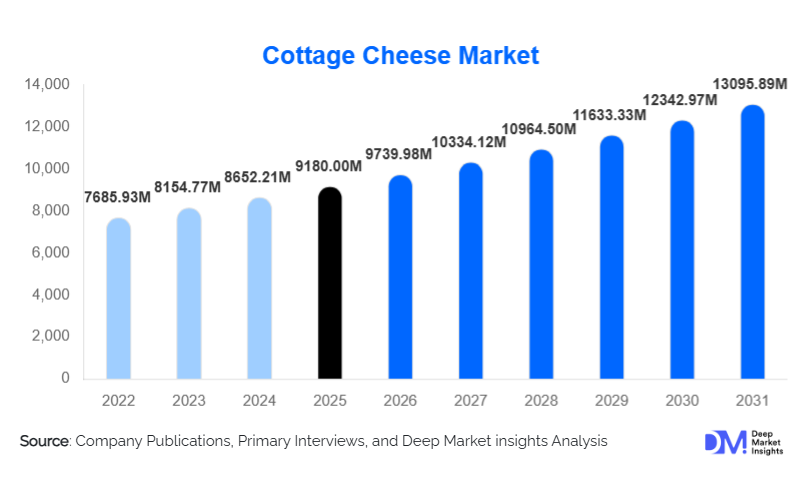
According to Deep Market Insights, the global cottage cheese market size was valued at USD 9,180.00 million in 2025 and is projected to grow from USD 9,739.98 million in 2026 to reach USD 13,095.89 million by 2031, expanding at a CAGR of 6.1% during the forecast period (2026–2031). The cottage cheese market growth is primarily driven by rising consumer preference for high-protein and low-fat dairy products, increasing health and fitness awareness, and the growing availability of flavored, lactose-free, and functional cottage cheese variants across retail and foodservice channels.
Key Market Insights
- Low-fat and fat-free cottage cheese products dominate global demand, driven by weight management, fitness, and sports nutrition trends.
- North America remains the largest market, supported by high per capita protein consumption and strong penetration of modern retail and private-label dairy products.
- Asia-Pacific is the fastest-growing region, fueled by urbanization, Western dietary adoption, and expanding cold-chain infrastructure.
- Supermarkets and hypermarkets account for the largest distribution share, while online grocery platforms are witnessing double-digit growth.
- Product innovation in flavors, probiotics, and lactose-free formulations is enhancing consumer appeal and supporting premium pricing.
- Foodservice adoption is accelerating, with cottage cheese increasingly used in salads, breakfast menus, and ready-to-eat meals.
What are the latest trends in the cottage cheese market?
Rising Demand for High-Protein and Functional Dairy
Cottage cheese is increasingly positioned as a functional food due to its high protein content, low-calorie profile, and versatility across meals. Consumers seeking muscle recovery, weight management, and balanced nutrition are driving demand for low-fat, fat-free, and protein-fortified cottage cheese. Manufacturers are also introducing probiotic-enriched and vitamin-fortified variants to target gut health and immunity, particularly among aging populations and fitness-focused consumers. This shift is transforming cottage cheese from a traditional dairy product into a value-added nutritional offering.
Flavor Innovation and Premiumization
Flavor innovation is playing a critical role in expanding consumer adoption. Savory herb-based, fruit-infused, and dessert-style cottage cheese products are gaining popularity, especially among younger demographics. Premium organic and clean-label offerings are also seeing increased traction, supported by rising disposable incomes and growing awareness of ingredient transparency. These trends are enabling brands to command higher margins while differentiating themselves in a competitive dairy landscape.
What are the key drivers in the cottage cheese market?
Growing Health and Fitness Consciousness
Increasing awareness of protein-rich diets and healthy snacking habits is a major driver of cottage cheese consumption. Fitness enthusiasts, athletes, and health-conscious consumers are incorporating cottage cheese into daily meals as a convenient protein source. The rise of home fitness, gym memberships, and sports nutrition awareness is directly supporting demand growth across developed and emerging economies.
Expansion of Modern Retail and Cold-Chain Infrastructure
The rapid expansion of supermarkets, hypermarkets, and refrigerated logistics is significantly improving the availability and shelf life of cottage cheese. Enhanced cold-chain capabilities in Asia-Pacific, Latin America, and the Middle East are enabling deeper market penetration and reducing spoilage-related losses. Private-label offerings by large retailers are further increasing affordability and accessibility, strengthening market growth.
What are the restraints for the global market?
Short Shelf Life and Logistics Challenges
Cottage cheese has a relatively short shelf life compared to other dairy products, increasing dependence on efficient refrigeration and distribution systems. In regions with limited cold storage infrastructure, this raises transportation costs and restricts market expansion. Managing inventory efficiently remains a key challenge for manufacturers and retailers.
Volatility in Raw Milk Prices
Fluctuations in raw milk prices, driven by feed costs, seasonal production patterns, and regulatory pricing controls, can impact profit margins. Smaller producers are particularly vulnerable to cost volatility, which may limit their ability to compete with large-scale dairy processors.
What are the key opportunities in the cottage cheese industry?
Emerging Market Expansion
Asia-Pacific, Latin America, and the Middle East present significant growth opportunities due to rising disposable incomes and evolving dietary preferences. Countries such as China, India, Brazil, and the UAE are witnessing growing acceptance of Western-style dairy products. Localized flavors, smaller pack sizes, and competitive pricing strategies can help brands capture these untapped markets.
Foodservice and Industrial Applications
The increasing use of cottage cheese in foodservice and industrial food processing offers long-term growth potential. Restaurants, cafés, and catering services are incorporating cottage cheese into salads, wraps, and breakfast menus. Industrial applications in ready meals, bakery fillings, and protein snacks are also expanding, supporting steady volume growth.
Report Scope
| Report Metric | Details |
|---|---|
| Market Size in 2025 | USD 9180 Million |
| Market Size in 2026 | USD 9739.98 Million |
| Market Size in 2031 | USD 13095.89 Million |
| CAGR | 6.1% (2026-2031) |
| Base Year for Estimation | 2025 |
| Historical Data | 2022-2024 |
| Forecast Period | 2026-2031 |
| Report Coverage | Revenue Forecast, Competitive Landscape, Supply Chain Disruption, Growth Factors, Environment & Regulatory Landscape and Trends |
| Geographies Covered | North America, Europe, APAC, Middle East and Africa, LATAM |
| Countries Covered | U.S., Canada, U.K., Germany, France, Spain, Italy, Russia, Nordic, Benelux, Rest of Europe, China, Korea, Japan, India, Australia, Singapore, Taiwan, South East Asia, Rest of Asia-Pacific, UAE, Turky, Saudi Arabia, South Africa, Egypt, Nigeria, Rest of MEA, Brazil, Mexico, Argentina, Chile, Colombia, Rest of LATAM |
Explore more data points, trends and opportunities Download Free Sample Report
Product Type Insights
Low-fat cottage cheese leads the global cottage cheese market, accounting for approximately 38% of total market share in 2025. The dominance of this segment is primarily driven by rising health awareness, increasing adoption of high-protein diets, and growing consumer focus on weight management and heart health. Low-fat variants strike a balance between taste and nutrition, making them highly appealing to fitness enthusiasts, working professionals, and aging populations seeking healthier dairy alternatives without compromising on flavor.
Full-fat cottage cheese continues to maintain stable demand, particularly among consumers who prioritize taste, texture, and satiety. This segment remains popular in traditional consumption patterns and culinary applications, including cooking, baking, and foodservice use, where creamier textures are preferred. Meanwhile, fat-free cottage cheese is gaining traction among calorie-conscious consumers, especially in developed markets, supported by increasing dietary awareness and clinical nutrition recommendations.
End-Use Insights
Household consumption dominates the cottage cheese market, representing nearly 63% of total demand. This leadership is driven by the product’s versatility across meals, ease of preparation, and alignment with everyday dietary habits such as breakfast consumption, snacking, and meal supplementation. The growing trend of home cooking, especially post-pandemic, has further strengthened household demand across both developed and emerging markets.
The foodservice segment is the fastest-growing end-use category, expanding at a CAGR of over 9%. Growth is supported by increasing incorporation of cottage cheese into restaurant menus, cafés, and quick-service restaurants, particularly in salads, wraps, breakfast bowls, and protein-focused meals. Health-oriented foodservice chains and casual dining formats are actively adopting cottage cheese as a clean-label, protein-rich ingredient to meet evolving consumer preferences.
Distribution Channel Insights
Supermarkets and hypermarkets dominate the global distribution landscape, accounting for approximately 42% of total sales. Their leadership is driven by wide product assortments, strong cold-chain infrastructure, aggressive promotional strategies, and the rapid expansion of private-label cottage cheese offerings. These channels provide high visibility and accessibility, particularly in urban markets, reinforcing consumer trust and repeat purchases.
Online retail is the fastest-growing distribution channel, supported by increasing digital grocery adoption, rising smartphone penetration, and the convenience of home delivery. Subscription-based dairy delivery models and direct-to-consumer platforms are gaining popularity, particularly among younger consumers and urban households seeking fresh, protein-rich foods regularly. Specialty and health food stores continue to play a critical role in premium and organic cottage cheese sales. These outlets cater to niche consumer segments focused on clean-label, organic, lactose-free, and functional dairy products, enabling brands to strengthen positioning and achieve higher margins.
Explore more data points, trends and opportunities Download Free Sample Report
Cottage Cheese Market Segmentations
By Product Type
- Low-Fat Cottage Cheese
- Full-Fat Cottage Cheese
- Fat-Free Cottage Cheese
- Flavored Cottage Cheese
- Lactose-Free Cottage Cheese
By End Use
- Household / Retail Consumption
- Foodservice & Hospitality
- Industrial Food Processing
By Distribution Channel
- Supermarkets & Hypermarkets
- Online Retail
- Convenience Stores
- Specialty & Health Food Stores
- Foodservice Distribution
By Source
- Cow Milk-Based
- Buffalo Milk-Based
- Mixed Milk-Based
Regional Insights
North America
North America holds approximately 41% of the global cottage cheese market, with the United States alone accounting for nearly 32% of global demand. Regional dominance is driven by high per capita protein consumption, strong fitness and sports nutrition culture, and widespread consumer familiarity with cottage cheese as a dietary staple. Well-developed cold-chain infrastructure, extensive supermarket penetration, and strong private-label competition further support high consumption levels. In addition, continuous product innovation in low-fat, flavored, and lactose-free variants sustains market maturity and steady growth.
Europe
Europe accounts for around 27% of global market share, led by Germany, the United Kingdom, France, and Nordic countries. Growth in the region is primarily driven by strong demand for clean-label, organic, and minimally processed dairy products. European consumers place high importance on ingredient transparency, sustainability, and nutritional balance, which aligns well with cottage cheese offerings. Steady demand from foodservice and industrial food processing, combined with rising adoption of protein-rich diets, continues to support regional market expansion.
Asia-Pacific
Asia-Pacific is the fastest-growing regional market, expanding at a CAGR of over 10%. Growth is fueled by rapid urbanization, rising disposable incomes, and increasing adoption of Western dietary habits across China, India, Japan, and Australia. Improving cold-chain infrastructure and expanding modern retail networks are enabling greater penetration of fresh dairy products. Additionally, growing awareness of protein intake, rising fitness participation, and increasing lactose-free product availability are accelerating cottage cheese adoption in this region.
Latin America
Latin America holds a smaller but steadily growing share of the global market, with Brazil and Mexico emerging as key demand centers. Market growth is supported by expanding modern retail infrastructure, rising middle-class populations, and increasing awareness of protein-rich diets. While cottage cheese consumption remains relatively niche compared to traditional dairy products, urban consumers and younger demographics are increasingly adopting healthier dairy alternatives, creating long-term growth potential.
Middle East & Africa
The Middle East & Africa region is witnessing gradual but consistent growth, led by the UAE, Saudi Arabia, and South Africa. Growth drivers include increasing urbanization, rising demand for premium and imported dairy products, and growing health awareness among consumers. The region also benefits from a strong foodservice sector, particularly in hospitality-driven economies, where cottage cheese is increasingly used in international and health-focused cuisine. Expanding cold-chain logistics and higher disposable incomes in Gulf countries are further supporting market development.
Key Players in the Cottage Cheese Market
- Lactalis Group
- Danone
- Kraft Heinz Company
- Saputo Inc.
- Arla Foods
- FrieslandCampina
- Dairy Farmers of America
- Fonterra
- Emmi Group
- Savencia Fromage & Dairy
- Müller Group
- Yili Group
- Mengniu Dairy
- Amul
- Sodiaal Group