Container-Based Vertical Farming Market Size
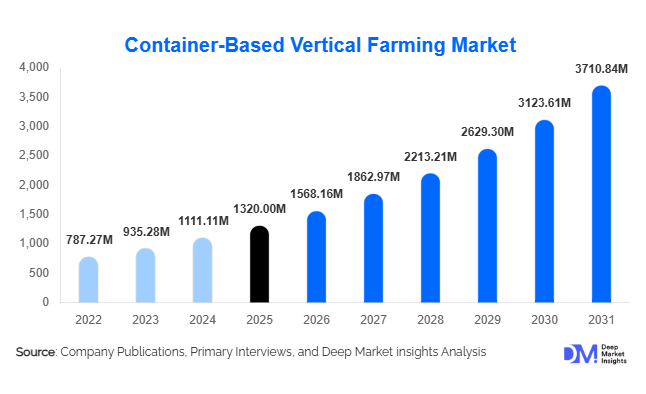
According to Deep Market Insights, the global container-based vertical farming market size was valued at USD 1,320 million in 2025 and is projected to grow from USD 1,568.16 million in 2026 to reach USD 3,710.84 million by 2031, expanding at a CAGR of 18.8% during the forecast period (2026–2031). The market growth is primarily driven by the increasing demand for sustainable agriculture solutions, rising urbanization, and the need for localized food production systems. Container-based farming offers a scalable, resource-efficient approach by enabling crop cultivation in controlled environments, independent of climatic conditions. Growing consumer preference for pesticide-free, fresh produce and advancements in LED lighting, automation, and IoT-based farm management are further accelerating market expansion globally.
Key Market Insights
- Container-based vertical farming is gaining traction as a sustainable food production model, reducing water usage by up to 90% compared to traditional farming methods.
- Hydroponic systems dominate due to cost efficiency, ease of operation, and scalability across commercial deployments.
- North America leads the market, supported by strong venture capital investments and early adoption of agritech innovations.
- Middle East & Africa is the fastest-growing region, driven by food security concerns and limited arable land.
- Leafy greens and herbs remain the primary crops, owing to short growth cycles and consistent demand from urban consumers.
- Technological integration, including AI, IoT, and smart climate control systems, is significantly improving productivity and operational efficiency.
What are the latest trends in the container-based vertical farming market?
Expansion of Urban Micro-Farming Models
Container-based vertical farming is increasingly being deployed within urban environments as part of decentralized food production systems. Cities are integrating modular farms into rooftops, parking spaces, and industrial zones to reduce reliance on long-distance food supply chains. This trend is gaining momentum as municipalities seek to improve food security and sustainability. Urban micro-farming models are particularly attractive due to their scalability and ability to deliver fresh produce directly to consumers, reducing logistics costs and carbon emissions. The concept of “farm-to-fork within cities” is rapidly becoming a mainstream strategy in developed and emerging economies alike.
Integration of AI and IoT in Smart Farming
Technological advancements are transforming container-based vertical farming operations. AI-driven analytics are being used to monitor plant health, optimize nutrient delivery, and predict crop yields. IoT-enabled sensors provide real-time data on temperature, humidity, and lighting conditions, enabling precise control over growing environments. Automation is reducing labor dependency while enhancing consistency and productivity. These smart farming technologies are particularly beneficial for large-scale commercial operators, helping them achieve higher yields and lower operational costs, thereby improving overall profitability.
What are the key drivers in the container-based vertical farming market?
Rising Demand for Sustainable Agriculture
Global concerns over climate change, soil degradation, and water scarcity are driving the adoption of sustainable farming practices. Container-based vertical farming addresses these challenges by using significantly less water, eliminating the need for pesticides, and enabling year-round production. Governments and organizations are increasingly supporting such solutions through subsidies and policy initiatives, further boosting market growth. The ability to produce food in controlled environments also reduces dependency on unpredictable weather conditions, making it a reliable alternative to traditional agriculture.
Increasing Urbanization and Local Food Demand
Rapid urbanization is creating a strong demand for locally produced, fresh food. Urban populations are expanding, while arable land is shrinking, making traditional farming less viable near cities. Container-based farming provides a practical solution by enabling food production within urban areas. Retailers and foodservice providers are increasingly sourcing produce from local container farms to ensure freshness and reduce transportation costs. This shift toward localized food systems is a major driver of market expansion.
What are the restraints for the global market?
High Initial Capital Investment
The setup costs for container-based vertical farms are relatively high, including expenses for containers, LED lighting, climate control systems, and automation technologies. These costs can be a barrier for small-scale farmers and new entrants, limiting widespread adoption. Although operational efficiencies improve over time, the initial investment remains a significant challenge for market growth.
Energy Consumption Challenges
Container-based farming relies heavily on artificial lighting and climate control systems, leading to high energy consumption. In regions with expensive electricity, this can significantly impact operational costs and profitability. While advancements in energy-efficient technologies are helping mitigate this issue, energy consumption remains a key restraint for the market.
What are the key opportunities in the container-based vertical farming industry?
Expansion in Emerging Markets
Emerging economies in Asia-Pacific, the Middle East, and Africa present significant growth opportunities due to increasing food demand, water scarcity, and reliance on food imports. Governments in these regions are actively promoting vertical farming through subsidies and policy support, creating a favorable environment for market entry and expansion.
Subscription-Based Farm-to-Consumer Models
The rise of direct-to-consumer business models is opening new revenue streams for container farm operators. Subscription-based delivery of fresh produce is gaining popularity among urban consumers, offering convenience and ensuring consistent demand. This model also allows producers to maintain better pricing control and customer engagement.
Report Scope
| Report Metric | Details |
|---|---|
| Market Size in 2025 | USD 1320 Million |
| Market Size in 2026 | USD 1568.16 Million |
| Market Size in 2031 | USD 3710.84 Million |
| CAGR | 18.8% (2026-2031) |
| Base Year for Estimation | 2025 |
| Historical Data | 2022-2024 |
| Forecast Period | 2026-2031 |
| Report Coverage | Revenue Forecast, Competitive Landscape, Supply Chain Disruption, Growth Factors, Environment & Regulatory Landscape and Trends |
| Geographies Covered | North America, Europe, APAC, Middle East and Africa, LATAM |
| Countries Covered | U.S., Canada, U.K., Germany, France, Spain, Italy, Russia, Nordic, Benelux, Rest of Europe, China, Korea, Japan, India, Australia, Singapore, Taiwan, South East Asia, Rest of Asia-Pacific, UAE, Turky, Saudi Arabia, South Africa, Egypt, Nigeria, Rest of MEA, Brazil, Mexico, Argentina, Chile, Colombia, Rest of LATAM |
Explore more data points, trends and opportunities Download Free Sample Report
Product Type Insights
The product type landscape of the container farming market is primarily segmented into hydroponic, aeroponic, and other emerging cultivation systems, with hydroponic container farms maintaining a dominant position. In 2025, hydroponic systems account for approximately 52% of the global market share, owing to their relative simplicity, cost-effectiveness, and strong track record of commercial success. Hydroponics relies on nutrient-rich water solutions rather than soil, enabling growers to achieve highly controlled growing environments. This control translates into predictable yields, shorter crop cycles, and the ability to produce high-quality crops consistently across seasons, which is particularly valuable in urban and non-arable environments.As technological advancements continue to reduce costs and improve system reliability, aeroponics is expected to gain traction, particularly in premium produce segments and research-intensive applications. Hybrid systems combining hydroponic and aeroponic elements are also being explored, offering a balance between efficiency and operational feasibility. Overall, the product type segment is evolving toward higher efficiency, automation, and sustainability, with hydroponics leading due to its accessibility and aeroponics gaining momentum as innovation progresses.
Application Insights
The application landscape of the container farming market is diverse, encompassing urban agriculture, food security initiatives, research and development, and disaster relief applications. Among these, urban agriculture remains the leading segment, contributing nearly 45% of the market share. The primary driver for this segment is the increasing need to localize food production within densely populated urban areas, where access to fresh produce is often limited. Container farms provide a practical solution by enabling year-round cultivation in compact spaces such as rooftops, parking lots, and unused urban land.The growth of urban agriculture is further supported by rising consumer awareness regarding food quality, sustainability, and traceability. Urban consumers are increasingly demanding locally grown, pesticide-free produce, which container farms are uniquely positioned to deliver. Additionally, municipalities are integrating urban farming into smart city initiatives, promoting food resilience and reducing the carbon footprint associated with long-distance food transportation. The ability of container farms to operate independently of external climatic conditions makes them particularly suitable for cities facing environmental challenges such as pollution and extreme weather.Disaster relief applications, although currently niche, are gaining importance as climate-related disasters become more frequent. Container farms can be rapidly deployed in affected areas to provide immediate access to fresh food, supporting humanitarian efforts. Their portability and independence from external infrastructure make them highly effective in crisis situations. Overall, the application segment is characterized by strong growth potential, driven by urbanization, sustainability goals, and the need for resilient food systems.
Distribution Channel Insights
The distribution channel landscape of the container farming market reflects the evolving dynamics of food supply chains and consumer preferences. Direct sales to retailers dominate the segment, accounting for approximately 40% of total distribution. The leading driver for this segment is the increasing demand from supermarkets and grocery chains for locally sourced, fresh produce. Retailers are leveraging container farms to reduce supply chain complexities, ensure consistent product availability, and enhance the freshness and quality of their offerings.Online subscription models are emerging as a rapidly growing distribution channel, driven by the increasing adoption of e-commerce and changing consumer lifestyles. The primary driver for this segment is convenience, as consumers seek regular delivery of fresh produce directly to their homes. Subscription services often provide curated selections of vegetables and herbs, ensuring consistent quality and availability. The integration of digital platforms with container farming operations allows for efficient order management, demand forecasting, and customer engagement.Overall, the distribution channel segment is undergoing transformation, with a strong emphasis on localization, efficiency, and direct-to-consumer models. The integration of technology and changing consumer preferences are expected to further drive innovation in this space.
End-Use Insights
The end-use segment of the container farming market is primarily driven by the food retail and foodservice industries, which collectively account for a substantial share of demand. Among these, the foodservice sector is one of the fastest-growing segments, with growth exceeding 20% CAGR. The leading driver for this segment is the increasing demand for fresh, high-quality, and sustainably sourced ingredients in restaurants, hotels, and catering services.Foodservice operators are leveraging container farms to gain greater control over their supply chains, reduce dependency on external suppliers, and ensure consistent product quality. The ability to grow produce on-site or nearby allows for enhanced freshness and customization, enabling chefs to experiment with unique varieties and flavors. This trend is particularly prominent in premium dining establishments and urban centers, where differentiation and quality are key competitive factors.Export-oriented demand is also gaining traction, particularly in regions seeking to reduce reliance on imported produce and enhance their agricultural competitiveness. Container farms enable the production of high-quality crops that meet international standards, supporting export opportunities. Overall, the end-use segment is characterized by strong growth across multiple industries, driven by the need for freshness, sustainability, and supply chain resilience.
Explore more data points, trends and opportunities Download Free Sample Report
Container-Based Vertical Farming Market Segmentations
By Farm Type
- Hydroponic Container Farms
- Aeroponic Container Farms
- Aquaponic Container Farms
By Crop Type
- Leafy Greens
- Herbs
- Fruits & Vegetables
- Microgreens
- Specialty Crops
By Technology Integration
- Climate Control Systems
- LED Lighting Systems
- Automation & IoT Systems
- Irrigation & Nutrient Systems
By Ownership Model
- Commercial Farms
- Institutional Farms
- Government & Community Farms
- Individual/Entrepreneurial Farms
By Distribution Channel
- Direct Sales to Retailers
- Online Subscription Models
- Foodservice & Hospitality Supply
- Institutional Procurement
Regional Insights
North America
North America holds approximately 34% of the global market share in 2025, with the United States leading the region. The growth of the container farming market in North America is driven by a combination of technological advancement, strong investment in agritech startups, and high consumer demand for organic and locally sourced produce. The region benefits from a well-established infrastructure that supports the adoption of advanced farming technologies, including automation, IoT, and artificial intelligence.Government support and funding for sustainable agriculture initiatives also play a crucial role in driving market growth. In Canada, policies promoting food security and environmental sustainability are encouraging the adoption of container farming solutions. Additionally, the presence of leading agritech companies and research institutions fosters innovation and accelerates market development. Urbanization and the demand for fresh produce in metropolitan areas further contribute to the region’s strong market position.
Europe
Europe accounts for around 22% of the global market share, with countries such as the Netherlands, Germany, and the United Kingdom leading adoption. The region’s growth is primarily driven by its strong emphasis on sustainability, environmental regulations, and innovation in agricultural practices. European governments are actively promoting vertical farming and controlled environment agriculture as part of their broader climate and food security strategies.Urbanization and limited availability of arable land in many European countries further drive the adoption of container farming. Cities are increasingly integrating urban agriculture into their planning frameworks, creating opportunities for container-based solutions. Consumer demand for organic and sustainably produced food is also a significant factor, as European consumers place a high value on quality and environmental responsibility.
Asia-Pacific
Asia-Pacific represents approximately 29% of the global market, with major contributions from China, Japan, and India. The region is characterized by rapid urbanization, population growth, and increasing pressure on traditional agricultural systems. These factors are driving the adoption of container farming as a viable solution for ensuring food security and meeting the growing demand for fresh produce.India is emerging as a high-growth market within the region, driven by increasing startup activity, supportive government policies, and growing awareness of sustainable agriculture. The need to address challenges such as water scarcity, land degradation, and supply chain inefficiencies is further fueling demand. Additionally, the expanding middle-class population and changing dietary preferences are contributing to the growth of the market.
Middle East & Africa
The Middle East & Africa region is the fastest-growing market, with a projected CAGR exceeding 22%. The primary driver for growth in this region is the urgent need to address food security challenges in arid and water-scarce environments. Countries such as the United Arab Emirates and Saudi Arabia are investing heavily in container farming and vertical farming technologies to reduce their dependence on food imports.In addition to food security, the region is also focusing on sustainability and innovation as part of its economic diversification strategies. The adoption of advanced technologies and the establishment of agritech hubs are contributing to the rapid growth of the container farming market in the Middle East & Africa.
Latin America
Latin America is gradually adopting container-based farming, with Brazil and Mexico leading the market. While the region currently represents a smaller share compared to other regions, it offers significant growth potential. The primary driver for market growth is the increasing urban demand for fresh and locally sourced produce, particularly in major cities.Government initiatives and investments in agricultural modernization are also supporting market growth. As awareness of sustainable farming practices increases, more stakeholders are exploring container farming as a viable alternative. The growing interest in export-oriented agriculture further enhances the potential for container farming in the region, as it enables the production of high-quality crops that meet international standards.
Key Players in the Container-Based Vertical Farming Market
- Freight Farms
- Square Roots
- CropBox
- PodPonics
- Urban Crop Solutions
- Agrilution
- Grow Pod Solutions
- Vertical Harvest
- Green Spirit Farms
- Intelligent Growth Solutions
- Hydrofarm Holdings Group
- BrightFarms
- Plenty Unlimited Inc.
- AeroFarms
- Infarm