Global Collagen Supplements Market Size
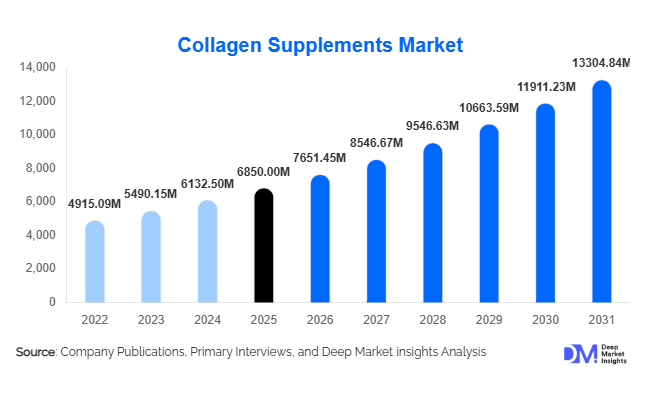
According to Deep Market Insights,the global collagen supplements market size was valued at USD 6,850 million in 2026 and is projected to grow from USD 7,651.45 million in 2026 to reach USD 13,304.84 million by 2031, expanding at a CAGR of 11.7% during the forecast period (2026–2031). The collagen supplements market growth is primarily driven by rising awareness of anti-aging and preventive health benefits, increasing adoption of nutricosmetics, the expansion of e-commerce channels, and the growing popularity of functional nutrition among aging and health-conscious populations globally.
Key Market Insights
- Bovine collagen dominates the global market, offering cost-effective, scalable, and versatile Type I and III collagen, widely used in beauty, joint, and wellness supplements.
- Powder formulations remain the leading format, favored for ease of use in beverages, high bioavailability, and customizable dosing.
- Beauty & Personal Care applications lead demand, driven by strong consumer interest in skin, hair, and nail health, supported by clinical evidence and influencer marketing campaigns.
- North America holds the largest regional share, with U.S. consumers driving premium and preventive healthcare adoption.
- Asia-Pacific is the fastest-growing region, fueled by China, Japan, and South Korea due to rising disposable income, social media influence, and a culture of ingestible beauty solutions.
- Technological adoption, including peptide innovations, marine sourcing, and fermentation-based collagen, is reshaping the competitive landscape and premium product offerings.
What are the latest trends in the collagen supplements market?
Nutricosmetics and Beauty-from-Within Solutions
The collagen supplements market is witnessing strong growth in beauty-from-within products, where ingestible collagen is marketed for skin elasticity, hair strength, and nail health. Products are increasingly combined with synergistic ingredients like vitamin C, hyaluronic acid, and biotin to enhance efficacy. Influencer marketing, dermatologist endorsements, and social media content are shaping consumer adoption, particularly among millennials and Gen Z. Premium marine collagen is emerging as a preferred option due to higher perceived bioavailability and sustainability appeal, allowing companies to target higher price segments.
Sports Nutrition and Active Aging
Collagen supplements are expanding in sports nutrition, targeting athletes and active adults to improve joint health, connective tissue recovery, and muscle performance. Clinical research supporting collagen’s role in reducing joint discomfort and enhancing recovery is fueling adoption. Innovative delivery forms like ready-to-drink beverages and gummies are being developed to cater to on-the-go consumers. The growing active aging population also drives demand, particularly in North America and Europe, as individuals seek preventive measures for musculoskeletal health.
What are the key drivers in the collagen supplements market?
Growing Aging Population
With global life expectancy increasing, demand for supplements supporting bone health, joint mobility, and skin aging is rising. Adults aged 35+ are the primary consumers of collagen products for preventive and therapeutic benefits. Clinical validation of collagen peptides enhances consumer confidence, further driving adoption in both functional nutrition and beauty categories.
Rise of E-Commerce and Direct-to-Consumer Channels
Online platforms are becoming the dominant distribution channel, providing convenient access, detailed product information, and subscription-based models. Brands leverage DTC models to offer personalized recommendations and recurring delivery services, improving customer retention and lifetime value. Social media, influencer campaigns, and online reviews significantly influence purchase decisions, particularly among younger demographics.
Consumer Shift Towards Preventive Healthcare and Wellness
Rising awareness of preventive healthcare and proactive wellness is motivating consumers to adopt collagen supplements. The “beauty-from-within” trend and sports nutrition integration further reinforce this shift. Growth is supported by premiumization, with marine collagen and peptide-specific formulations attracting high-value consumers.
What are the restraints for the global market?
Raw Material Price Volatility
Dependence on bovine, marine, and porcine sources exposes manufacturers to fluctuations in livestock and fish supply, impacting production costs and profit margins. Regulatory restrictions on fishing and livestock sourcing, combined with environmental constraints, can disrupt supply chains and limit scalability.
Regulatory and Compliance Challenges
Inconsistent regulations across global markets regarding health claims, labeling, and functional benefits create barriers for product approval and marketing. Misinformation and unverified claims may affect consumer trust, requiring companies to invest heavily in clinical substantiation and quality assurance.
What are the key opportunities in the collagen supplements industry?
Marine and Sustainable Collagen
Marine collagen, perceived as higher quality and more bioavailable than bovine sources, offers premium market opportunities. Growing consumer preference for sustainable and eco-friendly ingredients supports investment in marine collagen extraction and branding. Companies focusing on traceability, eco-certification, and sustainable sourcing can capture premium pricing and expand in Asia-Pacific, North America, and Europe.
Technological Innovation in Peptides and Fermentation-Based Collagen
Emerging fermentation-derived and plant-based collagen alternatives present opportunities for tapping vegan and environmentally conscious consumers. Innovations in peptide technology improve absorption and efficacy, offering differentiated products. Early movers with proprietary technology could gain competitive advantage in premium and niche segments.
Expansion in Sports Nutrition and Active Aging Segments
Targeting athletes, fitness enthusiasts, and the aging population provides growth potential. Partnerships with gyms, physiotherapy networks, and wellness programs can drive adoption. Products tailored for joint recovery, mobility, and muscle performance position collagen supplements as essential functional nutrition products beyond beauty applications.
Report Scope
| Report Metric | Details |
|---|---|
| Market Size in 2025 | USD 6850 Million |
| Market Size in 2026 | USD 7651.45 Million |
| Market Size in 2031 | USD 13304.84 Million |
| CAGR | 11.7% (2026-2031) |
| Base Year for Estimation | 2025 |
| Historical Data | 2022-2024 |
| Forecast Period | 2026-2031 |
| Report Coverage | Revenue Forecast, Competitive Landscape, Supply Chain Disruption, Growth Factors, Environment & Regulatory Landscape and Trends |
| Geographies Covered | North America, Europe, APAC, Middle East and Africa, LATAM |
| Countries Covered | U.S., Canada, U.K., Germany, France, Spain, Italy, Russia, Nordic, Benelux, Rest of Europe, China, Korea, Japan, India, Australia, Singapore, Taiwan, South East Asia, Rest of Asia-Pacific, UAE, Turky, Saudi Arabia, South Africa, Egypt, Nigeria, Rest of MEA, Brazil, Mexico, Argentina, Chile, Colombia, Rest of LATAM |
Explore more data points, trends and opportunities Download Free Sample Report
Product Type Insights
The global collagen supplements market is characterized by strong dominance of bovine collagen, which contributes nearly 38% of the total market share in 2025. The leadership of bovine collagen is primarily driven by its cost efficiency, abundant raw material availability from the meat processing industry, and well-established extraction infrastructure. Its compatibility with large-scale production and versatile applications across beauty, sports, and clinical nutrition further strengthen its position as the leading product segment. Marine collagen is steadily gaining traction, particularly in premium and clean-label categories, supported by rising consumer preference for pescatarian and sustainably sourced ingredients. Type I collagen leads the collagen type segment with approximately 44% share, owing to its superior bioavailability and proven efficacy in improving skin elasticity, reducing wrinkles, and supporting hair and nail health, making it the preferred choice in nutricosmetics.
In terms of formulation, powder formats dominate the market, accounting for nearly 46% of total sales. The leading driver for powder collagen is its versatility in consumption, allowing easy integration into beverages, smoothies, functional foods, and meal replacements, along with higher concentration per serving compared to capsules or ready-to-drink formats. Online sales represent approximately 35% of global distribution, driven by direct-to-consumer subscription models, influencer-led marketing, and expanding e-commerce ecosystems that provide broader product visibility and recurring revenue streams. Beauty & Personal Care applications remain the largest demand contributor, capturing around 40% of the overall market, primarily fueled by growing consumer awareness of ingestible beauty solutions and long-term skin health maintenance.
Application Insights
Beauty & Personal Care applications dominate the collagen supplements market, driven by increasing consumer preference for nutricosmetics targeting skin hydration, anti-aging, hair strengthening, and nail health. The leading growth driver in this segment is the shift toward preventive beauty regimes, where consumers seek clinically backed, ingestible solutions as an extension of topical skincare. Sports Nutrition represents one of the fastest-growing applications, supported by rising gym memberships, expanding athletic communities, and increased demand for joint recovery and muscle performance support. Clinical and therapeutic nutrition is emerging as a significant segment, particularly in elderly care, orthopedic recovery, and hospital-based nutritional programs where collagen supports tissue repair and mobility. General wellness supplements continue to expand as manufacturers combine collagen with vitamins, minerals, hyaluronic acid, and herbal actives to create multifunctional formulations. Export-driven demand remains strong from Japan, Germany, and the United States, reflecting high consumer awareness and mature supplement markets.
Distribution Channel Insights
Online and e-commerce channels dominate the distribution landscape due to their convenience, subscription-based purchasing models, detailed product transparency, and global accessibility. The leading driver for online channel growth is the rapid expansion of direct-to-consumer strategies supported by digital marketing, influencer collaborations, and personalized wellness platforms that enhance brand loyalty and recurring purchases. Pharmacies, drug stores, and specialty nutrition retailers remain essential, particularly for clinical-grade and therapeutic collagen products where consumer trust and professional recommendation play a critical role. Supermarkets and hypermarkets primarily cater to mid-range and mass-market consumers, offering competitively priced collagen powders and ready-to-drink formats. Omnichannel strategies are increasingly adopted to ensure consistent brand presence across both digital and offline touchpoints.
End-Use Insights
The Beauty & Personal Care segment represents the largest end-use category, driven by the rapid expansion of ingestible beauty products and increasing consumer demand for holistic skincare solutions. The leading growth driver is the convergence of nutraceuticals and cosmetics, often referred to as nutricosmetics, which positions collagen as a daily beauty essential. Sports Nutrition is the fastest-growing end-use segment, supported by aging populations seeking mobility support, higher sports participation rates, and preventive joint health awareness. Clinical and therapeutic nutrition applications are expanding steadily, particularly within hospital recovery programs and elderly nutrition management. Export demand remains robust from Japan, Germany, and the United States, while growth in Asia-Pacific and Latin America is supported by rising disposable income, expanding middle-class populations, and increasing awareness of functional nutrition benefits.
Explore more data points, trends and opportunities Download Free Sample Report
Collagen Supplements Market Segmentations
By Source
- Bovine Collagen
- Marine Collagen
- Porcine Collagen
- Poultry Collagen
- Multi-Source & Others
By Form
- Powder
- Capsules & Tablets
- Liquid
- Gummies & Soft Chews
- Ready-to-Drink (RTD)
By Collagen Type
- Type I
- Type II
- Type III
- Multi-Type Blends
- Specialty/Peptide-Specific Formulations
By Distribution Channel
- Pharmacies & Drug Stores
- Supermarkets & Hypermarkets
- Specialty Nutrition Stores
- Online/E-commerce
- Direct-to-Consumer (DTC) Subscription
By End-Use Application
- Beauty & Personal Care (Nutricosmetics)
- Bone & Joint Health
- Sports Nutrition & Muscle Recovery
- General Wellness & Preventive Health
- Clinical & Therapeutic Nutrition
Regional Insights
North America
North America accounts for approximately 34% of the global collagen supplements market in 2025, led by the United States, where collagen supplement sales exceed USD 2 billion. The primary regional growth driver is the strong culture of preventive healthcare and high consumer awareness regarding functional nutrition and anti-aging solutions. Advanced e-commerce infrastructure, widespread digital marketing adoption, and subscription-based supplement models further accelerate growth. Canada contributes steadily to regional demand, supported by increasing interest in clean-label beauty supplements and joint health products, alongside regulatory clarity that supports nutraceutical innovation.
Europe
Europe represents roughly 22% of the global market, with key contributions from Germany, France, Italy, and the United Kingdom. Regional growth is primarily driven by an aging population and rising demand for clinically validated, clean-label, and sustainably sourced supplements. Consumers in Europe prioritize traceability, quality certifications, and environmentally responsible sourcing, which supports premium marine collagen adoption. Preventive healthcare initiatives and growing awareness of musculoskeletal health among elderly populations further strengthen collagen consumption across the region.
Asia-Pacific
Asia-Pacific holds approximately 30% of the global market and remains the fastest-growing region, expanding at an estimated CAGR of around 13%. Growth is driven by strong beauty-from-within culture, expanding middle-class income, and high digital commerce penetration. Japan’s long-standing beverage-based collagen consumption culture continues to sustain mature demand, while China’s cross-border e-commerce ecosystem enables rapid market expansion and premium brand access. South Korea drives innovation in premium marine collagen and beauty-focused formulations, supported by advanced cosmetic integration. Australia contributes steady growth through high consumer awareness of wellness supplements and regulatory standards that encourage quality assurance.
Latin America
Latin America accounts for approximately 8% of the global market, with Brazil and Mexico leading regional adoption. The primary growth driver is the expanding urban middle class combined with increasing consumer interest in beauty enhancement and functional nutrition. Rising import penetration, expanding pharmacy retail chains, and growing digital commerce platforms are supporting market expansion. Greater awareness of preventive health and aesthetic wellness trends further fuels collagen supplement demand.
Middle East & Africa
The Middle East and Africa region holds nearly 6% of the global market share. Growth is primarily driven by rising disposable incomes, expanding retail infrastructure, and increasing consumer focus on premium wellness products. The United Arab Emirates and Saudi Arabia lead regional demand with strong retail availability and high-income consumer segments seeking beauty and anti-aging solutions. South Africa plays a central role in Sub-Saharan Africa, with increasing intra-African trade and growing awareness of nutritional supplementation in countries such as Nigeria. The gradual modernization of retail channels and rising health consciousness continue to support long-term market expansion.
Key Players in the Collagen Supplements Market
- Nestlé Health Science
- Amway Corporation
- Shiseido Co., Ltd.
- The Clorox Company
- GNC Holdings LLC
- Vital Proteins LLC
- Gelita AG
- Rousselot BV
- Nitta Gelatin Inc.
- Meiji Holdings Co., Ltd.
- Darling Ingredients Inc.
- Weishardt Group
- NeoCell Corporation
- Blackmores Limited
- Youtheory Inc.