Coconut Milk Market Size
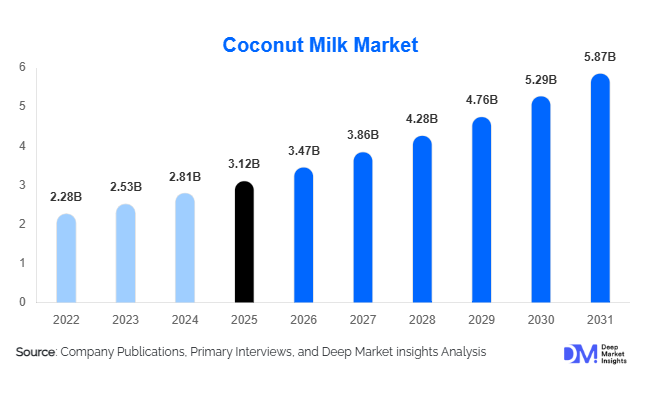
According to Deep Market Insights, the global coconut milk market size was valued at USD 3.12 billion in 2025 and is projected to grow from USD 3.47 billion in 2026 to reach USD 5.87 billion by 2031, expanding at a CAGR of 11.1% during the forecast period (2026–2031). The coconut milk market growth is primarily driven by the rising global demand for plant-based dairy alternatives, increasing consumer preference for vegan and lactose-free products, and expanding use of coconut-derived ingredients across food processing, beverages, bakery, and personal care industries.
Key Market Insights
- Coconut milk consumption is increasingly shifting toward plant-based and clean-label nutrition trends, with consumers preferring natural, dairy-free, and minimally processed food products.
- Asia-Pacific dominates global coconut milk production and exports, supported by strong coconut cultivation infrastructure across the Philippines, Indonesia, India, Thailand, and Vietnam.
- North America remains the leading high-value consumption market, driven by growing vegan populations, lactose intolerance awareness, and premium dairy alternative demand.
- Organic and fortified coconut milk products are witnessing rapid growth, particularly among health-conscious consumers seeking functional beverages and nutritional products.
- Foodservice operators and café chains are increasingly integrating coconut milk into menus, accelerating commercial demand for barista-grade and ready-to-use coconut milk products.
- Technological advancements in aseptic packaging and shelf-life stabilization are improving product distribution efficiency and enabling wider retail penetration globally.
What are the latest trends in the coconut milk market?
Premium Plant-Based Beverage Innovation Accelerating
The global coconut milk market is witnessing rapid innovation in premium plant-based beverage formulations. Manufacturers are increasingly introducing fortified coconut milk products enriched with calcium, protein, vitamins, probiotics, and functional ingredients to target health-conscious consumers. Barista-style coconut milk products designed specifically for coffee applications are gaining strong traction across cafés and foodservice chains due to improved frothing and texture stability. Brands are also expanding flavored variants including vanilla, chocolate, and tropical fruit blends to attract younger consumers seeking convenient dairy-free beverages. The growing popularity of ketogenic and paleo diets is further driving innovation in unsweetened and high-MCT coconut milk formulations that align with wellness-focused dietary preferences.
Sustainable Packaging and Ethical Sourcing Becoming Core Industry Trends
Sustainability is emerging as a defining trend in the coconut milk industry, with consumers increasingly demanding ethically sourced and environmentally responsible products. Companies are investing heavily in recyclable cartons, BPA-free cans, and lightweight flexible packaging solutions to reduce environmental impact. Coconut milk manufacturers are additionally implementing traceable sourcing systems and direct farmer partnerships to improve supply chain transparency and ensure fair trade practices. Several producers are also focusing on organic certifications and carbon footprint reduction initiatives to strengthen brand positioning in premium retail markets. Retailers across North America and Europe are increasingly prioritizing shelf space for clean-label and sustainably packaged coconut milk products, further accelerating this trend.
What are the key drivers in the coconut milk market?
Rising Demand for Plant-Based Dairy Alternatives
The increasing global adoption of vegan, flexitarian, and lactose-free diets is one of the primary drivers supporting coconut milk market growth. Consumers are actively replacing traditional dairy products with plant-based alternatives due to health, ethical, and environmental concerns. Coconut milk is widely preferred because of its creamy texture, natural sweetness, and compatibility with multiple food and beverage applications. Food manufacturers are increasingly incorporating coconut milk into yogurts, frozen desserts, smoothies, creamers, soups, sauces, and ready meals to meet evolving dietary preferences. The rapid expansion of plant-based product portfolios across supermarkets and foodservice establishments is significantly strengthening market demand.
Growing Consumer Preference for Clean-Label and Functional Foods
Consumers are increasingly prioritizing clean-label food products that are free from artificial preservatives, additives, and allergens. Coconut milk aligns strongly with this trend as it is naturally lactose-free, gluten-free, and soy-free. The market is additionally benefiting from rising awareness regarding the nutritional benefits of medium-chain triglycerides (MCTs) naturally present in coconut products. Functional beverage manufacturers are leveraging these health attributes to position coconut milk as a wellness-oriented ingredient suitable for sports nutrition, ketogenic diets, and immunity-focused products. Premium organic coconut milk products are particularly witnessing strong growth across North America and Europe where health-conscious consumers are willing to pay higher prices for natural and sustainably sourced food products.
What are the restraints for the global market?
Volatility in Raw Coconut Supply and Pricing
The coconut milk market remains highly dependent on coconut production conditions in Southeast Asian countries. Climatic disruptions such as typhoons, droughts, irregular rainfall, and pest infestations can significantly affect coconut harvests and create volatility in raw material prices. These fluctuations directly impact manufacturing costs, export competitiveness, and profit margins for processors. Supply chain disruptions also create challenges for long-term procurement contracts, particularly for multinational food manufacturers that rely heavily on stable coconut ingredient sourcing.
Intensifying Competition from Alternative Plant-Based Milks
The rapid growth of oat milk, almond milk, soy milk, and cashew milk categories is intensifying competition within the broader plant-based beverage industry. Consumers now have access to multiple dairy-free alternatives, creating pricing pressure and increased competition for retail shelf space. Some consumers additionally perceive coconut milk as relatively high in saturated fat content compared to competing alternatives, which may restrict adoption among calorie-conscious buyers. Manufacturers are therefore increasingly investing in reduced-fat formulations and nutritional education campaigns to strengthen competitive positioning.
What are the key opportunities in the coconut milk industry?
Expansion of Functional and Nutritional Beverage Applications
The growing global demand for functional nutrition presents major opportunities for coconut milk manufacturers. Coconut milk is increasingly being incorporated into protein beverages, meal replacement drinks, sports nutrition formulations, and immunity-support products. Rising adoption of ketogenic, paleo, and wellness-oriented diets is encouraging brands to develop premium coconut milk beverages enriched with protein, vitamins, probiotics, and botanical extracts. This trend is creating opportunities for companies to expand beyond conventional culinary applications into high-margin functional beverage categories. The growing popularity of ready-to-drink wellness beverages among urban consumers is expected to further strengthen this opportunity over the forecast period.
Export-Oriented Growth in Emerging Economies
Major coconut-producing countries including the Philippines, Indonesia, India, Sri Lanka, and Thailand are increasingly investing in export-oriented coconut processing industries. Government initiatives supporting agricultural modernization, food processing infrastructure, and value-added exports are creating favorable conditions for market expansion. Rising demand for Asian cuisine, vegan products, and tropical ingredients across Europe, North America, and the Middle East is accelerating import demand for packaged coconut milk products. Emerging retail channels and e-commerce platforms are additionally enabling smaller regional brands to access international consumer markets more efficiently.
Report Scope
| Report Metric | Details |
|---|---|
| Market Size in 2025 | USD 3.12 Billion |
| Market Size in 2026 | USD 3.47 Billion |
| Market Size in 2031 | USD 5.87 Billion |
| CAGR | 11.1% (2026-2031) |
| Base Year for Estimation | 2025 |
| Historical Data | 2022-2024 |
| Forecast Period | 2026-2031 |
| Report Coverage | Revenue Forecast, Competitive Landscape, Supply Chain Disruption, Growth Factors, Environment & Regulatory Landscape and Trends |
| Geographies Covered | North America, Europe, APAC, Middle East and Africa, LATAM |
| Countries Covered | U.S., Canada, U.K., Germany, France, Spain, Italy, Russia, Nordic, Benelux, Rest of Europe, China, Korea, Japan, India, Australia, Singapore, Taiwan, South East Asia, Rest of Asia-Pacific, UAE, Turky, Saudi Arabia, South Africa, Egypt, Nigeria, Rest of MEA, Brazil, Mexico, Argentina, Chile, Colombia, Rest of LATAM |
Explore more data points, trends and opportunities Download Free Sample Report
Product Type Insights
The global coconut milk market is witnessing substantial expansion across multiple product categories as consumer demand for plant-based, dairy-free, and clean-label food ingredients continues to accelerate worldwide. Among all product types, regular full-fat coconut milk maintains its dominant position in the market and accounts for a significant share of global revenues due to its extensive application across household cooking, industrial food manufacturing, and foodservice operations. The segment continues to benefit from the growing popularity of Asian cuisines, vegan cooking trends, and increasing incorporation of coconut milk into processed food formulations. Its naturally rich texture, creamy consistency, and mild sweetness make it highly suitable for curries, soups, sauces, gravies, bakery fillings, desserts, confectionery products, and ready meals. The leading position of the regular full-fat coconut milk segment is primarily driven by rising global demand for versatile dairy alternatives that can replicate the texture and mouthfeel of traditional dairy ingredients while offering plant-based nutritional benefits. In addition, food manufacturers increasingly utilize full-fat coconut milk in premium culinary products because it enhances flavor profiles and improves product consistency in both savory and sweet applications.Organic coconut milk variants are additionally witnessing significant growth across developed economies as consumers increasingly prioritize clean-label, sustainably sourced, and chemical-free food products. Rising awareness regarding pesticide-free farming practices, ethical sourcing standards, and environmental sustainability is supporting higher demand for certified organic coconut milk products across North America and Europe. Organic coconut milk is gaining strong traction among premium retail consumers who seek minimally processed food products with transparent ingredient sourcing. Manufacturers are responding by strengthening organic certification initiatives, improving sustainable sourcing partnerships, and enhancing eco-friendly packaging solutions to attract environmentally conscious buyers. The growing consumer shift toward holistic wellness and natural food ingredients is expected to continue supporting strong long-term growth within the organic coconut milk segment.
Application Insights
The food and beverage segment remains the largest application area within the global coconut milk market and continues to account for a dominant share of overall industry revenues. The segment’s leadership is primarily driven by increasing utilization of coconut milk across dairy alternatives, bakery products, confectionery items, frozen desserts, soups, sauces, curries, nutritional beverages, and ready-to-eat food products. The rapid expansion of vegan and flexitarian dietary lifestyles globally has significantly increased demand for plant-based ingredients capable of replacing conventional dairy components in processed foods and beverages. Coconut milk has emerged as one of the most preferred dairy alternatives because of its creamy consistency, versatile functionality, and compatibility with multiple culinary applications. Food manufacturers are increasingly incorporating coconut milk into innovative product formulations to meet rising consumer demand for lactose-free, allergen-friendly, and plant-based nutritional products.Dairy-free yogurt, vegan ice cream, plant-based creamers, and non-dairy beverage applications are among the fastest-growing categories within the food and beverage segment. Consumers are increasingly seeking healthier alternatives to traditional dairy products due to growing awareness regarding lactose intolerance, cholesterol concerns, and digestive health. Coconut milk serves as a highly suitable ingredient for premium dairy-free formulations because it provides desirable texture, mouthfeel, and flavor enhancement. Manufacturers are also focusing on fortification strategies involving calcium, vitamin D, probiotics, and protein enrichment to improve the nutritional profile of coconut milk-based products. The continued expansion of plant-based food innovation across supermarkets, cafés, and quick-service restaurants is expected to sustain long-term growth across food and beverage applications.Nutraceutical and wellness-oriented applications are also emerging as high-growth opportunities within the global coconut milk market. Coconut milk is increasingly being utilized in ketogenic diets, sports nutrition products, functional beverages, and immunity-support formulations due to its healthy fat composition and nutritional benefits. Rising global interest in functional nutrition, digestive wellness, and energy-boosting dietary solutions is creating new opportunities for coconut milk integration across health-focused product categories. The growing popularity of wellness lifestyles and preventive healthcare consumption patterns is expected to further support expansion across nutraceutical applications.
Distribution Channel Insights
Supermarkets and hypermarkets continue to dominate global coconut milk sales due to their extensive retail reach, strong product visibility, broad assortment availability, and ability to support large-scale consumer purchasing behavior. The leading position of this distribution channel is largely driven by rising consumer preference for one-stop shopping destinations that provide access to both mainstream and premium coconut milk products. Organized retail infrastructure plays a critical role in enhancing consumer awareness, supporting product comparison, and facilitating new product discovery. Supermarkets and hypermarkets also provide manufacturers with strategic shelf placement opportunities and promotional visibility that contribute significantly to brand expansion and volume growth.Specialty health stores continue to represent an important distribution channel for premium coconut milk products targeting wellness-oriented consumers. Organic food retailers, vegan specialty stores, and natural product chains are increasingly expanding shelf space dedicated to plant-based dairy alternatives and clean-label nutritional products. Consumers shopping through specialty channels are generally more willing to pay premium prices for certified organic, sustainably sourced, and fortified coconut milk products. Manufacturers are increasingly leveraging specialty retail partnerships to position coconut milk as part of broader health and wellness lifestyle trends.Direct-to-consumer sales models are also gaining momentum as coconut milk brands increasingly invest in subscription services, personalized nutrition offerings, social media marketing, and consumer education initiatives. Digital engagement strategies allow manufacturers to strengthen brand differentiation, gather consumer insights, and improve customer retention while expanding profit margins through reduced intermediary dependence. The continued evolution of omnichannel retail strategies is expected to remain a key growth driver across the global coconut milk distribution landscape.
End-Use Insights
Food processing companies account for the largest end-use segment within the global coconut milk market due to rising industrial demand for plant-based ingredients in packaged foods, beverages, frozen desserts, sauces, soups, confectionery products, and bakery applications. The leading position of the segment is primarily driven by increasing global demand for vegan and dairy-free food formulations. Coconut milk offers manufacturers a highly versatile ingredient capable of improving texture, creaminess, and flavor while supporting clean-label product positioning. Food processors are increasingly integrating coconut milk into innovative product development initiatives to address evolving consumer preferences for healthier and plant-based food solutions.The foodservice and hospitality industry is also witnessing increasing coconut milk utilization as cafés, restaurants, hotels, and quick-service chains expand dairy-free menu offerings. Coconut milk is becoming increasingly common in specialty coffees, smoothies, curries, desserts, and international cuisine menus. Rising consumer demand for customized plant-based meal options is encouraging foodservice operators to incorporate coconut milk into mainstream menu development strategies.Household consumption remains particularly strong across Asia-Pacific where coconut milk forms an essential component of traditional cuisines. Rising urbanization, changing dietary preferences, and increasing availability of packaged coconut milk products are supporting household consumption growth across both developed and emerging markets. Consumers increasingly prefer ready-to-use packaged coconut milk solutions due to convenience advantages and longer shelf stability compared to fresh coconut extraction methods.Cosmetic and personal care companies are additionally increasing adoption of coconut milk ingredients in skincare and haircare product formulations emphasizing hydration, nourishment, and natural ingredient positioning. Rising consumer demand for botanical and naturally derived cosmetic ingredients is expected to support further expansion within this end-use category over the forecast period.
Packaging Insights
Aseptic carton packaging accounts for a significant share of the global coconut milk packaging market due to its extended shelf life, lightweight structure, transportation efficiency, and suitability for modern retail distribution systems. The segment is witnessing strong adoption across North America and Europe where consumers increasingly prioritize convenient, portable, and environmentally sustainable packaging formats. Aseptic cartons help preserve product freshness without requiring refrigeration before opening, making them highly attractive for manufacturers and retailers seeking supply chain efficiency and reduced storage costs.Flexible packaging formats such as pouches and sachets are witnessing rapid growth across emerging economies because of affordability, portability, and convenience advantages. Single-use sachets are particularly popular among price-sensitive consumers in developing markets where smaller purchase quantities improve accessibility. Flexible packaging also offers reduced material usage and lower transportation costs, supporting improved operational efficiency for manufacturers.Sustainability considerations are increasingly influencing packaging innovation strategies across the coconut milk industry. Manufacturers are investing heavily in recyclable materials, BPA-free containers, biodegradable packaging technologies, and environmentally friendly production processes to align with evolving consumer expectations and regulatory requirements. Growing environmental awareness among consumers is expected to continue driving demand for sustainable coconut milk packaging solutions globally.
Explore more data points, trends and opportunities Download Free Sample Report
Coconut Milk Market Segmentations
By Product Type
- Regular Coconut Milk
- Coconut Cream
- Powdered Coconut Milk
- Condensed & Sweetened Coconut Milk
- Ready-to-Drink Coconut Milk Beverages
By Nature
- Conventional
- Organic
By Application
- Food & Beverage
- Personal Care & Cosmetics
- Nutraceuticals & Functional Foods
- Household & Others
By Distribution Channel
- Supermarkets & Hypermarkets
- Convenience Stores
- Specialty Health Stores
- Online Retail/E-commerce
- Foodservice Suppliers
By End Use
- Household Consumers
- Food Processing Companies
- Foodservice & Hospitality
- Bakery & Confectionery Manufacturers
- Cosmetic & Personal Care Companies
Regional Insights
North America
North America represents one of the most significant consumption markets for coconut milk globally, led primarily by the United States and Canada. The regional market is experiencing strong growth due to rising vegan populations, increasing lactose intolerance awareness, expanding plant-based dietary adoption, and growing consumer preference for clean-label food products. The strongest driver supporting North American market expansion is the rapid growth of the dairy alternatives industry, which has encouraged food manufacturers and retailers to significantly increase coconut milk product offerings across mainstream retail channels. Consumers are increasingly incorporating coconut milk into coffee beverages, smoothies, bakery products, dairy-free desserts, and nutritional beverages.The region also benefits from advanced retail infrastructure, high disposable income levels, extensive e-commerce penetration, and strong product innovation capabilities. Premiumization trends are particularly prominent in North America, with consumers showing strong interest in organic, fortified, non-GMO, and sustainably sourced coconut milk products. Rapid growth in café culture and specialty beverage consumption is further contributing to increased coconut milk demand across foodservice channels. In addition, rising health consciousness and growing awareness regarding digestive wellness are encouraging consumers to transition away from traditional dairy products toward plant-based alternatives.
Europe
Europe accounts for a substantial share of the global coconut milk market and continues to witness strong demand growth across Germany, the United Kingdom, France, the Netherlands, Italy, and Nordic countries. The leading growth driver in Europe is the rapid expansion of veganism and flexitarian dietary patterns, which has significantly increased demand for plant-based dairy alternatives across both retail and foodservice sectors. European consumers increasingly prioritize sustainable, ethically sourced, and environmentally friendly food products, creating highly favorable conditions for premium coconut milk brands.Government support for clean-label food standards, sustainability initiatives, and recyclable packaging adoption is further accelerating market penetration across the region. Food manufacturers are increasingly integrating coconut milk into bakery products, dairy-free desserts, beverages, and ready meals to meet changing consumer preferences. Europe also benefits from strong organic food consumption trends and high awareness regarding environmental sustainability, encouraging increased adoption of certified organic coconut milk products. The rapid expansion of specialty vegan retail stores and plant-based restaurant chains is expected to further strengthen long-term regional demand.
Asia-Pacific
Asia-Pacific dominates the global coconut milk market in both production and consumption due to abundant coconut cultivation, extensive processing capabilities, and strong cultural integration of coconut-based food products. Countries such as the Philippines, Indonesia, India, Thailand, and Vietnam serve as major production hubs and export-oriented processing centers. The primary growth driver within Asia-Pacific is the region’s strong traditional culinary dependence on coconut milk across Southeast Asian and South Asian cuisines. Coconut milk remains an essential ingredient in curries, soups, desserts, sauces, and beverages throughout the region.Rapid urbanization, rising disposable incomes, increasing packaged food consumption, and expansion of organized retail infrastructure are further accelerating regional market growth. India is emerging as one of the fastest-growing markets due to increasing health awareness, growing demand for dairy alternatives, and rising penetration of packaged coconut milk products across urban households. China, Japan, and South Korea are additionally witnessing rising demand for dairy-free beverages, functional nutrition products, and tropical ingredient-based food innovations. Expanding export opportunities and growing investments in food processing technologies continue to strengthen Asia-Pacific’s leadership position within the global coconut milk industry.
Latin America
Latin America is witnessing gradual but steady growth in coconut milk consumption, particularly across Brazil, Mexico, Argentina, and Chile. The major growth driver in the region is increasing consumer exposure to international cuisines and rising adoption of plant-based dietary lifestyles among urban populations. Consumers are increasingly embracing dairy-free beverages, vegan desserts, and tropical food ingredients as awareness regarding health and wellness continues to expand. The growing middle-class population and expansion of modern retail infrastructure are also improving accessibility to premium coconut milk products across major metropolitan markets.Foodservice operators, café chains, and international restaurant brands are contributing significantly to regional market expansion by incorporating coconut milk into beverages, desserts, and specialty menu offerings. Increasing social media influence and global food trends are further supporting demand for exotic and tropical ingredient-based food products. As retail modernization continues across Latin America, coconut milk manufacturers are expected to benefit from wider distribution networks and improving consumer awareness.
Middle East & Africa
The Middle East & Africa region is emerging as a promising growth market for coconut milk products due to increasing health awareness, rising expatriate populations, expanding premium retail infrastructure, and growing exposure to international cuisines. The strongest growth driver in the region is the increasing demand for imported premium dairy alternatives among affluent urban consumers seeking healthier beverage and food options. Countries such as the UAE, Saudi Arabia, and Qatar are witnessing particularly strong demand growth due to rising vegan awareness, premium grocery expansion, and increasing café culture development.Retail modernization, growth in organized supermarket chains, and rising availability of imported plant-based food products are supporting broader market penetration across the region. South Africa is also experiencing rising demand for lactose-free and vegan food products, particularly among younger urban consumers. The growing popularity of Asian cuisine and expansion of tourism and hospitality industries are additionally contributing to increased coconut milk utilization across foodservice applications. Long-term market growth across the Middle East & Africa is expected to remain supported by improving consumer purchasing power, urbanization trends, and increasing health-conscious dietary behavior.
Key Players in the Coconut Milk Market
- The Vita Coco Company
- Thai Coconut Public Company Limited
- McCormick & Company
- Danone S.A.
- Nestlé S.A.
- Goya Foods Inc.
- Celebes Coconut Corporation
- Axelum Resources Corp.
- Renuka Foods PLC
- Chaokoh Coconut
- Pacific Foods
- Sambu Group
- Ducoco Produtos Alimentícios S.A.
- CocoGoods Co.
- Aroy-D Brand