Coconut Market Size
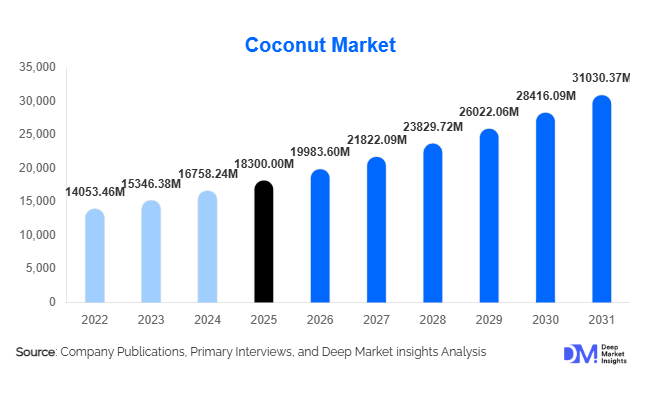
According to Deep Market Insights, the global coconut market size was valued at USD 18,300 million in 2025 and is projected to grow from USD 19,983.60 million in 2026 to reach USD 31,030.37 million by 2031, expanding at a CAGR of 9.2% during the forecast period (2026–2031). The market growth is primarily driven by increasing global demand for plant-based food ingredients, rising adoption of coconut-derived products in personal care and nutraceuticals, and expanding applications across food processing industries. The market is also benefiting from strong export demand and advancements in coconut processing technologies, enabling longer shelf life and broader international distribution.
Key Market Insights
- Plant-based and dairy alternative demand is accelerating coconut consumption, particularly for coconut milk, oil, and water across developed markets.
- Asia-Pacific dominates global production and supply, with Indonesia, the Philippines, and India leading exports and processing.
- Food & beverage applications account for the largest share, driven by bakery, beverages, and ready-to-eat product demand.
- Organic and premium coconut products are gaining traction, supported by clean-label and health-conscious consumer preferences.
- North America is the fastest-growing consumption region, driven by vegan diets and functional beverage trends.
- Technological advancements in processing and packaging are improving product quality, scalability, and global supply chain efficiency.
What are the latest trends in the coconut market?
Rise of Functional and Value-Added Coconut Products
The coconut market is increasingly shifting toward value-added and functional products such as MCT oil, coconut protein, coconut sugar, and fortified coconut beverages. These products cater to health-conscious consumers seeking nutritional benefits such as improved metabolism, low glycemic index, and gluten-free alternatives. Food manufacturers are incorporating coconut ingredients into functional snacks, sports nutrition products, and dietary supplements, significantly increasing their market penetration. This trend is also enabling producers to achieve higher profit margins compared to raw coconut sales, driving investment in advanced processing capabilities and product innovation.
Expansion of Plant-Based and Vegan Applications
The rapid growth of plant-based diets is a key trend reshaping the coconut market. Coconut milk and cream are widely used as dairy substitutes in beverages, desserts, and ready meals. With increasing lactose intolerance and vegan adoption globally, coconut-based alternatives are becoming mainstream across retail and foodservice channels. Major food brands are expanding their product lines with coconut-based yogurts, ice creams, and beverages, strengthening demand across developed economies. This trend is further supported by growing consumer awareness regarding sustainability and ethical food consumption.
What are the key drivers in the coconut market?
Growing Demand for Natural and Organic Ingredients
Consumers are increasingly shifting toward natural, minimally processed, and organic food and personal care products. Coconut-derived ingredients align well with this demand due to their perceived health benefits and clean-label positioning. Coconut oil, in particular, has gained widespread adoption in skincare and haircare products, while organic coconut food products are gaining shelf space in premium retail channels.
Expansion of Food Processing and Beverage Industry
The rapid growth of the global food processing industry is a major driver for coconut demand. Coconut ingredients are widely used in bakery, confectionery, beverages, and ready-to-eat foods. Increasing urbanization, busy lifestyles, and rising disposable incomes are fueling consumption of processed foods, indirectly boosting coconut market growth.
What are the restraints for the global market?
Climate Dependency and Supply Volatility
Coconut production is highly dependent on tropical climatic conditions, making it vulnerable to weather fluctuations, natural disasters, and pest infestations. These factors can significantly impact yield and supply, leading to price volatility and supply chain disruptions.
Fragmented Supply Chain and Limited Mechanization
The coconut industry is largely dominated by smallholder farmers, particularly in Asia-Pacific regions. Limited mechanization and fragmented supply chains result in inefficiencies in harvesting, processing, and distribution. This poses challenges in maintaining consistent quality and scaling production to meet global demand.
What are the key opportunities in the coconut industry?
Growth in Plant-Based Food Industry
The expanding plant-based food industry presents a significant opportunity for coconut market players. Coconut-based dairy alternatives are witnessing strong demand in beverages, desserts, and ready meals. Companies can capitalize on this trend by introducing innovative and fortified coconut products catering to vegan and lactose-intolerant consumers.
Expansion into Emerging Markets
Emerging markets in the Middle East, Africa, and Eastern Europe are witnessing rising demand for healthy and natural food products. Increasing disposable incomes and urbanization are creating opportunities for coconut exporters to expand their presence in these regions.
Report Scope
| Report Metric | Details |
|---|---|
| Market Size in 2025 | USD 18300.00 Million |
| Market Size in 2026 | USD 19983.60 Million |
| Market Size in 2031 | USD 31030.37 Million |
| CAGR | 9.2% (2026-2031) |
| Base Year for Estimation | 2025 |
| Historical Data | 2022-2024 |
| Forecast Period | 2026-2031 |
| Report Coverage | Revenue Forecast, Competitive Landscape, Supply Chain Disruption, Growth Factors, Environment & Regulatory Landscape and Trends |
| Geographies Covered | North America, Europe, APAC, Middle East and Africa, LATAM |
| Countries Covered | U.S., Canada, U.K., Germany, France, Spain, Italy, Russia, Nordic, Benelux, Rest of Europe, China, Korea, Japan, India, Australia, Singapore, Taiwan, South East Asia, Rest of Asia-Pacific, UAE, Turky, Saudi Arabia, South Africa, Egypt, Nigeria, Rest of MEA, Brazil, Mexico, Argentina, Chile, Colombia, Rest of LATAM |
Explore more data points, trends and opportunities Download Free Sample Report
Product Type Insights
The global coconut-based product landscape is primarily shaped by coconut oil, coconut water, coconut milk, and a range of emerging derivative products such as desiccated coconut, coconut flour, coconut sugar, and specialty concentrates. Among these, coconut oil continues to dominate the product segment, accounting for approximately 28% of the global market share in 2025. Its leadership is strongly supported by its multifunctional nature and deep penetration across food processing, cosmetics, pharmaceuticals, and industrial applications. The versatility of coconut oil stems from its stable fatty acid composition, natural antioxidant properties, and increasing perception as a healthier alternative to refined vegetable oils in certain applications. In the food industry, it is widely used in cooking oils, bakery fats, confectionery formulations, and ready-to-eat meals, while in personal care it is a key ingredient in moisturizers, hair oils, soaps, and skincare formulations. The demand driver for coconut oil is strongly linked to the global shift toward natural and minimally processed ingredients, combined with rising awareness regarding clean-label products and plant-based nutrition trends.Coconut water represents one of the fastest-expanding product categories due to its strong positioning as a natural electrolyte-rich beverage. Its growth is driven by increasing consumer interest in hydration drinks that are free from artificial additives, sugars, and preservatives. The rise in fitness culture, sports nutrition awareness, and functional beverage consumption has significantly boosted demand. Similarly, coconut milk has gained momentum as a dairy alternative, especially among lactose-intolerant consumers and vegan populations. The growth of plant-based diets globally has positioned coconut milk as a core ingredient in vegan cooking, coffee creamers, desserts, and packaged foods. Additionally, coconut flour and sugar are gaining traction in the health food segment, driven by demand for gluten-free and low-glycemic index alternatives. The overall product ecosystem is evolving rapidly as innovation in processing technologies enables better shelf stability, improved flavor retention, and expanded application scope.
Application Insights
The application landscape of coconut-based products is highly diversified, with the food and beverage segment emerging as the dominant application area, contributing approximately 55% of the total market share. This dominance is largely driven by the widespread incorporation of coconut ingredients into bakery products, confectionery items, dairy alternatives, beverages, sauces, and processed food formulations. The primary driver of this segment is the increasing consumer demand for healthier food options that are natural, plant-based, and free from synthetic additives. Food manufacturers are increasingly reformulating products using coconut derivatives to meet clean-label expectations and cater to vegan and vegetarian dietary trends. The rising popularity of ethnic cuisines and tropical flavor profiles in global markets has further strengthened coconut’s position as a preferred ingredient.The cosmetics and personal care segment represents the fastest-growing application area, supported by a strong shift toward organic and natural skincare solutions. Coconut oil, in particular, has become a foundational ingredient in premium beauty formulations due to its moisturizing, antimicrobial, and nourishing properties. The growth of this segment is driven by increasing consumer awareness of chemical-free beauty products, rising demand for sustainable sourcing, and the expansion of premium skincare brands targeting millennial and Gen Z consumers. Additionally, the pharmaceutical and nutraceutical industries are gradually increasing their use of coconut-based ingredients for functional health products, dietary supplements, and therapeutic formulations. Industrial applications, although smaller in share, continue to utilize coconut derivatives in biofuel production, lubricants, and specialty chemical manufacturing, further diversifying the application base.
Distribution Channel Insights
The distribution ecosystem of coconut-based products is characterized by a strong B2B dominance, with business-to-business channels accounting for nearly 60% of total market share. This dominance is primarily attributed to bulk procurement by food manufacturers, cosmetic companies, beverage producers, and industrial users. B2B transactions ensure consistent supply chains, cost efficiency, and standardized quality specifications, making them the preferred channel for large-scale consumption. The growth driver for B2B distribution is the increasing global demand for processed coconut ingredients, which requires large-volume sourcing agreements and long-term supplier contracts. Export-oriented production hubs in Asia-Pacific further strengthen B2B trade flows, particularly between producing and consuming regions.On the other hand, B2C distribution channels are experiencing rapid growth, particularly through online retail platforms and specialty health stores. The rise of e-commerce has transformed consumer accessibility to packaged coconut products, enabling direct-to-consumer sales and brand-driven marketing strategies. This shift is driven by increasing digital penetration, changing consumer purchasing behavior, and growing preference for convenience-driven shopping experiences. Supermarkets and hypermarkets also continue to play a significant role in developed markets, offering a wide range of coconut-based beverages, oils, and packaged food products. The expansion of private-label brands and health-focused retail chains has further accelerated B2C growth momentum.
End-Use Industry Insights
The food processing industry remains the largest end-use segment, accounting for approximately 48% of the global coconut market. This dominance is primarily driven by the growing global consumption of processed and packaged food products. The food processing sector utilizes coconut derivatives extensively due to their functional benefits, including flavor enhancement, texture improvement, and natural preservation properties. The increasing demand for convenience foods, ready-to-eat meals, and bakery products has significantly strengthened coconut’s role as a key ingredient in industrial food manufacturing. Additionally, the expansion of global food supply chains and rising urbanization have further fueled demand for processed food solutions incorporating coconut-based inputs.The cosmetics and personal care industry is the fastest-growing end-use sector, expanding at a CAGR exceeding 10%. This growth is strongly driven by consumer preference for natural, organic, and sustainable beauty products. Coconut-based ingredients are widely used in skincare, haircare, and personal hygiene formulations due to their perceived safety, effectiveness, and multifunctional benefits. The pharmaceutical and nutraceutical industries are also gradually increasing their reliance on coconut derivatives for functional health applications, particularly in digestive health, energy supplements, and natural therapeutic products. Industrial applications, though comparatively smaller, continue to grow steadily as coconut-based bio-products gain traction in sustainable manufacturing processes.
Explore more data points, trends and opportunities Download Free Sample Report
Coconut Market Segmentations
By Product Type
- Whole Coconut
- Coconut Oil
- Coconut Milk & Cream
- Coconut Water
- Desiccated Coconut
- Coconut Flour & Sugar
- Coconut-based Snacks & Ingredients
By Application
- Food & Beverages
- Personal Care & Cosmetics
- Pharmaceuticals & Nutraceuticals
- Animal Feed
- Industrial Applications
By Distribution Channel
- B2B
- Supermarkets & Hypermarkets
- Convenience Stores
- Online Retail
- Specialty Stores
Regional Insights
Asia-Pacific
Asia-Pacific dominates the global coconut market with approximately 62% market share in 2025, making it the primary production and consumption hub. The region’s leadership is driven by favorable tropical climatic conditions, abundant coconut plantations, and well-established agricultural infrastructure in countries such as Indonesia, the Philippines, India, Sri Lanka, and Vietnam. The key growth drivers in Asia-Pacific include strong domestic consumption patterns, expanding food processing industries, and robust export demand from North America and Europe. Additionally, government support for agricultural exports, investments in coconut value-chain development, and the presence of large-scale processing facilities contribute significantly to regional growth. Rising population levels and increasing consumption of coconut-based traditional foods further reinforce sustained demand within domestic markets.
North America
North America accounts for approximately 14% of the global market, with the United States being the largest importer of coconut-based products. The region’s growth is primarily driven by rising consumer awareness regarding plant-based diets, functional beverages, and organic food consumption. The increasing prevalence of lactose intolerance and dietary shifts toward veganism and flexitarian lifestyles have significantly boosted demand for coconut milk, coconut water, and coconut oil. The health and wellness trend plays a central role in shaping consumer behavior, with coconut products being positioned as natural, nutrient-rich alternatives. Additionally, the expansion of fitness culture, sports nutrition products, and premium organic retail channels further strengthens market growth in the region.
Europe
Europe holds nearly 12% market share, driven by strong demand for organic, ethically sourced, and sustainable coconut-based products. Countries such as Germany, the United Kingdom, France, and the Netherlands are key consumption centers. The primary growth driver in Europe is the increasing regulatory emphasis on clean-label food ingredients and sustainable sourcing practices. European consumers exhibit high preference for certified organic and fair-trade coconut products, which has encouraged suppliers to adopt transparent supply chains. The cosmetics and personal care industry in Europe also significantly contributes to demand, as natural beauty products gain mainstream acceptance. Additionally, the rising popularity of vegan diets and plant-based food innovations continues to support regional market expansion.
Middle East & Africa
The Middle East & Africa region is witnessing steady growth in the coconut market, primarily driven by increasing import dependency and rising awareness of healthy food consumption. The United Arab Emirates and Saudi Arabia represent key demand centers due to their high expatriate populations, strong retail infrastructure, and growing health-conscious consumer base. The growth driver in this region is the rapid expansion of modern retail formats, coupled with increasing availability of international food products. Additionally, the rising hospitality and tourism industry contributes to demand for coconut-based beverages and culinary applications. In Africa, urbanization and gradual improvement in income levels are supporting increased consumption of processed coconut products.
Latin America
Latin America exhibits moderate but steadily growing demand for coconut-based products, with Brazil emerging as the leading market in the region. The growth is primarily driven by increasing domestic consumption of coconut water, oils, and food ingredients. Brazil’s tropical climate supports local coconut production, which strengthens supply availability and reduces dependency on imports. The key growth driver in Latin America is the rising popularity of natural beverages and functional health drinks, particularly coconut water, which is widely consumed as a hydration product. Additionally, growing awareness of plant-based nutrition and expanding retail distribution networks are supporting broader market penetration across urban populations.
Key Players in the Coconut Market
- Vita Coco
- Thai Coconut Public Company
- Celebes Coconut Corporation
- PT Sambu Group
- Greenville Agro Corporation
- Marico Limited
- Dabur India Ltd
- McCormick & Company
- Goya Foods
- Coconut Palm Group
- Primex Coco Products
- SC Global Coco Products
- Coco do Vale
- Sumatera Baru
- Fiesta Ingredients