Cocoa Market Size
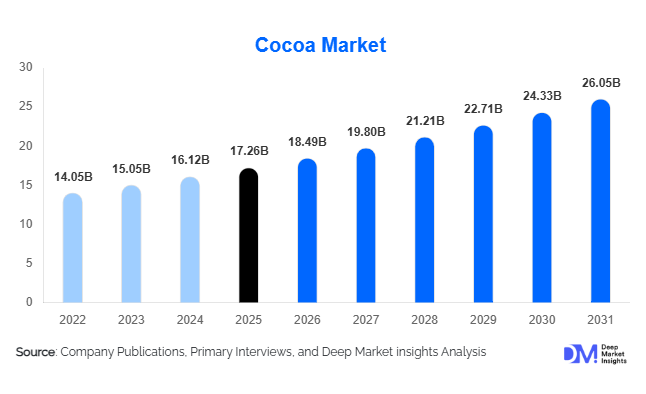
According to Deep Market Insights, the global cocoa market size was valued at USD 17.26 billion in 2025 and is projected to grow from USD 18.49 billion in 2026 to reach USD 26.05 billion by 2031, expanding at a CAGR of 7.1% during the forecast period (2026–2031). The cocoa market growth is primarily driven by rising global chocolate consumption, increasing demand for premium and dark chocolate products, expanding applications of cocoa ingredients in nutraceuticals and cosmetics, and the growing adoption of sustainable and traceable cocoa sourcing practices.
Key Market Insights
- Premium and dark chocolate consumption is accelerating globally, supported by increasing consumer preference for high-cocoa-content and health-oriented confectionery products.
- Sustainable and ethically sourced cocoa is becoming a core procurement priority for major chocolate manufacturers due to tightening environmental and labor regulations.
- Europe dominates the global cocoa market, driven by large-scale cocoa processing industries and strong chocolate manufacturing demand across Germany, Switzerland, Belgium, and the Netherlands.
- Asia-Pacific is the fastest-growing cocoa consumption region, supported by rising disposable incomes, urbanization, and expanding confectionery industries in China and India.
- Functional foods and nutraceutical applications are expanding rapidly, with cocoa flavanols increasingly used in wellness beverages, protein snacks, and dietary supplements.
- Technological advancements in cocoa processing and traceability, including AI-enabled crop monitoring and blockchain-based sourcing systems, are reshaping supply chain efficiency and sustainability compliance.
cocoa market latest trends
Growing Demand for Premium and Single-Origin Cocoa Products
The global cocoa market is witnessing a significant shift toward premiumization, particularly in developed economies where consumers are increasingly seeking high-quality, single-origin, and artisanal chocolate products. Premium cocoa products with higher cocoa content are gaining popularity due to their perceived health benefits and superior flavor profiles. Chocolate manufacturers are expanding portfolios featuring Criollo and Trinitario cocoa varieties, which are valued for their distinct aroma and taste characteristics. Single-origin chocolate products sourced from Ecuador, Ghana, Madagascar, and Peru are gaining traction among affluent consumers seeking traceable and ethically sourced ingredients. This trend is also encouraging investments in specialty cocoa farming, fermentation technologies, and advanced roasting techniques to preserve flavor complexity and enhance product differentiation.
Sustainability and Traceability Integration Across Cocoa Supply Chains
Sustainability has become one of the most influential trends in the cocoa market as governments, regulators, and consumers demand greater transparency across global supply chains. Major cocoa processors and chocolate manufacturers are investing heavily in blockchain traceability systems, satellite farm mapping, and farmer-support initiatives to comply with deforestation-free sourcing regulations. European Union sustainability regulations are compelling suppliers to strengthen environmental and labor compliance mechanisms. Companies are also adopting regenerative agriculture practices, carbon-neutral cocoa processing, and farmer income improvement programs to ensure long-term supply security. Certification programs such as Fairtrade and Rainforest Alliance are increasingly influencing procurement decisions, while consumers are showing stronger preference for cocoa products with verified ethical sourcing credentials.
cocoa market drivers
Rising Global Chocolate Consumption
The increasing global demand for chocolate and confectionery products remains the primary growth driver for the cocoa market. Consumption of premium chocolate products has risen significantly across North America, Europe, and Asia-Pacific due to changing consumer lifestyles and rising disposable incomes. Dark chocolate products containing higher cocoa percentages are particularly witnessing strong growth because consumers increasingly associate cocoa-rich products with antioxidant and wellness benefits. Seasonal gifting trends, expanding retail penetration, and product innovation in flavored and functional chocolate segments are further accelerating cocoa demand worldwide. Emerging markets such as India, China, Indonesia, and Vietnam are also witnessing rising chocolate consumption due to westernized dietary habits and rapid urbanization.
Expansion of Cocoa Applications in Functional Foods and Nutraceuticals
Cocoa is increasingly being utilized beyond traditional confectionery applications, particularly in functional foods and nutraceutical products. Cocoa flavanols and polyphenols are associated with cardiovascular health, cognitive wellness, and antioxidant benefits, encouraging food manufacturers to incorporate cocoa ingredients into protein bars, fortified snacks, nutritional beverages, and dietary supplements. The growing global focus on wellness and preventive healthcare is creating substantial demand for high-purity cocoa extracts and flavanol-rich cocoa powders. This diversification of applications is helping reduce dependence on traditional chocolate demand while opening high-margin growth opportunities for cocoa ingredient manufacturers.
global market restraints
Volatility in Cocoa Bean Prices
The cocoa market remains highly vulnerable to raw material price volatility due to concentrated production in West African countries such as Côte d’Ivoire and Ghana. Climate disruptions, crop diseases, labor shortages, and geopolitical uncertainties can significantly affect cocoa harvests and international pricing. Cocoa futures prices have experienced sharp fluctuations over recent years, increasing procurement risks for manufacturers and processors. Rising energy and logistics costs further compound pricing instability across global supply chains. These fluctuations directly impact manufacturer profitability and increase operational uncertainty for downstream industries.
Stringent Sustainability and Regulatory Compliance Requirements
Increasing regulatory pressure related to sustainability, deforestation-free sourcing, and labor standards is creating operational challenges across the cocoa value chain. European Union regulations regarding traceability and environmental compliance require exporters and processors to implement sophisticated monitoring systems and documentation frameworks. Small-scale farmers often lack the financial and technological resources needed to comply with these standards, limiting market accessibility for certain suppliers. Additionally, ongoing concerns regarding child labor and low farmer incomes continue to create reputational and compliance risks for multinational chocolate manufacturers and cocoa processors.
cocoa industry key opportunities
Growth of Functional and Wellness-Oriented Cocoa Products
The rapid expansion of the global functional foods and wellness industry presents substantial growth opportunities for cocoa manufacturers. Cocoa ingredients rich in flavanols and antioxidants are increasingly incorporated into health beverages, protein supplements, nutritional bars, and fortified snacks. Consumers are actively seeking natural ingredients with scientifically supported health benefits, positioning cocoa as an attractive functional ingredient. Manufacturers are also developing low-sugar and high-cocoa-content products to align with evolving health-conscious consumer preferences. The growing demand for plant-based and clean-label food products is expected to further strengthen cocoa ingredient adoption across wellness-focused applications.
Expansion of Sustainable and Traceable Cocoa Supply Chains
Sustainable cocoa sourcing initiatives represent a major long-term opportunity for market participants. Companies investing in blockchain traceability, regenerative agriculture, and farmer-support programs are strengthening supply chain resilience while enhancing brand value in premium markets. Governments and international organizations are increasingly supporting sustainable cocoa farming through infrastructure development, financial assistance, and certification programs. In addition, carbon-credit linked cocoa farming initiatives are emerging as new revenue-generation opportunities for producers and cooperatives. Manufacturers capable of ensuring transparent and ethically sourced cocoa supply chains are expected to gain competitive advantages across North American and European markets.
Report Scope
| Report Metric | Details |
|---|---|
| Market Size in 2025 | USD 17.26 Billion |
| Market Size in 2026 | USD 18.49 Billion |
| Market Size in 2031 | USD 26.05 Billion |
| CAGR | 7.1% (2026-2031) |
| Base Year for Estimation | 2025 |
| Historical Data | 2022-2024 |
| Forecast Period | 2026-2031 |
| Report Coverage | Revenue Forecast, Competitive Landscape, Supply Chain Disruption, Growth Factors, Environment & Regulatory Landscape and Trends |
| Geographies Covered | North America, Europe, APAC, Middle East and Africa, LATAM |
| Countries Covered | U.S., Canada, U.K., Germany, France, Spain, Italy, Russia, Nordic, Benelux, Rest of Europe, China, Korea, Japan, India, Australia, Singapore, Taiwan, South East Asia, Rest of Asia-Pacific, UAE, Turky, Saudi Arabia, South Africa, Egypt, Nigeria, Rest of MEA, Brazil, Mexico, Argentina, Chile, Colombia, Rest of LATAM |
Explore more data points, trends and opportunities Download Free Sample Report
Product Type Insights
Cocoa powder remains the leading product segment, accounting for a significant share of the global cocoa market due to its extensive application across bakery, confectionery, beverages, and nutritional products. Alkalized cocoa powder is particularly popular in premium desserts and instant beverage mixes because of its enhanced flavor and darker appearance. Cocoa butter continues to witness strong demand from both chocolate manufacturers and cosmetics companies due to its functional and moisturizing properties. Cocoa liquor and cocoa mass are critical intermediate ingredients used extensively in industrial chocolate manufacturing. Specialty cocoa ingredients such as cocoa flavanols and cocoa fiber are gaining traction in functional nutrition and wellness-focused food applications. Fine-flavor cocoa products are also expanding steadily as artisanal and premium chocolate manufacturers seek differentiated ingredients with superior taste profiles.
Application Insights
Chocolate and confectionery applications dominate the cocoa market globally, driven by rising consumption of dark chocolate, premium confectionery, and seasonal gifting products. Bakery applications are expanding steadily as cocoa ingredients are increasingly incorporated into cakes, pastries, cookies, and dessert mixes. Beverage applications, including hot cocoa drinks and ready-to-drink wellness beverages, are witnessing strong growth due to rising demand for indulgent yet functional beverages. Nutraceutical and functional food applications are emerging rapidly as manufacturers integrate cocoa flavanols into protein snacks, dietary supplements, and fortified products. Cocoa butter usage in cosmetics and personal care products is also increasing significantly due to growing consumer preference for natural skincare ingredients and plant-based formulations.
Distribution Channel Insights
Direct industrial B2B sales dominate the cocoa market, supported by long-term procurement contracts between cocoa processors and food manufacturers. Large confectionery and bakery companies typically procure cocoa ingredients directly from processors to ensure supply consistency and pricing stability. Commodity traders and cocoa exchanges continue to play an important role in global cocoa distribution, particularly for raw cocoa beans and bulk cocoa derivatives. Online retail channels are gaining traction for premium cocoa powders, artisanal chocolate ingredients, and specialty baking cocoa products. Supermarkets and specialty food stores remain important retail channels for branded cocoa-based consumer products, while digital commerce platforms are increasingly supporting direct-to-consumer sales of organic and premium cocoa ingredients.
End-Use Industry Insights
The food and beverage industry represents the largest end-use sector for cocoa, supported by robust demand from confectionery, bakery, dairy, and beverage manufacturers. Chocolate manufacturing remains the single largest contributor to cocoa consumption globally. Bakery and dessert industries are also witnessing rising demand for cocoa ingredients as premium baked products and indulgent desserts gain popularity worldwide. Nutraceutical companies are increasingly utilizing cocoa extracts and flavanol-rich ingredients in wellness supplements and functional nutrition products. The cosmetics and personal care sector is emerging as one of the fastest-growing end-use industries for cocoa butter due to rising demand for natural moisturizers, skincare creams, and anti-aging formulations. Foodservice demand from cafés, hotels, bakeries, and dessert chains is also contributing significantly to global cocoa consumption growth.
Explore more data points, trends and opportunities Download Free Sample Report
Cocoa Market Segmentations
By Product Type
- Cocoa Beans
- Cocoa Butter
- Cocoa Powder
- Cocoa Liquor/Mass
- Cocoa Ingredients & Extracts
By Nature
- Conventional Cocoa
- Organic Cocoa
- Fair-Trade Certified Cocoa
- Sustainably Sourced Cocoa
By Bean Variety
- Forastero
- Criollo
- Trinitario
- Specialty Hybrid Varieties
By Application
- Chocolate & Confectionery
- Bakery Products
- Beverages
- Dairy & Frozen Desserts
- Nutraceuticals & Functional Foods
- Cosmetics & Personal Care
- Pharmaceuticals
By Distribution Channel
- Direct Industrial/B2B Sales
- Commodity Traders & Exchanges
- Supermarkets & Hypermarkets
- Specialty Stores
- Online Retail
- Convenience Stores
Regional Insights
North America
North America accounts for a substantial share of the global cocoa market, led primarily by the United States and Canada. Strong chocolate consumption, growing demand for premium confectionery, and rising interest in organic cocoa products are supporting regional market expansion. Functional cocoa beverages and wellness-oriented snacks are also witnessing increased adoption. The United States remains one of the world’s largest chocolate-consuming countries, supported by strong retail distribution and high per-capita confectionery spending.
Europe
Europe dominates the global cocoa market with approximately 36% market share in 2025, supported by its strong chocolate manufacturing and cocoa processing industries. Germany, Switzerland, Belgium, France, and the Netherlands are major contributors to regional demand. The Netherlands serves as a key cocoa trading and grinding hub globally due to its strategic logistics infrastructure. European consumers are increasingly demanding sustainable, organic, and ethically sourced cocoa products, driving investments in certified cocoa supply chains and traceability systems.
Asia-Pacific
Asia-Pacific is the fastest-growing regional market, accounting for nearly 24% of global cocoa demand in 2025. China and India are emerging as major growth engines due to expanding middle-class populations, urbanization, and increasing consumption of premium confectionery products. Japan and South Korea continue to demonstrate strong demand for high-quality chocolate and wellness-oriented cocoa products. Rising food processing investments and westernized snacking habits across Southeast Asia are further accelerating regional cocoa ingredient demand.
Latin America
Latin America plays a critical dual role as both a cocoa-producing and consuming region. Ecuador is globally recognized for its fine-flavor cocoa exports, while Brazil remains a major cocoa producer and growing chocolate consumption market. Regional governments are increasingly promoting value-added cocoa processing industries to enhance export competitiveness and reduce dependence on raw bean exports. Premium and artisanal chocolate production is also expanding steadily across the region.
Middle East & Africa
The Middle East & Africa region remains strategically important to the global cocoa market due to its dominant cocoa cultivation activities. Côte d’Ivoire and Ghana collectively account for a majority share of global cocoa bean exports. Governments in West Africa are investing in productivity enhancement programs, sustainable farming initiatives, and processing infrastructure to strengthen export competitiveness. Meanwhile, countries such as the UAE and Saudi Arabia are witnessing rising demand for premium chocolate products due to luxury retail expansion, tourism growth, and increasing consumer spending on confectionery products.
Key Players in the Cocoa Market
- Barry Callebaut AG
- Cargill Incorporated
- Olam Group
- ECOM Agroindustrial Corp.
- Blommer Chocolate Company
- Fuji Oil Holdings Inc.
- Guan Chong Berhad
- Cemoi Group
- Touton S.A.
- JB Foods Limited
- Puratos Group
- Natra S.A.
- BT Cocoa
- Indcresa
- Dutch Cocoa B.V.