Cocoa Butter Market Size
According to Deep Market Insights, the global cocoa butter market size was valued at USD 7,250 million in 2025 and is projected to grow from USD 7,880.75 million in 2026 to reach USD 11,959.56 million by 2031, expanding at a CAGR of 8.7% during the forecast period (2026–2031). The cocoa butter market growth is primarily driven by increasing global demand for premium chocolate products, rising adoption of natural ingredients in cosmetics and personal care, and expanding applications in pharmaceuticals and nutraceuticals.
Key Market Insights
- Premium chocolate consumption is driving cocoa butter demand, particularly in developed markets where high cocoa-content products are gaining popularity.
- Natural and organic cocoa butter is witnessing strong demand in cosmetics and skincare formulations due to clean-label trends.
- Europe dominates the global market, supported by established chocolate manufacturing industries in Germany, Belgium, and Switzerland.
- Asia-Pacific is the fastest-growing region, driven by rising disposable income and expanding confectionery consumption in China and India.
- Supply chain concentration in West Africa creates price volatility and influences global market dynamics.
- Technological advancements in extraction and processing are improving yield efficiency and product quality.
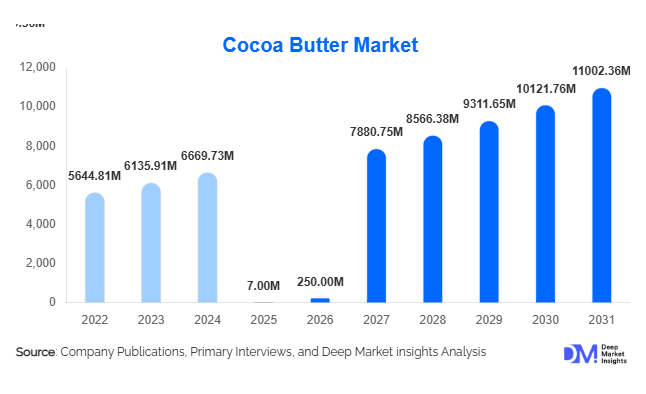
What are the latest trends in the cocoa butter market?
Shift Toward Premium and Ethical Cocoa Products
The cocoa butter market is increasingly influenced by the growing demand for premium and ethically sourced cocoa products. Consumers are prioritizing high-quality chocolate made with sustainably sourced cocoa butter, pushing manufacturers to adopt fair-trade and organic certifications. This trend is particularly strong in Europe and North America, where ethical consumption and transparency in sourcing are critical purchase drivers. Companies are investing in traceable supply chains and direct sourcing from farmers to ensure consistent quality while meeting sustainability standards. Premiumization is also enabling manufacturers to command higher margins, especially in artisanal chocolate segments.
Expansion of Cocoa Butter in Cosmetics and Personal Care
The cosmetics and personal care sector is emerging as a major growth driver for cocoa butter. Its natural moisturizing properties and antioxidant benefits make it a preferred ingredient in skincare, haircare, and lip care products. With the rise of the clean beauty movement, brands are increasingly incorporating cocoa butter into formulations as a plant-based alternative to synthetic ingredients. The demand for organic and chemical-free products is further accelerating this trend, particularly among younger consumers and premium skincare brands. This diversification beyond food applications is significantly enhancing market growth potential.
What are the key drivers in the cocoa butter market?
Rising Demand for Chocolate and Confectionery
The global increase in chocolate consumption remains the primary driver for cocoa butter demand. Premium and dark chocolate segments are growing rapidly, requiring higher cocoa butter content. Developed markets such as Europe and North America continue to lead consumption, while emerging markets in Asia-Pacific are witnessing strong growth due to urbanization and rising disposable incomes.
Growth of Natural and Organic Cosmetics
The expanding global cosmetics industry is boosting cocoa butter demand, particularly in natural skincare products. Consumers are increasingly choosing plant-based ingredients, and cocoa butter’s moisturizing and skin-healing properties make it a key component in lotions, creams, and balms. This trend is further supported by regulatory shifts favoring clean-label formulations.
What are the restraints for the global market?
Volatility in Cocoa Bean Prices
Cocoa butter production is highly dependent on cocoa bean availability, which is concentrated in West Africa. Climate change, political instability, and supply chain disruptions can lead to significant price fluctuations, impacting manufacturers’ margins and overall market stability.
Competition from Cocoa Butter Substitutes
The availability of cocoa butter equivalents (CBEs) and substitutes (CBS) presents a challenge, particularly in cost-sensitive markets. These alternatives are often cheaper and widely used in industrial chocolate production, limiting the growth potential of pure cocoa butter.
What are the key opportunities in the cocoa butter industry?
Growth in Premium Chocolate Segment
The premium chocolate segment offers significant growth opportunities, particularly in developed markets. Increasing consumer preference for high-quality, artisanal chocolates is driving demand for high-grade cocoa butter. Manufacturers focusing on sustainability and quality differentiation can capture premium pricing and expand their market share.
Expansion in Emerging Markets
Emerging economies in Asia-Pacific and Latin America present strong growth opportunities. Rising middle-class populations, urbanization, and increasing consumer awareness are driving demand for chocolate and personal care products. Investments in local processing facilities can further enhance market penetration and reduce supply chain costs.
Report Scope
| Report Metric | Details |
|---|---|
| Market Size in 2025 | USD 7250 Million |
| Market Size in 2026 | USD 7880.75 Million |
| Market Size in 2031 | USD 11959.56 Million |
| CAGR | 8.7% (2026-2031) |
| Base Year for Estimation | 2025 |
| Historical Data | 2022-2024 |
| Forecast Period | 2026-2031 |
| Report Coverage | Revenue Forecast, Competitive Landscape, Supply Chain Disruption, Growth Factors, Environment & Regulatory Landscape and Trends |
| Geographies Covered | North America, Europe, APAC, Middle East and Africa, LATAM |
| Countries Covered | U.S., Canada, U.K., Germany, France, Spain, Italy, Russia, Nordic, Benelux, Rest of Europe, China, Korea, Japan, India, Australia, Singapore, Taiwan, South East Asia, Rest of Asia-Pacific, UAE, Turky, Saudi Arabia, South Africa, Egypt, Nigeria, Rest of MEA, Brazil, Mexico, Argentina, Chile, Colombia, Rest of LATAM |
Explore more data points, trends and opportunities Download Free Sample Report
Product Type Insights
The global cocoa butter market is characterized by a diverse range of product types, each catering to specific functional, sensory, and regulatory requirements across industries. Among these, natural cocoa butter continues to dominate the market, accounting for approximately 48% of the total market share in 2025. This leadership position is primarily attributed to its superior quality, authentic aroma, and compatibility with premium chocolate formulations and high-end cosmetic products. Natural cocoa butter retains its inherent flavor and nutritional profile, making it highly desirable among manufacturers focused on delivering clean-label, minimally processed, and high-value products. The growing global inclination toward transparency in ingredient sourcing and labeling further strengthens the demand for natural cocoa butter, particularly in developed markets where consumers are willing to pay a premium for authenticity and quality.Organic cocoa butter, although currently representing a smaller share of the overall market, is emerging as one of the fastest-growing segments. This growth is driven by increasing consumer awareness regarding sustainability, environmental impact, and ethical sourcing practices. Certified organic cocoa butter appeals to environmentally conscious consumers and brands that emphasize eco-friendly production methods and fair trade practices. The expansion of organic product lines across both food and cosmetic industries is expected to accelerate the adoption of this segment over the forecast period. Additionally, regulatory support and certification programs are enhancing consumer trust, thereby contributing to sustained growth in the organic cocoa butter segment.The evolution of product types within the cocoa butter market reflects broader industry trends, including premiumization, sustainability, and innovation in product formulations. Manufacturers are increasingly investing in advanced processing technologies to enhance product quality while maintaining cost efficiency, further diversifying the product landscape and enabling targeted applications across multiple industries.
Application Insights
Cocoa butter serves as a critical ingredient across a wide array of applications, with the chocolate and confectionery segment leading the market by a significant margin. In 2025, this segment accounts for nearly 55% of the total market share, driven by cocoa butter’s indispensable role in chocolate production. Its unique physical properties, including a sharp melting point just below body temperature and a smooth, creamy texture, make it essential for achieving the desired mouthfeel and structural integrity in chocolate products. The continued global demand for premium and artisanal chocolates, coupled with innovation in flavor profiles and product formats, is further reinforcing the dominance of this segment. The leading segment driver here is the irreplaceable functional role of cocoa butter in chocolate manufacturing, combined with rising consumer demand for indulgent and high-quality confectionery experiences.Beyond confectionery, the cosmetics and personal care segment is witnessing rapid expansion and is recognized as the fastest-growing application area. The increasing consumer shift toward natural and organic skincare solutions has significantly boosted the demand for cocoa butter due to its moisturizing, antioxidant, and skin-repairing properties. It is widely used in lotions, creams, lip balms, and hair care products, offering both functional and marketing advantages. The clean beauty movement, along with heightened awareness of harmful synthetic chemicals, is driving manufacturers to incorporate natural ingredients like cocoa butter into their formulations. This segment’s growth is further supported by social media influence, evolving beauty standards, and the expansion of premium personal care brands.Overall, the application landscape of the cocoa butter market is evolving in response to changing consumer preferences, technological advancements, and the growing emphasis on natural and functional ingredients across industries.
Distribution Channel Insights
The distribution dynamics of the cocoa butter market are predominantly shaped by large-scale industrial demand and established supply chain networks. Direct B2B sales account for approximately 70% of the total market share, making it the dominant distribution channel. This dominance is driven by the need for consistent quality, bulk procurement, and long-term supply agreements between cocoa butter manufacturers and major end-users such as chocolate producers, cosmetic companies, and pharmaceutical firms. The leading driver for this segment is the operational efficiency and cost-effectiveness associated with direct sourcing, which enables manufacturers to maintain stable supply chains and optimize production processes.Online distribution channels are gradually gaining traction, especially among small-scale manufacturers, niche brands, and startups in the cosmetics and specialty food sectors. E-commerce platforms offer convenience, transparency, and access to a diverse supplier base, enabling buyers to compare products and prices efficiently. The growth of digital marketplaces and the increasing adoption of online procurement strategies are expected to further expand this segment, although it currently represents a relatively smaller share compared to traditional channels.The evolving distribution landscape reflects the increasing complexity of global supply chains and the need for adaptability in meeting diverse customer requirements. As digital transformation continues to reshape procurement practices, the integration of online and offline channels is likely to become a key trend in the cocoa butter market.
End-Use Industry Insights
The food processing industry remains the largest end-user of cocoa butter, accounting for approximately 60% of total demand. This dominance is primarily driven by the extensive use of cocoa butter in chocolate manufacturing and other confectionery products. The leading segment driver is the continuous global demand for chocolate, supported by population growth, urbanization, and increasing disposable incomes. Additionally, the trend toward premium and specialty chocolates is encouraging manufacturers to use high-quality cocoa butter, further boosting demand within this segment.The cosmetics and personal care industry represents the fastest-growing end-use segment, with a projected CAGR exceeding 9.5%. This growth is fueled by the rising popularity of natural and organic beauty products, as well as increasing consumer awareness of skincare benefits associated with cocoa butter. Its emollient properties and ability to improve skin elasticity make it a preferred ingredient in a wide range of personal care formulations. The expansion of global beauty and wellness industries, coupled with innovation in product development, is expected to sustain strong growth in this segment.The diversification of end-use industries highlights the versatility of cocoa butter and its ability to meet the evolving needs of multiple sectors. As industries continue to innovate and prioritize quality and sustainability, the demand for cocoa butter is expected to remain robust across all major end-use segments.
Explore more data points, trends and opportunities Download Free Sample Report
Cocoa Butter Market Segmentations
By Product Type
- Natural Cocoa Butter
- Deodorized Cocoa Butter
- Organic Cocoa Butter
- Conventional Cocoa Butter
By Application
- Chocolate & Confectionery
- Food & Beverage
- Cosmetics & Personal Care
- Pharmaceuticals
- Nutraceuticals
By Distribution Channel
- Direct/B2B Sales
- Distributors & Wholesalers
- Online Retail
Regional Insights
North America
North America holds approximately 25% of the global cocoa butter market share, supported by strong demand across both food and personal care industries. The region’s growth is primarily driven by the high consumption of premium chocolate products and the increasing popularity of organic and clean-label cosmetics. Consumers in the United States and Canada exhibit a strong preference for ethically sourced and sustainably produced ingredients, which has encouraged manufacturers to adopt transparent sourcing practices. Additionally, the presence of established chocolate brands, advanced manufacturing capabilities, and robust distribution networks further contribute to market expansion. The growing trend of health-conscious consumption, coupled with the rising demand for functional and natural ingredients, is expected to sustain growth in the North American cocoa butter market.
Europe
Europe dominates the global cocoa butter market with around 32% share in 2025, making it the largest regional market. This dominance is underpinned by the region’s long-standing tradition of chocolate production and consumption, particularly in countries such as Germany, Belgium, and Switzerland. High per capita chocolate consumption and a strong preference for premium and artisanal products are key drivers of demand. Furthermore, stringent quality standards and regulatory frameworks in Europe ensure the use of high-quality cocoa butter in food and cosmetic products. The region also benefits from a well-developed cosmetics industry that активно incorporates natural ingredients. Sustainability initiatives, including fair trade and ethical sourcing practices, are gaining traction, further supporting market growth. The combination of strong consumer demand, advanced manufacturing infrastructure, and regulatory support makes Europe a pivotal market for cocoa butter.
Asia-Pacific
Asia-Pacific accounts for nearly 22% of the global market and is the fastest-growing region, with a CAGR exceeding 10%. The region’s rapid growth is driven by rising disposable incomes, urbanization, and changing consumer lifestyles in countries such as China and India. The increasing popularity of Western-style confectionery products, including chocolate, is significantly boosting demand for cocoa butter. Additionally, the expanding middle class and growing awareness of personal care and wellness are driving the adoption of cocoa butter in cosmetic products. Local manufacturing capabilities are also improving, supported by government initiatives and foreign investments. The combination of a large consumer base, evolving consumption patterns, and increasing industrialization makes Asia-Pacific a key growth engine for the global cocoa butter market.
Latin America
Latin America contributes approximately 12% of the global market, with Brazil emerging as a major consumer and producer. The region benefits from its proximity to cocoa-producing areas, which ensures a steady supply of raw materials and reduces transportation costs. Increasing domestic consumption of chocolate and confectionery products is a key driver of market growth. Additionally, the growing cosmetics industry in the region is creating new opportunities for cocoa butter applications. Government support for agricultural development and investments in processing infrastructure are further enhancing the region’s market potential. As consumer awareness of natural and sustainable products increases, the demand for high-quality cocoa butter is expected to rise in Latin America.
Middle East & Africa
The Middle East & Africa region accounts for around 9% of the global cocoa butter market, with significant production hubs located in countries such as Ivory Coast and Ghana. The region plays a crucial role in the global cocoa supply chain, and increasing investments in local processing are expected to boost value addition and economic development. In the Middle East, rising disposable incomes and a growing preference for premium chocolate products are driving demand. Additionally, the expanding cosmetics industry in the region is contributing to increased consumption of cocoa butter. Infrastructure development, improved trade policies, and government initiatives aimed at strengthening the agricultural sector are key factors supporting regional growth. As local processing capabilities continue to expand, the Middle East & Africa region is expected to play an increasingly important role in the global cocoa butter market.
Key Players in the Cocoa Butter Market
- Barry Callebaut
- Cargill Incorporated
- Olam Group
- ECOM Agroindustrial
- Blommer Chocolate Company
- Fuji Oil Holdings
- Guan Chong Berhad
- JB Foods Limited
- Touton Group
- Plot Enterprise
- Natra SA
- Dutch Cocoa
- United Cocoa Processor
- Indcresa
- Cocoa Processing Company