Cloves Market Size
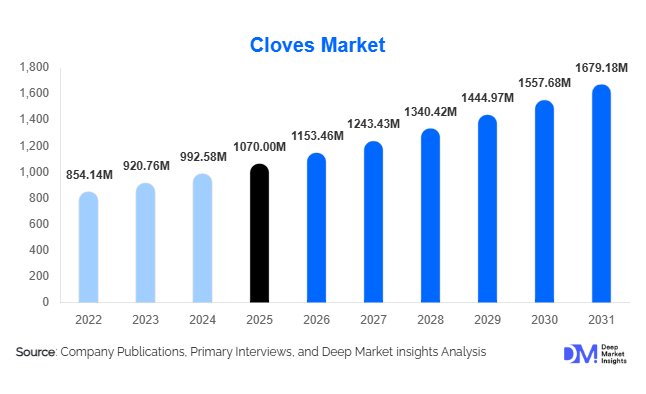
According to Deep Market Insights, the global cloves market size was valued at USD 1,070 million in 2025 and is projected to grow from USD 1,153.46 million in 2026 to reach USD 1,679.18 million by 2031, expanding at a CAGR of 7.8% during the forecast period (2026–2031). The cloves market growth is primarily driven by increasing demand for natural ingredients across food, pharmaceutical, and personal care industries, along with rising global consumption of spices and herbal products.
Key Market Insights
- Cloves are increasingly used as multifunctional natural ingredients, spanning food flavoring, medicinal formulations, and cosmetic applications.
- Asia-Pacific dominates the market, led by Indonesia and India due to strong production and consumption patterns.
- Essential oils and extracts are gaining traction, driven by demand in pharmaceuticals and aromatherapy.
- Organic and sustainably sourced cloves are witnessing rising demand, particularly in North America and Europe.
- Export-driven supply chains shape the global market, with Africa and Southeast Asia acting as key suppliers.
- Technological advancements in extraction and processing are improving product quality and expanding applications.
What are the latest trends in the cloves market?
Shift Toward Value-Added Clove Products
The cloves market is evolving beyond raw spice consumption toward value-added derivatives such as clove oil and oleoresins. These products offer higher margins and are widely used in pharmaceuticals, personal care, and nutraceuticals. Manufacturers are increasingly investing in advanced extraction technologies to enhance yield, purity, and consistency. This trend is particularly prominent in developed markets where demand for standardized, high-quality ingredients is strong. Additionally, clove oil is gaining popularity in dental care and therapeutic applications, further accelerating its adoption.
Growing Demand for Organic and Sustainable Cloves
Consumer preference is rapidly shifting toward organic and sustainably sourced spices. Certifications such as organic and fair trade are becoming essential for market entry in premium regions like Europe and North America. Producers are adopting sustainable farming practices, traceability systems, and eco-friendly packaging to meet evolving consumer expectations. This trend is enabling suppliers to command premium pricing while aligning with global sustainability goals.
What are the key drivers in the cloves market?
Rising Demand for Natural and Herbal Ingredients
The increasing shift toward natural and plant-based ingredients is a major growth driver. Cloves are widely recognized for their antimicrobial, antioxidant, and anti-inflammatory properties, making them a preferred choice in food preservation and herbal medicine. This trend is particularly strong in nutraceuticals and functional foods.
Expansion of Pharmaceutical and Personal Care Applications
The pharmaceutical and cosmetics industries are driving significant demand for clove-derived products. Clove oil is extensively used in dental care products, skincare formulations, and pain relief applications. The growing global healthcare sector and rising consumer awareness about natural remedies are further boosting demand.
What are the restraints for the global market?
Price Volatility of Raw Materials
The cloves market is highly dependent on agricultural output, making it vulnerable to climatic fluctuations and seasonal variations. This leads to price volatility, which can impact profitability and supply chain stability.
Limited Mechanization in Production
In many producing regions, cloves cultivation and processing remain labor-intensive with limited technological adoption. This results in inconsistent quality and supply constraints, posing challenges for large-scale industrial applications.
What are the key opportunities in the cloves industry?
Growth of Herbal Healthcare and Nutraceuticals
The rising popularity of herbal medicine and dietary supplements presents a significant opportunity for cloves. Their medicinal properties make them ideal for incorporation into health products, including immunity boosters and digestive aids. This segment is expected to witness strong growth as consumers increasingly seek natural health solutions.
Expansion into Emerging Markets
Emerging economies in Africa and Latin America are witnessing increasing spice consumption due to urbanization and rising incomes. These regions offer untapped potential for market expansion, supported by improving distribution networks and growing awareness of global cuisines.
Report Scope
| Report Metric | Details |
|---|---|
| Market Size in 2025 | USD 1070.00 Million |
| Market Size in 2026 | USD 1153.46 Million |
| Market Size in 2031 | USD 1679.18 Million |
| CAGR | 7.8% (2026-2031) |
| Base Year for Estimation | 2025 |
| Historical Data | 2022-2024 |
| Forecast Period | 2026-2031 |
| Report Coverage | Revenue Forecast, Competitive Landscape, Supply Chain Disruption, Growth Factors, Environment & Regulatory Landscape and Trends |
| Geographies Covered | North America, Europe, APAC, Middle East and Africa, LATAM |
| Countries Covered | U.S., Canada, U.K., Germany, France, Spain, Italy, Russia, Nordic, Benelux, Rest of Europe, China, Korea, Japan, India, Australia, Singapore, Taiwan, South East Asia, Rest of Asia-Pacific, UAE, Turky, Saudi Arabia, South Africa, Egypt, Nigeria, Rest of MEA, Brazil, Mexico, Argentina, Chile, Colombia, Rest of LATAM |
Explore more data points, trends and opportunities Download Free Sample Report
Product Type Insights
The global cloves market is primarily segmented into whole cloves, ground cloves, clove oil, and clove extracts, each serving distinct industrial and consumer needs while contributing differently to overall market dynamics. Whole cloves continue to dominate the global market, accounting for approximately 42% of the total share, largely due to their strong cultural and culinary significance across traditional cuisines in Asia, the Middle East, and parts of Africa. The leading driver behind the dominance of whole cloves is their widespread use in household cooking, spice blends such as garam masala, pickling mixtures, and festive food preparations, where intact spice form is preferred for flavor retention and visual appeal. In addition, whole cloves are extensively used in tea infusions and traditional medicinal preparations, further strengthening their demand in both domestic and export markets.Clove oil and clove extracts constitute the fastest-growing product categories, driven by their high concentration of eugenol, which offers antimicrobial, antifungal, analgesic, and antioxidant properties. The key driver for these segments is the rapid expansion of pharmaceutical, cosmetic, and aromatherapy applications. In pharmaceuticals, clove oil is increasingly used in dental care products, topical pain relievers, and herbal formulations. In cosmetics, it is incorporated into skincare and oral hygiene products due to its antibacterial properties. The growing consumer shift toward natural and plant-based ingredients is significantly boosting demand for these value-added derivatives. Additionally, higher profit margins and increasing industrial applications are encouraging producers to invest in extraction technologies, further supporting segment expansion.
Application Insights
The cloves market finds extensive application across food and beverages, pharmaceuticals, personal care, aromatherapy, and nutraceuticals, with the food and beverage sector leading with nearly 55% of total market share. The primary driver of this dominance is the deep integration of cloves in global culinary traditions, especially in bakery products, confectionery items, spice blends, and savory dishes. The rising demand for ethnic foods, coupled with the growing popularity of flavored and spiced products in developed economies, is further strengthening consumption. Food manufacturers increasingly rely on cloves for their distinctive aroma and preservative properties, which enhance both taste and shelf life.Personal care and cosmetics represent another expanding application area, driven by growing consumer preference for natural skincare and oral care products. Clove oil is extensively used in toothpaste, mouthwashes, creams, and anti-acne formulations due to its antibacterial and soothing properties. The increasing influence of clean-label beauty trends and organic product certifications is significantly contributing to segment growth.Aromatherapy and nutraceutical applications, while relatively smaller in market size, are emerging as high-growth niches. The primary driver in these segments is rising consumer focus on holistic wellness, stress relief, and immunity-boosting products. Clove oil is widely used in essential oil blends for relaxation therapies and in dietary supplements aimed at improving digestive and immune health, indicating strong future growth potential.
Distribution Channel Insights
The distribution landscape of the cloves market is characterized by a strong dominance of direct B2B sales, which account for approximately 65% of global distribution. This channel is primarily driven by bulk procurement from food processors, pharmaceutical companies, spice manufacturers, and cosmetic industries. The key growth driver for B2B dominance is the need for consistent quality, standardized supply, and cost efficiency, which is best achieved through direct sourcing relationships with producers and exporters. Long-term contracts and integrated supply chains further strengthen this segment’s position in the market.Retail distribution channels, including supermarkets, hypermarkets, specialty stores, and online platforms, are experiencing steady expansion. The main driver for retail growth is increasing consumer demand for packaged, branded, and hygienically processed spice products. Urbanization and rising disposable incomes are encouraging consumers to purchase premium spice variants in smaller, convenient packaging formats. Supermarkets and specialty stores are particularly important in developed markets, where consumers prioritize quality assurance and product authenticity.E-commerce is emerging as a rapidly growing distribution channel, especially for premium and specialty spice products such as organic cloves, essential oils, and artisanal spice blends. The primary driver of this growth is the increasing penetration of digital retail platforms and changing consumer purchasing behavior toward online grocery shopping. E-commerce platforms also provide wider accessibility, product variety, and direct-to-consumer pricing advantages, making them increasingly important in both developed and developing regions.
End-Use Industry Insights
The food processing industry remains the largest end-use segment, accounting for nearly 50% of global demand for cloves. The primary driver of this dominance is the extensive use of cloves as a flavoring, preservative, and aromatic agent in processed foods, sauces, baked goods, and spice mixes. The expansion of the global processed food industry, driven by changing lifestyles, urbanization, and increasing demand for convenience foods, continues to support strong consumption.The cosmetics and personal care industry is also expanding steadily, supported by the increasing use of clove-derived ingredients in skincare, oral care, and hair care formulations. The key driver is the global shift toward natural and chemical-free personal care products, with consumers increasingly seeking organic and plant-based alternatives. Clove oil’s antimicrobial properties make it especially valuable in anti-acne and oral hygiene applications.Household consumption continues to contribute significantly to overall demand, particularly in Asia-Pacific and parts of Africa, where cloves are a staple spice in daily cooking. Cultural food habits, traditional medicine practices, and strong domestic culinary usage patterns remain the primary drivers of this segment.
Explore more data points, trends and opportunities Download Free Sample Report
Cloves Market Segmentations
By Product Type
- Whole Cloves
- Ground Cloves
- Clove Oil
- Clove Extracts
By Application
- Food & Beverages
- Pharmaceuticals
- Personal Care & Cosmetics
- Nutraceuticals & Dietary Supplements
- Aromatherapy
By Distribution Channel
- Direct/B2B Sales
- Supermarkets/Hypermarkets
- Specialty Stores
- Online Retail
Regional Insights
Asia-Pacific
Asia-Pacific dominates the global cloves market with approximately 45% share, driven by strong production and consumption bases in Indonesia and India. Indonesia remains the largest global producer, benefiting from favorable agro-climatic conditions, established export infrastructure, and strong domestic demand from the food and tobacco industries. The key growth driver in Indonesia is the high consumption of cloves in traditional kretek cigarettes and culinary applications. India’s demand is fueled by its extensive spice consumption culture, expanding food processing industry, and growing use of cloves in Ayurvedic and herbal medicine systems. Rising population, urbanization, and increasing export-oriented spice production further reinforce regional leadership.
Africa
Africa accounts for approximately 25% of the global market, with Madagascar and Tanzania serving as major production and export hubs. The primary driver of growth in this region is favorable tropical climate conditions, which support high-quality clove cultivation. Government initiatives aimed at agricultural modernization, farmer training, and export promotion are further strengthening production capabilities. Africa is also the fastest-growing region, with a CAGR exceeding 8.5%, driven by increasing foreign investment in spice farming and expanding global demand for organic and sustainably sourced spices. Rising global preference for traceable and ethically sourced agricultural products is further enhancing Africa’s export competitiveness.
Europe
Europe holds around 15% share of the global cloves market, with Germany, the UK, and France being major importers. The key driver in this region is strong demand from the food processing industry, particularly in bakery, confectionery, and beverage applications. Additionally, the rising popularity of organic, non-GMO, and premium-quality spices is significantly influencing import patterns. European consumers are increasingly health-conscious, leading to higher demand for natural flavoring agents and plant-based ingredients. Strict food safety regulations also contribute to demand for high-quality, certified spice imports.
North America
North America represents approximately 10% of the global market, with the United States being the largest consumer. The primary growth driver in this region is the increasing adoption of natural and clean-label ingredients in food, beverages, and health products. The expanding ethnic food market, particularly Indian, Middle Eastern, and Asian cuisines, is also boosting demand for cloves. Furthermore, rising interest in herbal medicine, dietary supplements, and essential oils is supporting market growth in pharmaceutical and wellness applications.
Latin America & Middle East
Collectively accounting for around 5% of the global market, Latin America and the Middle East are emerging as promising regions for future growth. In Latin America, Brazil is leading demand due to expanding food processing industries and growing consumer awareness of spices in daily cooking. The Middle East, particularly the UAE and Saudi Arabia, is witnessing rising imports driven by strong culinary traditions, hospitality sector growth, and increasing demand for premium spice products. The key driver across both regions is rising disposable income, increasing urbanization, and growing exposure to international cuisines, which is gradually expanding cloves consumption beyond traditional usage patterns.
Key Players in the Cloves Market
- McCormick & Company
- Olam Group
- Archer Daniels Midland Company
- Synthite Industries Ltd.
- Mane SA
- Kerry Group
- Givaudan
- Symrise AG
- Sensient Technologies
- EHL Ingredients
- PT Indo Spice
- Madagasikara Voakajy
- Berjaya Corporation
- Indian Spices Company
- Vikas WSP Ltd.