Churros Market Size
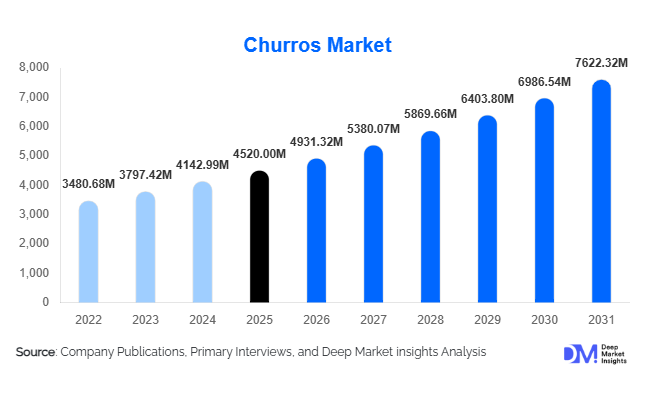
According to Deep Market Insights, the global churros market size was valued at USD 4,180 million in 2025 and is projected to grow from USD 4,931.32 million in 2026 to reach USD 7,622.32 million by 2031, expanding at a CAGR of 9.1% during the forecast period (2026–2031). The churros market growth is driven by increasing global demand for indulgent snack foods, rapid expansion of quick-service dessert chains, and rising consumer preference for experiential street-style desserts across both developed and emerging economies.
Key Market Insights
- Premium and filled churros are gaining strong global traction, supported by flavor innovation and social-media-driven dessert culture.
- Quick-service restaurants and café chains dominate sales channels, accounting for a significant share of organized churros consumption worldwide.
- Asia-Pacific is emerging as the fastest-growing region, fueled by urbanization, youth demographics, and expanding mall-based food retail.
- Frozen and ready-to-fry churros are expanding rapidly, enabling scalability for foodservice operators and retail distribution.
- Digital food delivery platforms are accelerating impulse dessert purchases and expanding market accessibility beyond physical outlets.
- Product diversification into vegan, baked, and low-sugar variants is widening consumer adoption among health-conscious audiences.
What are the latest trends in the churros market?
Premiumization and Gourmet Flavor Innovation
The churros industry is undergoing rapid premiumization as brands introduce gourmet formats featuring artisanal chocolate dips, pistachio fillings, matcha coatings, and fusion-inspired toppings. Consumers increasingly perceive churros as experiential desserts rather than traditional street snacks. Dessert cafés and specialty bakeries are leveraging customization—allowing consumers to choose fillings, coatings, and sauces—to enhance perceived value and increase average order size. Limited-edition seasonal flavors and collaborations with confectionery brands are also helping companies maintain repeat consumer engagement while supporting higher pricing benchmarks.
Expansion of Frozen and Retail-Ready Churros
Technological advancements in freezing and par-frying processes are enabling large-scale commercialization of churros through retail and institutional channels. Frozen churros allow restaurants, cinemas, and theme parks to offer standardized products with minimal preparation time. Retail-ready packaged churros are expanding across supermarkets and convenience stores, particularly in North America and Europe. Air-fryer-compatible formats and ready-to-bake kits are also gaining popularity among home consumers, transforming churros from an occasional street food into a convenient household dessert option.
What are the key drivers in the churros market?
Growth of Global Dessert Culture
The increasing popularity of indulgent desserts across urban populations has significantly boosted churros demand. Younger consumers actively seek visually appealing foods suitable for social media sharing, positioning churros as a highly marketable product. Dessert-focused outlets and hybrid café concepts are integrating churros alongside waffles, donuts, and bubble tea, strengthening category visibility globally.
Rapid Expansion of Quick-Service and Café Chains
Quick-service restaurants (QSRs), amusement parks, and café franchises are expanding churros offerings due to their high margins and operational simplicity. Churros require relatively low ingredient costs while enabling premium pricing through toppings and customization. Large chains are integrating churros into limited-time menus, increasing global exposure and driving consistent demand growth.
What are the restraints for the global market?
Health and Nutrition Concerns
Churros are traditionally deep-fried and sugar-rich products, creating challenges amid rising consumer focus on healthier eating habits. Regulatory scrutiny around sugar consumption and calorie labeling may influence long-term consumption patterns, particularly in developed markets.
Volatility in Raw Material Prices
Fluctuations in wheat flour, edible oil, and sugar prices directly impact production costs and profit margins. Small independent vendors are particularly vulnerable to commodity price volatility, which may lead to pricing instability across markets.
What are the key opportunities in the churros industry?
Emerging Market Urbanization
Rapid urbanization across Southeast Asia, India, and Latin America presents significant opportunities for churros brands. Rising disposable incomes and expanding shopping mall ecosystems are encouraging adoption of Western-style desserts. Organized food retail expansion allows both international franchises and regional players to scale quickly in tier-1 and tier-2 cities.
Technology Integration and Delivery Platforms
Food delivery aggregators and cloud kitchens are enabling churros brands to expand without heavy investment in dine-in infrastructure. AI-driven demand forecasting and centralized production kitchens improve inventory management and reduce wastage. Digital ordering also encourages impulse dessert purchases, particularly during evening consumption occasions.
Product Innovation and Health-Oriented Variants
The development of baked churros, gluten-free recipes, and plant-based formulations offers growth opportunities among health-conscious consumers. Brands introducing portion-controlled snack packs and reduced-sugar coatings are successfully expanding consumer demographics beyond traditional indulgence buyers.
Report Scope
| Report Metric | Details |
|---|---|
| Market Size in 2025 | USD 4520 Million |
| Market Size in 2026 | USD 4931.32 Million |
| Market Size in 2031 | USD 7622.32 Million |
| CAGR | 9.1% (2026-2031) |
| Base Year for Estimation | 2025 |
| Historical Data | 2022-2024 |
| Forecast Period | 2026-2031 |
| Report Coverage | Revenue Forecast, Competitive Landscape, Supply Chain Disruption, Growth Factors, Environment & Regulatory Landscape and Trends |
| Geographies Covered | North America, Europe, APAC, Middle East and Africa, LATAM |
| Countries Covered | U.S., Canada, U.K., Germany, France, Spain, Italy, Russia, Nordic, Benelux, Rest of Europe, China, Korea, Japan, India, Australia, Singapore, Taiwan, South East Asia, Rest of Asia-Pacific, UAE, Turky, Saudi Arabia, South Africa, Egypt, Nigeria, Rest of MEA, Brazil, Mexico, Argentina, Chile, Colombia, Rest of LATAM |
Explore more data points, trends and opportunities Download Free Sample Report
Product Type Insights
The global churros market is strongly influenced by evolving consumer preferences toward indulgent, customizable, and premium dessert offerings, with filled churros accounting for approximately 38% of the total market size in 2025. This segment’s leadership is primarily driven by the rising consumer inclination toward value-added desserts that provide enhanced sensory experiences beyond traditional snack formats. Filled churros, particularly chocolate, caramel, and cream-based variants, deliver higher perceived product value and enable brands to command premium pricing while improving customer retention rates. The ability to introduce seasonal fillings, limited-edition flavors, and localized variants further strengthens product differentiation strategies across competitive dessert markets. In addition, filled churros align well with modern social media-driven food consumption trends, where visually appealing and indulgent desserts stimulate impulse purchases and digital engagement.While filled variants dominate, traditional plain churros continue to maintain strong relevance within street food ecosystems due to their affordability, simplicity, and cultural familiarity, especially in high-footfall urban locations and tourism hubs. Meanwhile, mini churros are emerging as one of the fastest-growing product formats as operators increasingly focus on portability and portion-controlled snacking. Their adoption across cinemas, amusement parks, and takeaway-focused outlets is accelerating because they enable quick serving times, easy sharing, and compatibility with bundled snack offerings. Overall, the leading segment growth is supported by premiumization trends, menu innovation, and the growing integration of churros into modern dessert concepts worldwide.
Flavor Insights
Flavor innovation remains a critical growth engine shaping competitive positioning in the global churros market, with chocolate-flavored churros capturing nearly 34% of global demand in 2025. The dominance of chocolate flavor is largely attributed to its universal consumer acceptance across age groups and geographic markets, along with its compatibility with multiple toppings, fillings, and dipping sauces. Chocolate-based offerings benefit from strong cross-category appeal, allowing churros to compete effectively with brownies, waffles, and other dessert staples in cafés and quick-service environments. The leading segment driver stems from consumer preference for familiar yet indulgent taste profiles that reduce purchase hesitation while encouraging repeat consumption.Beyond chocolate, regional flavor adaptation is becoming increasingly important as brands tailor offerings to local taste preferences. Matcha-flavored churros in Asia-Pacific markets, dulce de leche variations in Latin America, and pistachio or saffron-inspired flavors in Middle Eastern markets illustrate how localization strategies are expanding consumer reach. Continuous experimentation with flavors not only enhances menu novelty but also enables seasonal promotions and limited-time offerings that stimulate demand cycles. As consumers increasingly seek experiential dining and dessert exploration, flavor innovation is expected to remain central to premium positioning and brand differentiation.
Distribution Channel Insights
Foodservice channels accounted for approximately 62% of the global churros market in 2025, making them the dominant distribution pathway due to the product’s strong association with freshly prepared consumption experiences. Cafés, quick-service restaurants (QSRs), dessert kiosks, and specialty bakeries benefit from churros’ relatively low preparation complexity combined with high profit margins. High-traffic environments such as shopping malls, tourist destinations, entertainment districts, and transportation hubs significantly amplify impulse purchasing behavior, which acts as the primary driver for this leading segment.Additionally, churros integrate seamlessly into diversified dessert menus, allowing operators to expand average order value through beverage pairings and combo offerings. The rapid expansion of digital ordering ecosystems is further reshaping distribution dynamics, with online delivery platforms emerging as the fastest-growing channel. Increasing consumer preference for dessert-at-home consumption, late-night delivery trends, and app-based promotional campaigns are accelerating online sales penetration. Ghost kitchens and delivery-only dessert brands are also leveraging frozen and semi-prepared churro formats to scale operations efficiently, contributing to channel diversification across urban markets.
Format Insights
Freshly prepared churros represented approximately 57% of total consumption in 2025, reflecting strong global consumer preference for hot, freshly fried desserts that deliver superior texture, aroma, and immediate indulgence. The leading driver behind this segment is the experiential element associated with live preparation, which enhances perceived freshness and authenticity while attracting consumers through sensory appeal. Foodservice operators increasingly utilize open-kitchen concepts and live frying stations to create interactive dining experiences that strengthen customer engagement and brand memorability.At the same time, frozen churros are gaining substantial momentum as scalability and operational efficiency become critical priorities for large-scale buyers. Frozen formats allow standardized quality, extended shelf life, and simplified logistics for institutional clients, including restaurant chains, hotels, and catering services. Retail expansion through supermarkets and e-commerce grocery platforms is also supporting frozen product adoption, enabling consumers to recreate foodservice-style desserts at home. The coexistence of fresh and frozen formats highlights the market’s dual focus on experiential consumption and operational scalability.
End-Use Insights
Quick-service restaurants and cafés accounted for nearly 46% of global churros demand, maintaining their position as the largest end-use segment due to aggressive menu diversification strategies and growing consumer demand for affordable indulgence options. The leading segment driver is the ability of churros to deliver high margins with minimal preparation time, making them an attractive addition to beverage-led and dessert-focused outlets. Cafés increasingly position churros as complementary products alongside coffee, milkshakes, and specialty beverages, boosting cross-selling opportunities and enhancing customer dwell time.Institutional demand is expanding rapidly across cinema chains, amusement parks, and tourism venues, where churros’ portability and quick preparation align with high-volume service environments. These venues benefit from consistent consumer demand for convenient snacks during leisure activities. Furthermore, export-oriented growth is strengthening through rising shipments of frozen churros to emerging dessert markets across Asia-Pacific and the Middle East, where Western-style desserts continue gaining popularity. The steady global expansion of bakery and café industries, growing at approximately 7–9% annually, further reinforces long-term consumption growth by expanding points of sale and increasing dessert accessibility.
Explore more data points, trends and opportunities Download Free Sample Report
Churros Market Segmentations
By Product Type
- Traditional Plain Churros
- Filled Churros
- Mini & Bite-Sized Churros
- Frozen Ready-to-Bake / Ready-to-Fry Churros
- Gluten-Free & Vegan Churros
By Distribution Channel
- Foodservice
- Retail Stores
- Convenience Stores
- Online Retail & Direct-to-Consumer
- Wholesale & Institutional Supply
By End Use
- Quick Service Restaurants
- Cafés & Bakeries
- Street Vendors & Food Trucks
- Household Consumption
- Entertainment Venues & Theme Parks
By Preparation Format
- Freshly Prepared Churros
- Frozen Pre-Processed Churros
- Ready-to-Cook Mixes
- Ready-to-Eat Packaged Churros
By Flavor Type
- Classic Cinnamon Sugar
- Chocolate-Coated
- Filled Dessert Variants
- Savory & Fusion Flavors
Regional Insights
North America
North America accounted for approximately 28% of the global churros market in 2025, supported by strong consumption across the United States and Mexico. Regional growth is primarily driven by the widespread presence of theme parks, sports stadiums, festivals, and quick-service restaurant chains that position churros as high-margin snack offerings. The region benefits from well-established dessert innovation ecosystems, enabling premium toppings, fusion flavors, and seasonal menu launches. Increasing adoption of food delivery applications and expanding late-night dessert culture across urban centers further accelerate consumption. Additionally, multicultural culinary influences and strong Hispanic food heritage contribute to sustained demand and product familiarity.
Europe
Europe held nearly 24% market share, with Spain serving as a cultural and historical anchor for churros consumption. Regional growth is supported by tourism-driven demand, particularly in major travel destinations where traditional foods remain central to culinary experiences. France, Germany, and the United Kingdom are witnessing increased adoption through specialty dessert cafés and street food festivals that promote experiential eating trends. Rising café culture, premium dessert positioning, and growing consumer willingness to explore international cuisines are key drivers expanding churros beyond traditional markets into modern urban food scenes.
Asia-Pacific
Asia-Pacific represents the fastest-growing regional market, projected to expand at over 11% CAGR, driven by rapid urbanization, expanding middle-class populations, and evolving Western dessert consumption patterns. Countries such as China, Japan, South Korea, and India are experiencing strong growth due to the proliferation of shopping malls, café chains, and youth-oriented dining environments. Social media influence and visually appealing desserts significantly drive demand among younger consumers. In India, accelerating adoption through mall kiosks, franchise dessert brands, and food delivery platforms is creating new consumption occasions, while localized flavor innovation enhances market acceptance across diverse consumer bases.
Latin America
Latin America accounted for around 14% of global market share, led by Brazil, Argentina, and Mexico, where churros already hold deep cultural familiarity. Regional growth is supported by strong street food traditions combined with increasing premiumization within metropolitan markets. Urban consumers are increasingly adopting filled and gourmet churro variants offered through cafés and dessert boutiques. Economic urbanization, rising tourism activity, and the expansion of organized foodservice chains are gradually transforming churros from traditional snacks into premium dessert experiences, supporting stable yet evolving market expansion.
Middle East & Africa
The Middle East & Africa region is witnessing accelerating demand for churros, particularly across the UAE and Saudi Arabia, fueled by expanding tourism sectors and rapidly developing café ecosystems. Growth is driven by increasing disposable income levels, strong mall culture, and consumer preference for international dessert brands. Entry of global dessert franchises into Gulf markets is promoting premium product positioning and encouraging menu diversification among local operators. Additionally, a young demographic profile and strong social dining culture contribute to rising demand for shareable desserts, positioning churros as an attractive offering within modern café and entertainment environments.
Key Players in the Global Churros Market
- Grupo Bimbo
- J&J Snack Foods Corp.
- Goya Foods Inc.
- Churromania
- San Churro
- Loop Churros
- The Churro Factory
- Churro Borough
- La Lola Churrería
- Chocolateria Valor
- Churros Factory
- Churroholic
- Golden Churros Inc.
- Coolhaus (Dessert Innovations)
- Mr. Churro