Chicory Market Size
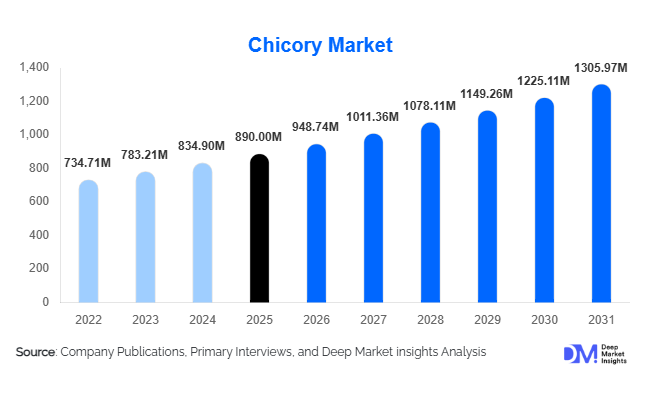
According to Deep Market Insights, the global chicory market size was valued at USD 890 million in 2025 and is projected to grow from USD 948.74 million in 2026 to reach USD 1,305.97 million by 2031, expanding at a CAGR of 6.6% during the forecast period (2026–2031). The chicory market growth is primarily driven by rising demand for natural coffee substitutes, increasing adoption of prebiotic dietary fibers such as inulin, and expanding applications across functional foods, nutraceuticals, and animal nutrition industries.
Chicory root remains the dominant product segment, supported by its widespread use in roasted coffee blends and industrial inulin extraction. Europe continues to lead both production and consumption, while Asia-Pacific is emerging as the fastest-growing region due to expanding food processing industries and growing health awareness. Clean-label trends, sugar reduction initiatives, and digestive health awareness are significantly influencing global demand patterns.
Key Market Insights
- Chicory inulin is witnessing strong growth, driven by rising global demand for prebiotic and gut-health ingredients.
- Food & beverage applications account for over 50% of global demand, particularly in coffee blends, bakery, and dairy reformulation.
- Europe dominates the global market, contributing approximately 38% of total revenue in 2025.
- Asia-Pacific is the fastest-growing region, expanding at nearly 8–9% CAGR due to rising processed food demand.
- The top five companies control over 52% of the global market share, reflecting moderate industry consolidation.
- Organic chicory is gaining premium traction, although conventional production still accounts for over 70% of total volume.
What are the latest trends in the chicory market?
Rising Adoption of Prebiotic and Functional Ingredients
Chicory-derived inulin is increasingly incorporated into functional foods and beverages due to its prebiotic properties. Manufacturers are reformulating bakery products, dairy items, protein bars, and low-sugar beverages with inulin to enhance fiber content while maintaining taste and texture. The global push toward digestive wellness and microbiome health is accelerating demand, particularly in North America and Europe. Food producers are marketing fiber-enriched products with digestive health claims, further strengthening chicory’s positioning as a high-value functional ingredient.
Growth in Coffee Substitutes and Caffeine-Free Beverages
The demand for caffeine-free and plant-based beverages has increased significantly, especially among health-conscious consumers. Roasted chicory powder is widely used in coffee blends across Europe and India, sometimes constituting up to 40% of certain regional blends. Ready-to-drink chicory beverages and premium artisanal blends are emerging as niche segments. Sustainability positioning and reduced caffeine consumption trends are further supporting product innovation in this space.
What are the key drivers in the chicory market?
Increasing Demand for Digestive Health Solutions
Consumers worldwide are prioritizing gut health, boosting demand for prebiotic fibers such as inulin extracted from chicory root. The global nutraceutical industry, valued at over USD 450 billion, is incorporating chicory-based ingredients into supplements and fortified foods. Regulatory approvals for fiber claims and sugar-reduction initiatives are reinforcing chicory’s role as a preferred natural ingredient.
Clean-Label and Sugar Reduction Trends
Food manufacturers are under pressure to reduce artificial additives and added sugars. Chicory inulin functions as both a natural sweetener and fiber enhancer, supporting sugar-reduction strategies without compromising taste. This aligns with clean-label movement trends across Europe and North America, where consumers prefer plant-based and minimally processed ingredients.
What are the restraints for the global market?
Agricultural Dependency and Yield Volatility
Chicory cultivation is climate-sensitive, and yield variability directly impacts raw material prices. Fluctuations in root availability affect processing margins, particularly for inulin extraction facilities operating at scale.
Limited Awareness in Emerging Economies
While awareness of chicory’s health benefits is strong in Europe, penetration in several developing markets remains limited. Consumer education and distribution expansion are necessary to unlock full market potential in Latin America and parts of Asia and Africa.
What are the key opportunities in the chicory industry?
Expansion into Emerging Markets
Rapid industrialization and food processing expansion in the Asia-Pacific and Latin America offer strong export opportunities. India is emerging as a leading roasted chicory exporter, supported by government-backed agricultural modernization initiatives. Localization of processing facilities can reduce supply chain costs and enhance competitiveness.
Innovation in Functional and Plant-Based Foods
The rise of plant-based diets and fiber-fortified foods presents substantial growth avenues. Chicory can be integrated into dairy alternatives, protein snacks, gluten-free bakery, and sugar-free confectionery. Companies investing in high-purity inulin extraction technologies can capture premium margins in the nutraceutical segment.
Report Scope
| Report Metric | Details |
|---|---|
| Market Size in 2025 | USD 890 Million |
| Market Size in 2026 | USD 948.74 Million |
| Market Size in 2031 | USD 1305.97 Million |
| CAGR | 6.6% (2026-2031) |
| Base Year for Estimation | 2025 |
| Historical Data | 2022-2024 |
| Forecast Period | 2026-2031 |
| Report Coverage | Revenue Forecast, Competitive Landscape, Supply Chain Disruption, Growth Factors, Environment & Regulatory Landscape and Trends |
| Geographies Covered | North America, Europe, APAC, Middle East and Africa, LATAM |
| Countries Covered | U.S., Canada, U.K., Germany, France, Spain, Italy, Russia, Nordic, Benelux, Rest of Europe, China, Korea, Japan, India, Australia, Singapore, Taiwan, South East Asia, Rest of Asia-Pacific, UAE, Turky, Saudi Arabia, South Africa, Egypt, Nigeria, Rest of MEA, Brazil, Mexico, Argentina, Chile, Colombia, Rest of LATAM |
Explore more data points, trends and opportunities Download Free Sample Report
Product Type Insights
Chicory root remains the cornerstone of the global chicory market, accounting for approximately 45% of the market share in 2025. Its dominance is driven by its dual utility: as a key ingredient in roasted coffee blends and as the primary source for inulin extraction. Inulin extract, however, is the fastest-growing product segment due to escalating demand from functional food and nutraceutical manufacturers focusing on digestive health, sugar reduction, and fiber enrichment. Roasted chicory powder continues to be widely used in coffee blends, particularly in Europe and India, where consumer acceptance of caffeine-free beverages is high. Meanwhile, liquid chicory extracts are gaining traction, particularly in ready-to-drink beverages and functional beverages, owing to ease of formulation and clean-label positioning. The growth of chicory root and inulin products is further reinforced by rising consumer awareness of gut health, prebiotic benefits, and natural sugar alternatives, making these segments highly attractive for both industrial and retail applications.
Application Insights
The food & beverage segment represents 54% of total global demand, establishing it as the leading application area. Within this segment, coffee substitutes and fiber-enriched bakery products are the largest contributors, supported by health-conscious consumer trends, sugar reduction initiatives, and clean-label preferences. The nutraceutical sector is expanding rapidly, with a CAGR of nearly 8%, driven by global adoption of dietary supplements and functional foods incorporating chicory inulin for digestive health and immunity benefits. Animal feed applications are also witnessing steady growth, particularly in Europe, where prebiotic-rich feed is increasingly used to improve livestock gut health and productivity. Pharmaceuticals and cosmetic applications are emerging niche segments, leveraging the bioactive and antioxidant properties of chicory extracts. The diversity of applications highlights chicory’s versatility, offering multiple high-growth avenues across industrial, commercial, and retail use cases.
Distribution Channel Insights
B2B industrial supply remains the dominant distribution channel for chicory, as bulk quantities are delivered directly to food processors, beverage manufacturers, and nutraceutical companies. Retail channels are expanding, particularly through supermarkets, hypermarkets, and specialty stores, driven by increasing consumer interest in roasted chicory products and organic variants. Online sales are emerging as a critical growth driver in North America and Asia-Pacific, offering direct-to-consumer access for premium and functional chicory products. E-commerce adoption is accelerated by consumer preference for convenience, home delivery, and access to specialty products that may not be locally available. Additionally, partnerships with foodservice providers and ready-to-drink beverage manufacturers are strengthening supply chains and expanding consumption points beyond traditional retail.
End-Use Industry Insights
The food processing industry accounts for over 40% of global chicory consumption, reflecting the central role of chicory in coffee blends, bakery products, and functional beverages. Beverage manufacturing, including roasted chicory drinks, inulin-fortified beverages, and ready-to-drink formulations, constitutes a growing end-use segment. The nutraceutical industry is the fastest-growing end-use segment, benefiting from increased consumer focus on prebiotics, digestive wellness, and sugar reduction. Export-driven demand remains strong, particularly from Belgium and India, which serve as major processing and export hubs. Belgium’s advanced extraction and processing facilities and India’s cost-competitive roasted chicory production are enabling global supply chains and fueling cross-border growth. The expansion of functional food and beverage industries, coupled with rising global health awareness, is expected to continue driving demand across end-use sectors.
Explore more data points, trends and opportunities Download Free Sample Report
Chicory Market Segmentations
By Product Type
- Chicory Root
- Chicory Leaves
- Chicory Inulin Extract
- Roasted Chicory Powder
- Liquid Chicory Extract
By Form
- Raw/Fresh
- Powder
- Liquid
- Granules
- Concentrated Extract
By Application
- Food & Beverages
- Nutraceuticals & Dietary Supplements
- Animal Feed
- Pharmaceuticals
- Cosmetics & Personal Care
By End-Use Industry
- Food Processing Industry
- Beverage Manufacturing
- Nutraceutical Companies
- Pharmaceutical Industry
- Animal Nutrition Industry
- Retail / Direct Consumer
By Distribution Channel
- B2B Industrial Supply
- Supermarkets/Hypermarkets
- Specialty Stores
- Online Retail
Regional Insights
Europe
Europe leads the global chicory market with approximately 38% market share in 2025. Key producing countries include Belgium, France, Germany, and the Netherlands, with Belgium alone accounting for a substantial share of processed inulin exports. The region’s growth is driven by high consumer acceptance of coffee substitutes, increasing focus on functional foods, and stringent clean-label regulations that favor natural ingredients like chicory. Advanced processing infrastructure, including automated extraction facilities and quality certifications, enhances production efficiency and export competitiveness. Rising health consciousness, sugar reduction initiatives, and growing nutraceutical consumption in Germany, France, and the U.K. are further propelling demand for chicory-based products across food and beverage, nutraceutical, and functional applications.
Asia-Pacific
Asia-Pacific holds nearly 26% of the global market and is the fastest-growing region, expanding at a CAGR of approximately 8–9%. India is a leading producer of roasted chicory, while China is rapidly scaling inulin extraction capabilities to meet growing functional food demand. Drivers of growth include rising urbanization, increasing disposable incomes, expansion of processed and convenience food industries, and heightened awareness of digestive and metabolic health. The burgeoning middle-class population in countries like India and China is fueling the consumption of health-oriented beverages and fortified foods. Additionally, government initiatives promoting agricultural modernization and export-oriented production, coupled with rising e-commerce penetration, are supporting regional expansion. Ready-to-drink beverage launches and fiber-fortified snack innovations are also contributing to increased market adoption.
North America
North America accounts for approximately 18% of the global market, led by the United States. Growth is supported by the functional foods and dietary supplements industry, sugar reduction initiatives, and rising consumer preference for prebiotic and plant-based ingredients. Increasing awareness of gut health and immunity has driven demand for inulin-enriched foods, beverages, and supplements. The presence of large food processing companies and e-commerce channels enhances product accessibility. Additionally, regulatory support for fiber claims and functional ingredient labeling is incentivizing manufacturers to adopt chicory-derived products in both retail and foodservice applications.
Latin America
Latin America represents a smaller but growing segment, primarily driven by Brazil and Argentina. These countries are experiencing moderate growth in beverage reformulation and fiber-enriched products. Drivers include the rising health-conscious population, increasing adoption of processed foods, and expanding urban middle-class consumer base. Growing investment in functional foods and the availability of cost-effective raw materials support market development. Export opportunities to North America and Europe also provide additional growth channels for regional producers.
Middle East & Africa
This region accounts for nearly 8% of global demand, with key markets including the UAE, Saudi Arabia, Qatar, and South Africa. Growth is driven by increasing beverage consumption, rising disposable incomes, and the expansion of retail and foodservice sectors. Government initiatives to promote health-oriented food products and support for agricultural and industrial processing contribute to market development. In Africa, domestic and intra-African trade is gradually increasing, while the Middle East’s luxury and functional beverage segments are growing due to rising health awareness and premiumization trends.
Key Players in the Chicory Market
- BENEO GmbH
- Cosucra Groupe Warcoing
- Sensus (Royal Cosun)
- Leroux
- PMV Nutrient Products
- Farmvilla Food Industries
- Pioneer Chicory
- STOKROS Company Ltd
- Reily Foods Company
- Cargill
- Südzucker AG
- Givaudan (Naturex)
- Garuda International
- Herbs Botanica
- Starwest Botanicals