Global Cherimoya Market Size
According to Deep Market Insights, the global cherimoya market size was valued at USD 360 million in 2025 and is projected to grow from USD 383.40 million in 2026 to reach USD 525.29 million by 2031, expanding at a CAGR of 6.5% during the forecast period (2026–2031). The cherimoya market growth is primarily driven by rising global demand for exotic and functional fruits, increasing consumer preference for nutrient-dense superfruits, and expanding cold-chain logistics that are improving international availability of highly perishable tropical produce.
Key Market Insights
- Fresh cherimoya dominates global consumption, supported by strong retail demand in supermarkets and specialty fruit stores across developed economies.
- Latin America remains the primary production hub, with Peru and Ecuador leading global exports due to favorable climatic conditions and established agricultural infrastructure.
- North America is the largest import-driven demand region, fueled by increasing consumer preference for exotic fruits and functional nutrition.
- Europe is a strong premium consumption market, with demand concentrated in Spain, Germany, France, and the UK for organic and exotic fruit categories.
- Asia-Pacific is the fastest-growing region, driven by rising disposable incomes, urbanization, and expanding awareness of superfruits in countries like India, China, and Japan.
- E-commerce and direct-to-consumer fruit delivery platforms are reshaping distribution, improving accessibility of exotic fruits beyond traditional retail networks.
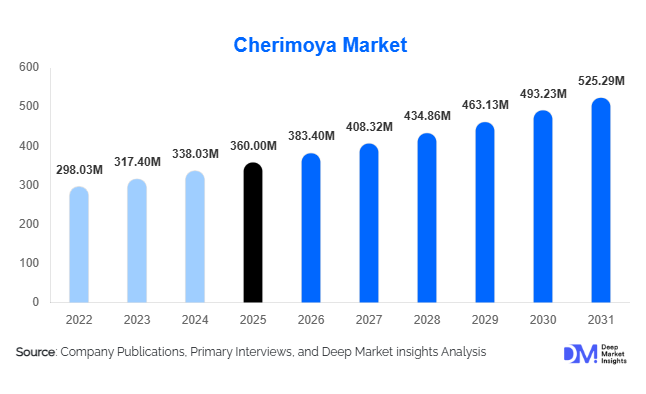
global cherimoya market latest trends
Rising Demand for Exotic and Functional Fruits
Consumers globally are increasingly shifting toward nutrient-rich exotic fruits that offer health benefits beyond basic nutrition. Cherimoya is gaining traction due to its high vitamin C content, antioxidant properties, and creamy texture, making it suitable for both fresh consumption and functional food applications. Its positioning as a “superfruit” is expanding demand in premium retail channels, particularly in urban markets across North America and Europe. The growing popularity of plant-based diets and clean-label foods is further reinforcing cherimoya’s market adoption.
Expansion of Processed and Value-Added Applications
The use of cherimoya in processed food products is expanding rapidly, especially in smoothies, ice creams, yogurts, desserts, and functional beverages. Food manufacturers are increasingly adopting cherimoya pulp and puree formats due to their convenience, longer shelf life, and year-round availability. This trend is reducing dependency on seasonal fresh fruit supply and enabling global scalability. Additionally, the emergence of frozen cherimoya products is supporting international trade and minimizing post-harvest losses.
global cherimoya market drivers
Growing Health-Conscious Consumer Base
The increasing global focus on health, wellness, and immunity-boosting foods is a major growth driver for the cherimoya market. Consumers are actively seeking natural alternatives to processed sugar-rich foods, and cherimoya’s natural sweetness and nutrient density make it an attractive option. Its integration into smoothies, detox diets, and functional beverages is further accelerating consumption across developed and emerging markets.
Improvement in Cold-Chain and Export Infrastructure
Advancements in refrigerated transport, controlled atmosphere storage, and post-harvest handling have significantly improved cherimoya’s export viability. Previously constrained by short shelf life, cherimoya is now being shipped efficiently from Latin America to global markets. This has enabled wider distribution across North America, Europe, and Asia-Pacific, reducing spoilage and expanding commercial scalability.
global market restraints
Highly Perishable Nature and Supply Chain Limitations
Cherimoya has a very short shelf life, making it highly sensitive to handling, storage, and transportation conditions. This leads to high post-harvest losses and increases logistics costs, particularly in long-distance export markets. Despite improvements in cold-chain systems, maintaining quality consistency remains a major operational challenge for global distributors.
Seasonal Production and Geographic Concentration
Global cherimoya production is concentrated in limited regions such as Peru, Ecuador, and parts of Spain. This geographic concentration creates supply volatility and seasonal dependency, leading to price fluctuations in international markets. Any climatic disruption in key producing regions can significantly impact global supply availability.
global cherimoya industry key opportunities
Expansion of Export-Oriented Cultivation
Latin American countries are increasingly investing in export-focused cherimoya cultivation supported by government agricultural modernization programs. Improved irrigation systems, certification standards, and trade facilitation initiatives are enabling producers to access high-value markets in North America and Europe. This creates strong long-term export growth potential.
Growth in Nutraceutical and Cosmetic Applications
Cherimoya extracts are gaining interest in nutraceutical and skincare industries due to their antioxidant and vitamin-rich composition. The fruit is being explored for use in dietary supplements, anti-aging skincare formulations, and wellness products. This diversification beyond fresh fruit consumption is expected to significantly expand market value.
E-commerce and Direct-to-Consumer Expansion
Online grocery platforms and direct farm-to-consumer delivery models are improving accessibility of exotic fruits like cherimoya in non-native markets. This channel is enabling small and mid-sized producers to reach global consumers without heavy reliance on traditional distribution networks, increasing market penetration.
Report Scope
| Report Metric | Details |
|---|---|
| Market Size in 2025 | USD 360.00 Million |
| Market Size in 2026 | USD 383.40 Million |
| Market Size in 2031 | USD 525.29 Million |
| CAGR | 6.5% (2026-2031) |
| Base Year for Estimation | 2025 |
| Historical Data | 2022-2024 |
| Forecast Period | 2026-2031 |
| Report Coverage | Revenue Forecast, Competitive Landscape, Supply Chain Disruption, Growth Factors, Environment & Regulatory Landscape and Trends |
| Geographies Covered | North America, Europe, APAC, Middle East and Africa, LATAM |
| Countries Covered | U.S., Canada, U.K., Germany, France, Spain, Italy, Russia, Nordic, Benelux, Rest of Europe, China, Korea, Japan, India, Australia, Singapore, Taiwan, South East Asia, Rest of Asia-Pacific, UAE, Turky, Saudi Arabia, South Africa, Egypt, Nigeria, Rest of MEA, Brazil, Mexico, Argentina, Chile, Colombia, Rest of LATAM |
Explore more data points, trends and opportunities Download Free Sample Report
Product Type Insights
The fresh cherimoya segment continues to account for the largest share of the global market, primarily driven by increasing consumer preference for natural, nutrient-rich, and minimally processed fruits. Rising awareness regarding the health benefits associated with cherimoya, including its vitamin, antioxidant, and dietary fiber content, has significantly strengthened demand for fresh produce across retail and foodservice sectors. The growing popularity of exotic tropical fruits among health-conscious consumers and premium grocery buyers has further accelerated the expansion of the fresh product category. In addition, improvements in cold-chain logistics and international fruit trade networks have enhanced the availability and shelf life of fresh cherimoya across key importing markets.The dried cherimoya segment remains comparatively niche but is gradually gaining momentum in the global health-snacking market. Increasing consumer demand for shelf-stable, preservative-free, and nutrient-dense snack alternatives is encouraging the adoption of dried exotic fruits. The segment is also benefiting from the expansion of online retail channels and specialty health food stores that cater to premium and wellness-oriented consumers. As demand for convenient fruit snacks continues to rise globally, dried cherimoya products are expected to witness steady long-term growth.
Application Insights
Direct consumption remains the leading application segment in the global cherimoya market, supported by rising retail demand for fresh exotic fruits and increasing consumer inclination toward healthy dietary habits. The segment’s dominance is primarily attributed to growing awareness regarding the nutritional profile of cherimoya, including its high vitamin C, potassium, and antioxidant content. Consumers are increasingly incorporating tropical fruits into daily diets as part of wellness-focused lifestyles, which continues to support strong retail sales across supermarkets, specialty stores, and premium grocery outlets. In addition, the growing popularity of plant-based and natural food consumption trends is further strengthening demand for fresh cherimoya products.Nutraceutical applications are emerging as a promising growth area due to increasing consumer demand for natural ingredients with perceived health benefits. Cherimoya extracts are being explored for use in dietary supplements and wellness products owing to their antioxidant compounds and nutrient content. Growing preventive healthcare trends and rising expenditure on nutritional products are expected to further support market penetration within the nutraceutical sector.In addition, export-oriented demand from hospitality, luxury retail, and gourmet food industries continues to support market expansion globally. Hotels, fine-dining restaurants, and premium dessert manufacturers are increasingly utilizing cherimoya in high-end culinary preparations, further strengthening commercial demand across international markets.
Distribution Channel Insights
Supermarkets and hypermarkets continue to dominate the global cherimoya market owing to their extensive retail reach, established cold-chain infrastructure, and strong consumer trust in organized retail systems. The leading position of this segment is driven by increasing consumer preference for purchasing fresh fruits through modern retail outlets that offer product quality assurance, better storage conditions, and a wide variety of imported produce. The expansion of premium supermarket chains and rising shelf space allocation for exotic fruits are further contributing to the growth of this distribution channel. In addition, promotional activities and in-store product visibility continue to enhance consumer awareness and trial purchases of cherimoya.Specialty fruit stores and wholesale distributors continue to play a vital role in supplying premium-grade cherimoya products to niche consumer segments, restaurants, and institutional buyers. These channels are particularly important in markets where demand for imported tropical fruits is concentrated among high-income consumers and gourmet food establishments. Wholesale distributors also support international trade by facilitating bulk supply to retailers and foodservice operators.The foodservice channel, including hotels, restaurants, cafes, and dessert chains, is witnessing increasing adoption of cherimoya in gourmet menus and specialty culinary applications. Rising consumer demand for unique dining experiences and tropical fruit-based desserts is encouraging chefs and foodservice providers to incorporate cherimoya into premium offerings. Growth in tourism, luxury hospitality, and international cuisine trends is further supporting expansion of the foodservice segment globally.
Explore more data points, trends and opportunities Download Free Sample Report
Cherimoya Market Segmentations
By Product Type
- Fresh Cherimoya
- Frozen Cherimoya
- Cherimoya Pulp & Puree
- Processed Products
- Dried/Dehydrated Cherimoya
By Distribution Channel
- Supermarkets & Hypermarkets
- Specialty Fruit Stores
- Online Retail & E-commerce Platforms
- Wholesale Distributors
- Foodservice
By Application
- Direct Fresh Consumption
- Food & Beverage Processing
- Dairy & Frozen Desserts
- Smoothies & Functional Beverages
- Nutraceuticals & Cosmetics
By Geography
- North America
- Europe
- Asia-Pacific
- Latin America
- Middle East & Africa
Regional Insights
North America
North America represents one of the largest import-driven markets for cherimoya, led primarily by the United States and Canada. Market growth in the region is being driven by rising consumer awareness regarding healthy eating habits and increasing demand for nutrient-rich exotic fruits. The growing multicultural population and expanding interest in international cuisines are encouraging greater consumption of tropical fruit varieties across urban markets. In addition, the rapid expansion of premium grocery retailers, organic food chains, and health-focused supermarkets is improving product accessibility for consumers. Strong growth in smoothie bars, wellness-oriented foodservice establishments, and functional beverage markets is also contributing to increasing cherimoya demand. Furthermore, advancements in refrigerated logistics and import distribution networks are supporting the efficient supply of fresh cherimoya products throughout the region.
Europe
Europe continues to represent a strong premium consumption market for cherimoya, with Spain, Germany, France, Italy, and the United Kingdom accounting for significant demand. Regional market growth is being supported by rising consumer preference for organic, sustainably sourced, and exotic fruit products. European consumers are increasingly seeking natural and clean-label foods, which is positively influencing the adoption of tropical fruits such as cherimoya. Spain plays an important dual role in the market by serving as both a consumer and limited domestic producer, supported by favorable Mediterranean climatic conditions. In addition, growing imports through well-established fresh produce trade networks are strengthening product availability across major European retail channels. The expansion of vegan diets, functional food consumption, and premium fruit offerings in supermarkets is further driving regional market growth.
Asia-Pacific
Asia-Pacific is projected to be the fastest-growing region in the global cherimoya market due to rapidly rising disposable incomes, urbanization, and increasing awareness of superfruits among consumers. Countries such as China, India, Japan, South Korea, and several Southeast Asian nations are witnessing strong growth in demand for imported exotic fruits. Expanding middle-class populations and changing dietary preferences are encouraging consumers to explore premium and health-oriented food products. The region is also benefiting from rapid expansion of organized retail infrastructure, online grocery platforms, and premium supermarket chains that are improving access to imported tropical fruits. In addition, growing popularity of smoothies, fruit-based desserts, and wellness beverages among younger consumers is supporting higher cherimoya consumption. Increasing investments in cold-chain logistics and international fruit import networks are expected to further accelerate regional market expansion.
Latin America
Latin America dominates global cherimoya production, particularly across Peru, Ecuador, Chile, and selected Andean regions that provide highly favorable climatic and agricultural conditions for cultivation. Regional growth is strongly supported by abundant natural resources, suitable highland environments, and extensive agricultural expertise in tropical fruit farming. The region also benefits from established export infrastructure and increasing international demand for exotic fruits from North America, Europe, and Asia-Pacific. Government initiatives supporting agricultural exports and rural farming development are further strengthening production capabilities. In addition, rising urbanization and improving consumer purchasing power within Latin American countries are gradually increasing domestic consumption of premium tropical fruits. Investments in post-harvest handling, packaging technologies, and export-oriented supply chains are expected to further enhance the region’s competitiveness in the global market.
Middle East & Africa
The Middle East & Africa region is emerging as a developing market for cherimoya, supported by increasing demand for premium imported fruits and expanding luxury hospitality industries. Countries such as the United Arab Emirates and Saudi Arabia are witnessing growing consumption of exotic fruits through upscale retail outlets, gourmet restaurants, and high-end hotels. Rising disposable incomes, strong tourism activity, and evolving consumer preferences toward premium food products are key factors driving regional growth. In addition, the expansion of organized retail and international food trade networks is improving accessibility to imported cherimoya products across metropolitan areas.
Key Players in the Global Cherimoya Market
- Fresh Del Monte Produce Inc.
- Dole plc
- Chiquita Brands International
- Westfalia Fruit
- Fyffes plc
- Camposol S.A.
- Danper Trujillo S.A.C.
- Grupo Hualtaco
- Unifrutti Group
- Hortifrut S.A.