Cell-Free Protein Synthesis Market Size
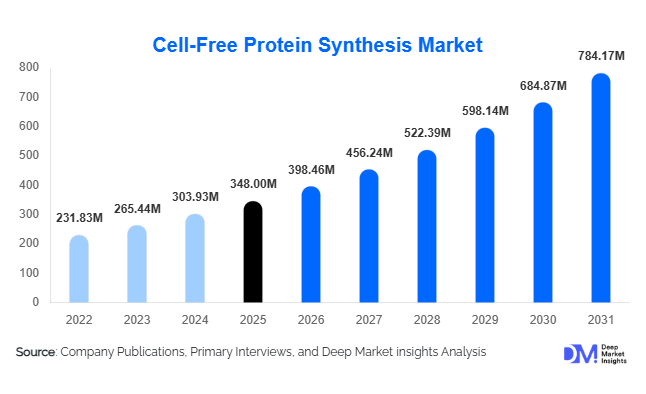
According to Deep Market Insights,the global cell-free protein synthesis market size was valued at USD 348 million in 2025 and is projected to grow from USD 398.46 million in 2026 to reach USD 784.17 million by 2031, expanding at a CAGR of 14.5% during the forecast period (2026–2031). The cell-free protein synthesis market growth is primarily driven by increasing demand for rapid protein production technologies, expanding synthetic biology research, and the growing need for high-throughput platforms in drug discovery and vaccine development.
Key Market Insights
- Cell-free protein synthesis systems are gaining adoption in synthetic biology and protein engineering research, enabling rapid prototyping of proteins without the limitations of cell-based expression systems.
- Biopharmaceutical companies are increasingly utilizing CFPS platforms for early-stage drug discovery, therapeutic protein screening, and antibody engineering.
- North America dominates the market, supported by strong biotechnology research infrastructure, large pharmaceutical R&D investments, and advanced laboratory automation.
- Asia-Pacific is the fastest-growing region, driven by rising biotechnology research funding and rapid expansion of biopharmaceutical manufacturing hubs.
- Technological advancements in cell-free lysate preparation and energy regeneration systems are significantly improving protein yield and reaction efficiency.
- Automation and high-throughput screening technologies are accelerating the integration of CFPS systems into modern drug discovery workflows.
What are the latest trends in the cell-free protein synthesis market?
Integration of Artificial Intelligence in Protein Engineering
One of the most transformative trends in the cell-free protein synthesis (CFPS) market is the integration of artificial intelligence and computational protein design tools. Biotechnology companies and research laboratories increasingly rely on machine learning algorithms to predict protein structures and optimize genetic sequences. These computational models allow researchers to design protein variants digitally before synthesizing them using CFPS platforms. The rapid testing capability of cell-free systems significantly shortens experimental cycles, enabling researchers to test hundreds of protein variants within a short period. This integration is particularly beneficial in enzyme engineering, therapeutic antibody development, and biomaterial design. As computational biology continues to evolve, the combination of AI-driven protein design and CFPS validation is expected to become a standard workflow in biotechnology laboratories.
Decentralized and Portable Biomanufacturing Platforms
Another emerging trend is the development of portable cell-free protein synthesis platforms for decentralized biomanufacturing. Researchers are designing compact systems capable of producing therapeutic proteins, vaccines, and diagnostic reagents outside traditional laboratory environments. These portable CFPS platforms can be used in remote areas, field laboratories, or during emergency outbreaks where rapid protein production is required. This capability is particularly valuable for pandemic preparedness and disaster response scenarios. Governments and global health organizations are investing in these technologies to enable rapid on-demand production of critical biological components. Such advancements are expected to expand the scope of CFPS technology beyond research laboratories into real-world healthcare and field applications.
What are the key drivers in the cell-free protein synthesis market?
Increasing Demand for Rapid Protein Production in Drug Discovery
Pharmaceutical companies require rapid protein expression technologies to accelerate drug discovery pipelines. Traditional cell-based expression systems often require extensive optimization and long culture periods, which slows down early-stage research. Cell-free protein synthesis provides a faster alternative by enabling direct translation of genetic templates into proteins within hours. This speed advantage allows researchers to quickly validate drug targets, screen protein variants, and analyze protein interactions. As pharmaceutical R&D spending continues to rise globally, the demand for CFPS systems is expected to increase significantly.
Growth in Synthetic Biology and Bioengineering Research
The rapid expansion of synthetic biology research is another major growth driver for the CFPS market. Synthetic biology aims to engineer biological systems for applications such as sustainable chemicals, advanced biomaterials, and programmable therapeutics. Cell-free systems provide a simplified environment for testing synthetic gene circuits and metabolic pathways before introducing them into living organisms. Governments across North America, Europe, and Asia are investing heavily in synthetic biology research initiatives, creating strong demand for CFPS kits, reagents, and automated protein synthesis platforms.
What are the restraints for the global market?
High Cost of Cell-Free Expression Reagents
Despite the advantages of cell-free protein synthesis technology, the cost of reagents and specialized kits remains relatively high compared to conventional protein expression methods. Many CFPS kits require purified enzymes, optimized energy systems, and proprietary lysates, which increase overall costs. This pricing barrier can limit adoption among smaller academic laboratories and institutions with limited research budgets.
Challenges in Scaling for Industrial Manufacturing
Another restraint affecting the market is the limited scalability of CFPS systems for large-scale industrial protein production. While the technology is highly efficient for laboratory-scale experiments and rapid prototyping, scaling reactions to industrial production volumes remains technically complex. Continuous expression systems and improved lysate engineering are being developed to address these limitations, but widespread industrial adoption still requires further technological advancement.
What are the key opportunities in the cell-free protein synthesis industry?
Expansion of Synthetic Biology Startups
The rapid growth of synthetic biology startups worldwide presents a significant opportunity for CFPS technology providers. Many of these startups focus on designing engineered proteins and enzymes for applications such as sustainable materials, industrial biocatalysts, and next-generation therapeutics. Cell-free systems enable these companies to quickly prototype biological constructs, reducing development time and experimental costs. Venture capital investments in synthetic biology companies have increased significantly over the past decade, creating a strong customer base for CFPS reagents and automation platforms.
Next-Generation Vaccine and Therapeutic Development
The demand for rapid vaccine development platforms has increased substantially following recent global health emergencies. Cell-free protein synthesis systems allow researchers to produce viral antigens and diagnostic proteins rapidly without requiring complex cell culture infrastructure. This capability makes CFPS technology particularly useful for pandemic preparedness and emerging disease research. Pharmaceutical companies and public health agencies are exploring CFPS-based platforms for rapid antigen screening and vaccine candidate validation. As global health organizations prioritize faster response mechanisms for infectious disease outbreaks, CFPS technologies are expected to play an increasingly important role in vaccine development workflows.
Report Scope
| Report Metric | Details |
|---|---|
| Market Size in 2025 | USD 348 Million |
| Market Size in 2026 | USD 398.46 Million |
| Market Size in 2031 | USD 784.17 Million |
| CAGR | 14.5% (2026-2031) |
| Base Year for Estimation | 2025 |
| Historical Data | 2022-2024 |
| Forecast Period | 2026-2031 |
| Report Coverage | Revenue Forecast, Competitive Landscape, Supply Chain Disruption, Growth Factors, Environment & Regulatory Landscape and Trends |
| Geographies Covered | North America, Europe, APAC, Middle East and Africa, LATAM |
| Countries Covered | U.S., Canada, U.K., Germany, France, Spain, Italy, Russia, Nordic, Benelux, Rest of Europe, China, Korea, Japan, India, Australia, Singapore, Taiwan, South East Asia, Rest of Asia-Pacific, UAE, Turky, Saudi Arabia, South Africa, Egypt, Nigeria, Rest of MEA, Brazil, Mexico, Argentina, Chile, Colombia, Rest of LATAM |
Explore more data points, trends and opportunities Download Free Sample Report
Product Type Insights
The product landscape of the cell-free protein synthesis market is primarily dominated by reagents and expression kits, which accounted for nearly 48% of total market revenue in 2025. The leading position of this segment is driven by the growing demand for standardized and ready-to-use solutions that simplify complex protein synthesis workflows. These kits typically contain optimized combinations of enzymes, nucleotides, amino acids, buffers, and energy regeneration systems that allow researchers to conduct efficient protein production without the need for time-consuming reagent preparation. Academic research laboratories and biotechnology companies increasingly rely on these kits to accelerate experimental processes, reduce protocol variability, and improve reproducibility in protein expression studies. As life sciences research becomes more focused on high-throughput experimentation and rapid prototyping of proteins, the adoption of pre-formulated reagent kits continues to expand significantly.
Cell-free lysates represent another important product category within the market, particularly lysates derived from E. coli, wheat germ, rabbit reticulocytes, and insect cells. These lysates contain the cellular machinery necessary for protein synthesis while eliminating the complexity associated with maintaining living cell cultures. E. coli-based lysates remain the most widely used due to their high protein yield, cost-effectiveness, and compatibility with large-scale protein production experiments. Advances in lysate engineering and improved purification methods are further enhancing the performance and stability of these systems, making them increasingly attractive for both academic and commercial research applications.
DNA template products, including plasmid DNA and linear DNA constructs, are also gaining increasing traction as essential components in cell-free protein expression systems. The rapid preparation and modification of DNA templates allow researchers to quickly design and test multiple genetic sequences for protein production. This capability is particularly valuable in synthetic biology and protein engineering applications where rapid iteration and screening of gene variants are required. As gene synthesis technologies become faster and more affordable, demand for high-quality DNA templates compatible with cell-free systems is expected to grow steadily during the forecast period.
Application Insights
Protein engineering represents the leading application segment in the cell-free protein synthesis market, accounting for nearly 28% of total demand. The dominance of this segment is largely attributed to the growing need for rapid generation and screening of protein variants in drug discovery, enzyme optimization, and therapeutic antibody development. Cell-free systems provide a unique advantage over traditional cell-based expression methods because they allow researchers to directly manipulate reaction conditions and incorporate non-natural amino acids, enabling the design of highly specialized proteins. The ability to produce and analyze multiple protein variants simultaneously significantly accelerates protein engineering workflows, making CFPS platforms an increasingly valuable tool for pharmaceutical and biotechnology research.
Functional genomics research also represents a major application area, as scientists utilize cell-free expression platforms to investigate gene function, protein interactions, and regulatory pathways. These systems enable rapid protein expression without the limitations imposed by cell viability or toxicity, allowing researchers to study proteins that are otherwise difficult to express in living cells. As genomic sequencing projects continue to generate vast amounts of genetic data, the need for technologies that enable fast functional characterization of genes is expected to further expand the role of CFPS systems in genomics research.
Vaccine development and synthetic biology applications are also experiencing significant growth within the market. Pharmaceutical companies and biotechnology startups are increasingly adopting cell-free platforms to accelerate the development of therapeutic proteins, antigens, and novel biomolecules. CFPS technology enables rapid prototyping of vaccine candidates and biologics, reducing development timelines compared to conventional expression systems. Additionally, synthetic biology initiatives that focus on designing artificial metabolic pathways and programmable biological systems rely heavily on cell-free technologies for rapid experimentation and validation of engineered biological components.
End-Use Industry Insights
Biopharmaceutical and biotechnology companies represent the largest end-use segment in the cell-free protein synthesis market, contributing approximately 39% of global demand. The leadership of this segment is driven by the increasing adoption of CFPS technologies in drug discovery, biologics development, and therapeutic protein screening. Pharmaceutical companies utilize cell-free systems to rapidly produce and analyze candidate proteins during early-stage research, enabling faster identification of promising drug targets and reducing development timelines. In addition, the ability of CFPS systems to produce toxic or unstable proteins that are difficult to express in living cells makes them particularly valuable in advanced drug development programs.
Academic and research institutes also constitute a significant portion of market demand, supported by increasing government funding for biotechnology and life sciences research worldwide. Universities and public research organizations rely on cell-free protein synthesis platforms for fundamental studies in molecular biology, structural biology, and synthetic biology. These institutions often serve as innovation hubs that develop new CFPS methodologies, which are later commercialized by biotechnology companies.
Contract research organizations are emerging as one of the fastest-growing end-use segments, reflecting the growing trend of pharmaceutical companies outsourcing specialized research activities. CROs use CFPS technologies to perform protein expression, screening, and assay development services for clients involved in drug discovery and biotechnology research. The flexibility and rapid turnaround time associated with cell-free systems make them particularly suitable for outsourced research environments.
Industrial biotechnology companies are also increasingly adopting CFPS platforms for enzyme engineering and sustainable biochemical production applications. These companies leverage cell-free technologies to design and optimize enzymes used in biofuels, food processing, and environmentally friendly chemical manufacturing processes. The growing emphasis on sustainable industrial bioprocesses is expected to further support the adoption of cell-free protein synthesis technologies across industrial biotechnology sectors.
Explore more data points, trends and opportunities Download Free Sample Report
Cell-Free Protein Synthesis Market Segmentations
By System Type
- Prokaryotic Cell-Free Systems
- Eukaryotic Cell-Free Systems
- Hybrid & Synthetic Cell-Free Systems
By Product Type
- Reagents & Expression Kits
- Cell-Free Lysates
- DNA Templates
- Automation Platforms & Software
By Expression Mode
- Batch Expression Systems
- Continuous Flow Expression Systems
- Continuous Exchange Expression Systems
By Application
- Protein Engineering
- Functional Genomics
- Enzyme Production
- Therapeutic Protein Development
- Synthetic Biology
- Vaccine Development
- Diagnostic Biomarker Research
By End-Use Industry
- Biopharmaceutical & Biotechnology Companies
- Academic & Research Institutes
- Contract Research Organizations (CROs)
- Industrial Biotechnology Companies
- Diagnostic Development Companies
Regional Insights
North America
North America holds the largest share of the global cell-free protein synthesis market, accounting for approximately 39% of total revenue in 2025. The region's leadership is primarily driven by the strong presence of advanced biotechnology and pharmaceutical industries in the United States. The country hosts numerous leading life sciences companies, research institutes, and synthetic biology startups that actively utilize CFPS technologies for protein engineering and therapeutic development. High levels of pharmaceutical R&D spending and continuous technological innovation further contribute to regional market expansion. In addition, substantial government funding from agencies such as the National Institutes of Health and other research organizations supports academic and translational research programs that utilize cell-free protein synthesis platforms. Canada also contributes to regional growth through expanding biotechnology innovation clusters, government-backed life sciences initiatives, and increasing collaboration between academic institutions and biotechnology companies.
Europe
Europe represents the second-largest regional market, contributing nearly 27% of global demand for cell-free protein synthesis technologies. The region benefits from a strong scientific research infrastructure and a well-established pharmaceutical manufacturing sector. Countries such as Germany, the United Kingdom, and France serve as key contributors due to their large biotechnology research communities and advanced laboratory facilities. European universities and public research institutions play a significant role in advancing synthetic biology, structural biology, and protein engineering research, all of which rely on efficient protein expression technologies. Furthermore, collaborative research initiatives funded by the European Union, including programs focused on biotechnology innovation and life sciences development, are supporting the widespread adoption of cell-free protein synthesis systems across academic and commercial research environments. Increasing collaboration between academic institutions and biotechnology startups is also fostering innovation and commercialization of advanced CFPS technologies in the region.
Asia-Pacific
The Asia-Pacific region is projected to be the fastest-growing market for cell-free protein synthesis technologies during the forecast period. Rapid expansion of biotechnology and pharmaceutical research capabilities across countries such as China, Japan, South Korea, and India is significantly driving regional demand. China is making substantial investments in synthetic biology research, genomic technologies, and biomanufacturing infrastructure as part of its broader biotechnology development strategy. Japan continues to maintain a strong leadership position in advanced life sciences research, including protein engineering and structural biology. South Korea is also emerging as an important biotechnology hub due to increasing government support for research and development and the rapid growth of biotechnology startups. In India, expanding pharmaceutical research activities, rising government initiatives to strengthen domestic biotechnology innovation, and growing academic research capabilities are contributing to increased adoption of cell-free protein synthesis technologies across research institutions and emerging biotech companies.
Latin America
Latin America represents a smaller but steadily expanding market for cell-free protein synthesis technologies. Growth in the region is primarily supported by increasing investment in biotechnology research infrastructure and expanding pharmaceutical manufacturing capabilities. Brazil and Mexico are the leading markets in the region, driven by the development of local biotechnology clusters and increasing collaboration between universities and pharmaceutical companies. Government initiatives aimed at strengthening domestic biotechnology innovation and improving research capabilities are gradually supporting market development. Additionally, rising participation of Latin American research institutions in global scientific collaborations is facilitating greater access to advanced research technologies such as CFPS systems.
Middle East & Africa
The Middle East and Africa currently represent the smallest share of the global cell-free protein synthesis market; however, the region is gradually developing its biotechnology research ecosystem. Countries such as Israel and the United Arab Emirates are investing in biotechnology innovation programs, research infrastructure, and life sciences education to strengthen their knowledge-based economies. Israel, in particular, possesses a strong biotechnology startup ecosystem supported by advanced research institutions and venture capital investment, which is driving demand for cutting-edge protein synthesis technologies. In the Gulf region, government-led initiatives focused on biotechnology development and healthcare innovation are encouraging the establishment of research laboratories and biotechnology companies. As scientific research capacity continues to expand in the region, the adoption of cell-free protein synthesis technologies is expected to increase steadily.
Company Market Share
The cell-free protein synthesis market is moderately consolidated, with the top five companies accounting for approximately 46% of the global market. Leading market participants are actively focusing on expanding their reagent portfolios, improving the performance and stability of cell-free lysate systems, and developing automated protein synthesis platforms that support high-throughput experimentation. Strategic collaborations between biotechnology companies, academic institutions, and pharmaceutical organizations are becoming increasingly common, enabling technology developers to enhance product capabilities and accelerate commercialization. Continuous innovation in reagent formulation, lysate engineering, and system automation is expected to intensify competition among market participants while also expanding the overall adoption of cell-free protein synthesis technologies across research and industrial applications.
Key Players in the Cell-Free Protein Synthesis Market
- Thermo Fisher Scientific
- Merck KGaA
- Takara Bio
- Promega Corporation
- New England Biolabs
- GeneCopoeia
- Jena Bioscience
- Cube Biotech
- LenioBio
- Sutro Biopharma
- Arbor Biosciences
- Creative Biolabs
- Bioneer Corporation
- GeneFrontier Corporation
- CellFree Sciences