Caviar Substitute Market Size
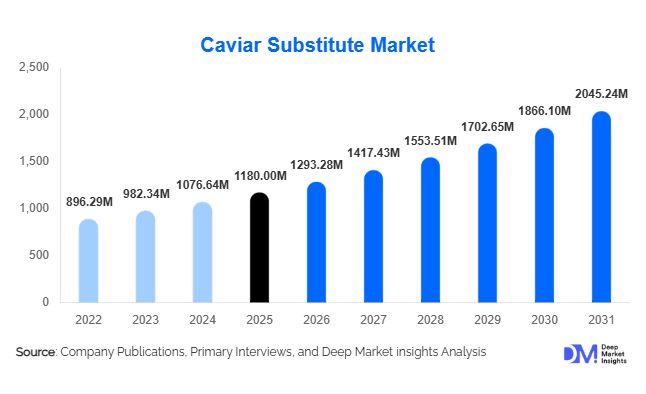
According to Deep Market Insights, the global caviar substitute market size was valued at USD 1,180 million in 2025 and is projected to grow from USD 1,293.28 million in 2026 to reach USD 2,045.24 million by 2031, expanding at a CAGR of 9.6% during the forecast period (2026–2031). The caviar substitute market growth is primarily driven by the rising demand for affordable luxury foods, increasing adoption of sustainable and plant-based alternatives, and the expansion of gourmet dining culture across developed and emerging economies.
Key Market Insights
- Fish-based caviar substitutes dominate the market, particularly lumpfish and capelin roe, due to their close resemblance to traditional caviar.
- Plant-based alternatives are witnessing the fastest growth, driven by vegan trends and sustainability concerns.
- Europe leads the global market, supported by strong culinary traditions and high consumption of gourmet foods.
- Asia-Pacific is the fastest-growing region, fueled by rising disposable incomes and expanding fine dining culture.
- HoReCa segment accounts for the largest share, as restaurants and hotels remain primary consumers.
- Technological advancements in molecular gastronomy are enabling innovative product formats and flavor customization.
What are the latest trends in the caviar substitute market?
Shift Toward Plant-Based and Sustainable Alternatives
The caviar substitute market is witnessing a strong shift toward plant-based and sustainable products, particularly those derived from seaweed and algae. Growing environmental concerns regarding overfishing and the endangered status of sturgeon species have led consumers and manufacturers to seek eco-friendly alternatives. Plant-based caviar not only reduces pressure on marine ecosystems but also aligns with the broader global movement toward vegan and flexitarian diets. Manufacturers are increasingly focusing on clean-label ingredients, organic sourcing, and minimal processing to appeal to health-conscious consumers. Additionally, innovations in texture and flavor replication are narrowing the gap between plant-based substitutes and traditional caviar, further accelerating adoption across retail and food service channels.
Innovation Through Molecular Gastronomy
Technological advancements, particularly in molecular gastronomy, are transforming the caviar substitute market. Techniques such as spherification allow producers to create visually appealing, flavor-rich pearls that mimic traditional caviar while offering unique customization options. This trend is gaining traction among high-end restaurants and chefs seeking to differentiate their culinary offerings. Customized flavors such as truffle, wasabi, citrus, and smoked variants are becoming increasingly popular, catering to evolving consumer preferences. These innovations are also enabling the development of hybrid products that combine plant-based and synthetic elements, expanding the market’s product portfolio and enhancing its appeal across diverse consumer segments.
What are the key drivers in the caviar substitute market?
Rising Demand for Affordable Luxury Foods
The increasing demand for premium yet affordable food products is a major driver of the caviar substitute market. Traditional caviar remains expensive and inaccessible to a large consumer base, creating a strong opportunity for substitutes that offer similar taste and visual appeal at a fraction of the cost. This trend is particularly evident among middle-income consumers who seek gourmet dining experiences without high expenditure. The growing popularity of home-based gourmet cooking and social media-driven food trends is further amplifying demand for visually appealing and premium-looking ingredients such as caviar substitutes.
Growing Focus on Sustainability and Ethical Sourcing
Sustainability concerns are significantly influencing purchasing decisions in the food industry. The overexploitation of sturgeon populations and strict regulations on wild caviar production have accelerated the shift toward alternative products. Caviar substitutes, especially those derived from plant-based sources, offer an environmentally responsible solution. Governments and regulatory bodies are also encouraging sustainable aquaculture practices and alternative food innovations, further supporting market growth. This driver is particularly strong in Europe and North America, where consumers are highly aware of environmental issues.
What are the restraints for the global market?
Perception of Inferior Quality Compared to Traditional Caviar
One of the key challenges in the caviar substitute market is the perception that substitutes are inferior in quality and authenticity compared to traditional caviar. This perception limits adoption in premium segments, particularly among high-end consumers and luxury dining establishments. Despite advancements in product quality, manufacturers need to invest in branding, marketing, and consumer education to overcome this barrier and enhance acceptance.
Volatility in Raw Material Supply
The availability and pricing of raw materials, particularly fish roe, can be highly volatile due to environmental factors, regulatory restrictions, and fluctuations in fish populations. This volatility impacts production costs and supply stability, posing challenges for manufacturers. Additionally, reliance on marine resources exposes the market to risks associated with climate change and ecosystem disruptions, which can further constrain growth.
What are the key opportunities in the caviar substitute industry?
Expansion in Emerging Markets
Emerging economies such as China, India, and Brazil present significant growth opportunities for the caviar substitute market. Rising disposable incomes, urbanization, and increasing exposure to global cuisines are driving demand for gourmet food products in these regions. The expansion of fine dining establishments and luxury hospitality services further supports market growth. Companies can capitalize on these opportunities by establishing local production facilities, forming strategic partnerships, and tailoring products to regional taste preferences.
Integration of Functional and Nutritional Ingredients
There is growing potential to enhance caviar substitutes with functional ingredients such as omega-3 fatty acids, vitamins, and antioxidants. This approach aligns with the increasing demand for health-oriented food products and provides an additional value proposition to consumers. Functional caviar substitutes can target niche markets, including health-conscious consumers and those seeking fortified foods, thereby expanding the market’s reach.
Report Scope
| Report Metric | Details |
|---|---|
| Market Size in 2025 | USD 1180 Million |
| Market Size in 2026 | USD 1293.28 Million |
| Market Size in 2031 | USD 2045.24 Million |
| CAGR | 9.6% (2026-2031) |
| Base Year for Estimation | 2025 |
| Historical Data | 2022-2024 |
| Forecast Period | 2026-2031 |
| Report Coverage | Revenue Forecast, Competitive Landscape, Supply Chain Disruption, Growth Factors, Environment & Regulatory Landscape and Trends |
| Geographies Covered | North America, Europe, APAC, Middle East and Africa, LATAM |
| Countries Covered | U.S., Canada, U.K., Germany, France, Spain, Italy, Russia, Nordic, Benelux, Rest of Europe, China, Korea, Japan, India, Australia, Singapore, Taiwan, South East Asia, Rest of Asia-Pacific, UAE, Turky, Saudi Arabia, South Africa, Egypt, Nigeria, Rest of MEA, Brazil, Mexico, Argentina, Chile, Colombia, Rest of LATAM |
Explore more data points, trends and opportunities Download Free Sample Report
Product Type Insights
The global market for caviar substitutes is characterized by a diverse range of product types that cater to varying consumer preferences, price sensitivities, and dietary requirements. Among these, fish-based caviar substitutes continue to dominate the market landscape, accounting for approximately 38% of the total market share in 2025. This dominance is largely attributed to their close resemblance to traditional caviar in terms of taste, texture, and visual appeal. Products derived from lumpfish and capelin roe are especially popular, as they offer a cost-effective alternative to sturgeon caviar while maintaining a premium sensory experience. These substitutes are widely adopted across both food service and retail applications, particularly in sushi, canapés, and gourmet appetizers where authenticity is valued.Synthetic and hybrid caviar substitutes are also carving out a niche in the premium segment of the market. These products combine natural and artificial elements to create highly customizable offerings in terms of color, flavor, and size. Their adoption is particularly prominent in high-end dining establishments, where visual presentation and culinary creativity play a crucial role. The leading driver for this segment is the demand for innovation and differentiation in gourmet cuisine, as chefs seek unique ingredients to elevate dining experiences. As a result, the continuous innovation across all product categories is significantly expanding consumer choice and supporting the overall growth of the market.
Application Insights
The application landscape of caviar substitutes is broad, encompassing food service, retail, and food processing industries. Among these, the food service sector remains the dominant application segment, contributing nearly 50% of the global market share. This dominance is driven by the widespread use of caviar substitutes in restaurants, hotels, and catering services, where they are utilized to enhance both the aesthetic and flavor profiles of dishes. Fine dining establishments, in particular, are key adopters, incorporating these products into gourmet menus to deliver a luxurious dining experience without the high cost associated with traditional caviar.The retail segment is also experiencing steady growth, supported by a rising interest in home-based gourmet cooking. Consumers are increasingly experimenting with premium ingredients in their kitchens, driven by cooking shows, social media influences, and a growing appreciation for global cuisines. The leading driver in this segment is the democratization of luxury food products, making them accessible to a wider audience through supermarkets and online platforms. Packaged caviar substitutes, often available in convenient formats, are gaining popularity among consumers seeking to recreate restaurant-style dishes at home.Meanwhile, the food processing industry is emerging as a significant application area. Manufacturers are incorporating caviar substitutes into ready-to-eat meals, sushi kits, and premium snack products. This trend is driven by the increasing demand for convenience foods that do not compromise on quality or presentation. The leading driver in this segment is the growth of the ready-to-eat and convenience food market, particularly in urban areas where busy lifestyles are shaping consumption patterns. As a result, the application scope of caviar substitutes continues to expand across multiple sectors.
Distribution Channel Insights
The distribution of caviar substitutes is supported by a well-established network of channels, with the HoReCa (Hotels, Restaurants, and Catering) segment emerging as the dominant contributor, accounting for approximately 44% of the market share. This dominance is largely due to the high volume consumption of caviar substitutes in professional food service settings, where they are used extensively in menu preparation. The leading driver for this channel is the consistent demand from the hospitality sector, which relies on reliable supply chains to meet customer expectations for quality and availability.Supermarkets and hypermarkets also play a crucial role in the distribution landscape, offering a wide variety of caviar substitute products to retail consumers. These outlets provide accessibility and convenience, enabling consumers to explore premium food options during routine shopping. The leading driver for this channel is the expansion of organized retail and the increasing shelf space dedicated to gourmet and specialty food products. Promotional activities, in-store sampling, and attractive packaging further enhance consumer engagement and drive sales.Specialty stores, although representing a smaller share, contribute significantly to the market by targeting niche consumer segments. These stores focus on premium and gourmet products, catering to discerning customers who prioritize quality and exclusivity. The leading driver here is the growing demand for curated food experiences and high-end ingredients, which is encouraging the proliferation of specialty retail outlets.
End-Use Insights
The end-use landscape of the caviar substitutes market is dominated by the food service industry, which continues to account for the largest share. This segment is supported by the global expansion of restaurants, hotels, and catering services, along with the increasing demand for premium dining experiences. The segment is growing at an estimated annual rate of 8–10%, reflecting strong and sustained demand. The leading driver for this segment is the rising consumer preference for dining out and experiencing diverse cuisines, which is encouraging establishments to incorporate innovative and visually appealing ingredients like caviar substitutes.Retail consumers are emerging as a key end-use segment, driven by the growing interest in gourmet cooking and premium food products. The increasing availability of caviar substitutes in retail outlets and online platforms is making these products more accessible to home cooks. The leading driver in this segment is the shift toward experiential cooking at home, where consumers seek to replicate restaurant-quality dishes and explore new culinary techniques.Export-driven demand is another significant factor contributing to market expansion. Countries with established seafood industries are leveraging their production capabilities to supply caviar substitutes to international markets. The leading driver here is globalization and the increasing demand for gourmet food products across borders, which is creating new opportunities for manufacturers and exporters.
Explore more data points, trends and opportunities Download Free Sample Report
Caviar Substitute Market Segmentations
By Product Type
- Plant-Based Caviar Substitutes
- Fish-Based Caviar Substitutes
- Synthetic/Hybrid Caviar
By Application
- Food Service Industry
- Retail Consumers
- Food Processing & Packaged Foods
- Luxury Dining & Hospitality
By Distribution Channel
- Online Retail
- Supermarkets & Hypermarkets
- Specialty Stores
- Direct Sales
Regional Insights
North America
North America holds approximately 28% of the global market share, with the United States serving as the primary driver of demand. The region’s strong gourmet food culture, high disposable incomes, and well-developed food service industry contribute significantly to market growth. Canada also plays an important role, particularly through its seafood processing sector. The leading drivers for regional growth include the increasing popularity of premium dining experiences, the expansion of the hospitality industry, and the growing trend of home-based gourmet cooking. Additionally, the presence of advanced retail infrastructure and a strong e-commerce ecosystem supports widespread product availability and consumer access.
Europe
Europe represents the largest market, accounting for around 32% of the global share in 2025. Countries such as France, Germany, and the United Kingdom are key contributors, driven by their rich culinary heritage and strong preference for luxury food products. The leading drivers for growth in this region include a deeply ingrained culture of fine dining, high consumer awareness of gourmet ingredients, and the widespread adoption of sustainable food practices. Additionally, stringent regulations on traditional caviar production are encouraging the adoption of substitutes, further supporting market expansion. The region’s emphasis on quality and authenticity continues to sustain demand for high-end caviar alternatives.
Asia-Pacific
Asia-Pacific is the fastest-growing region, with a CAGR exceeding 11%, led by countries such as China, Japan, and India. Rapid urbanization, rising disposable incomes, and increasing exposure to international cuisines are key factors driving growth. The leading drivers for this region include the growing popularity of sushi and fusion foods, the expansion of modern retail channels, and the increasing influence of Western dining trends. Additionally, a young and dynamic consumer base is more open to experimenting with new food products, further boosting demand. The region’s large population and evolving food culture present significant opportunities for market players.
Latin America
Latin America is an emerging market, with Brazil and Mexico leading demand. The region is experiencing gradual growth, supported by increasing urbanization and rising consumer awareness of global culinary trends. The leading drivers for regional growth include the expansion of the middle class, increased exposure to international cuisines through media and tourism, and the development of modern retail infrastructure. While the market is still in its early stages, the growing interest in premium food products is expected to drive steady expansion in the coming years.
Middle East & Africa
The Middle East & Africa region is witnessing steady growth, particularly in countries such as the UAE and Saudi Arabia. The expansion of luxury hospitality and fine dining sectors is a major contributor to demand for caviar substitutes. The leading drivers for growth in this region include a high-income consumer base, a thriving tourism industry, and significant investments in the hospitality sector. Additionally, the increasing number of international restaurants and hotels is driving the adoption of premium ingredients. As the region continues to position itself as a global hub for luxury tourism, the demand for high-end food products, including caviar substitutes, is expected to rise steadily.
Key Players in the Caviar Substitute Market
- Agroittica Lombarda
- Caviar de Neuvic
- Sterling Caviar
- Black River Caviar
- Tsar Nicoulai
- Petrossian
- California Caviar Company
- The Caviar Co.
- Marshallberg Farm
- Sturgeon AquaFarms
- Nordic Caviar
- Royal Belgian Caviar
- Russ & Daughters
- Paramount Caviar
- Imperia Caviar