Cat Supplements Market Size
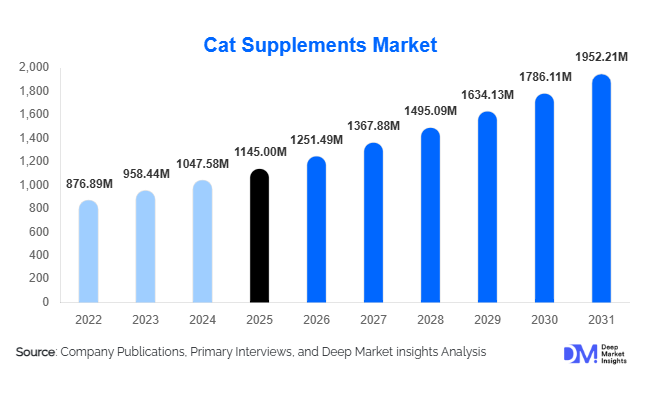
According to Deep Market Insights,the global cat supplements market size was valued at USD 1,145 million in 2025 and is projected to grow from USD 1,251.49 million in 2026 to reach USD 1,952.21 million by 2031, expanding at a CAGR of 9.3% during the forecast period (2026–2031). Market growth is primarily driven by increasing pet humanization, rising awareness of preventive feline healthcare, and growing demand for condition-specific nutritional supplementation for cats. As veterinary recommendations increasingly emphasize proactive wellness management, cat owners are incorporating joint support, digestive health, immune boosters, and skin & coat supplements into daily feeding routines.
Key Market Insights
- Joint & mobility supplements dominate the product landscape, accounting for nearly 24% of total 2025 revenue due to rising arthritis prevalence in aging feline populations.
- Premium and therapeutic supplements represent the fastest-growing price tier, contributing approximately 38% of global revenue as consumers prioritize clinically validated formulations.
- North America leads the global market, holding around 36% share in 2025, supported by high per-pet healthcare expenditure and strong e-commerce penetration.
- Asia-Pacific is the fastest-growing region, driven by rising pet ownership and expanding online pet retail ecosystems in China and India.
- Online retail channels account for nearly 29% of global sales, reflecting the growing adoption of subscription-based pet wellness models.
- Omega fatty acids and probiotics remain core functional ingredients, supported by strong demand for skin, coat, and digestive health management.
What are the latest trends in the cat supplements market?
Shift Toward Preventive & Condition-Specific Nutrition
Pet owners are increasingly moving from reactive treatment to preventive health management. Supplements targeting joint health, urinary tract support, immune strengthening, and calming solutions are witnessing accelerated adoption. Veterinary professionals are recommending early-stage supplementation, particularly for indoor and senior cats, to mitigate chronic health conditions. This shift is encouraging manufacturers to develop scientifically validated formulations backed by clinical trials and transparent labeling. Preventive nutrition positioning is strengthening repeat purchases and building long-term brand loyalty.
Rise of Clean-Label, Natural & Functional Formulations
Natural ingredient positioning is becoming central to product development. Formulations incorporating omega-3 fatty acids, probiotics, taurine, botanical extracts, and CBD-derived calming agents are gaining popularity. Consumers increasingly scrutinize ingredient sourcing, sustainability credentials, and absence of artificial additives. Functional treats and palatable chew formats are emerging as preferred delivery systems, improving compliance and simplifying administration. Sustainability initiatives such as recyclable packaging and responsibly sourced marine oils are further influencing purchase decisions among environmentally conscious consumers.
What are the key drivers in the cat supplements market?
Growing Pet Humanization & Premiumization
Cats are increasingly considered family members, leading to higher spending on preventive healthcare products. Premium supplements offering targeted therapeutic benefits are gaining traction, especially in developed markets such as the United States, Germany, and Japan. Rising disposable incomes and expanding pet insurance coverage are supporting adoption of high-value nutraceuticals.
Rising Prevalence of Age-Related & Lifestyle Disorders
The aging global feline population is a major driver of supplement demand. Osteoarthritis, obesity, kidney disease, and digestive sensitivities are becoming more common, particularly among indoor cats. Joint & mobility products and urinary health supplements are witnessing steady growth due to veterinarian-led awareness campaigns and early-intervention strategies.
What are the restraints for the global market?
Regulatory Inconsistencies Across Regions
Pet supplements are regulated differently across countries, often categorized between feed and pharmaceutical products. This regulatory fragmentation creates labeling complexities and limits cross-border product standardization, potentially affecting consumer trust and expansion strategies.
Price Sensitivity in Emerging Markets
Premium formulations often carry high price points due to specialized ingredients such as omega oils and patented probiotic strains. In price-sensitive markets, adoption remains limited to affluent urban consumers, constraining penetration in broader demographics.
What are the key opportunities in the cat supplements industry?
Expansion in Asia-Pacific Emerging Economies
Rapid urbanization and rising middle-class income levels in China, India, and Southeast Asia present significant expansion opportunities. Increasing online pet retail penetration and digital veterinary consultations are lowering entry barriers for global brands. Localization of flavor profiles and pricing strategies can accelerate market capture.
Personalized & Subscription-Based Supplement Models
Digital platforms offering customized supplement packs based on age, breed, and health conditions are emerging as high-potential growth avenues. Subscription models provide recurring revenue streams and enhance customer retention. AI-driven health profiling tools are further differentiating premium brands in competitive markets.
Report Scope
| Report Metric | Details |
|---|---|
| Market Size in 2025 | USD 1145.00 Million |
| Market Size in 2026 | USD 1251.49 Million |
| Market Size in 2031 | USD 1952.21 Million |
| CAGR | 9.3% (2026-2031) |
| Base Year for Estimation | 2025 |
| Historical Data | 2022-2024 |
| Forecast Period | 2026-2031 |
| Report Coverage | Revenue Forecast, Competitive Landscape, Supply Chain Disruption, Growth Factors, Environment & Regulatory Landscape and Trends |
| Geographies Covered | North America, Europe, APAC, Middle East and Africa, LATAM |
| Countries Covered | U.S., Canada, U.K., Germany, France, Spain, Italy, Russia, Nordic, Benelux, Rest of Europe, China, Korea, Japan, India, Australia, Singapore, Taiwan, South East Asia, Rest of Asia-Pacific, UAE, Turky, Saudi Arabia, South Africa, Egypt, Nigeria, Rest of MEA, Brazil, Mexico, Argentina, Chile, Colombia, Rest of LATAM |
Explore more data points, trends and opportunities Download Free Sample Report
Product Type Insights
Joint & mobility supplements dominate the market with approximately 24% share of 2025 revenue, primarily driven by the expanding senior cat population and the increasing prevalence of arthritis and age-related musculoskeletal disorders. The leading segment benefits from rising veterinary diagnoses of degenerative joint conditions, higher life expectancy of indoor cats, and growing owner awareness regarding preventive mobility care. Skin & coat supplements and digestive health formulations follow closely, supported by widespread concerns over allergies, excessive shedding, dull coat appearance, and gastrointestinal sensitivity linked to dietary transitions and processed food consumption. Calming and anxiety supplements are gaining significant traction as indoor living environments, multi-pet households, and urban noise exposure contribute to stress-related behaviors in cats. Multivitamins and immune support products continue to serve as foundational wellness solutions, particularly among first-time cat owners seeking preventive nutritional support and comprehensive daily supplementation.
Ingredient Type Insights
Omega fatty acids account for nearly 22% of ingredient-based revenue share in 2025, emerging as the leading ingredient segment due to their multifunctional benefits across inflammation management, dermatological health, cognitive function, and cardiovascular support. Their strong clinical backing and compatibility across multiple supplement categories contribute to widespread formulation adoption. Probiotics and prebiotics represent a rapidly expanding segment driven by growing digestive health awareness and increasing recognition of the gut–immune connection in feline wellness. Glucosamine and chondroitin maintain consistent demand within mobility-focused formulations as veterinarians increasingly recommend early joint support interventions. Taurine remains an essential component in feline supplementation owing to its critical physiological role in vision, cardiac function, and reproductive health, reinforcing its stable inclusion across premium and therapeutic-grade products.
Dosage Form Insights
Chewable tablets and soft chews lead the dosage form segment with around 31% market share in 2025, primarily driven by superior palatability, ease of administration, and improved compliance among pet owners. The leading segment benefits from flavor innovations and treat-like textures that reduce resistance in cats. Powders and liquid formulations remain highly relevant, particularly for cats that resist solid dosage forms, as they can be conveniently mixed with wet food or administered directly. Functional treat-based supplements are witnessing rising demand as they integrate reward-based feeding behavior with measurable therapeutic benefits, supporting consistent long-term usage and enhanced consumer engagement.
Distribution Channel Insights
Online retail and e-commerce channels account for nearly 29% of global sales in 2025, establishing themselves as the leading distribution segment due to subscription-based purchasing models, competitive pricing transparency, wider product assortments, and direct-to-consumer brand strategies. The segment’s growth is further supported by digital marketing, product review visibility, and doorstep delivery convenience. Veterinary clinics remain essential for prescription-based and therapeutic-grade supplements, benefiting from professional trust and clinical endorsements. Pet specialty stores continue to drive brand awareness and in-store consumer education, while supermarkets and hypermarkets primarily serve economy and mid-range product categories through high footfall and impulse purchasing patterns.
Life Stage Insights
Senior cats represent approximately 34% of supplement demand in 2025, making them the leading life-stage segment due to higher incidence of chronic conditions, reduced immunity, and mobility limitations associated with aging. Increased veterinary screening and preventive care awareness further strengthen demand in this category. Adult cats account for steady baseline consumption, supported by routine wellness supplementation and coat maintenance products. Kitten-specific supplementation is gradually expanding as early-life immune strengthening, digestive health optimization, and growth-support formulations gain popularity among new pet owners prioritizing preventive nutrition from infancy.
Explore more data points, trends and opportunities Download Free Sample Report
Cat Supplements Market Segmentations
By Product Type
- Joint & Mobility Supplements
- Skin & Coat Supplements
- Digestive Health Supplements
- Calming & Anxiety Supplements
- Immune Support Supplements
- Urinary Tract Health Supplements
- Multivitamins & General Wellness Supplements
- Dental Health Supplements
By Ingredient Type
- Omega Fatty Acids
- Probiotics & Prebiotics
- Glucosamine & Chondroitin
- Herbal & Botanical Extracts
- Vitamins & Minerals
- CBD & Hemp-Derived Ingredients
- Taurine & Amino Acids
By Dosage Form
- Chewable Tablets & Soft Chews
- Powders
- Liquids & Syrups
- Capsules & Tablets
- Functional Treats
By Distribution Channel
- Veterinary Clinics
- Pet Specialty Stores
- Online Retail & E-commerce
- Supermarkets & Hypermarkets
By Life Stage
- Kittens
- Adult Cats
- Senior Cats
By Price Tier
- Economy
- Mid-Range
- Premium & Therapeutic
Regional Insights
North America
North America holds around 36% of the 2025 global market, led by the United States, which alone accounts for nearly 30% of global revenue. Regional growth is driven by high per capita pet healthcare expenditure, strong humanization trends, widespread pet insurance coverage, and advanced veterinary infrastructure. Established pet retail chains and mature e-commerce ecosystems further accelerate premium supplement adoption. Canada contributes through growing demand for natural and premium formulations, rising disposable income levels, and increased awareness regarding preventive feline healthcare practices.
Europe
Europe commands approximately 28% share of the global market, with Germany, the United Kingdom, and France leading regional demand. Germany remains the largest European market due to a strong preventive healthcare culture and high veterinary consultation rates. Regional growth is supported by stringent quality standards, rising preference for clean-label and sustainably sourced ingredients, and increasing adoption of organic formulations. Consumers across Europe demonstrate strong inclination toward transparency in ingredient sourcing, driving innovation in plant-based, non-GMO, and environmentally responsible supplement products.
Asia-Pacific
Asia-Pacific represents the fastest-growing regional market, expanding at nearly 11% CAGR. China leads regional growth due to rapid urbanization, increasing single-person households, and rising pet adoption rates among younger demographics. Japan represents a mature premium market characterized by high spending per pet and demand for scientifically formulated products. India is emerging as a high-potential market driven by expanding middle-class income, accelerated digital retail penetration, growing awareness of pet nutrition, and increasing availability of international supplement brands through online marketplaces.
Latin America
Latin America accounts for roughly 6–7% of global demand, with Brazil and Mexico serving as the primary growth engines. Regional expansion is supported by increasing pet ownership rates, gradual premiumization of pet food and supplement categories, and improving retail infrastructure in urban centers. Rising awareness of preventive animal healthcare and growing presence of multinational pet care brands are further contributing to market penetration.
Middle East & Africa
The Middle East & Africa region holds around 4–5% share of the global market, led by the UAE and South Africa. Growth in this region is driven by rising urban affluence, increasing expatriate populations with higher pet care spending capacity, and expanding specialty pet retail networks. Premium imported products dominate the market landscape, particularly within metropolitan areas, while growing veterinary clinic networks support gradual adoption of therapeutic and condition-specific supplements.
Key Players in the Cat Supplements Market
- Nestlé Purina PetCare
- Mars Petcare
- Zoetis Inc.
- Virbac
- Nutramax Laboratories
- NOW Foods
- Vetoquinol
- Zesty Paws
- Nordic Naturals
- PetHonesty
- Ark Naturals
- Tomlyn Veterinary Science
- Beaphar
- GNC Holdings
- Boehringer Ingelheim