Cassia Tora Seeds Market Size
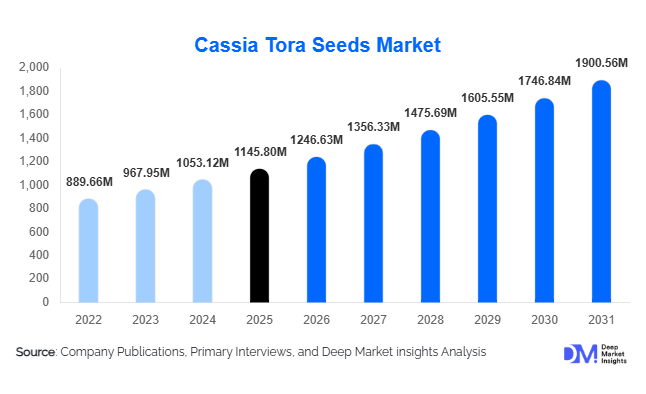
According to Deep Market Insights, the global cassia tora seeds market size was valued at USD 1,145.8 million in 2025 and is projected to grow from USD 1,246.63 million in 2026 to reach USD 1,900.56 million by 2031, expanding at a CAGR of 8.8% during the forecast period (2026–2031). The market growth is primarily driven by rising demand for natural hydrocolloids, increasing adoption of cassia gum in pet food formulations, and expanding applications across pharmaceuticals, food processing, and industrial thickening agents. Growing preference for plant-derived stabilizers and clean-label ingredients across global food systems has further strengthened commercial demand for cassia tora seeds.
Key Market Insights
- Pet food applications account for a major share of cassia gum consumption, supported by global expansion of premium pet nutrition markets.
- India dominates global production and exports, supplying a significant portion of raw cassia tora seeds and processed derivatives.
- Food-grade hydrocolloids are replacing synthetic stabilizers, increasing adoption in dairy, meat processing, and convenience foods.
- Asia-Pacific leads global demand growth, driven by expanding food processing and animal nutrition industries.
- Technological improvements in seed processing and gum purification are enhancing product consistency and export quality.
- Industrial applications such as textile printing and oil drilling additives are creating secondary demand streams.
What are the latest trends in the cassia tora seeds market?
Shift Toward Natural Hydrocolloids and Clean-Label Ingredients
Food manufacturers globally are increasingly replacing synthetic thickeners with plant-derived alternatives, positioning cassia tora derivatives as a competitive hydrocolloid solution. Cassia gum offers stabilizing, emulsifying, and gelling properties comparable to guar gum and locust bean gum, making it suitable for processed meats, dairy desserts, sauces, and frozen foods. Clean-label movements across Europe and North America have accelerated regulatory approvals and reformulation initiatives, encouraging manufacturers to adopt naturally sourced additives. As consumer scrutiny of ingredient lists intensifies, cassia tora seeds are becoming integral to ingredient transparency strategies.
Expansion of Premium Pet Food Industry
The rapid expansion of global pet ownership and premiumization of pet nutrition has significantly boosted cassia gum consumption. Pet food manufacturers rely on cassia-based stabilizers for moisture retention, texture improvement, and shelf-life enhancement in canned and wet pet food. The trend toward high-protein and grain-free formulations requires advanced binding systems, further strengthening cassia tora seed demand. Manufacturers are increasingly investing in specialized processing technologies to produce high-purity gum grades tailored to animal nutrition applications.
What are the key drivers in the cassia tora seeds market?
Rising Demand from Processed Food Industry
The global processed food sector continues to expand due to urbanization, changing dietary habits, and growth of ready-to-eat meals. Cassia gum functions as a stabilizer and thickener, improving product texture and consistency while maintaining cost efficiency. Food processors favor cassia derivatives because they deliver functional performance at relatively lower costs compared with alternative hydrocolloids, supporting widespread industrial adoption.
Growth in Animal Nutrition and Pet Care Markets
The pet care industry’s rapid growth across North America, Europe, and Asia-Pacific has emerged as a major growth catalyst. Premium pet food manufacturers increasingly use cassia gum for gel formation and emulsification. Rising disposable income and humanization of pets have led to higher spending on nutritional products, directly translating into increased cassia seed processing volumes.
Expansion of Natural Ingredient Supply Chains
Governments and agricultural stakeholders are promoting cultivation of non-traditional crops such as cassia tora due to their drought tolerance and low cultivation costs. Expansion of organized supply chains and export-oriented processing facilities has improved availability of standardized raw materials, enabling large-scale industrial procurement.
What are the restraints for the global market?
Raw Material Price Volatility
Cassia tora seeds are largely dependent on seasonal agricultural output, making supply vulnerable to climate variability and monsoon fluctuations. Price instability affects processors and exporters, creating uncertainty in long-term procurement contracts and profit margins.
Regulatory Compliance and Quality Standardization
Stringent food safety and additive regulations in developed markets require consistent gum purity and processing standards. Smaller processors often struggle to meet international certification requirements, limiting export participation and slowing market consolidation.
What are the key opportunities in the cassia tora seeds industry?
Expansion into Plant-Based and Vegan Food Applications
The global rise of plant-based foods presents strong opportunities for cassia tora derivatives as stabilizers in dairy alternatives, meat substitutes, and vegan desserts. Manufacturers are increasingly exploring cassia gum blends to enhance mouthfeel and structural integrity of plant-based formulations. This creates opportunities for value-added product innovation and higher-margin specialty grades.
Export Market Diversification
Growing demand from Southeast Asia, Latin America, and Eastern Europe provides exporters opportunities to diversify beyond traditional markets. Trade agreements and improved logistics infrastructure are enabling suppliers to expand into emerging food processing hubs. Countries seeking cost-effective hydrocolloids are increasingly adopting cassia-based solutions.
Technological Upgradation in Processing Facilities
Investment in automated cleaning, splitting, and purification technologies allows manufacturers to produce consistent, food-grade cassia gum. Advanced processing enhances yield efficiency, improves export competitiveness, and opens opportunities in pharmaceutical excipients and specialty industrial formulations.
Report Scope
| Report Metric | Details |
|---|---|
| Market Size in 2025 | USD 1145.80 Million |
| Market Size in 2026 | USD 1246.63 Million |
| Market Size in 2031 | USD 1900.56 Million |
| CAGR | 8.8% (2026-2031) |
| Base Year for Estimation | 2025 |
| Historical Data | 2022-2024 |
| Forecast Period | 2026-2031 |
| Report Coverage | Revenue Forecast, Competitive Landscape, Supply Chain Disruption, Growth Factors, Environment & Regulatory Landscape and Trends |
| Geographies Covered | North America, Europe, APAC, Middle East and Africa, LATAM |
| Countries Covered | U.S., Canada, U.K., Germany, France, Spain, Italy, Russia, Nordic, Benelux, Rest of Europe, China, Korea, Japan, India, Australia, Singapore, Taiwan, South East Asia, Rest of Asia-Pacific, UAE, Turky, Saudi Arabia, South Africa, Egypt, Nigeria, Rest of MEA, Brazil, Mexico, Argentina, Chile, Colombia, Rest of LATAM |
Explore more data points, trends and opportunities Download Free Sample Report
Product Type Insights
The global cassia tora seeds market demonstrates a diversified product structure, with cassia gum powder emerging as the leading product type, accounting for approximately 48% of the global market share in 2025. The dominance of cassia gum powder is primarily driven by its superior thickening, emulsifying, and stabilizing characteristics, which make it highly suitable for large-scale industrial applications, particularly in pet food and processed food manufacturing. The leading segment growth is strongly supported by the rapid expansion of premium pet nutrition products, where manufacturers increasingly require cost-efficient hydrocolloids capable of improving texture stability, moisture retention, and shelf life. Additionally, cassia gum powder offers compatibility with other hydrocolloids such as guar gum and carrageenan, further strengthening its adoption across complex food formulations.Split cassia seeds constitute an essential intermediate processing segment within the value chain, acting as the primary raw material for gum extraction. Demand for split seeds remains closely linked to processing capacity expansions across India and China, where integrated processing facilities continue to scale operations to meet rising export requirements. This segment benefits from growing investments in mechanized cleaning, grading, and splitting technologies that improve yield efficiency and product consistency, thereby enhancing profitability for processors.Raw cassia tora seeds continue to play a significant role in agricultural trade, particularly in export-oriented supply chains. These seeds are widely traded across international commodity markets and serve as the foundational input for downstream processing industries. Growth in this segment is supported by increasing cultivation in semi-arid regions, contract farming initiatives, and rising farmer participation due to favorable price realization compared to traditional crops.Organic-certified cassia derivatives represent an emerging yet rapidly expanding niche segment. Although currently constrained by limited certified cultivation acreage and higher compliance costs, demand is accelerating due to global clean-label trends and regulatory preference for naturally sourced additives. Food manufacturers in developed markets are increasingly integrating organic hydrocolloids into premium formulations, creating long-term growth potential for certified cassia products. As certification infrastructure improves and traceability systems strengthen, this segment is expected to witness accelerated adoption over the forecast period.
Application Insights
By application, pet food remains the dominant segment, accounting for nearly 42% of global consumption in 2025, supported by the structural expansion of the global pet care industry. The leading segment driver is the increasing demand for wet and semi-moist pet food formulations that require advanced stabilizing and gelling agents to maintain texture uniformity and product integrity during storage and transportation. Cassia gum’s ability to enhance palatability while reducing formulation costs makes it highly attractive to large pet food manufacturers. The ongoing premiumization of pet nutrition and the humanization trend in pet ownership continue to strengthen long-term demand fundamentals.The food and beverage segment represents the second-largest application area, driven by rising consumption of processed foods, dairy desserts, sauces, gravies, and meat products. Manufacturers increasingly utilize cassia derivatives to improve viscosity control and stabilize emulsions while meeting consumer demand for plant-based and naturally derived ingredients. Growth in convenience food consumption, urbanization, and changing dietary patterns globally are reinforcing this application segment’s expansion.Industrial applications maintain stable and resilient demand due to cassia gum’s rheological properties. Textile printing pastes rely on cassia-based thickeners for uniform dye dispersion, while oil drilling operations utilize the material for fluid viscosity management and sediment suspension. Industrial demand remains less volatile compared to food applications, providing a consistent baseline for market stability.Pharmaceutical applications are gradually gaining traction as purification technologies improve product quality and regulatory acceptance. Cassia derivatives are increasingly used as tablet binders, disintegrants, and controlled-release excipients. Rising pharmaceutical manufacturing activity in emerging economies and growing preference for plant-based excipients are expected to expand this segment steadily over time.
Distribution Channel Insights
Distribution dynamics within the cassia tora seeds market are largely characterized by industrial procurement structures, with direct B2B supply accounting for approximately 55% of global sales. The dominance of this channel is driven by long-term procurement agreements between processors and large-scale manufacturers seeking supply consistency, standardized quality, and price stability. Bulk purchasing arrangements also allow buyers to optimize logistics costs and ensure uninterrupted production cycles, particularly in pet food and food processing industries.Export traders play a strategically important role in the global value chain, especially in facilitating India-origin trade flows to North America, Europe, and East Asia. These intermediaries provide aggregation, quality inspection, financing, and logistics coordination services that enable small and medium agricultural producers to access international markets efficiently. The continued globalization of hydrocolloid trade strengthens the relevance of trader networks within the distribution ecosystem.Online ingredient sourcing platforms are emerging as supplementary procurement channels, reflecting the digital transformation of industrial purchasing. While still representing a smaller share of total transactions, these platforms are gaining traction among small and mid-sized buyers seeking flexible order quantities, faster supplier discovery, and transparent pricing. Digital procurement adoption is expected to expand gradually as supply chain digitization accelerates across specialty ingredient markets.
End-Use Industry Insights
The animal nutrition industry represents the fastest-growing end-use sector for cassia tora derivatives, supported by sustained global expansion of the pet food market, which continues to record annual growth exceeding 6–7%. Increasing awareness regarding pet health, rising disposable incomes, and growing adoption of companion animals across urban households are collectively driving demand for advanced feed stabilizers and texturizing agents. Cassia gum’s functional efficiency and cost competitiveness position it as a preferred ingredient within large-scale feed formulations.Processed food manufacturing remains a major contributor to overall market demand, fueled by global urbanization and increasing reliance on ready-to-eat and convenience food products. Food manufacturers increasingly incorporate hydrocolloids to improve mouthfeel, consistency, and shelf stability, thereby supporting steady consumption of cassia-based ingredients.Emerging opportunities are also developing within plant-based food production, where cassia derivatives are utilized to replicate texture characteristics traditionally achieved through animal-based ingredients. The expansion of vegan and alternative protein markets is creating new functional ingredient requirements, supporting incremental demand growth.Pharmaceutical and nutraceutical industries are gradually increasing adoption as excipient innovation advances. Improvements in purification technology and compliance with pharmacopeia standards are enabling cassia derivatives to penetrate higher-value medical applications. Meanwhile, export-driven demand remains strong, particularly from Europe and the United States, where advanced food processing industries rely heavily on imported hydrocolloids to maintain formulation performance standards.
Explore more data points, trends and opportunities Download Free Sample Report
Cassia Tora Seeds Market Segmentations
By Product Type
- Raw Cassia Tora Seeds
- Cassia Tora Seed Powder
- Split Cassia Tora Seeds
- Cassia Gum
By Application
- Animal Feed Additives
- Food Processing & Thickening Agents
- Pharmaceutical & Nutraceutical Products
- Industrial Applications
- Personal Care & Cosmetics
By Distribution Channel
- Direct Industrial Procurement
- Agricultural Commodity Traders
- Export & Bulk Trading Companies
- Online Ingredient Marketplaces
By End-Use Industry
- Animal Nutrition Industry
- Food & Beverage Manufacturing
- Pharmaceutical Industry
- Oil & Gas Drilling Industry
- Cosmetics & Personal Care Industry
Regional Insights
Asia-Pacific
Asia-Pacific dominates the global cassia tora seeds market, accounting for approximately 46% of total demand in 2025, supported by strong agricultural production capabilities and vertically integrated processing ecosystems. India serves as the world’s largest producer and exporter, benefiting from favorable agro-climatic conditions, abundant cultivation in semi-arid regions, and well-established processing clusters in Rajasthan and Gujarat. Regional growth is primarily driven by expanding export demand, government support for agricultural value addition, and increasing investments in hydrocolloid processing infrastructure.China acts as a major processing and consumption hub, supported by its large food additive manufacturing sector and diversified industrial applications. Growing domestic food processing activity and rising demand for stabilizers continue to drive imports and local processing expansion. Japan and South Korea represent high-value import markets focused on premium-grade cassia gum used in advanced food formulations. Additionally, Southeast Asian economies such as Thailand and Vietnam are emerging demand centers due to rapid industrialization, expanding packaged food industries, and increasing adoption of functional food ingredients.
North America
North America accounts for nearly 22% of global demand, led by strong import consumption in the United States. Regional growth is primarily driven by the rapid expansion of premium pet food manufacturing, where consistent ingredient quality and functional performance are critical. Stringent food safety regulations and labeling standards encourage procurement of highly refined cassia gum products, supporting value-added imports rather than raw materials.Innovation in clean-label food formulations and increasing consumer preference for natural additives further stimulate demand across processed food applications. Canada contributes steady growth through expanding animal nutrition markets and rising investments in specialty food manufacturing. The region’s mature but innovation-driven food industry ensures stable long-term demand growth.
Europe
Europe represents a mature yet steadily expanding market characterized by strong regulatory oversight and high-quality ingredient requirements. Demand is concentrated in Germany, France, Italy, and the Netherlands, where advanced food processing industries rely on imported hydrocolloids to support product reformulation initiatives. Regional growth is driven by clean-label trends, replacement of synthetic stabilizers with plant-derived alternatives, and increasing consumer preference for transparent ingredient sourcing.Strict additive regulations imposed by European authorities encourage manufacturers to adopt natural thickening agents with proven safety profiles, strengthening cassia gum adoption. Additionally, growth in plant-based food innovation and premium dairy alternatives continues to create incremental opportunities across the region.
Middle East & Africa
The Middle East and Africa market is experiencing gradual expansion supported by rising investments in food processing infrastructure and increasing dependence on imported functional ingredients. Countries such as the United Arab Emirates, Saudi Arabia, and South Africa are witnessing growth in packaged food production, which drives demand for stabilizers and viscosity modifiers.Regional growth drivers include population expansion, urbanization, diversification of food manufacturing industries, and increasing adoption of processed and convenience foods. Industrial applications, particularly in oilfield and textile sectors, also contribute to stable demand growth across selected economies.
Latin America
Latin America remains an emerging yet high-potential market led by Brazil and Mexico. Growth is primarily supported by expanding processed food industries, rising meat processing activities, and increasing adoption of stabilizers in food manufacturing. Brazil is expected to register the fastest growth within the region due to rapid expansion of domestic pet food production capacity and growing exports of animal nutrition products.Improving industrialization, rising middle-class consumption, and increasing penetration of packaged food products are strengthening regional demand fundamentals. As local manufacturers continue upgrading processing technologies and adopting global formulation standards, cassia-derived hydrocolloids are expected to witness increasing integration into mainstream food and industrial applications across Latin America.
Key Players in the Cassia Tora Seeds Market
- Avlast Hydrocolloids
- Agro Gums
- Premcem Gums Pvt. Ltd.
- Hindustan Gum & Chemicals Ltd.
- Jai Bharat Gum & Chemicals Ltd.
- Vikas WSP Ltd.
- Lucid Colloids Ltd.
- Shree Ram Industries
- Altrafine Gums
- Gum Corporation
- Dwarkesh Industries
- Maruti Hydrocolloids
- Shubh Psyllium Industries
- Shree Mahalaxmi Industries
- Raj Gum Industries