Capsule Coffee Market Size
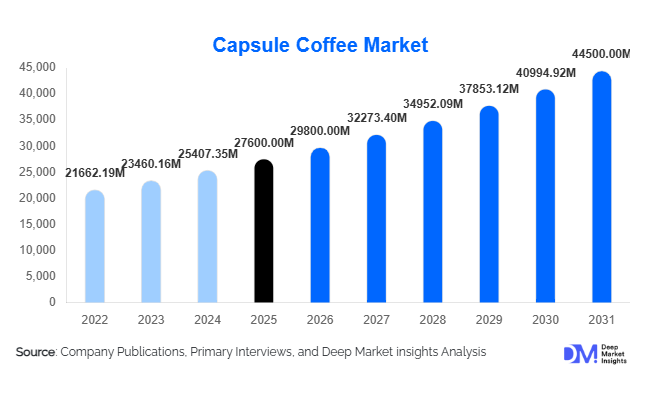
According to Deep Market Insights, the global capsule coffee market size was valued at USD 27,600 million in 2025 and is projected to grow from USD 29,800 million in 2026 to reach USD 44,500 million by 2031, expanding at a CAGR of 8.3% during the forecast period (2026–2031). The capsule coffee market growth is primarily driven by rising consumer preference for convenient, single-serve coffee solutions, increasing demand for premium and specialty coffee experiences, and growing penetration of coffee machines in households and commercial settings.
Key Market Insights
- Single-serve capsule systems dominate global consumption, driven by convenience, consistency, and ease of use across households and offices.
- Premiumization is a major growth trend, with increasing demand for specialty blends, organic coffee, and single-origin capsules.
- Europe leads the global market, supported by high coffee consumption and strong penetration of capsule machines.
- Asia-Pacific is the fastest-growing region, fueled by urbanization, rising disposable incomes, and westernized consumption habits.
- Sustainability is reshaping the market, with rising demand for biodegradable and recyclable capsules.
- Direct-to-consumer and subscription models are transforming distribution, enhancing customer retention and brand loyalty.
What are the latest trends in the capsule coffee market?
Sustainable and Compostable Capsules Gaining Momentum
Environmental concerns surrounding single-use plastic and aluminum waste are significantly influencing consumer behavior and regulatory frameworks. Manufacturers are investing in biodegradable, compostable, and recyclable capsule materials to reduce environmental impact. Innovations in plant-based polymers and paper-based capsules are gaining traction, while closed-loop recycling programs are being introduced to improve collection and reuse rates. Brands that successfully integrate sustainability into their product portfolios are witnessing stronger consumer loyalty and premium pricing power, especially in developed markets such as Europe and North America.
Expansion of Smart Coffee Ecosystems
Technological advancements are transforming capsule coffee systems into connected ecosystems. Smart coffee machines equipped with IoT capabilities enable users to customize brewing preferences, schedule brewing times, and automate capsule reordering. Integration with mobile applications and smart home systems enhances user experience and strengthens brand engagement. Subscription-based models linked to these ecosystems are further driving recurring revenue streams, while data analytics is enabling companies to better understand consumer preferences and optimize product offerings.
What are the key drivers in the capsule coffee market?
Rising Demand for Convenience and On-the-Go Lifestyles
Increasing urbanization and fast-paced lifestyles are driving demand for quick and hassle-free coffee solutions. Capsule coffee systems provide consistent quality with minimal preparation time, making them highly appealing to both residential and commercial users. The ability to brew café-quality coffee at home or in offices has significantly boosted adoption rates globally.
Growing Premium Coffee Culture
Consumers are increasingly seeking high-quality coffee experiences, leading to the rapid growth of premium and specialty capsule segments. Single-origin coffee, artisanal blends, and organic certifications are becoming key differentiators. This premiumization trend is enabling manufacturers to command higher margins while expanding their product portfolios.
Increased Penetration of Coffee Machines
The widespread availability of affordable coffee machines is accelerating capsule adoption. Bundled offerings, promotional discounts, and financing options are making machines more accessible, particularly in emerging markets. As machine penetration increases, recurring demand for compatible capsules continues to rise.
What are the restraints for the global market?
Environmental Concerns and Waste Management Issues
Despite recycling initiatives, a significant portion of used capsules ends up in landfills due to low consumer participation in recycling programs. This has led to increasing scrutiny from governments and environmental groups, potentially impacting market growth if not addressed effectively.
High Cost Compared to Traditional Coffee Formats
Capsule coffee remains relatively expensive on a per-cup basis compared to ground or instant coffee. This price disparity limits adoption among cost-sensitive consumers, particularly in developing regions where affordability is a key consideration.
What are the key opportunities in the capsule coffee industry?
Emerging Market Expansion
Regions such as Asia-Pacific and Latin America present significant growth opportunities due to low market penetration and increasing coffee consumption. Rising middle-class populations, urbanization, and exposure to global coffee culture are driving demand. Localization strategies, including region-specific flavors and affordable pricing models, can help companies capture these high-growth markets.
Innovation in Sustainable Packaging
The development of eco-friendly capsule materials offers a major opportunity for differentiation. Companies investing in compostable and biodegradable solutions can address regulatory challenges while attracting environmentally conscious consumers. Partnerships with recycling organizations and implementation of circular economy models further enhance growth potential.
Report Scope
| Report Metric | Details |
|---|---|
| Market Size in 2025 | USD 27600 Million |
| Market Size in 2026 | USD 29800 Million |
| Market Size in 2031 | USD 44500 Million |
| CAGR | 8.3% (2026-2031) |
| Base Year for Estimation | 2025 |
| Historical Data | 2022-2024 |
| Forecast Period | 2026-2031 |
| Report Coverage | Revenue Forecast, Competitive Landscape, Supply Chain Disruption, Growth Factors, Environment & Regulatory Landscape and Trends |
| Geographies Covered | North America, Europe, APAC, Middle East and Africa, LATAM |
| Countries Covered | U.S., Canada, U.K., Germany, France, Spain, Italy, Russia, Nordic, Benelux, Rest of Europe, China, Korea, Japan, India, Australia, Singapore, Taiwan, South East Asia, Rest of Asia-Pacific, UAE, Turky, Saudi Arabia, South Africa, Egypt, Nigeria, Rest of MEA, Brazil, Mexico, Argentina, Chile, Colombia, Rest of LATAM |
Explore more data points, trends and opportunities Download Free Sample Report
Product Type Insights
The product type segmentation of the coffee capsule market highlights the strong dominance of single-serve formats, which account for approximately 62% of the global market share in 2025. This leadership is primarily driven by the unparalleled convenience offered by single-serve systems, allowing consumers to prepare a consistent, high-quality cup of coffee within seconds. The increasing penetration of single-serve coffee machines across households, coupled with busy urban lifestyles, has significantly accelerated demand for these capsules. Furthermore, portion control minimizes wastage while ensuring flavor consistency, making them highly appealing to both new and experienced coffee consumers. The leading segment driver for single-serve capsules lies in their seamless integration with proprietary brewing systems, enabling brands to build strong ecosystems and encourage repeat purchases.In parallel, specialty beverage capsules, including cappuccino, latte, mocha, and flavored variants, are witnessing robust growth as consumers increasingly seek café-style experiences within the comfort of their homes. This trend is particularly prominent among younger demographics and urban consumers who value customization and indulgence. Manufacturers are responding by expanding their product portfolios with premium and seasonal offerings, further enhancing consumer engagement. Multi-serve capsules, although representing a smaller share, continue to find relevance in commercial environments such as offices, hotels, and restaurants, where efficiency and volume output are critical. However, their growth remains limited compared to the dynamic expansion of single-serve formats.
Coffee Type Insights
The coffee type segmentation reveals that Arabica-based capsules dominate the market with an estimated 55% share, largely due to their superior flavor profile, aromatic complexity, and premium positioning. Arabica coffee is widely preferred by consumers seeking a refined and smooth taste experience, which aligns with the broader premiumization trend observed across the coffee industry. The leading segment driver for Arabica capsules is the growing consumer inclination toward high-quality, specialty-grade coffee that replicates artisanal café experiences at home. This demand is further supported by increasing awareness of origin, roasting techniques, and flavor notes, particularly among millennial and Gen Z consumers.Specialty coffee capsules, including organic, fair-trade, and single-origin variants, represent the fastest-growing segment within this category. As consumers become more conscious of sustainability, ethical sourcing, and traceability, the demand for these premium offerings continues to rise. Brands are leveraging storytelling and transparency to build stronger emotional connections with consumers, thereby driving higher willingness to pay. Meanwhile, blended coffee capsules maintain a stable presence in the market by offering a balance between cost and flavor, catering to price-sensitive consumers without significantly compromising quality. This segment plays a crucial role in expanding market accessibility, particularly in emerging economies.
Capsule Material Insights
Capsule material plays a critical role in determining product quality, shelf life, and environmental impact. Aluminum capsules account for nearly 48% of the market, owing to their superior ability to preserve freshness, aroma, and flavor integrity. The leading segment driver for aluminum capsules is their excellent barrier properties, which protect coffee from oxygen, light, and moisture, ensuring a consistent and premium brewing experience. Additionally, aluminum is infinitely recyclable, which provides a sustainability advantage when supported by effective recycling infrastructure.However, the market is undergoing a significant shift toward environmentally friendly alternatives. Compostable and biodegradable capsules are emerging as the fastest-growing segment, driven by rising environmental awareness among consumers and increasing regulatory pressure to reduce plastic waste. Governments and environmental organizations across key regions are advocating for sustainable packaging solutions, prompting manufacturers to innovate and adopt eco-friendly materials. Plastic capsules, while still widely used due to their cost-effectiveness and compatibility with various machines, are gradually losing market share. Concerns regarding plastic waste, coupled with stricter regulations, are expected to further accelerate the transition toward sustainable materials in the coming years.
Compatibility Insights
Compatibility remains a defining factor in the coffee capsule market, with proprietary systems dominating approximately 70% of the market share. The leading segment driver for proprietary capsules is the closed-loop ecosystem strategy adopted by major brands, which ensures product compatibility exclusively with their machines. This approach not only enhances user experience through optimized brewing performance but also fosters strong customer loyalty and recurring revenue streams. Consumers often prefer these systems due to their reliability, consistent quality, and wide availability of branded capsule options.At the same time, open-system capsules are gaining traction, particularly among cost-conscious and environmentally aware consumers. These capsules offer greater flexibility by being compatible with multiple machines, enabling users to explore a wider range of brands and flavors. The growing popularity of private-label and third-party capsule manufacturers has further fueled the expansion of this segment. As competition intensifies, the balance between proprietary control and open compatibility is expected to play a crucial role in shaping market dynamics.
Distribution Channel Insights
The distribution landscape of the coffee capsule market is characterized by the continued dominance of traditional retail channels, with supermarkets and hypermarkets accounting for approximately 40% of the market share. The leading segment driver for this channel is the ability to offer a wide assortment of products under one roof, combined with strong consumer trust and the opportunity for in-store promotions. These retail formats provide consumers with the convenience of immediate purchase and the ability to compare different brands and variants physically.Nevertheless, the rapid growth of online retail and direct-to-consumer channels is reshaping the market. E-commerce platforms are increasingly preferred due to their convenience, competitive pricing, and access to a broader product range. Subscription-based models, in particular, are gaining popularity as they offer hassle-free replenishment and personalized recommendations. Brands are leveraging digital marketing strategies, data analytics, and customer insights to enhance engagement and build long-term relationships. This shift toward digital channels is expected to continue, supported by increasing internet penetration and evolving consumer purchasing behavior.
End-Use Insights
The end-use segmentation indicates that the household segment dominates the market, holding approximately 58% market share. The leading segment driver for this dominance is the growing adoption of coffee machines in residential settings, coupled with the rising trend of at-home coffee consumption. Factors such as convenience, cost savings compared to frequent café visits, and the desire for personalized coffee experiences are encouraging consumers to invest in home brewing systems. The COVID-19 pandemic further accelerated this trend, with many consumers continuing their at-home coffee habits even post-pandemic.The commercial segment, encompassing offices, hotels, restaurants, and cafés, is also experiencing steady growth. Businesses are increasingly adopting coffee capsule systems to ensure consistent quality, reduce preparation time, and enhance customer satisfaction. In office environments, capsule machines contribute to employee convenience and productivity, while in the hospitality sector, they enable efficient service delivery. As the global hospitality industry continues to recover and expand, the commercial segment is expected to witness sustained growth.
Price Segment Insights
Price segmentation reveals a strong inclination toward premium products, with premium capsules accounting for nearly 45% of the market. The leading segment driver for this category is the increasing consumer willingness to pay for superior quality, unique flavors, and enhanced coffee experiences. Premium capsules often feature high-quality beans, advanced roasting techniques, and innovative packaging, which justify their higher price points. The trend toward premiumization is particularly evident in developed markets, where consumers prioritize quality over cost.Mid-range products serve as a bridge between affordability and quality, catering to the mass market and ensuring broad accessibility. These capsules offer a satisfactory balance of taste and price, making them popular among everyday consumers. Economy capsules, on the other hand, target price-sensitive segments, particularly in emerging economies where affordability remains a key consideration. The presence of multiple price tiers enables manufacturers to address diverse consumer needs and expand their market reach.
Explore more data points, trends and opportunities Download Free Sample Report
Capsule Coffee Market Segmentations
By Product Type
- Single-Serve Coffee Capsules
- Multi-Serve Coffee Capsules
- Specialty Beverage Capsules
By Coffee Type
- Arabica-Based Capsules
- Robusta-Based Capsules
- Blended Coffee Capsules
- Specialty / Premium Capsules
By Capsule Material
- Plastic Capsules
- Aluminum Capsules
- Compostable / Biodegradable Capsules
- Recyclable Paper-Based Capsules
By Distribution Channel
- Supermarkets & Hypermarkets
- Convenience Stores
- Online Retail
- Specialty Stores
- Direct-to-Consumer (Subscriptions)
By End-Use
- Household / Residential
- Commercial
Regional Insights
North America
North America holds approximately 30% of the global market share, driven primarily by the United States and Canada. The region benefits from a high level of consumer awareness, widespread adoption of single-serve coffee machines, and a strong preference for premium coffee products. One of the key drivers of regional growth is the increasing demand for convenience-oriented solutions, which aligns with the fast-paced lifestyles of consumers. Additionally, the presence of established market players and continuous product innovation contribute to sustained growth. The rising popularity of sustainable and recyclable capsules is another significant factor, as environmentally conscious consumers seek eco-friendly alternatives. Subscription-based purchasing models and direct-to-consumer strategies are further enhancing market penetration and customer retention in the region.
Europe
Europe dominates the global coffee capsule market with an estimated 38% share, supported by countries such as Germany, France, Italy, and Switzerland. The region’s deep-rooted coffee culture and high per capita coffee consumption serve as major growth drivers. Consumers in Europe exhibit a strong preference for premium and specialty coffee, which has led to the widespread adoption of capsule systems. Sustainability is a critical factor influencing purchasing decisions, with stringent regulations and environmental awareness driving the demand for recyclable and biodegradable capsules. Furthermore, the presence of leading coffee brands and well-established distribution networks ensures consistent market expansion. Innovation in flavor profiles, packaging, and brewing technologies continues to play a pivotal role in maintaining Europe’s market leadership.
Asia-Pacific
Asia-Pacific is the fastest-growing region in the coffee capsule market, with a CAGR exceeding 10%. Key markets such as China, Japan, South Korea, and India are experiencing rapid growth due to urbanization, rising disposable incomes, and increasing exposure to western coffee culture. One of the primary drivers of regional growth is the expanding middle-class population, which is increasingly adopting premium lifestyle products, including coffee machines and capsules. The proliferation of modern retail formats and e-commerce platforms is also facilitating market expansion. Additionally, manufacturers are introducing affordable machines and localized product offerings to cater to diverse consumer preferences. The growing influence of café chains and the shift toward at-home consumption are further accelerating adoption across the region.
Latin America
Latin America accounts for approximately 10% of the global market share, with Brazil emerging as a key contributor. While the region has traditionally been known for coffee production and export, domestic consumption is witnessing a steady rise. Increasing urbanization and changing consumer lifestyles are driving demand for convenient coffee solutions, including capsules. The growing availability of affordable coffee machines and the expansion of retail and distribution networks are supporting market growth. Additionally, rising awareness of premium coffee and specialty variants is encouraging consumers to explore new formats. As economic conditions improve and consumer purchasing power increases, the adoption of coffee capsules is expected to gain further momentum in the region.
Middle East & Africa
The Middle East & Africa region is emerging as a promising growth market for coffee capsules, particularly in countries such as the UAE, Saudi Arabia, and South Africa. The expansion of the hospitality and tourism sectors serves as a major driver, as hotels and restaurants increasingly adopt capsule systems to enhance service quality and operational efficiency. Rising disposable incomes and changing consumer preferences are also contributing to increased demand for premium coffee products. In addition, the growing influence of western lifestyles and café culture is encouraging consumers to replicate these experiences at home. The introduction of innovative products, coupled with expanding distribution channels, is expected to drive sustained growth in the region over the forecast period.
Key Players in the Capsule Coffee Market
- Nestlé
- JDE Peet’s
- Keurig Dr Pepper
- Starbucks Corporation
- Lavazza Group
- Illycaffè
- Tchibo
- Jacobs Douwe Egberts
- Gloria Jean’s Coffees
- Peet’s Coffee
- Dunkin’ Brands
- Dualit
- Caffitaly System
- Segafredo Zanetti
- Luigi Lavazza S.p.A