Caffeine Market Size
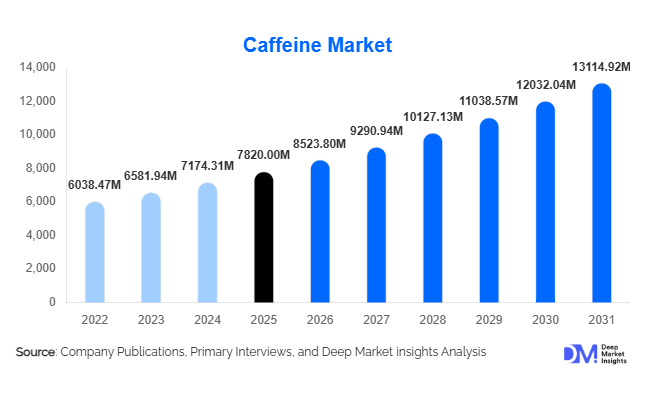
According to Deep Market Insights, the global caffeine market size was valued at USD 7,820 million in 2025 and is projected to grow from USD 8,523.80 million in 2026 to reach USD 13,114.92 million by 2031, expanding at a CAGR of 9.0% during the forecast period (2026–2031). The caffeine market growth is primarily driven by rising global consumption of energy drinks, functional beverages, pharmaceuticals, and nutraceutical products incorporating caffeine as a key active ingredient. Increasing consumer preference for alertness-enhancing products, expanding sports nutrition applications, and the rapid commercialization of ready-to-drink beverages are supporting sustained demand across both developed and emerging economies.
Key Market Insights
- Functional beverages remain the largest demand driver, accounting for a significant share of caffeine consumption globally.
- Synthetic caffeine dominates supply due to cost efficiency, purity consistency, and scalability for industrial applications.
- Asia-Pacific leads consumption growth, supported by expanding energy drink markets and pharmaceutical manufacturing capacity.
- Natural caffeine extraction is gaining traction amid clean-label and plant-based product trends.
- Pharmaceutical-grade caffeine demand is rising due to increased use in pain relief and respiratory medications.
- E-commerce and direct beverage branding are accelerating new product launches globally.
What are the latest trends in the caffeine market?
Shift Toward Natural and Clean-Label Caffeine
Consumers are increasingly seeking naturally sourced caffeine derived from coffee beans, tea leaves, guarana, and yerba mate. Beverage manufacturers are reformulating products to emphasize plant-based sourcing and transparency in ingredient labeling. Natural caffeine is becoming particularly important in premium energy drinks, organic beverages, and functional wellness products. Brands are highlighting origin traceability and sustainable sourcing practices to differentiate products in competitive retail environments. This trend is driving investments in extraction technologies that preserve bioactive compounds while improving yield efficiency.
Expansion of Functional Beverage Ecosystems
The rapid evolution of functional beverages—including energy drinks, cognitive performance beverages, and ready-to-drink coffees—is reshaping caffeine demand patterns. Manufacturers are combining caffeine with adaptogens, amino acids, vitamins, and nootropics to create multifunctional products targeting productivity, focus, and fitness performance. The rise of hybrid beverages positioned between soft drinks and dietary supplements is expanding consumer demographics beyond traditional energy drink consumers, including professionals and health-conscious individuals.
What are the key drivers in the caffeine market?
Growing Energy Drink Consumption
The global expansion of energy drink consumption remains the most significant growth driver for caffeine demand. Urbanization, longer working hours, and lifestyle changes are encouraging consumers to seek quick energy solutions. Emerging economies are witnessing double-digit growth in energy beverage penetration, supported by aggressive marketing and youth-oriented branding strategies.
Rising Pharmaceutical Applications
Caffeine is widely used as an active pharmaceutical ingredient (API) in analgesics, migraine medications, and neonatal respiratory treatments. Pharmaceutical-grade caffeine demand is increasing due to expanding healthcare access and higher production of combination drugs. Its effectiveness in enhancing pain relief absorption continues to support stable industrial demand.
Sports Nutrition and Cognitive Enhancement Trends
The popularity of fitness culture and performance optimization is boosting caffeine usage in pre-workout supplements, fat burners, and cognitive enhancement products. Athletes and professionals increasingly view caffeine as a scientifically validated performance enhancer, driving innovation across nutraceutical formulations.
What are the restraints for the global market?
Regulatory and Health Concerns
Government scrutiny around caffeine consumption limits, labeling standards, and youth-targeted marketing remains a challenge. Several countries have introduced regulations governing caffeine concentration in beverages, creating compliance complexities for manufacturers operating globally.
Raw Material Price Volatility
Natural caffeine extraction depends heavily on coffee and tea supply chains, which are vulnerable to climate variability and agricultural disruptions. Fluctuating raw material costs influence production economics and create pricing uncertainty for manufacturers relying on botanical sources.
What are the key opportunities in the caffeine industry?
Functional Wellness and Nootropic Products
The integration of caffeine into nootropic supplements presents a major opportunity for both established manufacturers and startups. Products designed for mental clarity, productivity enhancement, and stress management are expanding caffeine’s relevance beyond traditional beverages. Growth in remote working cultures and digital professions further supports this opportunity.
Emerging Market Penetration
Rising disposable incomes in Southeast Asia, Latin America, and Africa are creating new demand pools. Local beverage manufacturers are launching region-specific caffeine products tailored to cultural taste preferences, enabling faster adoption rates compared to global standardized offerings.
Advanced Extraction and Sustainable Production
Technological advancements in decaffeination and extraction processes allow higher purity yields with lower environmental impact. Companies investing in green extraction technologies and circular production models are expected to gain competitive advantages as sustainability regulations tighten globally.
Report Scope
| Report Metric | Details |
|---|---|
| Market Size in 2025 | USD 7820 Million |
| Market Size in 2026 | USD 8523.80 Million |
| Market Size in 2031 | USD 13114.92 Million |
| CAGR | 9% (2026-2031) |
| Base Year for Estimation | 2025 |
| Historical Data | 2022-2024 |
| Forecast Period | 2026-2031 |
| Report Coverage | Revenue Forecast, Competitive Landscape, Supply Chain Disruption, Growth Factors, Environment & Regulatory Landscape and Trends |
| Geographies Covered | North America, Europe, APAC, Middle East and Africa, LATAM |
| Countries Covered | U.S., Canada, U.K., Germany, France, Spain, Italy, Russia, Nordic, Benelux, Rest of Europe, China, Korea, Japan, India, Australia, Singapore, Taiwan, South East Asia, Rest of Asia-Pacific, UAE, Turky, Saudi Arabia, South Africa, Egypt, Nigeria, Rest of MEA, Brazil, Mexico, Argentina, Chile, Colombia, Rest of LATAM |
Explore more data points, trends and opportunities Download Free Sample Report
Source Type Insights
The global caffeine market demonstrates a clear structural dominance of synthetic caffeine, which accounted for approximately 62% of total market share in 2025. This leadership position is primarily driven by the scalability, cost efficiency, and standardized purity levels achievable through chemical synthesis processes. Synthetic caffeine production enables manufacturers to maintain consistent alkaloid concentration, uniform particle size distribution, and predictable performance characteristics, all of which are essential for large-scale beverage, pharmaceutical, and nutraceutical applications. As global beverage companies continue to expand production volumes, the need for reliable and uninterrupted ingredient supply has elevated synthetic caffeine as the preferred sourcing option. Its relatively lower production cost compared to naturally extracted caffeine also allows manufacturers to optimize margins while maintaining competitive product pricing across mass-market energy drinks, carbonated beverages, and dietary supplements.Furthermore, synthetic caffeine aligns well with modern industrial manufacturing systems that demand high throughput and precise formulation consistency. Pharmaceutical manufacturers particularly favor synthetic variants because regulatory frameworks require exact dosing accuracy and reproducible compound quality. Advances in chemical synthesis technologies have further improved purity levels, reducing impurities and enhancing safety compliance across global markets. Supply chain stability also contributes to synthetic caffeine’s dominance, as production is less dependent on agricultural variability, climate fluctuations, or crop yield uncertainties.Despite synthetic caffeine’s leadership, natural caffeine is experiencing accelerated growth momentum, particularly within premium and health-oriented product categories. Derived primarily from coffee beans, tea leaves, guarana berries, and yerba mate, natural caffeine is increasingly associated with clean-label positioning and plant-based ingredient sourcing. Consumers are demonstrating growing awareness regarding ingredient transparency, encouraging beverage brands to highlight natural origins as part of broader wellness narratives. This trend is especially visible in organic energy drinks, specialty ready-to-drink coffees, and functional beverages targeting health-conscious demographics.Natural caffeine’s expansion is also supported by evolving regulatory and marketing dynamics that favor recognizable ingredient sourcing. Premium beverage manufacturers leverage natural caffeine claims to differentiate products in saturated markets, enabling higher pricing strategies and improved brand loyalty. Although extraction costs remain higher due to agricultural processing requirements, technological improvements in solvent-free extraction and sustainable sourcing methods are gradually narrowing the cost gap between natural and synthetic variants. As consumer preference continues shifting toward perceived authenticity and sustainability, natural caffeine is expected to capture increasing share within high-value product segments, complementing rather than replacing synthetic caffeine’s industrial-scale dominance.
Form Insights
Anhydrous caffeine powder represents the leading form within the global caffeine market, capturing nearly 55% of total market share in 2025. Its market leadership is strongly linked to functional versatility, extended shelf stability, and superior formulation efficiency across multiple industries. The removal of moisture during processing enhances chemical stability and allows manufacturers to store and transport caffeine without degradation risks, making anhydrous powder particularly suitable for global supply chains.The leading segment driver behind anhydrous caffeine’s dominance lies in its precise dosing capability. Beverage formulators, pharmaceutical manufacturers, and nutraceutical companies require exact measurement control to ensure consistent product efficacy and regulatory compliance. Powdered caffeine enables accurate blending into dry mixes, capsules, tablets, and liquid concentrates, minimizing formulation variability. This precision is especially critical in energy drinks and dietary supplements, where dosage consistency directly impacts consumer safety and product performance.Another factor supporting the segment’s growth is its compatibility with automated manufacturing technologies. Modern production facilities rely on high-speed mixing and encapsulation systems that favor uniform powder inputs. Anhydrous caffeine integrates seamlessly into these processes, reducing production downtime and enhancing operational efficiency. Additionally, the form’s lightweight structure reduces transportation costs compared to liquid or extract-based alternatives, contributing to improved logistics economics for global suppliers.Liquid caffeine and encapsulated formats continue to grow in niche applications, particularly in ready-to-drink beverages and specialized pharmaceutical formulations. However, their adoption remains secondary due to higher storage complexity and shorter shelf life. As manufacturing automation expands globally and precision nutrition products gain popularity, anhydrous caffeine powder is expected to maintain its leading position while benefiting from ongoing advancements in micronization and solubility enhancement technologies.
Application Insights
Beverages dominate global caffeine applications, accounting for approximately 48% of the overall market share. The leading segment driver behind this dominance is the sustained global expansion of energy drinks and ready-to-drink (RTD) coffee categories, both of which rely heavily on caffeine as a functional ingredient delivering alertness, mental focus, and perceived performance enhancement. Rapid urbanization, increasingly demanding work lifestyles, and growing consumer preference for convenient energy solutions continue to reinforce beverage-sector demand.Energy drinks represent one of the fastest-evolving beverage categories worldwide, fueled by younger demographics seeking functional stimulation and lifestyle-oriented branding experiences. Manufacturers are continuously innovating with new flavor profiles, sugar-free variants, and functional ingredient combinations that incorporate vitamins, amino acids, and botanical extracts alongside caffeine. These innovations sustain repeat consumption and expand consumer reach beyond traditional athletic audiences to include students, professionals, and gaming communities.Ready-to-drink coffee products also contribute significantly to caffeine application growth. The premiumization of coffee culture, combined with convenience-focused retail formats, has transformed caffeine consumption patterns globally. Consumers increasingly prefer portable caffeine solutions that eliminate preparation time while maintaining café-style experiences. Retail expansion across supermarkets, convenience stores, and online platforms further accelerates product accessibility, reinforcing beverage sector leadership.Beyond beverages, caffeine applications are diversifying into functional foods, confectionery products, and performance nutrition items. Caffeinated snacks, gums, and protein bars are emerging as alternative delivery systems targeting consumers seeking controlled energy intake throughout the day. These developments broaden caffeine’s role from a traditional stimulant ingredient to a multifunctional component integrated across modern food innovation ecosystems.
Distribution Channel Insights
Business-to-business (B2B) industrial supply channels dominate caffeine distribution, accounting for nearly 70% of total global sales. The leading segment driver is the large-scale procurement requirements of multinational beverage, pharmaceutical, and nutraceutical manufacturers that depend on stable ingredient sourcing through long-term supply agreements. These contracts ensure predictable pricing structures, consistent quality standards, and uninterrupted production continuity.B2B distribution networks operate through specialized ingredient suppliers and chemical distributors capable of managing regulatory documentation, quality certifications, and international logistics coordination. Pharmaceutical-grade caffeine shipments, for instance, require strict compliance with global pharmacopeia standards, reinforcing the importance of established supplier relationships. Bulk purchasing also enables manufacturers to achieve economies of scale, reducing input costs and improving operational planning.The expansion of global manufacturing hubs in Asia has further strengthened B2B dominance, as exporters supply caffeine ingredients to beverage companies worldwide. Digital procurement platforms and integrated supply chain management systems are improving transparency and efficiency, enabling manufacturers to monitor inventory levels and optimize purchasing cycles. While business-to-consumer (B2C) retail sales of caffeine supplements are growing through e-commerce channels, industrial procurement remains the primary revenue contributor due to significantly higher transaction volumes.
End-Use Industry Insights
The beverage industry continues to represent the largest end-use sector within the caffeine market, supported by sustained innovation and global consumption growth. Increasing consumer reliance on functional beverages for energy, productivity, and lifestyle enhancement drives continuous demand expansion. Beverage manufacturers actively explore formulation improvements such as reduced sugar content, natural ingredient sourcing, and hybrid functional blends to maintain competitive differentiation.Nutraceuticals represent the fastest-growing end-use segment, with an estimated CAGR exceeding 10%. The leading growth driver is rising consumer interest in performance optimization, fitness, and cognitive wellness. Caffeine’s scientifically recognized stimulant properties make it a key ingredient in pre-workout supplements, fat-burning formulations, and nootropic products targeting mental focus and endurance. Growth in online fitness communities and personalized nutrition trends further accelerates adoption.Pharmaceutical demand is expanding steadily as caffeine remains widely used in pain relief medications, respiratory treatments, and neonatal care formulations. Growth in generic drug manufacturing, particularly across developing economies, supports consistent pharmaceutical consumption. Increasing healthcare expenditure worldwide and expanding access to affordable medicines reinforce long-term demand stability within this segment.
End-Use Analysis
The beverage industry drives the majority of global caffeine demand, supported by strong growth in energy drinks and ready-to-drink coffee markets, which collectively exceed USD 190 billion in value. The leading driver behind this dominance is the transformation of caffeine from a traditional stimulant into a lifestyle-oriented functional ingredient embedded within modern consumption habits. Consumers increasingly integrate caffeinated beverages into daily routines for productivity enhancement, social experiences, and convenience-driven consumption patterns.Nutraceutical applications are rapidly expanding as consumers seek performance-enhancing supplements aligned with fitness and wellness goals. Pre-workout supplements incorporating caffeine deliver measurable energy and endurance benefits, reinforcing repeat purchase behavior. Advances in formulation science allow manufacturers to combine caffeine with adaptogens, amino acids, and vitamins, creating multifunctional products appealing to health-conscious consumers.Pharmaceutical usage benefits from expanding generic medicine production, particularly across Asia where manufacturing costs remain competitive. Countries such as China and India serve as major export hubs supplying caffeine-based pharmaceutical ingredients globally. Export-oriented manufacturing ecosystems enable efficient large-scale production, strengthening global supply availability and supporting downstream industries.Emerging applications in functional confectionery, caffeinated snacks, and beauty supplements are further diversifying end-use demand channels. Cosmetic formulations increasingly incorporate caffeine for perceived skin-tightening and anti-fatigue properties, illustrating caffeine’s expanding role beyond ingestion-based applications. These emerging use cases highlight the ingredient’s versatility and reinforce long-term market expansion potential.
Explore more data points, trends and opportunities Download Free Sample Report
Caffeine Market Segmentations
By Product Type
- Natural Caffeine
- Synthetic Caffeine
By Source
- Coffee Beans
- Tea Leaves
- Guarana
- Cocoa Beans
- Synthetic Chemical Sources
By Application
- Beverages
- Pharmaceuticals
- Food & Confectionery
- Dietary Supplements & Nutraceuticals
- Cosmetics & Personal Care
By Form
- Powder Caffeine
- Liquid Caffeine Extracts
By Distribution Channel
- B2B Industrial Supply Contracts
- Direct Manufacturer Procurement
- Specialty Ingredient Distributors
- Online Ingredient Marketplaces
Regional Insights
North America
North America accounted for approximately 28% of the global caffeine market in 2025, driven primarily by the United States’ highly developed beverage and dietary supplement industries. Regional growth is strongly supported by high per-capita consumption of energy drinks, functional beverages, and performance supplements. Consumers in the region demonstrate strong acceptance of innovation, encouraging manufacturers to introduce premium formulations featuring natural caffeine sources, reduced sugar content, and functional ingredient blends.The region benefits from advanced retail infrastructure, widespread convenience store networks, and strong e-commerce penetration, all of which enhance product accessibility. Continuous product innovation pipelines and aggressive marketing strategies sustain demand momentum. Additionally, North America’s well-established pharmaceutical industry contributes steady caffeine consumption through over-the-counter medications and prescription formulations. Increasing focus on mental performance, productivity enhancement, and fitness lifestyles further strengthens regional growth prospects.
Europe
Europe maintains stable and mature caffeine demand supported by diversified applications across beverages, pharmaceuticals, and specialty nutrition products. Growth drivers in the region include strong regulatory frameworks that promote high-quality manufacturing standards and encourage pharmaceutical-grade caffeine production. Countries such as Germany, the United Kingdom, France, and Italy play central roles due to advanced food and beverage industries and established coffee consumption traditions.European consumers increasingly prioritize clean-label products and sustainable sourcing practices, driving demand for naturally derived caffeine. The rise of functional beverages with reduced artificial additives aligns with regional health awareness trends. Additionally, pharmaceutical manufacturing excellence across Europe supports consistent industrial demand, while innovation in specialty coffee beverages and premium energy drinks contributes incremental growth.
Asia-Pacific
Asia-Pacific dominates global caffeine consumption with nearly 35% market share in 2025, making it the largest regional market. Rapid urbanization, expanding middle-class populations, and increasing disposable incomes serve as primary growth drivers. Rising adoption of Western-style energy drinks and convenience beverages is reshaping consumption patterns across China, India, Japan, and South Korea.The region also functions as a global manufacturing hub for caffeine production and export. Cost-efficient production capabilities, expanding pharmaceutical manufacturing capacity, and strong agricultural supply chains enhance regional competitiveness. India represents one of the fastest-growing markets, with annual growth exceeding 11%, supported by a young population, increasing workforce participation, and expanding retail distribution networks. Digital commerce growth and aggressive market entry by international beverage brands further accelerate regional expansion.
Latin America
Latin America demonstrates steady growth led by Brazil and Mexico, where strong coffee culture and expanding beverage manufacturing industries drive caffeine consumption. Regional growth drivers include increasing urbanization, rising disposable income levels, and growing popularity of energy drinks among younger consumers. Local beverage manufacturers are actively launching affordable energy drink alternatives tailored to regional tastes, significantly increasing caffeine demand volumes.The presence of large coffee-producing economies also supports natural caffeine extraction opportunities, strengthening regional supply chains. Expansion of modern retail formats and improving distribution infrastructure are enhancing product availability, contributing to sustained market development across the region.
Middle East & Africa
The Middle East and Africa region is emerging as a fast-growing caffeine market, particularly in the United Arab Emirates, Saudi Arabia, and South Africa. A key regional growth driver is favorable demographic structure, characterized by a large youth population with increasing preference for convenience beverages and energy-enhancing products. Urban lifestyle changes, expanding hospitality sectors, and growing modern retail networks are accelerating caffeine consumption trends.Rising disposable income levels and increasing exposure to global beverage brands are encouraging adoption of energy drinks and ready-to-drink coffee products. Additionally, investments in food processing and beverage manufacturing infrastructure are supporting local production capabilities. As consumer awareness regarding functional beverages continues to rise, the region is expected to witness sustained demand growth, positioning it as an important emerging market within the global caffeine industry landscape.
Key Players in the Caffeine Market
- BASF SE
- CSPC Pharmaceutical Group Limited
- Jiangsu Jiuxu Pharmaceutical Co., Ltd.
- Aarti Industries Limited
- Shandong Xinhua Pharmaceutical Company Limited
- Kudos Chemie Limited
- Jilin Shulan Synthetic Pharmaceutical Co., Ltd.
- Foodchem International Corporation
- Hebei Guangxiang Pharmaceutical Co., Ltd.
- Alps Pharmaceutical Industry Co., Ltd.
- Nutra Green Biotechnology Co., Ltd.
- Applied Food Sciences Inc.
- Coffee Science Source
- Teawolf LLC
- Vitaquest International LLC