Cachaça Market Size
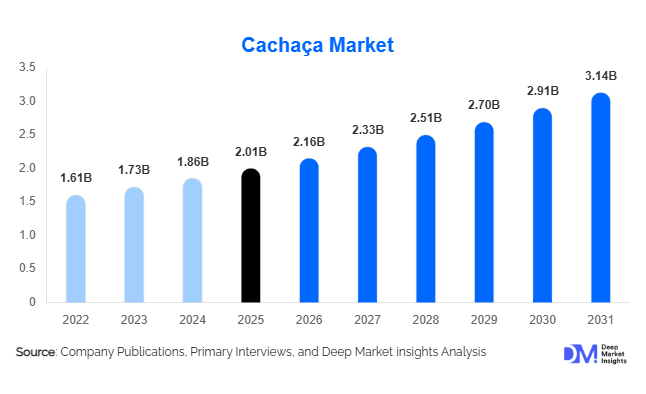
According to Deep Market Insights, the global cachaça market size was valued at USD 2.01 billion in 2025 and is projected to grow from USD 2.16 billion in 2026 to reach USD 3.14 billion by 2031, expanding at a CAGR of 7.7% during the forecast period (2026–2031). The cachaça market growth is primarily driven by rising global demand for premium craft spirits, increasing popularity of Brazilian cocktail culture, and expanding international exports of artisanal sugarcane-based alcoholic beverages.
Key Market Insights
- Premium and artisanal cachaça categories are rapidly gaining market share, driven by rising consumer preference for authentic craft spirits and aged alcoholic beverages.
- Brazil continues to dominate global production and consumption, accounting for more than half of total market demand due to strong domestic consumption and established sugarcane infrastructure.
- North America remains the leading export destination, supported by the rapid expansion of cocktail bars, Latin-themed restaurants, and premium spirits retail channels.
- Asia-Pacific is emerging as the fastest-growing regional market, fueled by increasing urban nightlife culture, premium alcohol experimentation, and rising disposable incomes.
- Online alcohol retailing and direct-to-consumer channels are reshaping distribution, allowing craft distillers to access international consumers more efficiently.
- Sustainability and organic production practices are becoming key competitive differentiators, especially among premium and export-focused brands.
What are the latest trends in the cachaça market?
Premiumization and Barrel-Aged Cachaça Expansion
The global cachaça industry is increasingly shifting toward premium and super-premium offerings as consumers seek differentiated alcoholic beverages with authentic heritage and artisanal craftsmanship. Producers are introducing aged expressions matured in traditional Brazilian woods such as amburana, bálsamo, and jequitibá, creating unique flavor profiles that distinguish cachaça from rum and tequila. Premium packaging, limited-edition releases, and single-origin positioning are also becoming mainstream strategies among leading brands. This trend is particularly strong in North America and Europe, where cocktail culture and luxury spirits consumption continue to expand. High-margin premium products are enabling producers to strengthen export revenues while improving global brand recognition.
Growth of Cocktail Culture and Experiential Consumption
The growing popularity of Latin American cocktails is significantly increasing global awareness of cachaça. Signature beverages such as the Caipirinha are becoming staples in premium bars, restaurants, and hospitality venues worldwide. Mixologists are increasingly using cachaça in tropical cocktails, fusion beverages, and craft cocktail menus, expanding its appeal beyond traditional Brazilian consumption. Hospitality operators are also investing in experiential alcohol programs, including tasting events, Brazilian-themed nightlife experiences, and cocktail masterclasses. Social media influence and experiential dining trends are further accelerating consumer engagement with premium cachaça brands.
What are the key drivers in the cachaça market?
Rising Demand for Craft and Authentic Spirits
The increasing global preference for craft alcoholic beverages is one of the primary drivers supporting cachaça market growth. Consumers are shifting away from mass-produced spirits toward authentic regional products with heritage value and artisanal production methods. Cachaça benefits from this trend due to its traditional sugarcane fermentation process, small-batch distillation methods, and distinctive Brazilian identity. Premium consumers are particularly attracted to aged and wood-finished variants that offer complex flavor profiles comparable to premium rum and whiskey categories. This trend is creating opportunities for producers to position cachaça as a luxury sipping spirit rather than only a cocktail ingredient.
Expansion of Global Cocktail and Hospitality Industries
The growth of cocktail bars, luxury hotels, and experiential dining venues worldwide is significantly boosting cachaça consumption. Urban nightlife expansion, tourism recovery, and rising disposable incomes are supporting premium alcohol demand across hospitality channels. Latin American-themed bars and restaurants are increasingly incorporating cachaça into curated cocktail menus, improving consumer familiarity with the category. Additionally, the rapid expansion of international travel retail and duty-free alcohol sales is helping premium cachaça brands penetrate high-value consumer segments globally.
What are the restraints for the global market?
Regulatory Complexity and Export Barriers
The cachaça market faces challenges related to alcohol regulations, import duties, labeling standards, and licensing requirements across different countries. Smaller artisanal distillers often struggle with compliance costs associated with export certification and international distribution. Variations in taxation frameworks and advertising restrictions also create operational challenges for global market expansion. These barriers can limit international scalability for small and medium-sized producers seeking to enter premium export markets.
Competition from Established Global Spirits
Cachaça competes with globally established spirit categories such as tequila, rum, vodka, whiskey, and gin, all of which possess stronger consumer recognition and distribution networks. Outside Brazil, consumer awareness of cachaça remains comparatively limited, requiring substantial investments in marketing, hospitality partnerships, and brand education. Intense competition within premium spirits categories also places pricing pressure on new entrants and smaller craft producers attempting to expand internationally.
What are the key opportunities in the cachaça industry?
Ready-to-Drink (RTD) Cocktail Innovations
The rapid growth of the global RTD alcoholic beverage market presents strong opportunities for cachaça producers. Younger consumers increasingly prefer convenient canned cocktails and flavored alcoholic beverages that combine premium taste with portability. Cachaça-based tropical cocktails, fruit-infused beverages, and low-calorie RTD variants are gaining popularity in urban markets across North America, Europe, and Asia-Pacific. This segment enables producers to diversify revenue streams beyond traditional bottled spirits while attracting younger demographics interested in convenience-driven alcohol consumption.
Export Expansion Across Emerging Premium Alcohol Markets
International demand for premium imported spirits is increasing significantly across Asia-Pacific and the Middle East. Countries such as Japan, China, South Korea, India, and the UAE are witnessing rapid growth in luxury hospitality, cocktail culture, and premium alcohol retailing. These markets provide long-term export opportunities for Brazilian cachaça producers seeking geographic diversification. Government-backed export promotion initiatives and expanding e-commerce alcohol distribution are further supporting international market penetration for premium artisanal brands.
Report Scope
| Report Metric | Details |
|---|---|
| Market Size in 2025 | USD 2.01 Billion |
| Market Size in 2026 | USD 2.16 Billion |
| Market Size in 2031 | USD 3.14 Billion |
| CAGR | 7.7% (2026-2031) |
| Base Year for Estimation | 2025 |
| Historical Data | 2022-2024 |
| Forecast Period | 2026-2031 |
| Report Coverage | Revenue Forecast, Competitive Landscape, Supply Chain Disruption, Growth Factors, Environment & Regulatory Landscape and Trends |
| Geographies Covered | North America, Europe, APAC, Middle East and Africa, LATAM |
| Countries Covered | U.S., Canada, U.K., Germany, France, Spain, Italy, Russia, Nordic, Benelux, Rest of Europe, China, Korea, Japan, India, Australia, Singapore, Taiwan, South East Asia, Rest of Asia-Pacific, UAE, Turky, Saudi Arabia, South Africa, Egypt, Nigeria, Rest of MEA, Brazil, Mexico, Argentina, Chile, Colombia, Rest of LATAM |
Explore more data points, trends and opportunities Download Free Sample Report
Product Type Insights
The global cachaça market is witnessing strong transformation as premiumization, authenticity, and craft spirit consumption continue to reshape purchasing behavior across both domestic and international markets. Among all product categories, artisanal and craft cachaça remain the leading contributors to premium value generation, accounting for nearly 38% of total market value in 2025. The rapid expansion of this segment is primarily driven by rising consumer preference for handcrafted alcoholic beverages that offer cultural heritage, superior production quality, and unique flavor profiles. Consumers increasingly associate craft cachaça with authenticity, traditional Brazilian distillation methods, and premium sugarcane sourcing, making it highly attractive within the growing global premium spirits industry.Industrial cachaça continues to maintain significant volume demand due to its affordability, broad accessibility, and dominant role within Brazil’s domestic alcohol market. Large-scale distillation facilities continue to benefit from efficient sugarcane supply chains and strong retail penetration throughout Latin America. Economy and mid-range products remain highly consumed among traditional consumers and mass-market hospitality channels where affordability and high-volume sales remain critical purchasing factors. Despite slower premium value growth compared to artisanal categories, industrial cachaça maintains an essential role in sustaining overall market consumption.Organic and sustainably produced cachaça is also emerging as a niche but rapidly expanding segment within the global market. Environmentally conscious consumers increasingly seek alcoholic beverages that incorporate traceable sugarcane sourcing, eco-friendly farming practices, and reduced environmental impact. Producers are responding through investments in organic certifications, renewable energy usage, sustainable packaging solutions, and carbon-conscious distillation processes. The sustainability movement within premium alcoholic beverages is expected to create additional long-term growth opportunities for organic cachaça manufacturers targeting health-conscious and environmentally aware consumers.
Application Insights
Cocktails and mixology applications account for the largest share of global cachaça consumption, representing approximately 41% of total market demand in 2025. The leading position of this segment is being driven by the continued globalization of cocktail culture, the growing popularity of tropical alcoholic beverages, and rising demand for experiential nightlife consumption. The Caipirinha remains the most widely consumed cachaça-based cocktail worldwide and continues to serve as the primary gateway for international consumer adoption. Increasing presence of Brazilian-themed restaurants, Latin-inspired bars, and tropical hospitality concepts is significantly supporting global cocktail-driven demand.The expansion of premium mixology culture across urban markets is further accelerating cachaça usage in cocktail innovation. Bartenders and mixologists increasingly utilize artisanal and aged cachaça variants in signature drinks due to their distinctive sugarcane flavor profiles and versatility within tropical and fruit-forward cocktails. The growth of social media beverage culture is also contributing to stronger consumer awareness, particularly among younger demographics seeking visually appealing and globally inspired alcoholic beverages. Cocktail festivals, mixology competitions, and influencer-driven beverage marketing continue to strengthen category visibility across North America, Europe, and Asia-Pacific.Culinary applications are also gradually expanding commercial demand for cachaça within gourmet food preparation and fusion cuisine development. Restaurants and premium food brands increasingly utilize cachaça in marinades, desserts, sauces, confectionery products, and upscale culinary recipes due to its aromatic profile and sugarcane-derived sweetness. Brazilian cuisine’s rising international popularity is further supporting the integration of cachaça into culinary innovation across hospitality and foodservice industries.Additionally, the growing ready-to-drink beverage industry is creating substantial opportunities for flavored and pre-mixed cachaça products. RTD cocktails appeal strongly to younger consumers seeking convenience, portability, and low-preparation alcoholic beverage options. Manufacturers are increasingly launching fruit-infused variants, sparkling cachaça cocktails, and tropical beverage blends targeting urban nightlife consumption and casual social occasions. Rising demand for convenient premium alcoholic beverages is expected to accelerate long-term growth across this application segment.
Distribution Channel Insights
Off-trade retail channels continue to dominate the global cachaça market, accounting for nearly 44% of total sales in 2025. The strong position of this segment is driven by widespread consumer preference for retail alcohol purchases, expanding premium liquor sections within supermarkets, and growing accessibility of imported spirits through organized retail infrastructure. Supermarkets, liquor specialty stores, hypermarkets, and wholesale retail chains remain the primary sales channels for both mainstream and premium cachaça products across domestic and export markets.The leading growth driver for off-trade retail channels is the increasing consumer tendency to purchase premium alcoholic beverages for home consumption, gifting, and social gatherings. Consumers are increasingly exploring premium spirits outside traditional hospitality environments, particularly as home mixology trends continue to expand globally. Retailers are responding by expanding shelf space for imported spirits, craft alcoholic beverages, and luxury alcohol collections, thereby improving cachaça visibility among broader consumer groups.Online alcohol retailing represents the fastest-growing distribution segment within the cachaça market due to accelerating e-commerce adoption and changing consumer purchasing behavior. Digital alcohol platforms allow consumers to access premium imported products that may not be widely available through physical retail stores. Producers are increasingly leveraging direct-to-consumer sales strategies, subscription alcohol services, and digital brand campaigns to improve customer engagement and strengthen international market penetration.On-trade distribution channels including bars, restaurants, hotels, lounges, and nightclubs remain critically important for premium brand positioning and consumer education. Cocktail-focused hospitality venues play a major role in introducing international consumers to cachaça-based beverages and premium sipping expressions. Luxury hotels and upscale dining establishments increasingly incorporate artisanal cachaça into curated cocktail menus and premium spirit offerings to satisfy rising demand for exotic and craft alcoholic beverages.
Consumer Demographic Insights
Millennials and Generation Z consumers represent the fastest-growing demographic segments within the global cachaça market. The leading driver supporting this demographic expansion is the increasing interest among younger consumers in craft cocktails, premium spirits experimentation, and culturally diverse drinking experiences. Younger consumers actively seek unique alcoholic beverages that align with social experiences, nightlife culture, and digital lifestyle trends, making cachaça highly attractive within experiential consumption environments.Social media influence continues to play a major role in shaping beverage purchasing behavior among younger demographics. Platforms featuring cocktail tutorials, nightlife content, premium beverage aesthetics, and travel-inspired experiences are significantly increasing awareness of cachaça products across global urban markets. Flavored variants, ready-to-drink cocktails, and visually distinctive premium packaging are particularly appealing to younger consumers who prioritize innovation, convenience, and shareable social experiences.Traditional consumers within Brazil continue to maintain strong demand for industrial and economy-grade cachaça products due to cultural familiarity, affordability, and widespread availability. Domestic consumption remains deeply integrated within Brazilian social traditions, celebrations, and casual drinking culture. However, affluent urban professionals within Brazil are increasingly shifting toward premium and super-premium variants as disposable incomes rise and premiumization trends strengthen throughout the domestic spirits industry.Luxury gifting culture is also contributing to stronger demand for reserve editions, collectible bottles, and long-aged cachaça products among high-income consumers. Premium packaging, handcrafted presentation, and limited-edition releases are becoming increasingly important purchasing factors within luxury consumer segments globally.
Price Category Insights
Premium and super-premium cachaça categories collectively accounted for nearly 36% of total global market value in 2025 despite contributing a smaller share of overall volume consumption. The primary growth driver behind this segment is the ongoing premiumization trend across the global alcoholic beverage industry, where consumers increasingly prioritize quality, authenticity, and exclusivity over low-cost mass-market products.Rising disposable incomes and expanding middle-class populations in emerging economies are supporting stronger consumer willingness to spend on high-end alcoholic beverages. Consumers increasingly perceive premium cachaça as a sophisticated spirit suitable for gifting, sipping, and luxury hospitality experiences. This perception is helping producers command higher price margins while strengthening brand differentiation in a highly competitive international spirits market.Super-premium and luxury cachaça products featuring extended aging periods, handcrafted bottles, limited production runs, and heritage branding continue to record strong demand growth across export markets. International consumers are increasingly drawn to artisanal Brazilian spirits that offer cultural uniqueness and premium craftsmanship comparable to high-end tequila, rum, and whiskey categories.Manufacturers throughout the cachaça industry are increasingly adopting premiumization strategies to improve profitability and strengthen long-term market positioning. Investments in barrel aging, premium branding, export-oriented packaging, sustainable production practices, and product innovation are helping producers capture greater value within international markets. The growing overlap between luxury hospitality, cocktail culture, and experiential alcohol consumption is expected to further strengthen demand for premium price categories through 2031.
Explore more data points, trends and opportunities Download Free Sample Report
Cachaça Market Segmentations
By Product Type
- Industrial Cachaça
- Artisanal / Craft Cachaça
- Premium & Super-Premium Cachaça
- Aged Cachaça
- Flavored & Infused Cachaça
By Application
- Direct Consumption
- Cocktails & Mixology
- Ready-to-Drink (RTD) Beverages
- Culinary Applications
By Distribution Channel
- Supermarkets & Hypermarkets
- Liquor Specialty Stores
- Bars, Restaurants & Hotels
- Online Retail & Alcohol E-commerce
- Duty-Free & Travel Retail
By Packaging Type
- Glass Bottles
- PET Bottles
- Cans & RTD Packaging
- Premium Collectible Packaging
By Consumer Demographic
- Millennials
- Generation Z
- Premium Spirits Enthusiasts
- Traditional Consumers
- Cocktail Consumers
Regional Insights
North America
North America accounted for nearly 16% of the global cachaça market in 2025, led primarily by the United States. Regional growth is being strongly supported by expanding cocktail culture, rising demand for premium imported spirits, and increasing consumer openness toward experimental alcoholic beverages. The U.S. market continues to benefit from the rapid expansion of craft cocktail bars, Latin American-themed restaurants, and premium nightlife venues where cachaça-based beverages are gaining popularity among urban consumers.The leading driver for regional growth is the increasing consumer preference for artisanal and premium spirits offering authenticity and cultural differentiation. American consumers are increasingly exploring alternatives to traditional spirits such as whiskey, vodka, and rum, creating favorable conditions for imported cachaça brands. Growing awareness of Brazilian culture, tourism influence, and tropical beverage trends are further accelerating category penetration across major metropolitan markets.Canada is also witnessing steady market expansion supported by multicultural consumption patterns, premium liquor retailing, and rising interest in imported craft alcohol products. E-commerce alcohol retailing and premium hospitality development continue to improve product accessibility and brand visibility across the North American market.
Europe
Europe represents approximately 14% of global cachaça demand, driven by strong consumption across Germany, the United Kingdom, France, Spain, and Portugal. Germany remains one of the leading European importers due to its mature cocktail industry, strong nightlife economy, and established Brazilian diaspora population. The region’s advanced premium spirits market provides favorable conditions for artisanal and aged cachaça products targeting sophisticated consumers.Tourism-driven hospitality growth across Southern Europe is further contributing to rising cachaça consumption within luxury hotels, beach resorts, restaurants, and entertainment venues. International tourism recovery, combined with increasing demand for experiential dining and nightlife experiences, continues to support premium alcohol sales across the region.
Asia-Pacific
Asia-Pacific is the fastest-growing regional market and is projected to expand at a CAGR exceeding 9% through 2031. The region’s rapid growth is being driven by rising urbanization, increasing disposable incomes, expanding nightlife industries, and strong premiumization trends across alcoholic beverages. Consumers throughout Asia-Pacific increasingly seek international premium spirits associated with luxury lifestyles and modern social experiences.Japan leads premium imported cachaça consumption within the region due to its sophisticated spirits culture and appreciation for artisanal alcohol craftsmanship. Japanese consumers demonstrate strong interest in aged spirits, refined flavor profiles, and high-quality imported beverages, creating substantial opportunities for premium cachaça producers.The rapid development of digital alcohol retailing and premium e-commerce infrastructure across Asia-Pacific is also improving consumer access to imported alcoholic beverages. Rising demand for premium experiential consumption is expected to continue driving long-term regional market growth.
Latin America
Latin America remains the dominant regional market, accounting for approximately 58% of global cachaça consumption in 2025. Brazil alone represented nearly 52% of global market value due to its extensive sugarcane production infrastructure, large domestic consumer base, and deeply rooted cultural association with cachaça consumption.The primary growth driver within Latin America is the strong domestic demand supported by cultural traditions, social consumption patterns, and established distribution networks. Cachaça remains one of the most widely consumed alcoholic beverages in Brazil and continues to play a major role within festivals, celebrations, hospitality, and everyday social occasionsArgentina, Chile, and Colombia are gradually emerging as secondary growth markets due to increasing cocktail culture, hospitality expansion, and premium alcohol demand. Regional tourism development and growing exposure to Brazilian cuisine and nightlife trends are further contributing to broader cachaça adoption across Latin America.
Middle East & Africa
The Middle East & Africa region is experiencing gradual but consistent growth led by the UAE and South Africa. Regional market expansion is primarily supported by luxury tourism growth, rising premium hospitality investments, and increasing demand for imported high-end alcoholic beverages within affluent urban consumer segments.Dubai’s luxury hotel industry, international tourism ecosystem, and upscale nightlife culture are creating favorable conditions for premium imported spirits including artisanal cachaça products. Luxury bars, rooftop lounges, and fine dining establishments increasingly incorporate exotic cocktails and international premium spirits to cater to global tourists and high-income consumers.Growth across the broader Middle East & Africa region is additionally supported by international hotel expansion, tourism infrastructure development, and increasing consumer exposure to global beverage trends. As luxury hospitality and experiential dining industries continue to expand, demand for premium and craft cachaça products is expected to strengthen steadily throughout the forecast period.
Key Players in the Cachaça Market
- Companhia Müller de Bebidas
- Ypióca
- Novo Fogo
- Leblon Cachaça
- Sagatiba
- Weber Haus
- Velho Barreiro
- Cachaça Germana
- Seleta
- Santo Grau