Cabbage Market Size
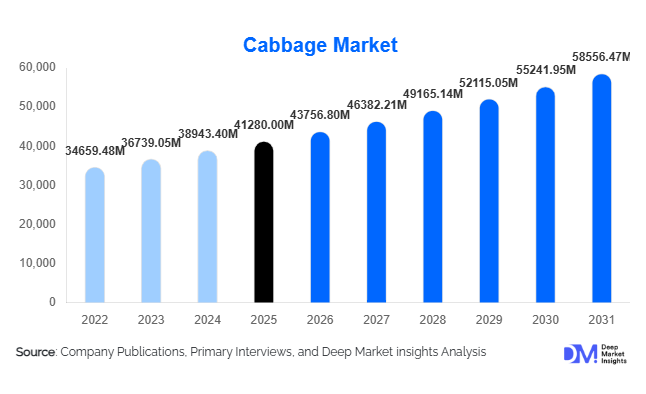
According to Deep Market Insights, the global cabbage market size was valued at USD 41,280 million in 2025 and is projected to grow from USD 43,756.80 million in 2026 to reach approximately USD 58,556.47 million by 2031, expanding at a CAGR of 6.0% during the forecast period (2026–2031). Market expansion is primarily driven by rising global vegetable consumption, increasing adoption of healthy diets, growth in processed food applications such as fermented foods and ready-to-cook vegetables, and expanding export-oriented horticulture production across Asia-Pacific and Europe. Increasing consumer awareness regarding nutrient-dense vegetables, combined with growing demand for affordable staple vegetables, has positioned cabbage as a key crop within global fresh produce supply chains.
Key Market Insights
- Fresh cabbage dominates global consumption, accounting for the majority of market value due to widespread culinary usage across Asia and Europe.
- Asia-Pacific leads production and consumption, supported by large-scale cultivation in China and India.
- Processed cabbage products such as kimchi, sauerkraut, and packaged salads are expanding rapidly in developed markets.
- Retail modernization and cold-chain expansion are improving shelf life and international trade volumes.
- Organic cabbage farming is gaining traction amid growing demand for chemical-free vegetables.
- Export-driven agriculture policies in emerging economies are strengthening global cabbage supply networks.
What are the latest trends in the cabbage market?
Growth of Functional and Fermented Foods
Fermented cabbage products such as kimchi, sauerkraut, and probiotic-rich packaged foods are witnessing strong global demand due to increasing consumer focus on gut health and immunity. Food manufacturers are integrating cabbage into functional food formulations, leveraging its fiber, antioxidant, and vitamin content. Retail-ready fermented foods have expanded significantly in North America and Europe, supported by premium branding and health-driven marketing. Restaurants and quick-service food chains are also incorporating cabbage-based dishes into plant-forward menus, reinforcing steady demand growth.
Technology-Driven Supply Chain Optimization
Technological advancements in precision farming, greenhouse cultivation, and post-harvest management are transforming cabbage production efficiency. Farmers are adopting drip irrigation, climate-controlled storage, and AI-based crop monitoring systems to improve yield consistency and reduce spoilage. Digital agricultural marketplaces are improving price transparency and enabling direct farm-to-retail distribution models. Cold-chain logistics investments are particularly important for export markets, helping reduce wastage and enabling long-distance shipment of fresh produce.
What are the key drivers in the cabbage market?
Rising Demand for Affordable Nutritious Vegetables
Cabbage remains one of the most cost-effective vegetables globally, making it a staple across developing and developed economies alike. Rising food inflation has shifted consumer preferences toward affordable vegetables with high nutritional density. Governments promoting vegetable consumption through dietary programs have further strengthened demand. Urban households increasingly prefer vegetables with longer shelf life, which favors cabbage compared to highly perishable leafy greens.
Expansion of Processed and Convenience Food Industry
The rapid growth of ready-to-cook meals, packaged salads, frozen vegetables, and fermented foods is significantly boosting cabbage consumption. Food processors value cabbage due to its versatility, stable supply availability, and compatibility with automated processing lines. Growth of quick-service restaurants and meal-kit services globally has further accelerated industrial demand.
Export-Oriented Horticulture Development
Countries across Asia and Europe are investing heavily in vegetable export programs to diversify agricultural revenues. Improved logistics infrastructure, trade agreements, and standardized grading systems are enabling cabbage exports to expand steadily. Increasing demand from Middle Eastern and Southeast Asian import markets is strengthening cross-border vegetable trade.
What are the restraints for the global market?
Price Volatility Due to Weather Dependency
Cabbage production remains highly dependent on climatic conditions. Extreme weather events, irregular rainfall patterns, and pest outbreaks create supply fluctuations that impact pricing stability. Seasonal oversupply in producing regions can also reduce farmer profitability.
Post-Harvest Losses and Logistics Constraints
In emerging markets, inadequate cold storage and fragmented distribution channels result in significant post-harvest losses. Transportation inefficiencies increase spoilage risks and reduce export competitiveness, limiting market value realization.
What are the key opportunities in the cabbage industry?
Expansion of Organic and Sustainable Farming
Organic vegetable consumption is increasing globally, creating opportunities for premium cabbage varieties cultivated using sustainable farming practices. Retailers are expanding organic produce sections, while certification programs allow farmers to command higher margins. Sustainable agriculture initiatives supported by governments and international organizations are encouraging reduced pesticide usage and regenerative farming models.
Value-Added Processing and Packaged Vegetables
The rise of convenience-oriented lifestyles presents opportunities in shredded cabbage, coleslaw mixes, fermented foods, frozen vegetables, and ready-to-cook meal components. Processing companies can enhance profitability by moving up the value chain, reducing reliance on raw commodity pricing.
Emerging Market Urbanization
Rapid urban population growth across Asia, Africa, and Latin America is expanding supermarket penetration and organized retail formats. This transformation supports consistent demand for standardized and packaged vegetables. Urban consumers increasingly prefer pre-cleaned and hygienically packaged produce, creating opportunities for branded cabbage suppliers and exporters.
Report Scope
| Report Metric | Details |
|---|---|
| Market Size in 2025 | USD 41280 Million |
| Market Size in 2026 | USD 43756.80 Million |
| Market Size in 2031 | USD 58556.47 Million |
| CAGR | 6% (2026-2031) |
| Base Year for Estimation | 2025 |
| Historical Data | 2022-2024 |
| Forecast Period | 2026-2031 |
| Report Coverage | Revenue Forecast, Competitive Landscape, Supply Chain Disruption, Growth Factors, Environment & Regulatory Landscape and Trends |
| Geographies Covered | North America, Europe, APAC, Middle East and Africa, LATAM |
| Countries Covered | U.S., Canada, U.K., Germany, France, Spain, Italy, Russia, Nordic, Benelux, Rest of Europe, China, Korea, Japan, India, Australia, Singapore, Taiwan, South East Asia, Rest of Asia-Pacific, UAE, Turky, Saudi Arabia, South Africa, Egypt, Nigeria, Rest of MEA, Brazil, Mexico, Argentina, Chile, Colombia, Rest of LATAM |
Explore more data points, trends and opportunities Download Free Sample Report
Product Type Insights
The global cabbage market demonstrates a diversified product landscape shaped by culinary traditions, agricultural adaptability, and evolving consumer preferences. Among all product categories, green cabbage continues to dominate the global market, accounting for approximately 52% of the total market share in 2025. Its leadership position is primarily attributed to its widespread cultivation across climatic regions, cost efficiency, and exceptional versatility in both raw and cooked applications. Green cabbage remains a staple ingredient across household kitchens, foodservice establishments, and food processing industries due to its neutral flavor profile, durability during transportation, and extended storage life compared to other leafy vegetables. These characteristics significantly reduce post-harvest losses, making it highly attractive for commercial farming and large-scale distribution systems.The dominance of green cabbage is further reinforced by its compatibility with diverse cuisines ranging from Asian stir-fries and European soups to American coleslaw preparations and Middle Eastern salads. The affordability factor also plays a critical role, particularly in emerging economies where cabbage serves as a nutrient-dense yet economical vegetable option. Large agricultural producers favor green cabbage varieties because they offer predictable yields, mechanized harvesting compatibility, and resilience to transportation stress, all of which strengthen supply chain efficiency.Napa cabbage holds strong regional dominance, particularly across East Asian countries where it serves as a foundational ingredient in fermented foods and traditional dishes. The growing global popularity of Korean and Chinese cuisine has elevated international demand for napa cabbage, especially within export-oriented agricultural systems. Its suitability for fermentation processes, including kimchi and pickled vegetables, supports consistent industrial demand from food processors. As fermented foods gain recognition for gut health benefits worldwide, napa cabbage is expected to experience sustained long-term growth supported by both cultural consumption patterns and health-driven dietary trends.
Form Insights
Based on form, the cabbage market is segmented into fresh and processed products, each addressing distinct consumer needs and distribution structures. Fresh cabbage remains the dominant category globally, accounting for nearly 68% market share in 2025. The segment’s leadership is driven primarily by strong household consumption patterns, particularly in developing economies where fresh produce markets remain central to daily food purchasing behavior. Consumers continue to favor fresh cabbage due to its affordability, perceived nutritional superiority, and adaptability in home cooking.The leading driver behind the fresh segment is its integration into daily diets across multiple regions combined with minimal processing requirements. Fresh cabbage maintains high demand within foodservice operations, including restaurants, institutional kitchens, and street food vendors, where bulk purchasing supports operational efficiency. Improvements in cold-chain infrastructure and transportation logistics have further strengthened fresh cabbage distribution, enabling longer-distance trade while maintaining quality standards.Fresh-cut and ready-to-cook cabbage formats are emerging as the fastest-growing subsegment within developed retail environments. Supermarkets and online grocery platforms increasingly stock pre-shredded cabbage mixes, salad kits, and meal preparation packs designed to reduce preparation time for consumers. This trend is particularly pronounced in North America and Western Europe, where convenience purchasing strongly influences consumer decisions. Food safety advancements, modified atmosphere packaging, and improved shelf-life technologies are enabling retailers to expand processed cabbage offerings while minimizing waste.
Nature Insights
From a production standpoint, conventional cabbage cultivation dominates global supply chains, accounting for approximately 82% of total production volume. The primary driver supporting conventional farming leadership is large-scale agricultural efficiency. Conventional methods allow farmers to achieve higher yields, standardized crop quality, and cost-effective production suitable for mass-market distribution. Mechanized farming practices, hybrid seed adoption, and established fertilizer systems further enhance productivity, enabling consistent supply to meet global consumption demand.However, organic cabbage represents the fastest-growing segment within the nature category, reflecting a structural shift in consumer purchasing priorities. Increasing concerns regarding pesticide exposure, environmental sustainability, and soil health are encouraging consumers to transition toward certified organic produce. Retailers and foodservice operators are expanding organic vegetable assortments to meet premium consumer expectations, particularly in developed economies where purchasing power supports higher price points.The leading growth driver for organic cabbage lies in rising awareness of clean-label food consumption combined with regulatory support for sustainable agriculture. Governments across Europe and North America are promoting organic farming through subsidies and certification frameworks, encouraging farmers to diversify cultivation practices. Additionally, younger consumers increasingly associate organic produce with environmental responsibility, contributing to long-term demand expansion. Although organic production currently represents a smaller share due to higher costs and lower yields, advancements in sustainable farming technologies are expected to gradually narrow the price gap between organic and conventional products.
Distribution Channel Insights
The distribution structure of the global cabbage market reflects regional economic diversity and varying retail development stages. Wholesale markets and traditional distribution channels collectively account for approximately 45% of global market share, particularly across Asia, Africa, and Latin America. These systems remain essential for connecting smallholder farmers with urban markets, ensuring rapid turnover of perishable produce. Open markets and local vendors continue to dominate fresh vegetable sales in developing economies due to affordability, accessibility, and cultural purchasing habits.The primary driver sustaining wholesale dominance is supply chain efficiency in high-volume agricultural regions where centralized distribution reduces transportation costs and facilitates price competitiveness. Informal distribution networks also allow flexible pricing mechanisms, benefiting both producers and consumers in price-sensitive markets.Modern retail channels, including supermarkets and hypermarkets, are expanding rapidly worldwide as organized retail penetration increases. These outlets provide standardized quality control, attractive packaging, and improved storage conditions, enhancing consumer confidence in fresh produce purchases. Retail chains are also investing heavily in private-label fresh vegetables, strengthening procurement partnerships with farmers and agricultural cooperatives.Online grocery platforms are emerging as a high-growth distribution channel, particularly in urban centers where digital adoption and home delivery services are expanding rapidly. The leading driver behind online grocery growth is convenience combined with improved last-mile delivery infrastructure. Consumers increasingly prefer doorstep delivery of fresh produce, especially following behavioral shifts toward digital purchasing habits. Subscription-based vegetable boxes and farm-direct delivery models are also gaining traction, allowing producers to establish direct relationships with consumers while improving margins.
End-Use Insights
Household consumption remains the largest end-use segment, accounting for nearly 60% of global cabbage demand. The segment’s dominance is driven by cabbage’s role as a staple vegetable integrated into daily meals across cultures. Its affordability, nutritional density, and long storage life make it particularly attractive for families seeking cost-effective healthy food options. Home cooking trends, especially in emerging markets, continue to support consistent demand growth.Foodservice demand represents a rapidly expanding segment fueled by global restaurant industry growth and changing dining habits. Quick-service restaurants, casual dining chains, and street food vendors increasingly incorporate cabbage into menus due to its versatility and low ingredient cost. Cabbage is widely used in wraps, salads, soups, and plant-based menu items, aligning with consumer demand for healthier and vegetable-forward meal options.The fastest-growing end-use segment is food processing, supported by rising demand for fermented foods, packaged salads, and ready-to-eat meals. The leading driver for this segment is industrial scalability, as cabbage offers high processing yield and relatively low raw material cost compared to other vegetables. Manufacturers benefit from consistent texture retention during fermentation and cooking processes, making cabbage highly suitable for large-scale production environments.
End-Use Industry Analysis
The food processing industry is emerging as a critical growth engine for the global cabbage market, expanding at an annual rate exceeding 7%. The increasing popularity of fermented foods, driven by consumer awareness of digestive health and probiotic nutrition, has significantly boosted industrial cabbage utilization. Products such as kimchi, sauerkraut, pickled vegetables, and packaged coleslaw mixes are gaining international acceptance, creating cross-border trade opportunities for cabbage-producing countries.Restaurants and quick-service chains are also increasing cabbage usage as part of evolving menu innovation strategies. The rise of plant-based diets and vegetable-centric meals has encouraged chefs to integrate cabbage into diverse culinary formats, including vegan bowls, tacos, wraps, and salads. Its ability to absorb flavors while maintaining texture makes it particularly attractive for modern food preparation techniques.Export-driven demand further strengthens industry growth, especially from Middle Eastern countries that rely heavily on imported vegetables due to climatic constraints. Global trade expansion, supported by improved refrigeration technologies and logistics infrastructure, enables year-round cabbage availability across international markets. The broader processed vegetable industry, valued above USD 320 billion globally, continues to generate sustained demand for cabbage as a reliable, cost-efficient raw material with strong processing adaptability.
Explore more data points, trends and opportunities Download Free Sample Report
Cabbage Market Segmentations
By Product Type
- Green Cabbage
- Red/Purple Cabbage
- Savoy Cabbage
- Napa/Chinese Cabbage
- Specialty & Hybrid Varieties
By Form
- Fresh Whole Cabbage
- Processed Cabbage
- Frozen Cabbage
- Fermented Cabbage
- Dehydrated & Powdered Cabbage
By Cultivation Type
- Conventional Farming
- Organic Farming
- Protected Cultivation
By Application
- Household Consumption
- Food Processing Industry
- Foodservice & HoReCa
- Animal Feed & By-products
- Nutraceutical & Functional Food Applications
By Distribution Channel
- Wholesale Markets & Mandis
- Modern Retail & Supermarkets
- Online Grocery Platforms
- Direct Farm-to-Consumer Sales
- Food Processing Procurement Contracts
Regional Insights
Asia-Pacific
Asia-Pacific dominates the global cabbage market, accounting for approximately 54% of total market share in 2025, making it both the largest production and consumption hub worldwide. China leads global output due to extensive agricultural land availability, advanced vegetable farming systems, and strong domestic consumption patterns. Large-scale farming operations supported by government agricultural policies enable consistent year-round supply.India follows as a major producer, benefiting from diverse climatic zones that allow multiple cultivation cycles annually. Expanding vegetable consumption driven by population growth, urbanization, and increasing nutritional awareness continues to strengthen domestic demand. Japan and South Korea contribute significantly to regional consumption through fermented food traditions, particularly kimchi production, which maintains stable industrial demand for napa cabbage varieties.Key regional growth drivers include rising urban populations, expanding middle-class income levels, improved cold-chain logistics, and strong cultural integration of cabbage into traditional diets. Additionally, rapid growth in organized retail and food delivery platforms across Southeast Asia is accelerating vegetable consumption. Governments across the region are investing in agricultural modernization and export-oriented farming, further supporting long-term market expansion.
Europe
Europe accounts for nearly 20% of global cabbage market share, characterized by stable consumption patterns and strong processing industry integration. Germany, Poland, the Netherlands, and France remain leading producers and consumers, supported by well-developed agricultural infrastructure and efficient supply chains. Traditional foods such as sauerkraut continue to sustain consistent demand across Central and Eastern Europe, where cabbage consumption per capita remains among the highest globally.Regional growth is primarily driven by increasing demand for organic produce, sustainability-focused agriculture, and premium packaged vegetables. Western European consumers are increasingly prioritizing locally sourced and environmentally certified produce, encouraging farmers to adopt organic cultivation practices. Technological advancements in greenhouse farming and precision agriculture are improving yields while reducing environmental impact.The expansion of plant-based diets across Europe also acts as a major growth catalyst. Consumers seeking healthier and environmentally friendly food alternatives are increasing vegetable intake, directly supporting cabbage consumption across retail and foodservice sectors.
North America
North America represents a mature yet steadily expanding cabbage market led by the United States, where consumption is strongly linked to packaged salads, coleslaw mixes, and fermented food products. Retail-ready fresh-cut vegetables serve as the primary growth driver, supported by consumer demand for convenience and healthy meal solutions. Food manufacturers increasingly incorporate cabbage into meal kits and ready-to-eat offerings targeting busy urban consumers.Canada contributes steady growth supported by rising health consciousness and increasing vegetable consumption trends. The region benefits from advanced cold storage infrastructure, efficient logistics networks, and strong supermarket penetration, enabling consistent availability of fresh and processed cabbage products throughout the year.Additional regional drivers include rising interest in probiotic foods, expansion of plant-based eating habits, and increasing multicultural culinary influences introducing Asian cabbage-based dishes into mainstream consumption.
Middle East & Africa
The Middle East and Africa region remains highly import-dependent due to limited domestic agricultural capacity in arid climates. Countries such as the United Arab Emirates and Saudi Arabia are emerging as major cabbage importers to meet growing food demand. Rapid population growth, urbanization, and expansion of hospitality and foodservice industries are key factors driving regional consumption.Growth drivers include increasing reliance on food imports, expansion of modern retail infrastructure, and rising expatriate populations introducing diverse dietary preferences. Investments in cold-chain logistics and food security initiatives are improving distribution efficiency, enabling higher volumes of fresh vegetable imports. Additionally, government-led diversification strategies aimed at strengthening food supply resilience are supporting long-term market expansion.
Latin America
Latin America demonstrates gradual but consistent growth within the global cabbage market, led by Brazil and Mexico. Expanding vegetable farming activities supported by favorable climatic conditions are increasing regional production capacity. Improvements in agricultural technology, irrigation systems, and farmer education programs are enhancing yield quality and consistency.Key growth drivers include improving cold-chain infrastructure, rising health awareness among consumers, and increasing integration with international trade networks. Export opportunities toward North America are expanding as logistics efficiency improves and trade agreements facilitate cross-border vegetable supply. Urban dietary shifts toward healthier eating habits are also encouraging higher vegetable consumption, supporting steady demand growth across retail and foodservice channels.
Key Players in the Global Cabbage Market
- Syngenta Group
- Bayer AG
- Limagrain Group
- Sakata Seed Corporation
- Enza Zaden
- Rijk Zwaan
- Takii & Co., Ltd.
- East-West Seed
- Bejo Zaden
- Namdhari Seeds
- UPL Limited
- Dole Food Company
- Fresh Del Monte Produce Inc.
- Bonduelle Group
- Greenyard NV