Butter and Ghee Market Size
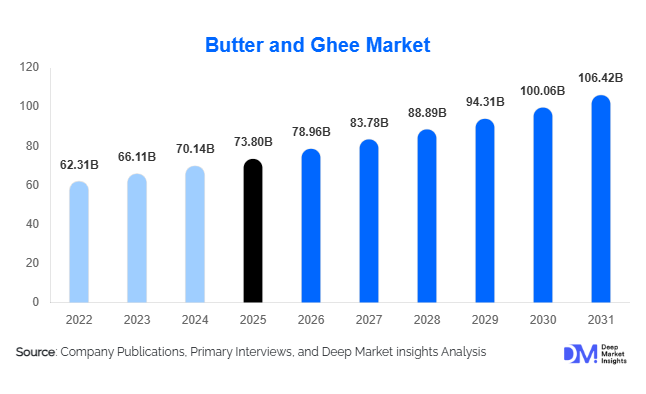
According to Deep Market Insights, the global butter and ghee market size was valued at USD 73.8 billion in 2025 and is projected to grow from USD 78.96 billion in 2026 to reach USD 106.42 billion by 2031, expanding at a CAGR of 6.1% during the forecast period (2026–2031). Market expansion is supported by rising consumption of natural dairy fats, increasing demand for traditional cooking ingredients, and growing adoption of premium clarified butter products across foodservice and household applications. The resurgence of clean-label and minimally processed food consumption has repositioned butter and ghee as healthier alternatives to hydrogenated vegetable oils and synthetic spreads.
Globally, butter continues to dominate Western dietary patterns, while ghee maintains strong cultural and culinary significance across South Asia, the Middle East, and parts of Africa. Increasing awareness of functional nutrition, ketogenic and high-fat dietary trends, and the perception of dairy fats as natural energy sources are accelerating demand. Food manufacturers are incorporating butterfat into bakery, confectionery, and ready-to-eat products to enhance flavor profiles and product differentiation. Simultaneously, premiumization trends are driving growth in organic, grass-fed, and artisanal butter categories.
Emerging economies are witnessing higher dairy consumption due to rising disposable income, urbanization, and expansion of modern retail channels. Export demand from Asia-Pacific and the Middle East is reshaping global trade flows, while technological advancements in cold-chain logistics are improving shelf stability and international distribution. As consumers increasingly prioritize authenticity, nutrition, and taste, the butter and ghee market is evolving from a commodity-driven industry toward a value-added premium dairy segment.
Key Market Insights
- Ghee consumption is expanding globally, driven by ethnic cuisines and functional nutrition trends.
- Premium and organic butter categories are gaining share due to clean-label demand.
- Asia-Pacific dominates consumption, supported by India’s large dairy ecosystem.
- Foodservice recovery and bakery expansion are accelerating butterfat utilization.
- Export-led dairy trade growth is reshaping supply chains across Oceania and Europe.
- Technological improvements in cold storage are enabling long-distance dairy exports.
What are the latest trends in the butter and ghee market?
Premiumization and Functional Dairy Positioning
Consumers increasingly perceive butter and ghee as natural, nutrient-rich fats compared to processed substitutes. Grass-fed butter, A2 milk-derived ghee, and organic-certified dairy fats are witnessing rapid adoption. Premium branding emphasizes traceability, animal welfare, and nutritional benefits such as fat-soluble vitamins and healthy fatty acid profiles. Retailers are expanding premium SKUs targeting health-conscious consumers, particularly in North America and Europe.
Expansion of Ethnic and Fusion Cuisine Globally
The globalization of Indian, Middle Eastern, and Mediterranean cuisines has significantly increased demand for ghee beyond traditional markets. Restaurants and packaged food manufacturers increasingly use clarified butter for flavor enhancement and high smoke-point cooking. Ready-to-cook meal kits and gourmet sauces now frequently incorporate ghee as a premium ingredient, supporting cross-cultural adoption.
What are the key drivers in the butter and ghee market?
Rising Demand for Natural Fats
Growing skepticism toward artificial trans fats and margarine has accelerated the return of dairy fats. Consumers are shifting toward minimally processed foods, driving butter consumption across households and foodservice sectors. Nutrition research supporting moderate dairy fat intake has further strengthened consumer confidence.
Growth of Bakery and Processed Food Industries
Butter remains a critical ingredient in bakery and confectionery manufacturing due to superior taste, texture, and mouthfeel properties. Global expansion of bakery chains, frozen desserts, and premium snacks is significantly increasing industrial butter demand. Emerging markets are witnessing double-digit growth in packaged bakery consumption, directly benefiting butterfat demand.
What are the restraints for the global market?
Volatility in Milk Prices
Butter and ghee production costs are heavily dependent on raw milk availability and feed prices. Climate variability and supply disruptions frequently cause price fluctuations, impacting profit margins for processors and food manufacturers.
Health Concerns Regarding Saturated Fat
Despite changing consumer perception, regulatory dietary guidelines in certain regions continue to caution against excessive saturated fat consumption. This limits adoption among health-sensitive consumers and institutional buyers.
What are the key opportunities in the butter and ghee industry?
Export Expansion into Emerging Markets
Rapid urbanization across Southeast Asia, Africa, and the Middle East is creating strong demand for imported dairy fats. Countries with surplus milk production such as New Zealand and Ireland are expanding export-focused production capacities. Trade agreements and improved logistics are opening new market entry opportunities for producers.
Value-Added and Fortified Ghee Products
Manufacturers are launching herb-infused, flavored, and nutritionally fortified ghee variants targeting wellness consumers. Functional positioning around immunity, digestion, and energy enhancement is creating differentiation within a traditionally commodity-driven category.
Foodservice and QSR Integration
Quick-service restaurants and premium dining establishments increasingly utilize butter-based cooking to improve taste authenticity. Expansion of global QSR chains across Asia and Africa is expected to generate sustained bulk demand for clarified butter products.
Report Scope
| Report Metric | Details |
|---|---|
| Market Size in 2025 | USD 73.8 Billion |
| Market Size in 2026 | USD 78.96 Billion |
| Market Size in 2031 | USD 106.42 Billion |
| CAGR | 6.1% (2026-2031) |
| Base Year for Estimation | 2025 |
| Historical Data | 2022-2024 |
| Forecast Period | 2026-2031 |
| Report Coverage | Revenue Forecast, Competitive Landscape, Supply Chain Disruption, Growth Factors, Environment & Regulatory Landscape and Trends |
| Geographies Covered | North America, Europe, APAC, Middle East and Africa, LATAM |
| Countries Covered | U.S., Canada, U.K., Germany, France, Spain, Italy, Russia, Nordic, Benelux, Rest of Europe, China, Korea, Japan, India, Australia, Singapore, Taiwan, South East Asia, Rest of Asia-Pacific, UAE, Turky, Saudi Arabia, South Africa, Egypt, Nigeria, Rest of MEA, Brazil, Mexico, Argentina, Chile, Colombia, Rest of LATAM |
Explore more data points, trends and opportunities Download Free Sample Report
Product Type Insights
Ghee accounted for approximately 41% of the global market share in 2025, positioning it as the leading product segment due to a combination of cultural significance, culinary versatility, and international demand. In India, ghee remains an essential component of daily cooking, festive rituals, and traditional medicine systems such as Ayurveda. The Middle East, driven by diaspora communities and traditional cooking practices, has witnessed consistent growth in ghee consumption, supported by high disposable incomes and premium product preferences. Additionally, countries across Europe and North America are increasingly integrating ghee into their diets, fueled by health-conscious trends such as ketogenic, paleo, and functional food diets. Compared to butter, ghee offers a longer shelf life, higher smoke point, and enhanced flavor profile, making it suitable for industrial-scale culinary applications and commercial foodservice operations. Global exports of ghee, particularly from India and New Zealand, are steadily rising, further cementing its dominance in the international market. Butter, while secondary to ghee in market share, remains a significant segment due to its widespread use in bakery, confectionery, and industrial food processing applications. Consumers favor butter for its creaminess and flavor, while manufacturers leverage its functional properties in pastries, chocolates, and frozen foods. The interplay between traditional consumption patterns, global culinary trends, and increasing awareness of product quality continues to drive the product segment’s growth worldwide.
Nature Insights
Conventional butter and ghee collectively held nearly 78% market share in 2025, primarily driven by affordability, widespread availability, and large-scale dairy production infrastructures. In regions such as Asia-Pacific and Europe, conventional dairy remains dominant due to well-established supply chains and strong local dairy farming traditions. However, the premium segment of organic and grass-fed variants is experiencing rapid growth, particularly in North America and Europe, as consumers increasingly prioritize sustainability, chemical-free sourcing, and ethical production practices. Organic ghee and butter appeal to health-conscious consumers seeking products free from synthetic hormones, pesticides, and artificial additives. Additionally, the functional food trend is enhancing demand for naturally sourced dairy fats, as they are perceived to contribute to better nutritional profiles, including higher levels of omega-3 fatty acids and vitamins A and E. The rising availability of traceable dairy products and certifications such as organic, A2, and grass-fed is enabling brands to differentiate themselves, creating new avenues for growth while catering to niche consumer segments. Overall, the coexistence of conventional and premium dairy variants ensures market coverage across a diverse consumer base, from price-sensitive households to affluent buyers seeking sustainable and functional nutrition.
Distribution Channel Insights
Retail channels accounted for around 52% of the global market in 2025, fueled by the expansion of supermarket chains, hypermarkets, and specialty grocery stores. In Asia-Pacific, the growth of organized retail infrastructure in urban centers has facilitated easier access to packaged dairy products, including butter and ghee, thereby promoting increased household consumption. Private-label dairy brands have also emerged as a key driver, offering competitive pricing and consistent quality, which appeals to middle-income consumers in emerging economies. E-commerce, although currently smaller in market share, is emerging as the fastest-growing distribution channel due to rising internet penetration, smartphone adoption, and direct-to-consumer subscription models. Online platforms enable consumers to access premium, specialty, and organic dairy products that may not be widely available in traditional retail outlets. In North America and Europe, e-commerce platforms increasingly offer value-added services, including home delivery, temperature-controlled shipping, and curated dairy boxes, which enhance convenience and product freshness. Modern trade and online retail are complemented by traditional channels, such as local grocery stores and wet markets, particularly in rural areas, ensuring comprehensive market reach. The growth of omnichannel strategies by leading dairy manufacturers is further strengthening distribution efficiency and consumer accessibility worldwide.
End-Use Insights
The household consumption segment led the market with nearly 46% of global demand in 2025, reflecting the central role of butter and ghee in daily cooking routines, festive cuisines, and traditional recipes. In India, ghee is not only used for frying and tempering but also holds cultural and religious significance, which sustains consistent consumption. In Europe, households prioritize high-quality butter for baking, sandwiches, and cooking, while in North America, butter adoption is being driven by dietary trends emphasizing natural fats and home baking resurgence. Foodservice applications, including restaurants, cafés, and bakery chains, are witnessing accelerated growth as premium dining experiences emphasize authentic flavors and artisanal preparations. Hotels and hospitality segments, especially in the Middle East and Southeast Asia, are increasingly incorporating ghee into large-scale catering operations due to its extended shelf life and heat stability. This combination of household and commercial consumption ensures robust demand across diverse markets, further reinforced by rising urbanization, disposable incomes, and a shift toward ready-to-eat and convenience-oriented foods.
End-Use Analysis
The food processing industry represents the fastest-growing end-use segment, driven by global bakery, confectionery, and ready-to-eat food markets collectively valued at over USD 650 billion. Butterfat is extensively used in chocolates, pastries, frozen desserts, sauces, and ready meals, offering unique textural and flavor-enhancing properties that synthetic alternatives cannot fully replicate. Dairy processing hubs in New Zealand, India, the European Union, and the United States are expanding manufacturing capacity to meet surging industrial demand and export requirements. In addition, nutraceutical and functional food applications are creating new growth opportunities for ghee, as it is increasingly incorporated into health-focused formulations, such as protein bars, herbal-infused spreads, and fortified snacks. Tourism growth, hospitality sector expansion, and the proliferation of premium cafés and bakery chains further elevate institutional demand, particularly in regions such as Asia-Pacific, the Middle East, and Europe. This convergence of industrial applications and consumer trends ensures that both butter and ghee maintain relevance across a broad spectrum of food production and consumption channels.
Explore more data points, trends and opportunities Download Free Sample Report
Butter and Ghee Market Segmentations
By Product Type
- Butter
- Ghee
By Nature
- Conventional
- Organic
- Grass-Fed / Premium
By Distribution Channel
- Retail
- Online / E-commerce
- Foodservice / HoReCa
- Specialty Stores
By End-Use Industry
- Household Cooking
- Bakery & Confectionery
- Foodservice & Restaurants
- Ready-to-Eat / Processed Foods
- Functional Foods / Nutraceuticals
Regional Insights
Asia-Pacific
Asia-Pacific dominated the global butter and ghee market with approximately 39% share in 2025, driven by India, China, and Southeast Asian nations. India remains the largest consumer of ghee globally, underpinned by deep-rooted cultural, religious, and culinary traditions. Increasing household incomes, urbanization, and premiumization are further elevating consumption levels. China, traditionally a milk-deficient market, is witnessing rapid growth in bakery and confectionery sectors, boosting butter imports and localized production. Southeast Asian countries, including Indonesia, Vietnam, Thailand, and the Philippines, are experiencing rising dairy adoption due to Western dietary influences, urban lifestyle changes, and growing awareness of high-quality ingredients. Regional growth is further supported by government initiatives promoting dairy development, investment in cold-chain infrastructure, and expansion of retail networks. Additionally, e-commerce penetration in emerging markets enables direct access to imported and premium dairy products, bridging the gap between supply and evolving consumer preferences. These factors collectively position Asia-Pacific as the largest and most dynamic regional market for butter and ghee.
Europe
Europe accounted for nearly 27% of global demand in 2025, with France, Germany, Ireland, and the Netherlands leading consumption. The region benefits from well-established dairy farming infrastructure, stringent quality standards, and robust export capabilities, making it a hub for both conventional and artisanal butter. European consumers favor high-quality, locally sourced, and organic dairy products, which supports premium pricing and encourages product innovation, such as cultured butter, European-style spreads, and specialty ghee. Growth in Europe is also influenced by the foodservice sector, where artisanal bakeries, gourmet restaurants, and confectionery producers demand premium dairy ingredients. Moreover, increasing awareness of functional foods and clean-label ingredients is driving organic butter adoption, while regulatory frameworks promoting sustainable dairy farming contribute to market transparency and consumer confidence. Cross-border trade within the EU and strong export-oriented production in Ireland and the Netherlands reinforce Europe’s strategic position in the global butter and ghee market.
North America
North America, led by the United States, remains a significant market for butter and ghee. Strong bakery, foodservice, and dairy processing sectors sustain steady demand, while diet-driven trends, such as keto, paleo, and high-fat eating patterns, have revived interest in natural dairy fats. Ghee is gaining traction among health-conscious and culinary-focused consumers due to its lactose-free profile, high smoke point, and versatility in cooking. Regional growth is further accelerated by the expansion of online retail and subscription services, enabling consumers to access specialty and imported dairy products. Canada, with its developed dairy regulations and consumer preference for premium butter, contributes to stable regional consumption. Industrial demand from processed food manufacturers, including bakery, confectionery, frozen foods, and ready meals, further reinforces market growth. Strategic partnerships between dairy producers and foodservice operators are enabling wider penetration of premium and functional dairy products across North America.
Middle East & Africa
The Middle East & Africa region is experiencing rapid growth in butter and ghee consumption, particularly in Saudi Arabia, the UAE, and South Africa. The growth is fueled by rising imports, expanding hospitality and foodservice industries, and increasing disposable incomes in urban centers. Ghee remains a staple cooking fat in Gulf countries, integrated into traditional dishes and modern culinary applications. Market expansion is also driven by the influx of expatriates and diaspora populations who maintain cultural dietary habits, sustaining demand for authentic and premium ghee products. Retail modernization, including hypermarkets and online grocery platforms, is enhancing product accessibility, while the rise of health-conscious trends is encouraging the introduction of organic and grass-fed variants. Investments in cold-chain infrastructure and international trade agreements are further facilitating regional market growth.
Latin America
Latin America, particularly Brazil and Mexico, represents a fast-growing market for butter and ghee, projected to register a CAGR of over 7% during the forecast period. Rising bakery consumption, expansion of modern retail, and improving cold-chain logistics support growth in the household and industrial segments. Brazil’s growing urban population and rising disposable income are driving premiumization, while Mexico is witnessing increased adoption of Western-style bakery and confectionery products. Foodservice demand is also accelerating, with cafes, hotels, and quick-service restaurants increasingly incorporating high-quality butter and ghee in their menus. Regional growth is further underpinned by government initiatives to strengthen local dairy production, reduce import dependency, and improve distribution networks. The convergence of evolving consumer preferences, infrastructure development, and industrial expansion positions Latin America as a key emerging market in the global butter and ghee landscape.
Key Players in the Butter and Ghee Market
- Nestlé S.A.
- Fonterra Co-operative Group Limited
- Arla Foods amba
- Lactalis Group
- FrieslandCampina
- Gujarat Cooperative Milk Marketing Federation (Amul)
- Land O’Lakes Inc.
- Dairy Farmers of America
- Kerry Group plc
- Royal A-ware
- Ornua Co-operative Limited
- Saputo Inc.
- Meiji Holdings Co., Ltd.
- Parag Milk Foods Ltd.
- Devondale Murray Goulburn